
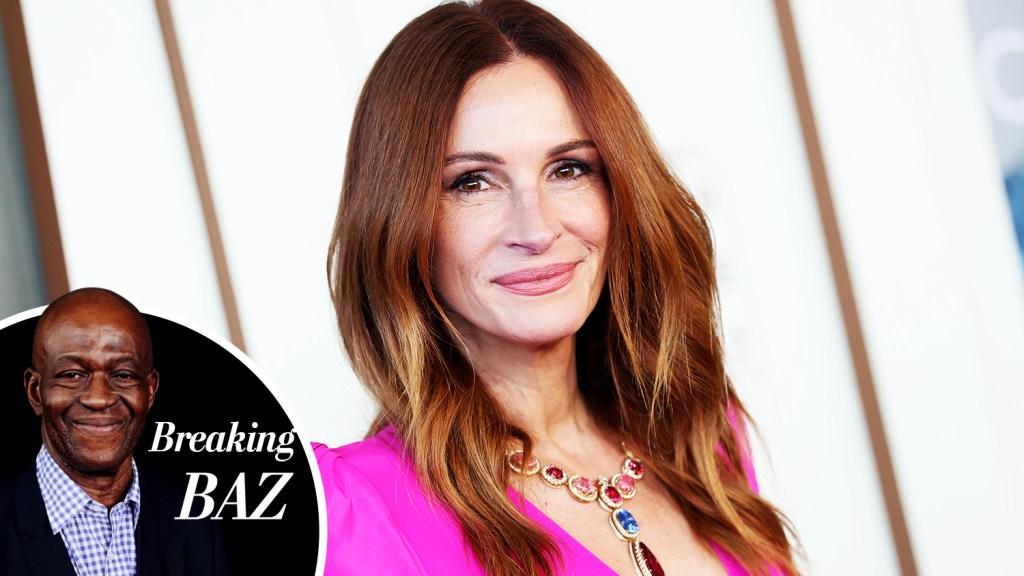
EXCLUSIVE: An AI version of Julia Roberts would be doomed from the start. A computer program could never replicate her signature gleaming smile — the one that lights up Notting Hill and Pretty Woman — or the inner turmoil that tortures Alma, the Yale philosophy professor she captures so astutely in Luca Guadagnino’s riveting drama After the Hunt.
Here’s an actor of quiet ambition, fire and energy who every so often unleashes a raw power that infuses a character with life and truth. It’s her best role since she played the titular Erin Brockovich a quarter of a century ago, collecting an Academy Award along the way. On Sunday, the star is a best dramatic actress nominee at the Golden Globes for After the Hunt.

Julia Roberts and Luca Guadagnino on ‘After the Hunt’ set
Amazon
Just the other day, Richard Curtis, who penned Notting Hill, voiced a belief that AI can never replace an actor, a screenwriter or any filmmaking creative.
“I don’t believe it’s possible either,” Roberts insists. “I think that at the root of every book and play and movie and TV show and essay and article is someone’s heart and soul, and those are not manufacturable.”
Are we at a dangerous crossroads?
“Yes,” she responds. “I think it’s interesting what AI can do for medicine, things like that. I think that’s something that as a world we should be so proud of and interested in.”
But she doesn’t engage in AI, and she’s “never used ChatGPT because I think it’s a slippery slope, right? Anytime you find that shortcut for something, and at first you go, ‘Oh, this is great.’ But is it?” Her voice sounds troubled.
These are concerns, too, for the future of the theatrical moviegoing experience.
Roberts shakes her head in agreement and says: “I think I like to maintain a robust sense of optimism for all things. I remember, there was a moment during Covid where I was talking to Bryan Lourd, my agent. We had this long conversation, and I got off the phone with him and … it was a moment where I thought, ‘It’s over. We’ll never be in a movie theater again.’ I just sat in my little rocking chair and just wept.”
The tears came, she tells me, at “the idea of that part of our culture being gone was so heartbreaking because I do find it so meaningful and so fun.”
RELATED: The Movies That Have Made More Than $1 Billion At The Global Box Office
Especially now, she continues, “with everybody with their heads down like this…” She lowers her head, as if reading a cell phone. “Where else do you sit with a group of people where everybody has their heads up, and you’re all kind of sharing energetically the same story? It’s a really unique thing to do in the theater — and in the movie theater— and the idea of that disappearing forever, it’s too heartbreaking for me to believe it could happen.”
It’s tricky though, isn’t it, what with the theater of war that Netflix and Paramount are waging over the future of Warner Bros? “Listen,” Roberts sighs, “it’s all dollars and cents, right? So hopefully, people keep going.”
Ayo Edebiri and Julia Roberts in ‘After the Hunt’
Yannis Drakoulidis /Amazon
As much as After the Hunt follows a clash of cultures — the cancel kind, plus social and moral differences — that follow when Maggie (Ayo Edebiri), one of Alma’s students alleges that faculty member Hank (Andrew Garfield) sexually assaulted her, it’s the beautifully bizarre, damaged, wonderful marriage between Alma and Frederick, her psychologist husband (Michael Stuhlbarg) that grips.
Nora Garrett wrote the screenplay, but it’s Guadagnino’s brilliant imagination that ensures Alma is the troubled beating heart of this film. And it’s clear from our conversation that Roberts leapt at the opportunity to work with him. The result for her is a sublime performance; unmissable for me.
He’s one of the most thoughtful, knowledgeable, deep, passionate people she’s ever met, Roberts says. “It goes on and on — what he knows, what he can absorb and comprehend and learn and retain and then share in a variety of languages. I mean, it’s kind of astonishing. I’ve never really encountered a person like him,” Roberts says as she continues to richly exalt her Sicilian artistic benefactor.
Roberts believes that he was a springboard for “my enthusiasm. … I think everything he said I wrote down, I was constantly making notes, thinking, ‘I have to look up who this person is. I need to see what this book is about.’ Just to create this sense of the academic world as its own universe,” she says.
I share Roberts’s enthusiasm for Guadagnino, having been a fan ever since Tilda Swinton tipped me off about his feature debut, The Protagonists, which she starred in for him back in 1999.
After the Hunt is studded with references to Alma and Frederick’s marriage. At one point, Garfield’s Hank belittles the idea of Frederick because he’s at home preparing a cassoulet for their supper, but Alma staunchly defends him: “He’s my husband. He’s always going to be there.”
Roberts says that she’s had some really profound conversations with friends about the marriage in the movie, citing one in particular she had with George Clooney. “I think it’s probably the most serious conversation we’ve had in 30 years. It had so much to do with the marriage story in the movie and how he felt about that. I think that George, you, myself, we’re kind of all of a certain age where we really appreciate when a story, a book, a movie — something that shows us the layers and the layers and the layers of something.”
Most of the scenes involving Roberts and Stuhlbarg are when Alma and Frederick are alone together. The two actors developed a close rapport, though it would seem that both approach things differently, a comment that elicits giggles from Roberts.
Michael Stuhlbarg and Julia Roberts in ‘After the Hunt’
Yannis Drakoulidis/Amazon MGM Studios
How so, I venture to ask? It’s something to do with how they each treated their copies of the script; Stuhlbarg’s pages were so pristine, Roberts recalls. “His notes were tiny. He had these straight lines and these small squiggly lines, and it was like hieroglyphics. And my script notoriously looks like it’s spent the night in a hamster cage. It’s my own madness, one that I never truly took note of until I looked at Michael’s script. And so I think that we melded within our differences. We just liked being with someone who was so different. And we also just had a real comfort in sharing physical space. I think he was comfortable with me physically. That scene in the kitchen where he’s on his knees and he’s got his head in my lap? We just understood our space together.”
The film smartly foreshadows what will befall Alma and Maggie and Hank. When Alma and her students discuss Michel Foucault’s ideas concerning the panopticon — the idea that people can be controlled by extreme surveillance —it’s a foreboding of the public torture that Alma will endure because of her reaction to Maggie’s ordeal. Another instance is when Stuhlbarg’s Fredrick notes that seeking tenure will make Alma above accountability, which one can relate to the sheer lack of accountability we observe at the highest echelons of public life.
RELATED: Luca Guadagnino And ‘After The Hunt’ Cast Talk Woody Allen Inspiration & The Film’s Politics: “It’s Not About Making A Manifesto Of Old-Fashioned Values” — Venice
“Listen,” says Roberts, “the timeliness of the parallels of just the idea of people striving to be in positions of power — for lack of a more interesting word — for the ultimate goal of not being responsible and accountable, that’s the horror of the modern world right now.”
Roberts finds it “great and interesting” to take “this massive horror” and put it into the arena of academia. It is, she says, “a place that’s small enough that you can see the whole, you can see every cog in the wheel. Because sometimes I just feel like I read the newspaper and you almost can’t comprehend…” Her face suddenly fills with anguish. “I think that’s very Luca to make something that you really can hold and examine.”
So what ails Alma? Roberts reckons “her genesis is pain. … The tree of Alma, that’s where it starts. And so I think to understand why she is the way she is and speaks the way she does and performs the way she does, whether at home or at school, it’s all trauma. … How did she find a place, make a decision to say to herself, ‘How can I best make it work for a life?’ and part of it is the masonry, right? You build the wall. The bricks of her wall are made of all these philosophers and all these concepts and all these things that she can proclaim from on high, because if you’re talking about all these other people and all these other things, you’re never talking about yourself.”
Julia Roberts in ‘After the Hunt’
The reason Alma and Frederick’s marriage “works so beautifully” is, she believes, “because Frederick is the only person that knows her pain, sees all of her and loves her in spite of that, loves her because, loves her anyway, loves her always. And she knows that. And I think there is no Frederick without Alma. There is no Alma without Frederick. And I think that’s how she survives.”
Alma’s attire is also part of her survival kit. Roberts explains that hair designer Massimo Gattabrusi (Queer, Challengers) and makeup designer Fernanda Perez (A Bigger Splash, Call Me By Your Name), both regular collaborators of Guadagnino’s, molded her look, with Gena Rowlands at the center of their mood board.
“They are avid researchers,” she says, “and they came in with a lot of materials for us to look at, and talk about — what the look was to be. It’s a uniform. She’s not spending time getting ready, and yet, make no mistake, there’s thought put into every little piece of everything, every loafer, every brush of the hair. And so it was interesting to try to create this studied look that seemed effortless. And definitely Gena Rowlands [was an influence]. We had so many pictures of her in the hair and makeup room.”
Interestingly, she and Rowlands appeared together in 1995’s Something to Talk About.
“So I knew her,” Roberts says. “And I was able to adore her up close for a period of time. So many of the characters that she played, they had this internal [dynamic]. It was like a Jenga game, and you just didn’t know when it was going to tumble. She was so good at that, the nuance of that quality. I think that was something that Luca and I discussed, just trying to find that internal nuance for Alma.”
John Cassavetes and Gena Rowlands
AMPAS
Sadly, she notes, Rowlands died the day after the film wrapped. “We were all gutted. We couldn’t believe it. Every day I would just sit and stare at pictures of her while I was getting ready for work in the makeup room. She was such a legend, such an inspiration.”
RELATED: Gena Rowlands Dies: ‘The Notebook’, ‘Gloria’ And ‘A Woman Under the Influence’ Star Was 94
The mention of Rowlands makes us both hark back to a time when audiences welcomed challenging movies like After the Hunt, where the answers weren’t fed to you. Like you would come out of the film and you’d have a heated discussion on the way home with your wife or with friends. The added benefit of After the Hunt has been is the number of fights one has participated in over dinner — even Christmas Day lunch— arguing over this movie. It’s rare, and I ask whether Roberts feels that as well.
“I do,” she responds. “I think that is my greatest sense of accomplishment with this movie, where this person thought this and this person thought that. My friends would see it and go, ‘Oh, well, we have to see it again. I mean, because she thinks this and I think that.’”
Roberts explains that when Guadagnino came to London to show her the film, she was on another movie, director Sam Esmail’s thriller Panic Carefully, starring Eddie Redmayne, Elizabeth Olsen, Brian Tyree Henry, Joe Alwyn and Ben Chaplin. Roberts says that she refused to sit with Guadagnino, just the two of them, to watch the movie. “That sounds like a complete nightmare,” she recalls telling him.
Guadagnino allowed her to invite Esmail, some cast mates from Panic Carefully, along with crew from After the Hunt that resided in London, about a dozen or so, and following the screening they hadn’t reached the exit doors before they stopped in a huddle for half an hour. “It was so wonderful just to hear how many different ways people examine it.”
But while the film has its champions — such as Deadline’s film critic Damon Wise — it’s also had its share of detractors, especially some critics and social commentators in the United States who have vilified it. Roberts thinks that’s what makes it really robust, saying, ”Everybody’s going to get something slightly different in their interpretation.”
From left: Andrew Garfield, Luca Guadagnino, Julia Roberts, Ayo Edebiri and Chloe Sevigny at the ‘After the Hunt’ premiere at the 2025 Venice Film Festival
Getty Images
Like me, Roberts is fascinated about which movies “float to the top” and what doesn’t, and who exactly determines that. She suggests that she’d like to attend a dinner party at my house to further discuss this topic. I suggest she bring plenty of her own ammunition. “I’m unafraid, Baz. I’m unafraid,” she says with mock bravado. (Actually, maybe not so mock!)
I ask her about rumors suggesting she might have plans to return to the stage. Is it true?
“I hope it’s true, “ she responds. “It’s been a long-held dream of mine to do that. And now that our kids are grown up, I think it affords me more of the space for something like that.”
I saw her make her Broadway debut in Richard Greenberg’s play Three Days of Rain, directed by Joe Mantello, with Bradley Cooper and Paul Rudd in 2006. “The three of us, just scared out of our minds,” she says of that experience. Mantello, who also acted with her in the screen version of Larry Kramer’s The Normal Heart, has remained a good friend all these years.
She’s open to doing something here in London, she says. “Of course I would, yes. I mean, it’s funny because there are these tiny theaters that are near our apartment in New York and little places near our house here [in San Francisco]. And I just think, ‘Oh, that would be so fun to do a play in a really small space.’ Almost like a workshop, almost like going to theater school, but people have to buy tickets to school.” She lets out that famous laugh. “Fingers crossed. It would be so great.”
She doesn’t return to it often, but she has long loved the idea of the stage. “I just think there’s really nothing like it; I’ve loved it since I was, like, a 7-year-old and saw Yul Brenner in The King and I at the Atlantic Civic Center Theater.” She remembers thinking, “This is the most magical thing a person can do with their life.”
Another movie with Guadagnino is also on her dance card. “He already has an idea for us, and every time I see him, he’s like, ‘Darling, this is what we’re going to do.’ I would pack my bags now to go do another movie with Luca,” she declares.
Andrew Garfield and Julia Roberts in ‘After the Hunt’
Yannis Drakoulidis/Amazon
Is that a serious proposition or just polite casual conversation? Smiling, then sighing, Roberts explains: “This is what I know about Luca: He is the most prolific. I mean, even this movie, this is the fastest I have ever read a script, talked to a director and ended up on a soundstage in my 30-plus-year career. The fastest. So when Luca says he has an idea, and he’s going to write a script, it wouldn’t surprise me if it comes as a late Christmas parcel.”
Roberts seems eager to experience working with Guadagnino again, even to play a character the complete antithesis of her — just as Alma was.
“She’s so different from my personality, from every natural instinct that I have towards the day, a person, a space. [I am,] I would say, almost opposite to her. And so in that regard, it’s very tiring and, in a way, kind of sad. I like to share a space, not command a space. And so I found those days the hardest in a way, especially with all those actors sitting at their desks looking at me with these big eyes with such expectations. And I was happy to leave it all behind, but I was also…” She looks for the words. “I felt so gratified.”
She reveals that she keeps in regular touch with Guadagnino, Garfield and Edebiri and has done ever since the movie wrapped. What do they talk about?
“Life,” she shrugs. “I think Ayo and I became such good friends. I admire her so much, and I really, truly adore her. I think she’s one of the most talented young people I have ever spent time with,” Roberts adds her voice quivering on the verge of unexpected tears. Her feelings for Edebiri “are so profound,” she says.
The friendship developed during rehearsals, and then a confrontation in the film between their characters culminated in a slap. That “sealed the deal” and it was like “friends for life,” she trills.
Our conversation goes on to encompass her romantic comedy classics, such as Roger Michell’s Notting Hill, based on a script by Richard Curtis. Did she have any sense, 27 years or more ago, that it would become an enduring favorite?
Julia Roberts in ‘Notting Hill’ (1999)
Everett
“Gosh, I just remember when my agent called me about Notting Hill and I thought, ‘Well, that sounds like the dumbest idea of any movie I could ever do. I’m going to play the world’s biggest movie star and I do what? And then what happens? This sounds so f*cking stupid.’ And then I read the script, and I was like, ‘Oh. This is so charming. It’s so funny. Oh, shit.’ And then I went to lunch with Richard [Curtis] and [producer] Duncan [Kenworthy] and beloved Roger Michell, may he rest in peace.”
RELATED: Roger Michell Dies: ‘Notting Hill’ Director Was 65
The lunch was fun, she recalls, even though her initial intent was to tell them, “No, this isn’t going to work. I’m passing on this movie.” “And they were just so charming and sweet and funny. And I thought, ‘Wow, this is really going to happen.’ And we had a beautiful time doing it. It was cast to perfection [by Mary Selway], all the friends, everybody. It was so great. And we had a beautiful time. And I think Roger, he just created the film in a way that it just, at every turn, it succeeded. It accomplished its goals with every…” She pauses. “Alec Baldwin!” she exclaims. “That’s brilliant casting.”
We chat about comedy; the structure, the architecture of it. There’s a math to it, Roberts suggests. “Because there is a math, but I think it changes depending on the kind of comedy that it is. Garry Marshall [who directed her in Pretty Woman] would always say that a joke is in three parts, like a drum beat. I mean, people have their different ways of looking at it. For me, I think it would just depend on what the goal is. But I mean, the joy of life is making people laugh for me. Especially my husband, if I can make my husband really laugh — because he makes me really laugh — then it just fills me up.”
What’s the secret sauce of a Julia Roberts laugh? A cinematic treasure, I wonder? “It’s not something for oneself to analyze,” she theorizes. “I think it comes from an authentic place of complete joy that I was just born of. It’s a credit to my parents, I suppose.”
Skirting back to Pretty Woman, it occurs to me to ask whether the philosopher Alma would have approved of the Vivian Ward character Roberts plays and of the film itself? Roberts roars with laughter. “This is going to be food for thought for the day!”
Also, would Julia Roberts — had she been the right age — made Pretty Woman today?
Richard Gere and Julia Roberts in ‘Pretty Woman’ (1990)
Touchstone Pictures
“Oh, it’s impossible. I have too many years of the weight of the world inside of me now that I wouldn’t be able to kind of levitate in a movie like that, right? I mean, not weight of the world, like, negative, but just all the things that we learn, all the things that we put in our pockets along the lane. It would be impossible to play someone who was really innocent, in a way. I mean, it’s a funny thing to say about a hooker, but I do think that there was an innocence to her, a kind of…” She pauses. “ I guess it’s just being young.”
Over the years, many have stopped seeing Pretty Woman as an affectionate fairytale.
“Well, I think anytime you have a huge passage of time and cultural shifts…” she muses. “Think about all the movies and plays of the ’20s and ’30s and ’40s — you would look at them now and just be like, ‘How are people saying these things, doing these things?’”
Look at Gone With the Wind, for example, she says. “I think these are the choices that we make as artists, as art appreciators and people that love to read books and go to the theater and yeah, times change, people change, ideas change.”
Roberts famously supports Manchester United and loves watching the footy on television. “Of course it’s more exciting when you’re there, live. Everything is,” she chortles. The World Cup looms large in her future with the hope of tickets to see the elite players perform at the game’s ultimate competition.
RELATED: FIFA 2026 World Cup: Full Schedule & Fixtures For Groups And Knockout Stages
“This has been quite the constant conversation on our house,” Roberts admits as a megawatt smile begins to form.
Before that, though, is the chance to get her feet wet one more time in Ocean’s 14. Is that on, I ask? “That’s what George says. I’m on his team.”
This is where pure mathematics is deployed to reassemble the ensemble. “We finally figured out how to align our schedules,” she says. “These are complicated schedules,” she notes while relaying that her Ocean’s teammate Don Cheadle will be starring with Edebiri on Broadway in a revival of David Auburn’s play Proof for a limited run in the spring and early summer. “There’s so many things to have to consider, but when George gets a bee in his bonnet, things happen.”
George Clooney and Julia Roberts
Speaking of Clooney, we chuckle over the running gag in Jay Kelly where his eponymous character, a movie star, finds that every set, hotel and trailer he visits includes a rider that dictates a slice of cheesecake at every stop, even though he detests the dessert. After watching the film, Roberts started to notice that everywhere she goes, “there is either a huge bag or a huge bowl of raw almonds. I have no idea why,” she shrugs.
And does she even like these nuts? “I like them, but not in bulk!” she says, gesticulating wildly with her hands. “I mean, they’re everywhere I go. It’s so funny. And so I just recently sent an email since watching Jay Kelly, since seeing all these almonds, I sent email and said, ’In the new year, one thing I would really like to do is review any and all riders that pertain to me in this world, because I think it might be time for a little reset on the almonds.’”