
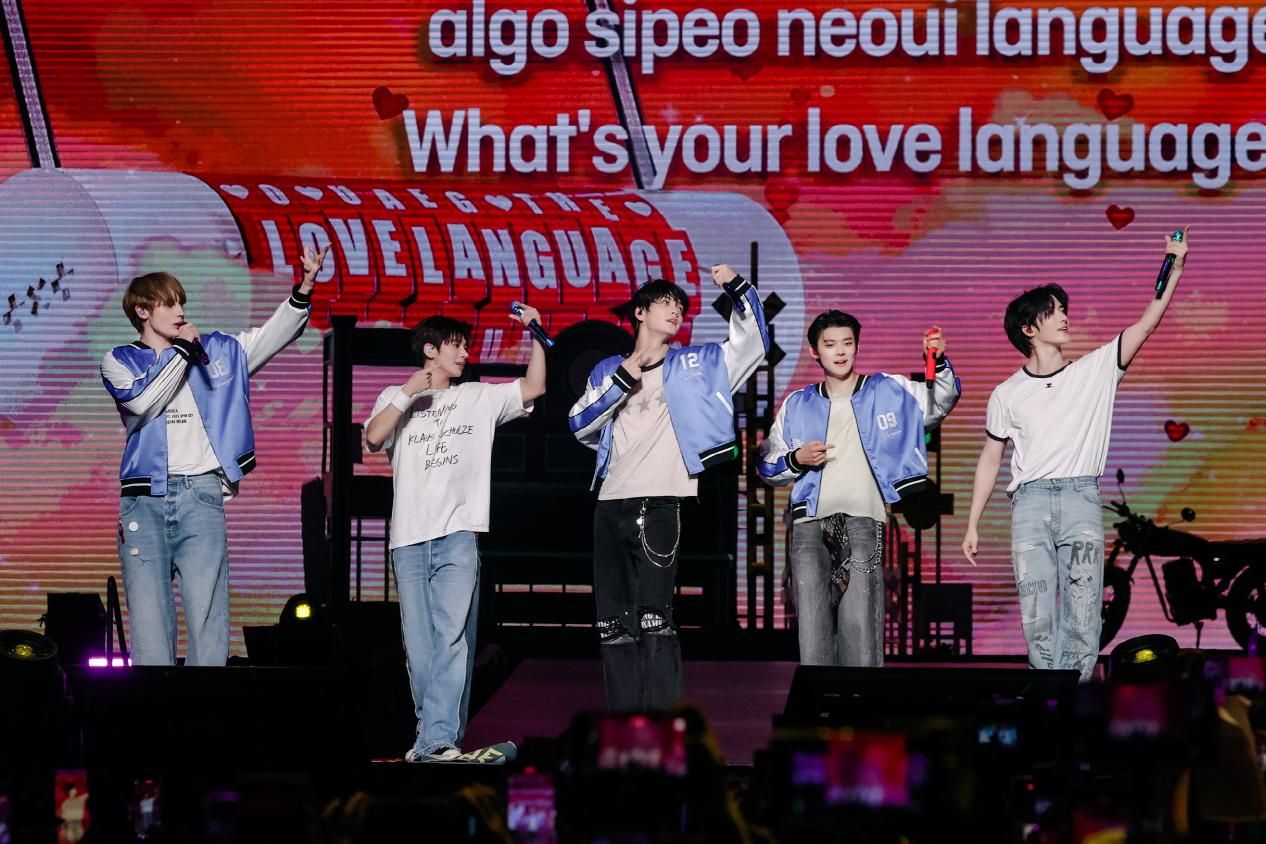
K-pop boy band Tomorrow X Together (TXT) performs at Galaxy Arena, the largest indoor concert venue in Macau, in May 2025. As K-pop concerts in mainland China remain restricted due to the unofficial “hallyu ban,” performances have increasingly been concentrated in Hong Kong and Macau. Courtesy of BigHit Music
Cautious talk of possibly easing China’s unofficial restrictions on Korean pop culture resurfaced this week following a summit between President Lee Jae Myung and Chinese leader Xi Jinping, but government officials and industry insiders alike cautioned that any tangible change would likely be slow and limited.
The two leaders held talks in Beijing on Monday, marking Lee’s first official visit to China since taking office in June 2025. In a briefing afterward, National Security Adviser Wi Sung-lac said the leaders agreed to gradually expand cultural exchanges, starting with less politically sensitive fields such as sports.
However, Wi stressed that China still does not officially acknowledge the existence of the so-called “hallyu ban,” a tacit restriction that has limited the activities of Korean entertainers in China since Korea’s Terminal High Altitude Area Defense deployment in 2016.
“China maintains that it does not recognize the policy as formally existing,” Wi told reporters about the hallyu ban. “In today’s dialogue, there were comments questioning whether it was even necessary to debate its existence. That makes it difficult to characterize the situation as entering a clear lifting phase.”
He added that both sides agreed to pursue a phased approach through working-level consultations rather than sweeping changes.
Presidential chief of staff Kang Hoon-sik echoed that view, saying Seoul and Beijing would move forward with detailed discussions in areas acceptable to both sides. But he cautioned during a radio show that “it will take time before any actual lifting occurs,” dampening expectations within Korea’s entertainment industry.
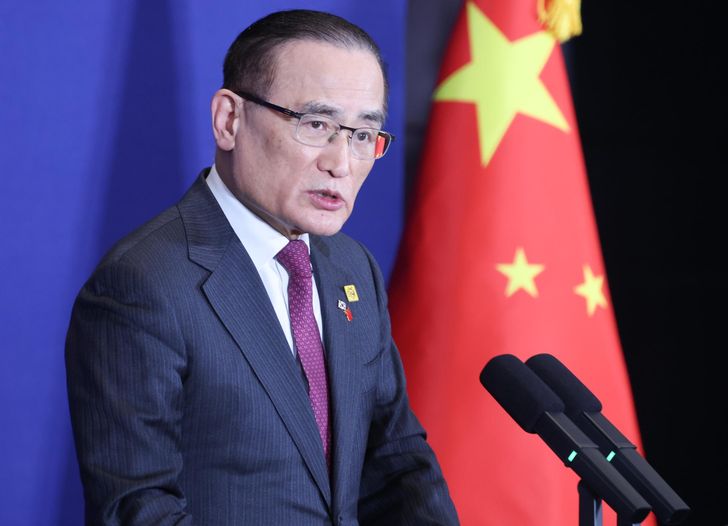
National Security Adviser Wi Sung-lac speaks during a press briefing on President Lee Jae Myung’s summit with Chinese President Xi Jinping at a hotel in Beijing, Monday. Yonhap
While some experts have interpreted the government’s emphasis on terms such as “gradual,” “phased” and “mutually acceptable” as a cautiously positive signal from Beijing, entertainment industry executives say optimism remains muted, reflecting disappointment rooted in past experiences.
An industry official working at a major entertainment label told The Korea Times that while “some hope is still there,” there’s a prevailing sense of skepticism stemming from repeated gaps between diplomatic messages and reality.
“There have been too many cases where things looked fine until the last moment,” the official said, noting that the uncertainty has become a real hurdle for the K-pop industry to invest in China extensively.
One frequently cited example involves boy band EPEX, which attempted to hold a fan concert in May 2025 in Fuzhou, China. Despite the preparations, events were abruptly canceled shortly before they were scheduled to take place, highlighting how K-pop performances can still be blocked through China’s unofficial administrative measures.
“Nothing feels secure,” the official said. “You can finalize contracts, flights and stage setups and still see everything canceled at the final step. The volatility is also too high, depending on shifts in government posture.”
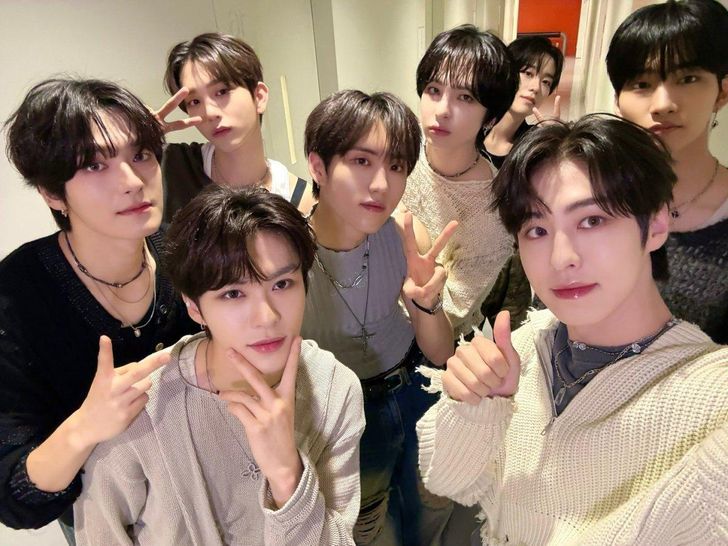
K-pop boy band EPEX / Courtesy of C9 Entertainment
Industry insiders also pointed to broader geopolitical factors that have recently complicated cultural exchanges.
Strains in China-Japan relations have reportedly affected activities involving K-pop groups that include Japanese members, forcing schedule changes or limiting appearances in one market or the other.
In December, Le Sserafim canceled a fan signing event that had been scheduled to take place in Shanghai. While organizers did not disclose a specific reason, industry observers said the group may have faced constraints because its lineup includes two Japanese members, Sakura and Kazuha. Similarly, Kenshin from the boy group CLOSEYOUREYES was unable to appear on stage in Hangzhou at a December fan event.
Many in the industry view Lee’s visit less as a signal of policy change than as a symbolic gesture. While the trip may mark a starting point for new dialogue, the persistence of unofficial, behind-the-scenes controls suggest any industrywide impact remains distant.
“If there is progress, it will likely begin with content distribution and move step by step,” a public relations executive at a local entertainment firm said, stating that companies should prepare for “a very steady change.”
“This is a moment that calls for both expectation and caution. Rather than relying heavily on China again, agencies need to approach it from the perspective of market diversification.”