
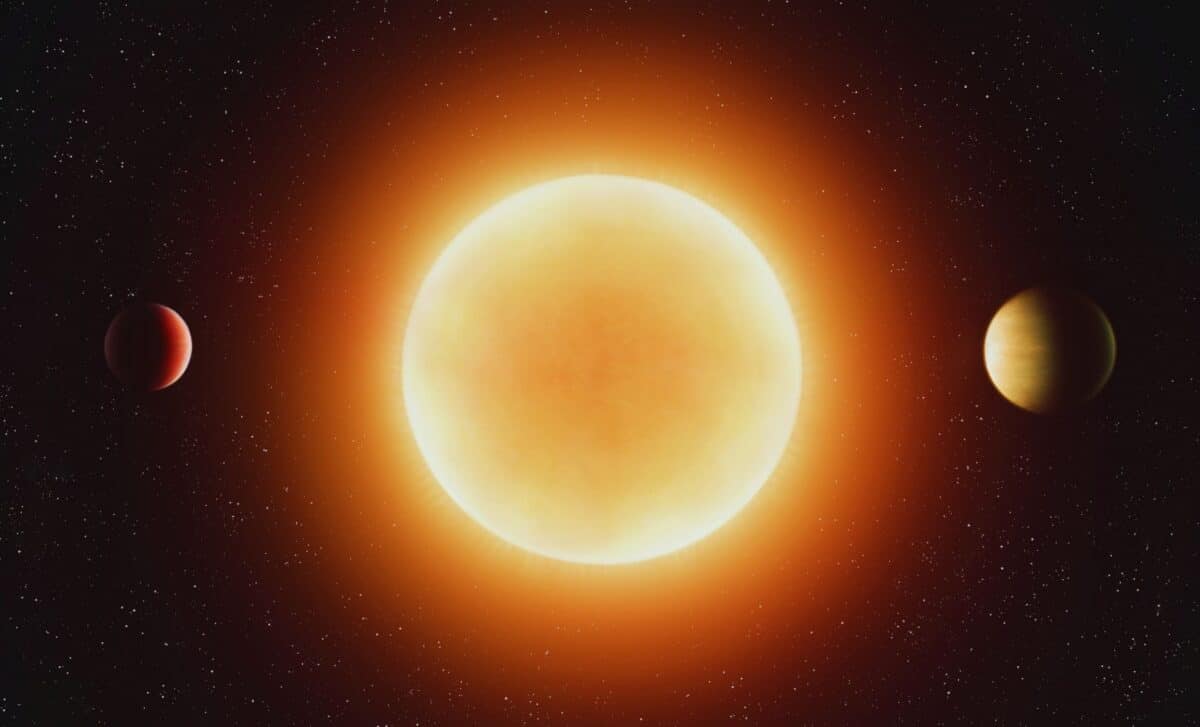
A rare alignment of two exoplanets with their star, marking one of the few known exosyzygies, an astronomical event involving celestial bodies outside our solar system, is expected to occur. Despite its rarity, the phenomenon may pass entirely unobserved due to the absence of scheduled telescope time.
The alignment, which will see two planets crossing their host star as viewed from Earth, mirrors a similar event recorded in 2010. Back then, the occurrence went unnoticed until a team led by Teruyuki Hirano of the Tokyo Institute of Technology identified it in archival data from NASA’s Kepler telescope. This time, scientists know it’s coming but are unlikely to capture it live.
What Is An Exosyzygy, And Why Does It Matter?
An exosyzygy refers to the alignment of three celestial bodies, a configuration known as a syzygy, but in a system located outside our solar system. The term draws from “exoplanet,” indicating its extra-solar context. When viewed from Earth, this formation appears as two planets simultaneously crossing the disk of their star, potentially within the field of vision of space telescopes.
This kind of triple alignment is exceptionally rare. As stated by the Graduate University for Advanced Studies (SOKENDAI), the only confirmed exosyzygy took place in 2010 and was discovered retrospectively. Because of their geometry, such events can help researchers refine the measurements of orbital parameters, detect gravitational interactions between planets, and even hint at the presence of other unseen objects within the system.
“We found that the event would likely happen in 2026, but it would depend on many factors, including the true planet masses, dynamical interactions among planets, and presence [or] absence of outer, additional planets in the system,” explained Teruyuki Hirano. “Our latest calculation still suggests that there is a good chance of the event happening in 2026.”
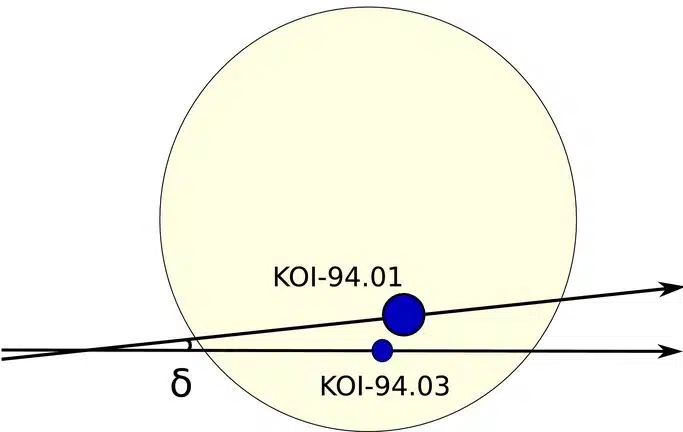 Schematic of the planetary alignment (exosyzygy). Credit: The Astrophysical Journal Letters
An Opportunity Lost in the Race for Telescope Time
Despite awareness of the upcoming event, astronomers are reportedly unable to secure telescope time to monitor it. Observational scheduling for large ground-based and space telescopes is highly competitive, with time often allotted years in advance. As a result, opportunities like this can be logistically impossible to accommodate, even when their scientific value is recognized.
According to New Scientist, no mission or observatory has been formally allocated to observe the 2026 alignment. This underscores a systemic challenge in the field: even pre-known, high-impact events can slip through the cracks due to administrative and infrastructural limitations.
“Since Kepler was forced to end its original mission, it became difficult for us to refine the system parameters and to search for another unknown planet,” explained Hirano, who has already circled the date. “I hope to observe, but I am not sure that I can get an observing time with an appropriate telescope for the whole event.”
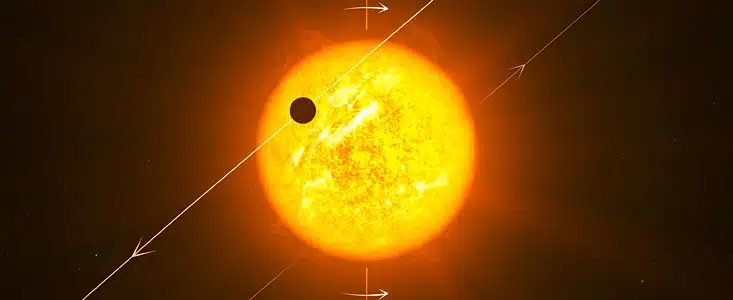 Exoplanet transiting its star, with stellar rotation and orbital path shown. Credit: ESO
A Reminder Of The Limits Of Astronomical Infrastructure
The inability to observe the 2026 event, expected to occur on April 1, in real time may limit what scientists can learn from it. In particular, real-time transit data are essential for determining transit timing variations, a key method for understanding the gravitational relationships between planets in a system. Without direct observation, astronomers lose the opportunity to gather high-fidelity data that could improve models of planetary dynamics.
Such missed chances also affect long-term planning. When rare events aren’t documented as they occur, it becomes harder to build datasets that reveal patterns across different systems. Based on reporting by the same source, the lack of flexibility in telescope operations may continue to hinder observations of phenomena that don’t fit neatly into scheduled observation windows.