

Luisa Neubauer (Hamburg, 29 years old), the public face of Fridays for Future in Germany — the youth movement born out of the school strikes against the climate crisis — was nicknamed “the German Greta Thunberg” for years. “At first, it helped people understand what I was doing. Now I’m a bit tired of the comparison. We’re very different,” she says in a café on the street where she lives in Berlin’s Kreuzberg district. Aware of the decline of environmental issues on the political agenda, Neubauer has just launched a new phase of mobilization, with street protests and more impactful projects. In a few days, she will travel to Antarctica with a scientific team. From there, she will connect with schools so that children can see the melting ice in real time. The mission: to transform a distant phenomenon into undeniable evidence, capable of shaking consciences more than any report full of statistics.
Question. December in Berlin and it’s 13°C, about 10 degrees warmer than usual. Is this the new normal?
Answer. I only see new states of abnormality. We’ve become accustomed to conditions that were once unusual, and we don’t even notice them anymore. It’s very serious, although we shouldn’t feel guilty for not freezing to death in December. That’s not the battle.
Q. Unlike other activists, you don’t view climate action as asceticism.
A. For me, ecology shouldn’t be a punitive force, but a joyful and liberating one. I’ve never understood my activism as a punishment, but as a way to reconcile myself with what I see and feel. It’s a matter of respect for the planet and those who live and will live on it, not a penance…
Q. Even so, your detractors call you a moralist, an extremist, or even a fundamentalist. Does that bother you?
A. It makes me smile that there are people who could dedicate their energy to something positive and instead choose to invest it in insulting young women who are concerned about the state of the planet. What I find less amusing is that the hatred and violence are real: I’ve needed security at protests for years. Even so, I try not to take it personally. It’s more a symptom of the fear of change, the erosion of patriarchy, and the social tensions affecting our continent.
Q. Why has the climate fallen onto the back burner on the political agenda?
A. Actually, it’s not even in the background: it’s been pushed much further back. When supposedly urgent issues like migration, the economy, or security arise, climate is always the first thing to be sidelined. It’s a convenient solution in the short term, but disconnected from reality: without a stable planet, no other political project can be sustained in the long run.
It makes me smile that there are people who could dedicate their energy to something positive and instead choose to invest it in insulting young women who are concerned about the state of the planet
Q. Why do you think Fridays for Future has lost momentum after electrifying all of Europe in the years leading up to the pandemic?
A. We created a wave that changed the conversation and made people start taking the climate seriously, because it was young people who were demanding it. But a pandemic, the return of war in Europe, or a major economic crisis can wear down any momentum. I always knew that wave wouldn’t last forever. We have to find other ways to keep it going.
Q. For example, large street protests have been revived across Germany.
A. We never stopped protesting: we’ve been doing it for seven years. The difference is that now we want to be much more concrete: instead of demanding that governments do more in the abstract, we point to specific projects, like a new gas pipeline, and take the protest to where the decisions are made. This localized pressure is producing results.
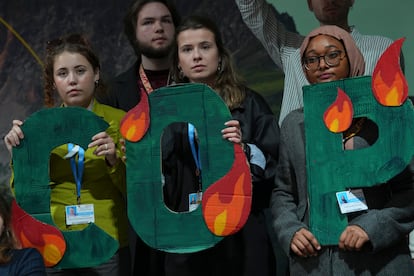 Luisa Neubauer, center, at a demonstration at COP28 in Baku, Azerbaijan, in November 2024.Peter Dejong (AP)
Q. Climate crisis skeptics no longer deny that there is a problem, but they attack solutions in the name of social inequality: the poorest cannot afford a hybrid vehicle.
A. We have gone through several phases: first they denied the crisis, then its severity, and now they deny the proposed solutions. It was said that phasing out coal would leave us without electricity, that wind power would ruin our landscapes, even that heat pumps would move us away from fire, supposedly the essence of human civilization. Today, what is denied is that all of this is a priority: the problem is acknowledged, but postponed indefinitely. This is a mistake.
Q. They say that climate measures are unfair to the less fortunate. Do you admit that some are?
A. It’s an excuse. The Paris Agreement established that those who pollute the most and have the greatest capacity to act must do more. It’s not up to the movement to demand that a struggling single mother buy organic lentils, but governments must fulfill their commitments. And they must do so with fair policies, not with subsidies that end up benefiting the wealthiest, as sometimes happens.
Q. Why are scientific data not enough to change mindsets?
A. Because feelings outweigh facts. Science is the foundation, but a graph or a figure will never move anyone on its own. Always guided by science, we must also consider what emotions we want to evoke. Only then will people be mobilized. The worst thing is believing that nothing can be done. Everyone can do something, even if they don’t see the immediate effect. My daily motivation is to prove it.
Science is the foundation, but a graph or a figure will never move anyone on its own. Always guided by science, we must also consider what emotions we want to evoke
Q. In 2023, your organization distanced itself from the international Fridays for Future movement following the war in Gaza. Do you still maintain that position?
A. To a large extent, things have changed. After [the Hamas-led attacks of] October 7, it was essential to express empathy with the victims and make it clear that there is no possible justification for violence. In Germany, because of how our historical memory works, if something like that was perceived as being minimized, it became impossible to continue working. That’s why we adopted that stance. Since then, we have denounced the genocide and demanded an end to arms exports to Israel, even when everyone advised against it.
Q. You have said your first inspiration was your grandmother, the activist Dagmar Reemtsma.
A. She campaigned against nuclear energy and participated in pacifist and feminist movements. When I was a child, she took me to events where men almost always spoke. She would stand up, challenge them, and dismantle their arguments with great conviction. She taught me not to simply repeat the obvious, but to point out the absurdity of opposing arguments. That always works.
Q. What was your political awakening?
A. In third grade, they wanted to close my school in Hamburg. My parents and other neighbors organized a protest and we blocked a main street. There were so many of us children that no cars could get through. In the end, they didn’t close it. I was impressed by the power of collective action.
Q. You even turned down a seat on the Siemens board. How was that offer presented to you?
A. Siemens was supplying electrical equipment to a huge coal mine in Australia. We organized a campaign, and I wrote an open letter to its CEO. His response was to offer me a seat on the supervisory board. I declined, of course, because it made no sense. The sad thing is that the media attention focused on whether or not I would accept that position, and not on the project we were denouncing…
Institutional politics, for the moment, seems like a rather uninspiring space to me. But I’m not closing that door
Q. You’ve also been criticized for flying. Can you defend the planet and still take a plane?
A. I no longer fly within Europe, and I only fly abroad in exceptional cases, for example, for climate conferences. But there’s a catch there: this demand for individual purity as a condition for having the right to speak. Not being pure doesn’t make you any less legitimate. It’s a very effective way to discredit and demobilize us.
Q. You were ridiculed for attending the Berlinale with an anti-far-right slogan printed on your dress. Do you regret it?
A. No, it was one of the most effective actions of the year. In January, for the first time since World War II, the German government sought the support of the far right for a parliamentary vote. The dress was a way of visually denouncing this broken taboo. Sometimes, an image achieves much more than a speech full of parliamentary jargon.
Q. You are a member of the German Greens and tipped to have a great political future. Do you see yourself as a minister or even as a second female chancellor?
A. Institutional politics, for the moment, seems like a rather uninspiring space to me. But I’m not closing that door: I’ll be 30 in a few months, and like any other young person, I wonder where life will take me. Even so, I’ve seen how the power of the people in the streets can be greater than that of any parliament. As long as I feel I can be of use there, I’ll keep fighting in that trench.
Sign up for our weekly newsletter to get more English-language news coverage from EL PAÍS USA Edition