
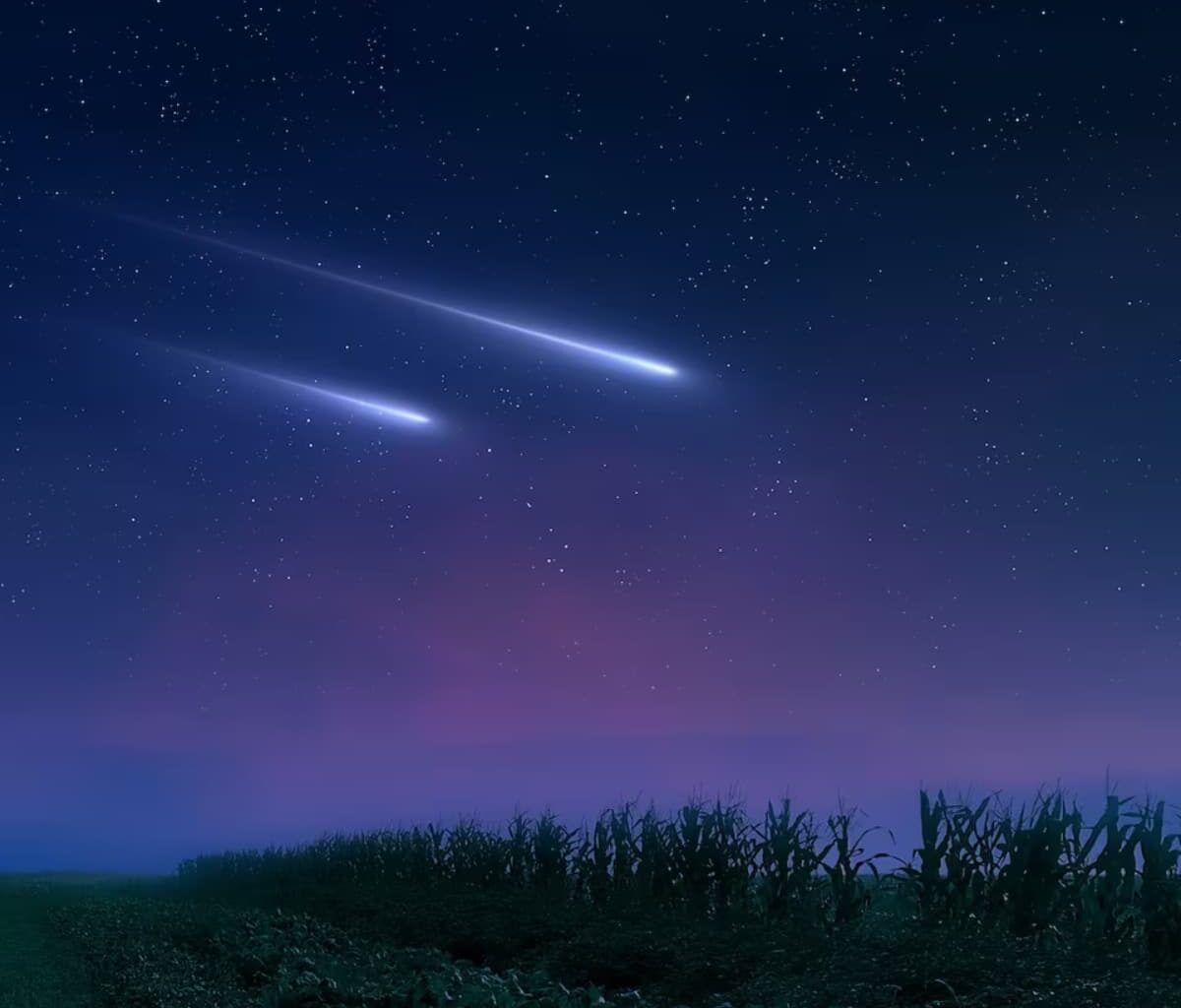
Catching a comet streaking across the sky is already a rare treat. This time, though, stargazers are in for something special—not one, but two comets at once. As soon as the Sun sets, it’s worth stepping outside and trying your luck.
While such an event isn’t entirely unprecedented, it’s rare enough to spark excitement among astronomy enthusiasts. Throughout October, observers in the Northern Hemisphere will be able to spot two comets crossing the night sky. Both originate from the distant edges of our Solar System and release gases that give them a distinctive green glow.
A first comet among the shooting stars
After 3 days of coming up to this spot with a vision, the clouds finally cleared (well kind of). The clouds decided to drift under Comet C/2024 A6 Lemmon opposed to over it and gave me this incredible view last night. ☄️ pic.twitter.com/PsK2gRxNB6
— KRL (@KennethLerose) October 16, 2025
The first is comet Lemmon, officially known as C/2025 A6, whose visibility had already been mentioned a few days ago.
Discovered in the United States by the Mount Lemmon Survey, the comet takes its name from the observatory responsible for spotting it.
I woke up early to capture Comet “C/2025 A6 (Lemmon)” before sunrise. But it’s starting to rise higher in the evening each day after sunset and will be much brighter near the end of the month. I used my Celestron RASA telescope, ZWO ASI533MC camera, and an Antlia L-Filter. pic.twitter.com/jzyoX0hR9m
— Chuck’s Astrophotography (@chucksastropho1) October 15, 2025
In recent days, astronomers announced that it had become visible to the naked eye—provided you’re observing from a location free of light pollution.
#PPOD: Comet Meets Aurora 🌠
Comet C/2025 A6 (Lemmon) is brightening fast! Discovered in January by the Mount Lemmon Survey, it swings closest to Earth on October 21 and reaches perihelion on November 8—about 79 million kilometers from the Sun. Currently around magnitude 5.4,… pic.twitter.com/J64FpPH4M8
— The SETI Institute (@SETIInstitute) October 15, 2025
At the moment, comet Lemmon is moving through the evening sky in Ursa Major, better known as the Big Dipper. Around October 21, it will appear below the handle before continuing toward the constellation Boötes.
The tree is not in danger. That’s because the comet pictured just above it, Comet C/2025 A6 (Lemmon), is far in the distance, well away from the Earth. Comet Lemmon now continues to brighten as it arcs through the inner Solar System, even though it has passed its nearest to the… pic.twitter.com/buUIARTdAY
— Astronomy Picture of the Day (@apod) October 14, 2025
That same Tuesday, October 21, the comet will make its closest approach to Earth, passing about 90 million kilometers away. With a new Moon occurring at the same time, moonlight won’t interfere, creating ideal viewing conditions. With a steady tripod, even a smartphone could capture a surprisingly decent photo.
Brilliant image of Comet C/2025 A6 Lemmon which is now a faint naked eye object. Credit Jason L Dain. pic.twitter.com/yBhz45FJ7J
— Con Stoitsis (@vivstoitsis) October 15, 2025
October 21 also marks the expected peak of the Orionids, a meteor shower produced by another famous visitor—Halley’s Comet.
Jumping Pound Alberta 20251015T0300-0430Z
1st image Comet C/2025 R2 SWAN
2nd image C/2025 A6 Lemmon
3/4th image the Aurora Borealis
Astrophotograhy nights don’t get much better that tonight, 2 comets and the aurora. I was taking down my set up when i noticed the low horizon… pic.twitter.com/Unvy9nXeOP
— Harlan Thomas (@theauroraguy) October 15, 2025
Two comets for the price of one
A newly discovered comet is already visible with binoculars. The comet, C/2025 R2 (SWAN) and nicknamed SWAN25B, is brightening significantly as it emerges from the Sun’s direction and might soon become visible on your smartphone — if not your eyes. Although the brightnesses of… pic.twitter.com/olCjX0eiQI
— Astronomy Picture of the Day (@apod) September 17, 2025
The second comet, C/2025 R2—better known as Swan—was only discovered last September as it prepared to pass closest to the Sun. It was identified using images from the Solar Wind Anisotropies instrument, which gave the comet its name.
Comet C/2025 R2 (SWAN) pic.twitter.com/VHmDcbJUrU
— Space 8K (@uhd2020) September 18, 2025
Currently shining at a magnitude of 6, Swan sits right at the threshold of naked-eye visibility. Because comet light is diffuse rather than sharply defined, that limit is harder to judge than it is for stars.
A new visitor from the outer Solar System, comet C/2025 R2 (SWAN) also known as SWAN25B was only discovered late last week, on September 11. That’s just a day before the comet reached perihelion, its closest approach to the Sun. First spotted by Vladimir Bezugly in images from… pic.twitter.com/yQN0k5Cvmh
— Astronomy Picture of the Day (@apod) September 20, 2025
Swan will be the first of the two to pass closest to Earth, doing so on Monday, October 20, at a distance of just 39 million kilometers.
Another incredible image of Comet C/2025 R2 SWAN done by Gerald Rhemann and Michael Jäger last September 15th from Namibia…
Wow‼️ pic.twitter.com/EAb3BErEyy
— Xavi Bros (@Xavi_Bros) September 16, 2025
As its trajectory carries it higher in the sky, it becomes easier to observe near the constellations Scutum and then Aquila.
Comet Observations from Caulfield this evening.
Comet C/2025 R2 Swan
Oct 15.38 UT, m1 5.7, DC 5/, Dia 10’.
20x80mm B
Close to star HD 157969 made estimates difficult.
Seestar images show how quicky the comet is moving pic.twitter.com/JxAi3Na5Y6
— Con Stoitsis (@vivstoitsis) October 15, 2025
So it’s time to grab your binoculars—and stay alert. Before long, another visitor from deep space, comet 3I/Atlas, could also join the display, making October an unforgettable month for skywatchers.

Nathalie Mayer
Journalist
Born in Lorraine on a freezing winter night, storytelling has always inspired me, first through my grandmother’s tales and later Stephen King’s imagination. A physicist turned science communicator, I’ve collaborated with institutions like CEA, Total, Engie, and Futura. Today, I focus on unraveling Earth’s complex environmental and energy challenges, blending science with storytelling to illuminate solutions.