
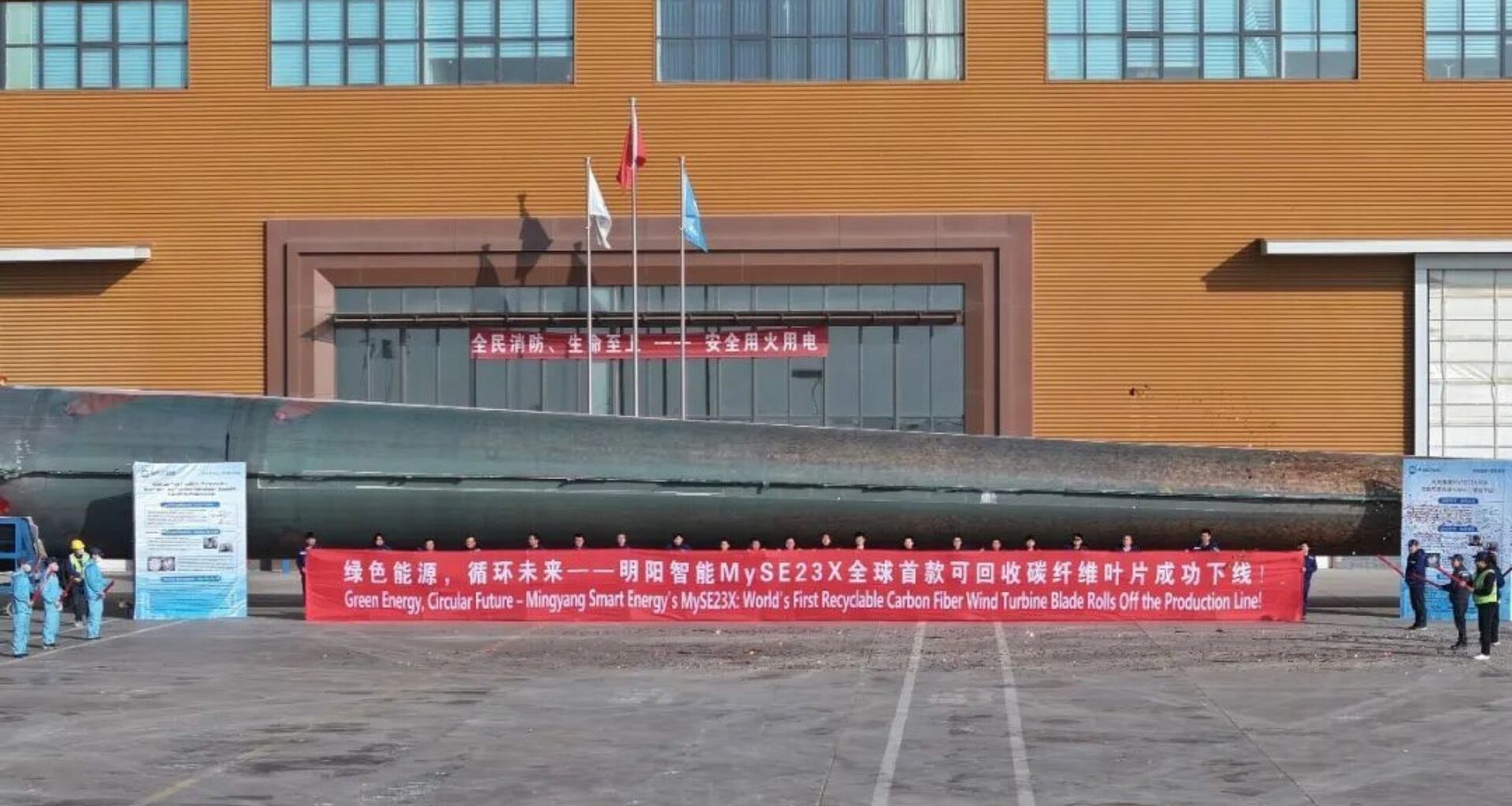
Chinese energy giant Ming Yang Smart Energy has developed the “world’s first fully recyclable carbon fiber wind turbine blade.”
Dubbed MySE23X, it measures over 110 meters (361 feet) long.
Announced on a LinkedIn post on January 7, the newly developed turbine blade uses a chemical degradation solution that works at ambient temperature and pressure.
This innovation targets the wind industry’s massive waste problem — typically, turbine blades are made of composites that are difficult to break down.
It could bring the wind energy sector closer to a carbon-neutral, waste-free future.
Chemical separation method for recycling
Conventional blades are difficult to recycle because their resin and fibers are permanently bonded during manufacturing.
Since these materials cannot be separated, decommissioned blades are typically buried in landfills or, at best, shredded into low-value filler for cement.
An earlier research from the University of Cambridge estimates that the world will accumulate 43 million tonnes of wind turbine blade waste by 2050.
As early-generation turbines reach the end of their lifespans, the disposal of these non-biodegradable composite materials is becoming a major global challenge.
This mounting waste is a primary driver of the industry’s shift toward fully recyclable blade technologies, such as those recently announced by Ming Yang.
Electrek reported that the company has designed a “special degradation solution.”
Compared with previous recycling attempts that required intense heat or high pressure — often damaging the fibers they sought to save — this new chemical process operates at ambient temperature and pressure. It chemically dissolves the glue holding the blade together.
The high-value carbon fiber can be recovered, cleaned, and reused in everything from new turbines to car parts.
The race for circularity
The MySE23X blade uses pultruded carbon fiber panels, which are much stronger and lighter than standard fiberglass.
At over 110 meters, it is designed for the world’s most powerful offshore turbines, where weight is the enemy of efficiency.
The environmental reputation of wind power technology is under closer scrutiny as the global transition to clean energy accelerates.
Critics have long pointed to non-recyclable turbines as a fundamental flaw in the renewable movement.
Ming Yang is not alone in this pursuit. At present, several companies are developing recyclable turbine blades.
Among them, Spain-based Siemens Gamesa is a major competitor in the race for circularity.
It has already deployed its recyclable blade technology in large-scale projects like the Kaskasi offshore wind farm in Germany and the Sofia wind farm in the UK
Their current sustainable blades are roughly 95% recyclable, but the company has committed to delivering fully recyclable blades by 2030 and making its entire wind turbine fleet 100% recyclable by 2040.
The adoption of these advanced materials allows the wind sector to transition toward a circular model with full lifecycle accountability and reinforces its commitment to a carbon-neutral future.
Meanwhile, Ming Yang is also famous for experimenting with wind turbine technology.
Beyond its latest recycling breakthrough, the energy giant has a history of industry “firsts,” including the development of an 18 MW typhoon-proof turbine and an unconventional dual-headed wind turbine system.