
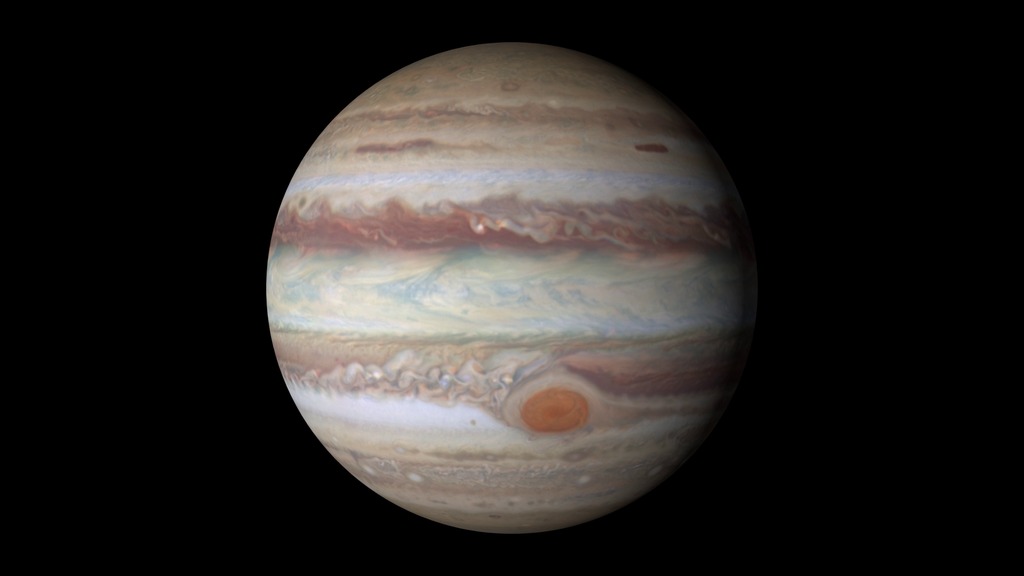
Jupiter looms large in this stunning map of the gas giant, comprised of Hubble Space Telescope data. Credit: NASA’s Goddard Space Flight Center/Space Telescope Science Institute
Jupiter reaches opposition on January 10, concurrently featuring a transit of its moon Callisto where the moon and its shadow appear to overlap. Subsequent transits of Io and Ganymede illustrate the increasing separation between the moon and its trailing shadow as the planet moves past opposition.
Observations of Saturn and its prominent moon Titan are detailed for multiple dates, alongside the visibility and positional changes of other inner moons including Rhea, Tethys, Dione, Enceladus, and Iapetus, noting specific alignments, occultations, and conjunctions.
The Moon undergoes a Last Quarter phase, achieves apogee, and forms a close angular proximity with the star Antares. Concurrently, the asteroid 16 Psyche is positioned near Aldebaran in Taurus, exhibiting retrograde motion.
The article provides guidance on locating celestial objects, including Jupiter in Gemini, Saturn transitioning into Pisces, and the open cluster M44 (the Beehive Cluster) in Cancer, while noting Mars’ conjunction with the Sun and its resultant invisibility.

Sky This Week is brought to you in part by Celestron.
Friday, January 9
Mars is in conjunction with the Sun at 7 A.M. EST, invisible in our sky until mid-March.
The bright moon Titan lies near its parent world, Saturn, in the evening sky tonight. The largest of the ringed planet’s moons, Titan is the only other solar system world known to host liquid on its surface, though its lakes and seas consist of hydrocarbons (like ethane and methane), not water.
The second-largest moon in the solar system after Ganymede, Titan is bigger than the planet Mercury and shines around magnitude 8.5, making it easy to spot even in smaller telescopes. Saturn this evening is about 35° high two hours after sunset, shining as the brightest light in the southwestern sky. Zoom in on Saturn with your telescope and Titan will appear just off the planet’s northwestern limb. Over the next few days, the moon will quickly move west, pulling farther from the planet day by day.
Closer to the ringed world, several smaller moons may be visible in larger amateur scopes: 10th-magnitude Rhea, Tethys, and Dione. Around 8 P.M. EST, Tethys lies just off the eastern end of Saturn’s rings, while Dione is off their western tip. Rhea is farther west, about 40” from Dione. All three should remain visible from much of the U.S., until Dione disappears in an occultation behind Saturn’s southwestern limb around 9:20 MST (only visible in the western half of the U.S., and most easily seen from the West Coast).
Sunrise: 7:22 A.M.
Sunset: 4:53 P.M.
Moonrise: —
Moonset: 10:51 A.M.
Moon Phase: Waning gibbous (55%)
*Times for sunrise, sunset, moonrise, and moonset are given in local time from 40° N 90° W. The Moon’s illumination is given at 10 P.M. local time from the same location.
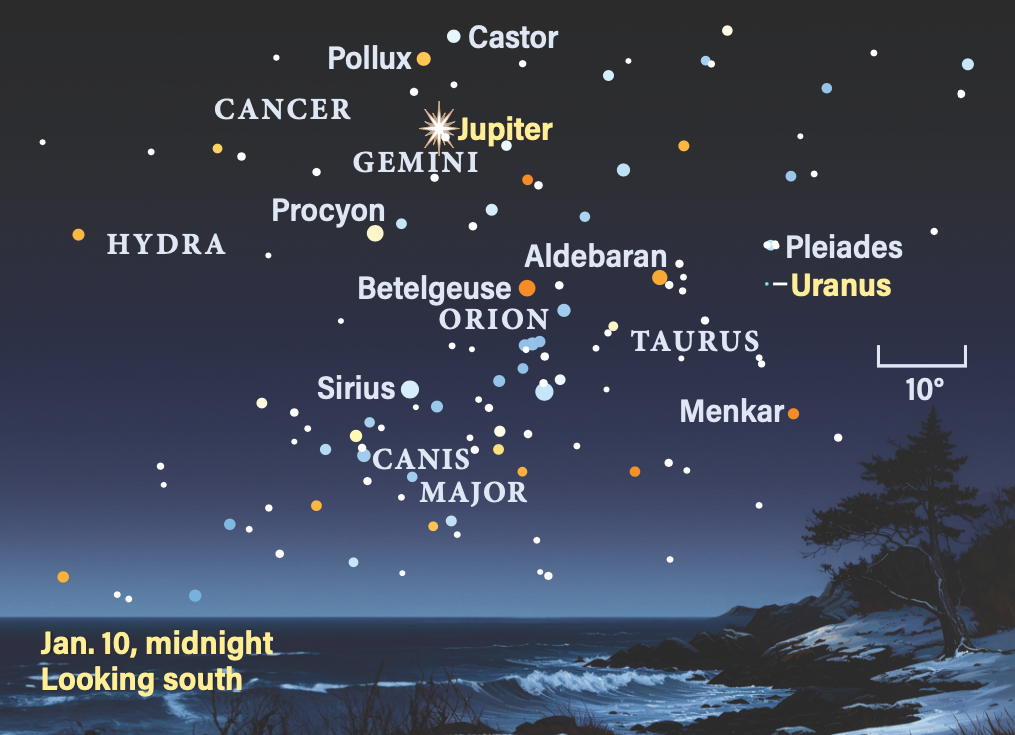
Jupiter shines brightly in Gemini as it reaches opposition this month. It’s also a great time to view Uranus near the Pleiades in Taurus, though you’ll need binoculars or a telescope. Credit: Astronomy: Roen Kelly
Saturday, January 10
The big event is finally here! Jupiter officially reaches opposition at 4 A.M. EST, and its moon Callisto is helping us usher in the big moment with a transit — moving simultaneously with its shadow across the face of the gas giant.
Jupiter is located in Gemini, sitting about 7° southwest of the star Pollux (Beta [β] Geminorum), which shines at magnitude 1.2. Glowing at magnitude –2.7, you absolutely can’t miss Jupiter, which outshines even the Northern Hemisphere’s brightest star, Sirius.
As the clock ticks over from midnight on the 9th to the early hours of January 10, Jupiter is high in the southern sky, some 70° above the horizon and located to the lower right of Pollux. Turn a telescope on the giant planet and you’ll see that by 12:30 A.M. CST (early on the 10th for the eastern half of the U.S.; still late on the 9th for the Mountain and Pacific time zones), Callisto is closing in on Jupiter’s southeastern limb. Europa is farther east, while Io (closer) and Ganymede lie to the gas giant’s west.
Callisto reaches the limb and begins to transit just minutes before 2 A.M. EST on the 10th (11 p.m. PST on the 9th in this time zone only). Within 10 minutes, it’s passed fully in front of the planet, moving from east to west. Two hours later, around 4 A.M. EST, Callisto is roughly central on the disk.
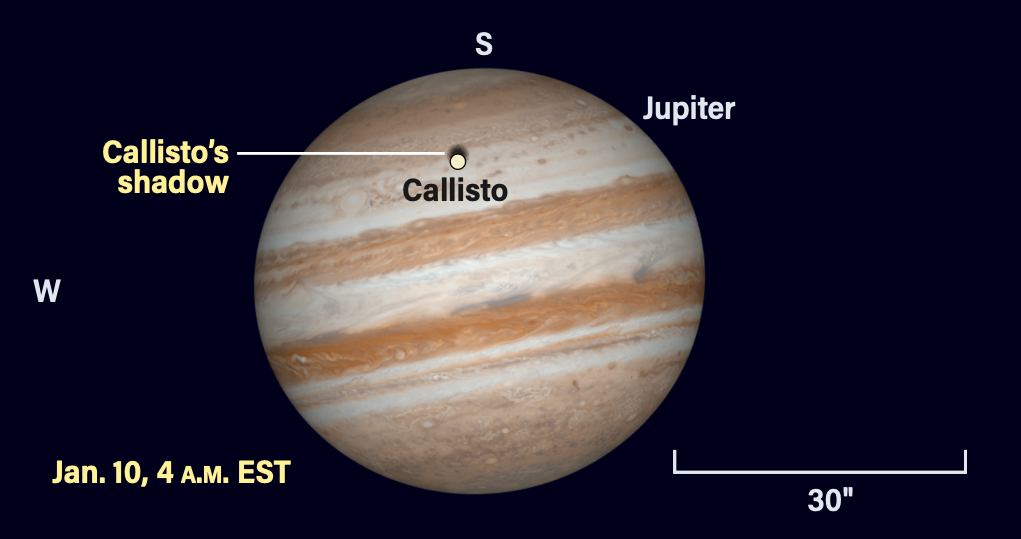
The day Jupiter reaches opposition, Callisto nearly blends with its shadow as they transit. Can you spot the shadow, just peeking out from Callisto’s southern edge? Credit: Astronomy: Roen Kelly
At opposition, the Sun appears directly behind us as we look at Jupiter and from a viewpoint above the solar system, Earth stands directly between the Sun and the gas giant. That means as moons cross Jupiter on this date only, they directly overlap their shadows. With Callisto central on the disk, look closely at the moon’s southern edge. Does this limb appear slightly darker or distended? This may be all the evidence of its shadow, also crossing the cloud tops at the same time, that you may see. You’ve got plenty of time to hunt for (or even try to photograph) it — Callisto’s transit ends shortly after 6 A.M. EST, roughly an hour before sunrise on the East Coast.
Even if you’re not an early riser, don’t worry. At opposition, planets rise around sunset and set around sunrise, so both morning and evening observers have plenty of time to view them. As Gemini rises in the east after sunset, Jupiter appears roughly level with Pollux, standing to the right of this star (which hangs beneath Castor [Alpha (α) Gem] as the Twins climb above the horizon in the early evening).
Last Quarter Moon occurs at 10:48 A.M. EST.
Sunrise: 7:22 A.M.
Sunset: 4:54 P.M.
Moonrise: 12:04 A.M.
Moonset: 11:13 A.M.
Moon Phase: Waning crescent (45%)
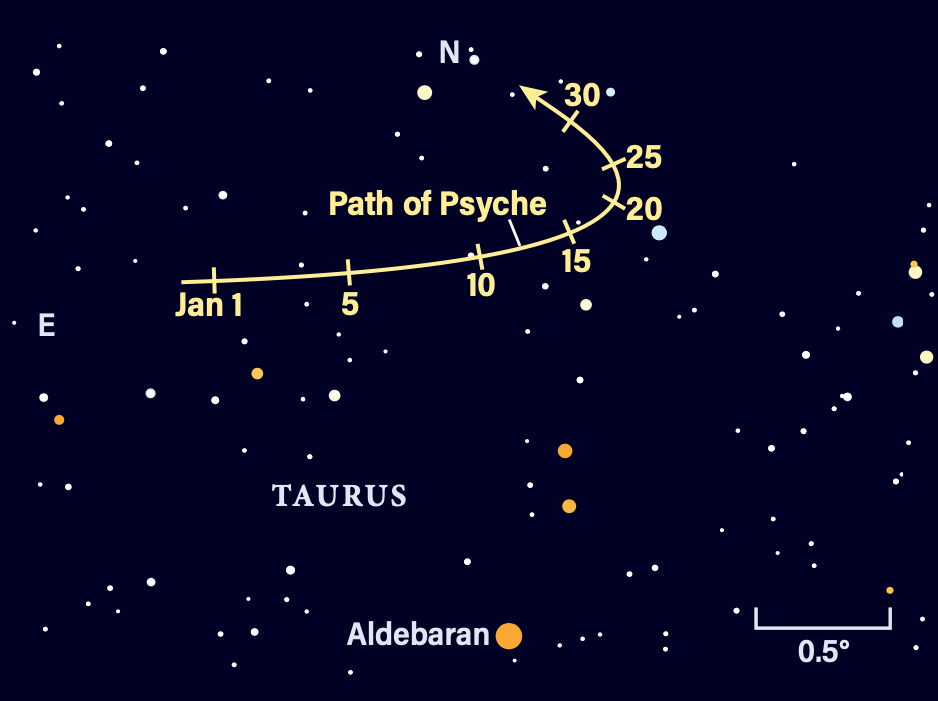
The strange, metallic asteroid Psyche arcs above the Bull’s eye, Aldebaran, this month. Credit: Astronomy: Roen Kelly
Sunday, January 11
The strange, metallic asteroid 16 Psyche is moving through Taurus the Bull this month. Tonight it is particularly easy to find as it slides north of the bright star Aldebaran.
Cataloged as Alpha Tauri, red giant Aldebaran shines at an easy-to-spot magnitude of 0.9, often envisioned as the Bull’s bright eye. By 7 P.M. local time, this star stands 50° high in the east, following the Pleiades star cluster (M45) up into the sky and located above the Hunter Orion and his familiar belt.
Center binoculars or a low-power telescope on Aldebaran, then scan just 1.4° due north to find magnitude 10.5 Psyche. (At lower powers or in binoculars, you may be able to spot both star and asteroid in the same field of view.)
Psyche is currently moving westward (retrograde) against the background stars; later this month, however, it will reach a stationary point and turn around, then moving eastward (prograde) across the sky. It will return to a point north of Aldebaran in the first few days of February, so make sure to come back and check it out then!
Sunrise: 7:21 A.M.
Sunset: 4:55 P.M.
Moonrise: 1:06 A.M.
Moonset: 11:36 A.M.
Moon Phase: Waning crescent (36%)
Monday, January 12
Io now transits Jupiter, showing us how quickly our view can change — now that we are a few days past opposition, the moon and its shadow won’t quite overlap, but instead Io’s shadow will now trail it across the planet’s cloud tops. (If you remember pre-opposition transits, such as Europa’s last week, the shadow previously began to transit before the moon that cast it.)
The transit begins late this evening, when Jupiter is still rising in the eastern sky for much of the U.S. Around 10 P.M. EST, Io is closing in on the planet’s eastern limb, with Ganymede much farther east. Europa and Callisto lie west of the planet, with the former closest to the gas giant.
Io’s transit begins around 10:40 P.M. EST. Its shadow is following close behind, beginning its own transit just four minutes later. By 10:50 P.M. EST, both moon and shadow are visible against the cloud tops near the eastern limb. It takes them about an hour to reach the center of the disk. A little more than an hour later, Io’s transit ends minutes before midnight in the Central time zone, with its shadow disappearing just a few minutes after midnight in the same time zone.
Sunrise: 7:21 A.M.
Sunset: 4:56 P.M.
Moonrise: 2:08 A.M.
Moonset: 12:01 P.M.
Moon Phase: Waning crescent (27%)
Tuesday, January 13
The Moon reaches apogee, the farthest point from Earth in its orbit, at 3:47 P.M. EST. At that time, our satellite will be 251,928 miles (405,439 kilometers) away.
We’re back at Jupiter yet again to catch a transit of the large moon Ganymede overnight tonight. You’ll want to be ready to go with your telescope trained on the gas giant around midnight in the Eastern time zone. At that time, Ganymede is approaching Jupiter’s southeastern limb, while Io is moving farther away from the planet on the eastern side. Europa lies far east of Jupiter, while Callisto is alone far to the planet’s west.
Ganymede reaches the limb and begins to transit at 12:34 A.M. EST (January 14th in EST only). Due to Ganymede’s larger orbit, its shadow takes longer than Io’s to appear, slipping onto the cloud tops at 12:58 A.M. EST.
Everyone has plenty of time to watch the event as the pair crosses Jupiter for nearly three hours. By 4 A.M. EST (now the 14th across the U.S.), Ganymede’s transit has just ended while its shadow remains visible on the cloud tops, still approaching the limb. The shadow transit finally ends around 4:20 A.M. EST.
Sunrise: 7:21 A.M.
Sunset: 4:57 P.M.
Moonrise: 3:10 A.M.
Moonset: 12:32 P.M.
Moon Phase: Waning crescent (19%)
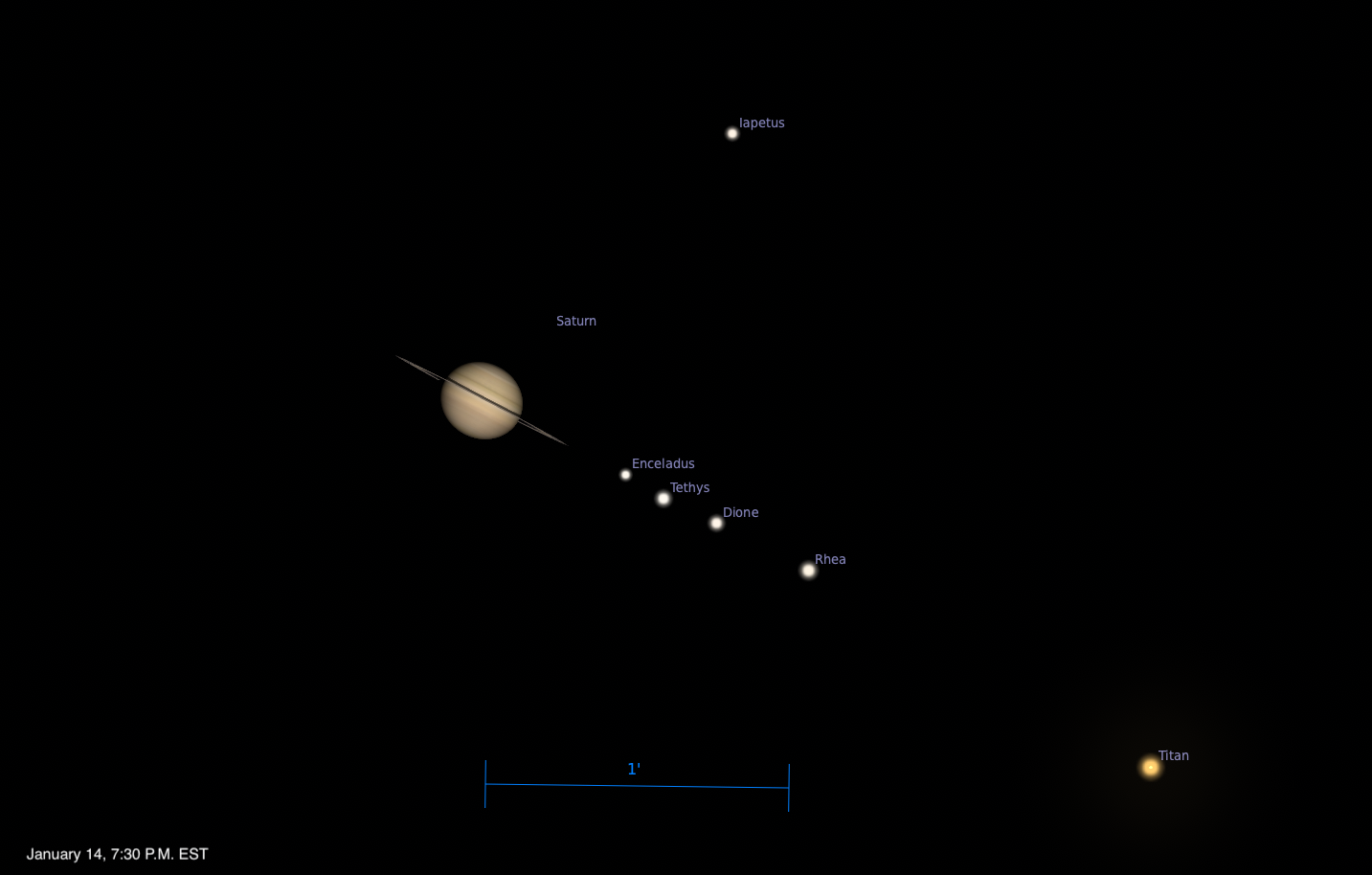
Iapetus is visible north of Saturn on the evening of January 14; additionally, if you look at the right time, you’ll see several of the ringed world’s other moons lined up to the west. Credit: Stellarium/Oleg Pluton
Wednesday, January 14
The Moon is now in Scorpius, passing close to the Scorpion’s deep red heart, magnitude 1.1 Antares. You can catch the pair in the early-morning sky, standing some 15° high in the southeast an hour before sunrise.
At that time, the waning Moon sits 3.5° to the upper right of Antares, near the 3rd-magnitude star Sigma (σ) Scorpii. Only the western limb of our satellite remains illuminated by the Sun, though the rest of its darkened face may show off some earthshine, as sunlight bounces off Earth and lights up the portions of the Moon already experiencing night. It’s sure to be a lovely pairing that astrophotographers won’t want to miss.
The Moon will pass 0.6° due south of Antares later today at 3 P.M. EST.
Saturn’s two-toned moon Iapetus reaches inferior conjunction today. Telescopic observers may be able to catch the 11th-magnitude moon some 1.2’ due north of Saturn this evening. The best time to look is early evening — about 90 minutes after sunset, Saturn is still more than 30° high in the southwest, glowing at magnitude 1.0. It’s easy to pick out as the brightest point of light here.
At 7:30 P.M. EST, the eastern half of the U.S. gets a special treat: In addition to Iapetus being easy to spot (thanks to its proximity to the planet), several of the ringed world’s other moons are perfectly lined up west of Saturn at this time. Farthest away is bright, mid-8th-magnitude Titan, which sits 2.5’ west of Saturn. Moving inward, you’ll spot 10th-magnitude Rhea, Dione, and then Tethys, with the latter closest to the planet. Observers with larger scopes might also be able to pick up faint (12th-magnitude) Enceladus, which lies closer to Saturn still, between Tethys and the edge of the rings.
Sunrise: 7:21 A.M.
Sunset: 4:58 P.M.
Moonrise: 4:12 A.M.
Moonset: 1:10 P.M.
Moon Phase: Waning crescent (12%)
Thursday, January 15
First-magnitude Saturn crosses into Pisces today, readily visible to the naked eye as the brightest light in the southwestern sky as it sinks slowly toward the horizon a few hours after sunset. You’ll want to catch the planet early in the evening, before it gets too low and the turbulent air nearer the horizon muddies the view.
Through a telescope, take some time to admire the planet’s thin rings, now tilted by roughly 1.5° to our line of sight. While Saturn’s disk stretches an impressive 15” across, the rings are nearly 38” from end to end.
Bright Titan still lies due west of Saturn, now a little less than 2’ from the planet’s center. The inner moons have changed locations significantly: 10th-magnitude Rhea is still west of the planet early in the evening, but disappears in an occultation behind the limb shortly before 7:30 P.M. EST. Similarly bright Dione and Tethys are now east of the planet, with the former closer to the rings than the latter. Twelfth-magnitude Enceladus, if it is visible in your scope, is also east of Saturn, but closing in on the ringed world’s eastern limb for a transit beginning shortly after 8 P.M. EST, as Saturn is starting to get low for those on the U.S. East Coast. The small moon will likely be lost to view against the brighter disk.
Around 8 P.M. CST, Dione passes south of Tethys to Saturn’s east, with the planet quite low in the Eastern time zone (though experienced observers can still attempt the view). The pair may appear to briefly merge in most scopes around this time. After this, Dione will appear farther east of Saturn, with Tethys closer to the planet.
Sunrise: 7:20 A.M.
Sunset: 4:59 P.M.
Moonrise: 5:11 A.M.
Moonset: 1:55 P.M.
Moon Phase: Waning crescent (7%)
Friday, January 16
While bright Jupiter has kept our gaze in Gemini most evenings — and indeed, you can spot it just ½° from the magnitude 3.5 star Wasat (Delta [δ] Geminorum) this evening — there’s much more in this region of the sky to enjoy.
Farther east, closer to the horizon and to the lower left of Gemini early in the evening as the constellations rise, Cancer the Crab holds at its heart the lovely open cluster M44. Often called the Beehive Cluster, this group is also called Praesepe, derived from the Latin word for manger. Shining at 3rd magnitude, M44 has been known since ancient times. It is a grouping of young stars some 730 million years old, located nearly 600 light-years from Earth. If you can spot it with the naked eye, it may appear as a misty patch of light. It contains at least a thousand stars, though only a few hundred of these are readily visible even under magnification in amateur instruments.
Sunrise: 7:20 A.M.
Sunset: 5:01 P.M.
Moonrise: 6:05 A.M.
Moonset: 2:48 P.M.
Moon Phase: Waning crescent (3%)