
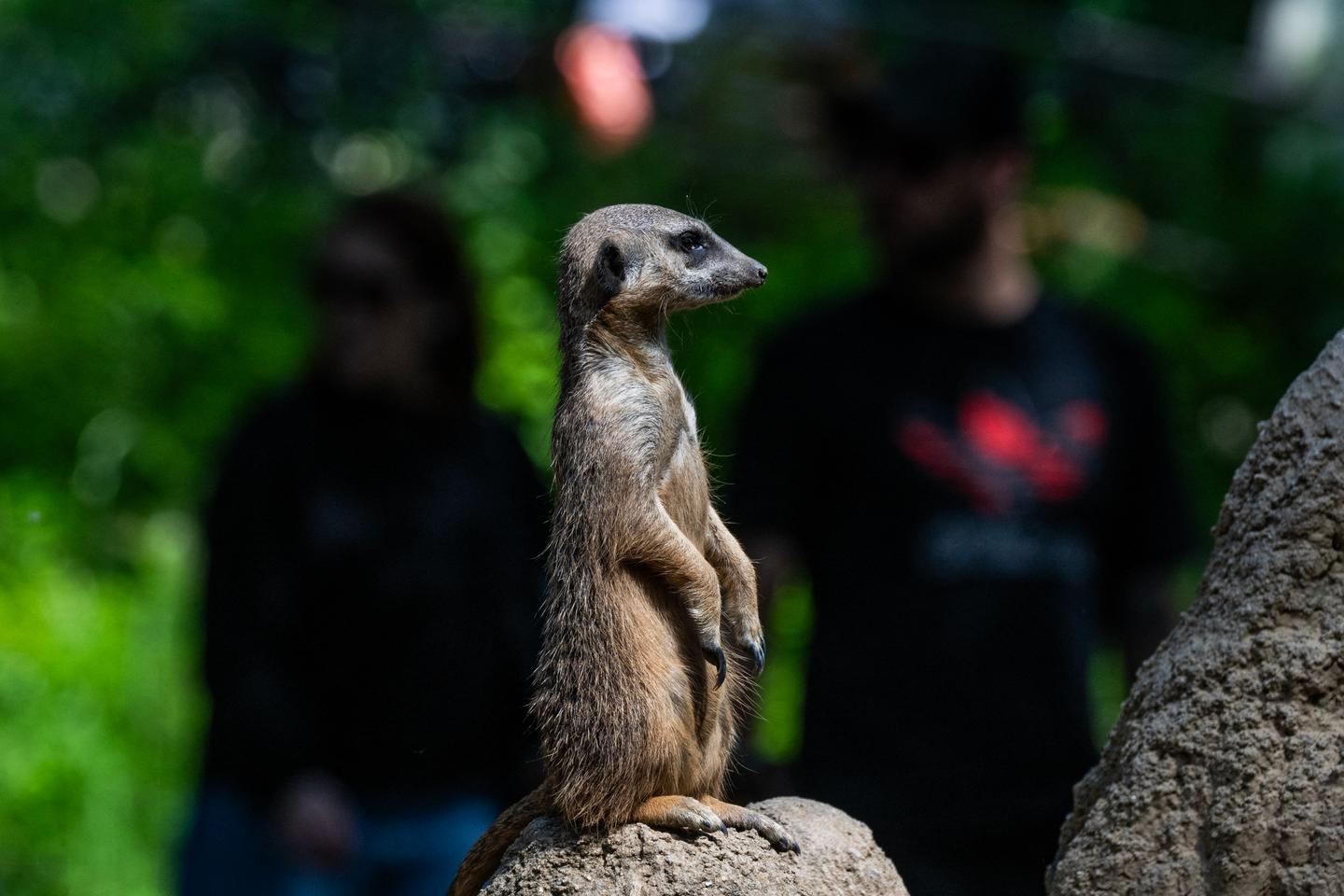
 A slender-tailed meerkat in its enclosure at the Berlin Zoo, May 20, 2025. JOHN MACDOUGALL / AFP
This column set out to explore the animal kingdom – to showcase its diversity of shapes, behaviors, evolutionary histories and cognitive abilities. Week after week, we examined many species, from the simplest to the most complex, from the most harmless to the most predatory, from the rarest to the most invasive. Yet one species escaped our curiosity – the most complex, certainly the most predatory and without a doubt the most invasive: Homo sapiens. While we have often compared the behavior of certain animals to our own – usually to marvel at the abilities of even our most distant cousins – we have never done the opposite. That is, to position our own behavior in relation to that of other animals.
This is precisely what anthropologist and archaeologist Mark Dyble, an assistant professor at the University of Cambridge, set out to do. In an article published on December 10, 2025, in the Proceedings of the Royal Society B journal, he compared the degree of monogamy across a broad sample of mammals. Why ask such a question? “My starting point was in trying to understand the evolution of human cooperation,” he explained. “Most highly cooperative animals species (e.g. social bees, ants, and highly social mammals like meerkats) have monogamous mating, so I wanted to see the extent to which we can say that humans are monogamous.”
You have 64.35% of this article left to read. The rest is for subscribers only.