
asteroid: A rocky object in orbit around the sun. Most asteroids orbit in a region that falls between the orbits of Mars and Jupiter. Astronomers refer to this region as the asteroid belt.
basic research: Research performed to gain a general understanding of how things work, and not with any particular application in mind. This type of work is contrasted with applied research, which is work done to accomplish a particular purpose — such as to cure disease, make a building stronger or make a fuel burn cleaner.
coexist: To exist at the same time as or along with.
cranial nerves: Pairs of nerves in mammals and dinosaurs that connect the brain directly to muscles and organs of the head and torso.
Cretaceous Period: The latter age of dinosaurs, it spanned from 145 million to 66 million years ago, it was a time when the whole planet had a relatively mild climate, with forests growing near both the North and South Poles. It marked the emergence of flowering plants and massive volcanic eruptions, which triggered big shifts in ocean ecosystems. And some regions cooled, leading dinosaurs there to adapt by evolving a coat of insulating feathers. Finally, it all came to an end 66 million years ago when a giant meteorite crashed into Earth, changing the global climate overnight. This wiped out all the dinosaurs (except those that would survive as birds), along with half of all plant and animal species.
dinosaur: A term that means terrible lizard. These reptiles emerged around 243 million years ago. All descended from egg-laying reptiles known as archosaurs. Their descendants eventually split into two lines. For many decades, they have been distinguished by their hips. The lizard-hipped line are believed to have led to the saurischians, such as two-footed theropods like T. rex and the lumbering four-footed Apatosaurus. A second line of so-called bird-hipped, or ornithischian dinosaurs, appears to have led to a widely differing group of animals that included the stegosaurs and duckbilled dinosaurs. Many large dinosaurs died out around 66 million years ago. But some saurischians lived on. They are now the birds we see today (and who have now evolved that so-called “bird-hipped” pelvis).
diversity: A broad spectrum of similar items, ideas or people. In a social context, it may refer to a diversity of experiences and cultural backgrounds. (in biology) A range of different life forms or a range of traits within the population of some species.
ecological: An adjective that refers to a branch of biology that deals with the relations of organisms to one another and to their physical surroundings. A scientist who works in this field is called an ecologist.
force: Some outside influence that can change the motion of an object, hold objects close to one another, or produce motion or stress in a stationary object.
forge: (verb) To shape metals under heat and/or pressure, or (colloquially) to form one element from another under the intense heat and pressure inside stars. Or to force a change in shape, ideas or attitudes.
fossil: Any preserved remains or traces of ancient life. There are many different types of fossils: The bones and other body parts of dinosaurs are called “body fossils.” Things like footprints are called “trace fossils.” Even specimens of dinosaur poop are fossils. The process of forming fossils is called fossilization.
juvenile: Young, sub-adult animals. These are older than “babies” or larvae, but not yet mature enough to be considered an adult.
link: A connection between two people or things.
mature: (adj.) Connoting an adult individual or full-grown and fully developed (non-juvenile) form of something. (verb) To develop toward — or into — a more complex and full-grown form of something, be it a living thing, a technology or an idea.
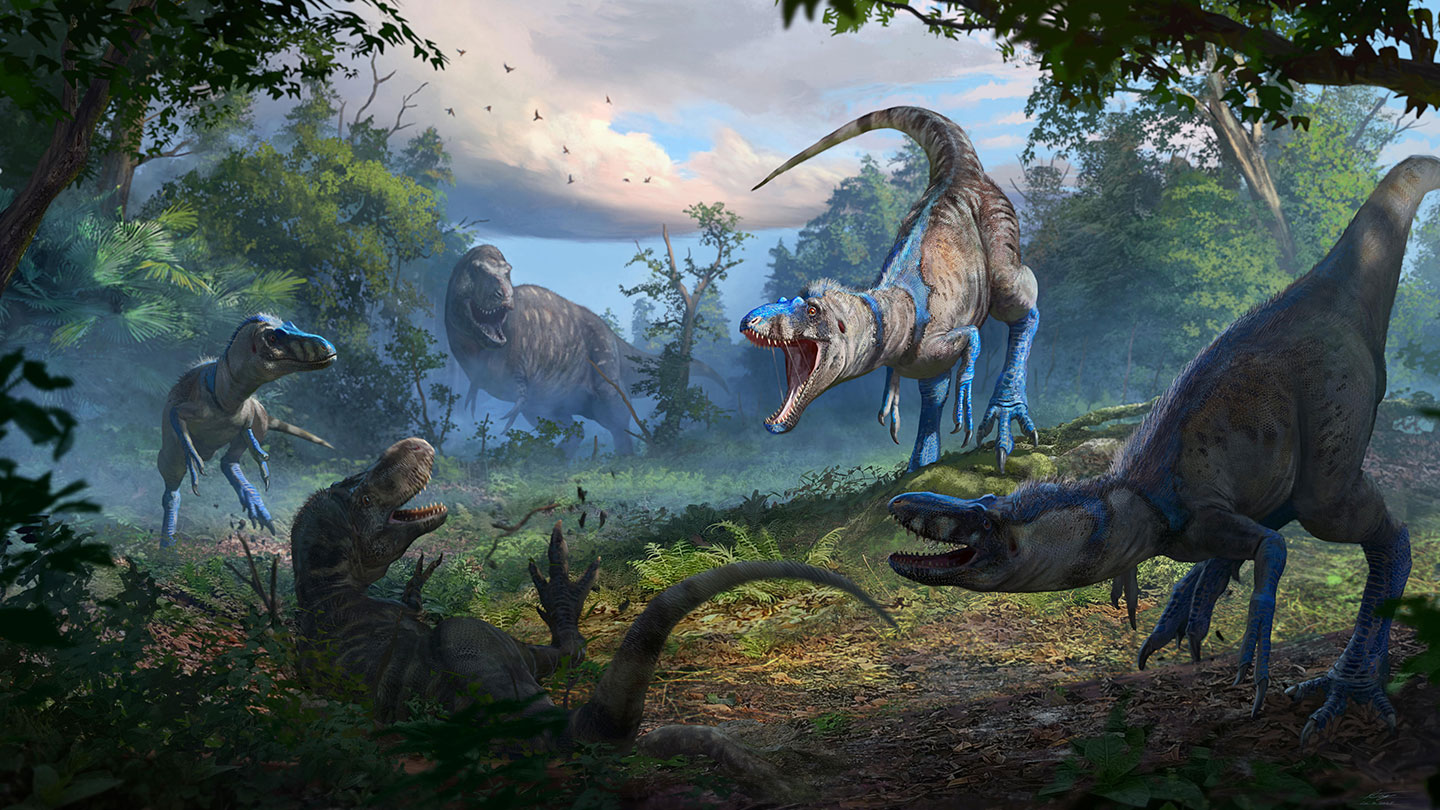
Nanotyrannus: A genus of relatively small tyrannosaurs that lived in the same place and at the same time as Tyrannosaurus rex. First discovered in 1988, scientists debated for decades as to whether they were a distinct species or just juvenile T. rexes. In 2025, researchers reported new analyses showing one full-grown adult who was small and bore distinct skeletal differences from T. rex. At the time, they also claimed finding evidence of a second species of these small T. rex cousins.
nerve: A long, delicate fiber that transmits signals across the body of an animal. An animal’s backbone contains many nerves, some of which control the movement of its legs or fins, and some of which convey sensations such as hot, cold or pain.
niche: A small or narrow pocket that sets something apart, or perhaps offers a region of protection. (In ecology) The term for the role that an organism plays in its community.
paleontologist: A scientist who specializes in studying fossils, the remains of ancient organisms.
predator: (adjective: predatory) A creature that preys on other animals for most or all of its food.
prey: (n.) An organism hunted by another, often for food. (v.) To attack and eat another organism.
respiratory: Of or referring to parts of the body involved in breathing (called the respiratory system). It includes the lungs, nose, sinuses, throat and other large airways.
sinus: Air-filled cavities (known as sinus cavities) around the nose and eyes.
skull: The skeleton of a person’s or animal’s head.
species: A group of similar organisms capable of producing offspring that can survive and reproduce.
system: A network of parts that together work to achieve some function. For instance, the blood, vessels and heart are primary components of the human body’s circulatory system. Similarly, trains, platforms, tracks, roadway signals and overpasses are among the potential components of a nation’s railway system. System can even be applied to the processes or ideas that are part of some method or ordered set of procedures for getting a task done.
tyrannosaur: A line of meat-eating dinosaurs that began during the late Jurassic Period, about 150 million years ago. These species persisted into the late Cretaceous Period, about 65 million years ago.
Tyrannosaurus rex: A top-predator dinosaur that roamed Earth during the late Cretaceous period. Adults could be 12 meters (40 feet) long.
vertebrae: (sing. vertebra) The bones that make up the neck, spine and tail of vertebrates. Bones in the neck are called cervical vertebrae. Bones in the tail, for animals that have them, are called caudal vertebrae.