
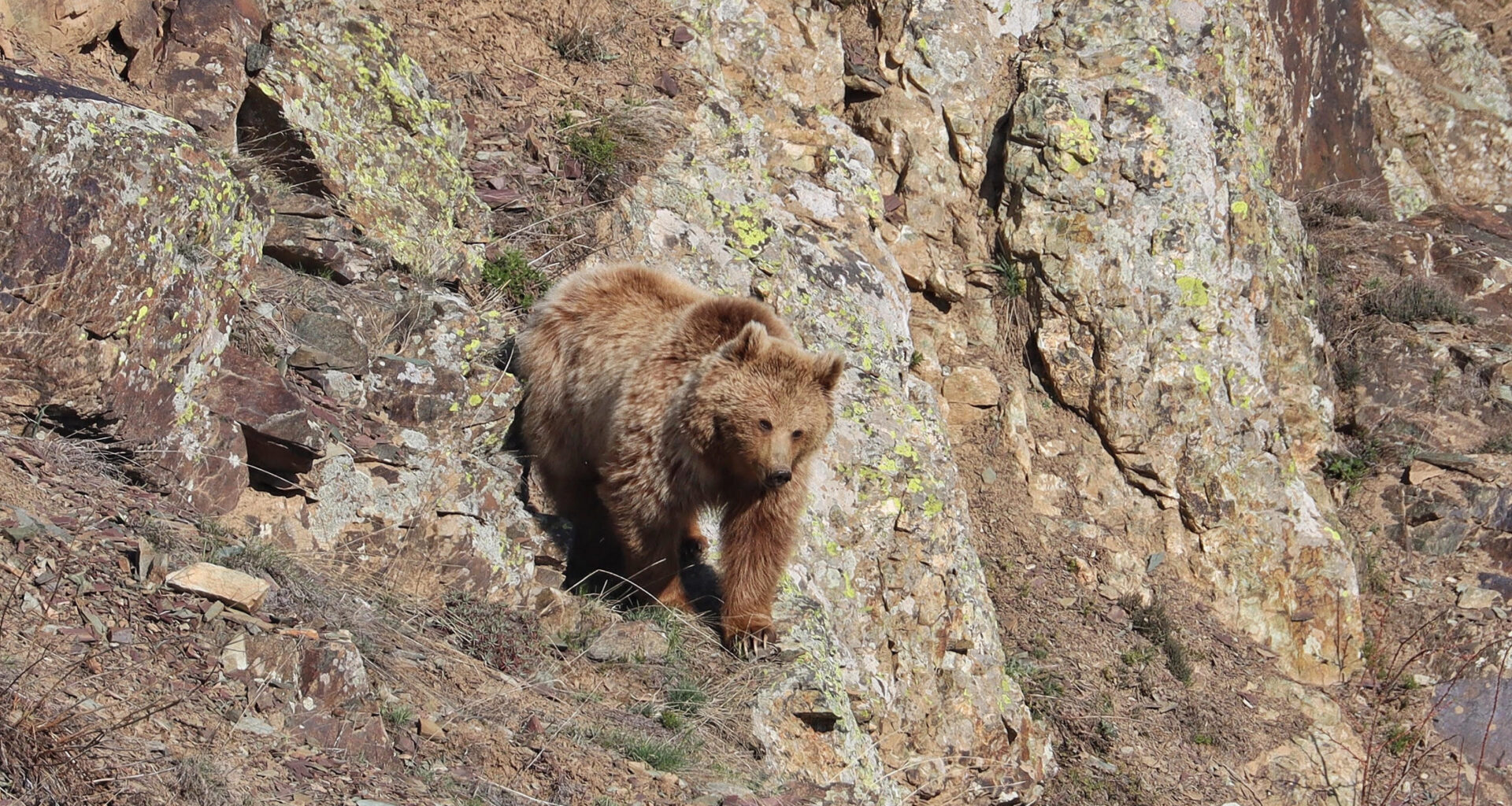
A systematic survey of the Trans-Himalayan region of Ladakh mapped brown bear occupancy and habitat suitability.Valley rangelands in western Ladakh, such as Drass, Suru, Shargole and Zanskar, emerged as the species’ most suitable habitats, with access to vegetation, water and mid-elevation rugged terrain.The most high-quality habitat, however, lies outside protected areas and overlaps with zones of rapid infrastructure expansion, underscoring the need for wildlife corridor protection.
See All Key Ideas
The Himalayan brown bear remains poorly studied in its high-altitude habitats. Only an estimated 130-220 individuals survive across the Himalayas and Trans-Himalayan ranges of India and Pakistan. In India, the species is threatened by low population densities and isolated, insular groups. Its true distribution in the Trans-Himalayan region of Ladakh has long been largely guesswork.
A new study covering more than 35,000 sq km now fills that gap. “It provides the first large-scale, systematic assessment of brown bear distribution and habitat suitability in the region and generates evidence directly relevant to conservation and development regulation,” says Niazul Khan, corresponding author, and Ph.D. scholar at the Wildlife Institute of India, Dehradun.
Working in a harsh landscape
The Trans-Himalayan region of Ladakh forms a stark but ecologically rich habitat. Winter temperatures sometimes fall below -30°C, vegetation is sparse, and traditional agro-pastoralism relies heavily on shared rangelands. Over the past decade, this region has also been transformed by expanding road networks, defence infrastructure, renewable energy projects and fast-growing tourism.
Western Ladakh, particularly the upper Suru Valley, Shargole and Zanskar Valley, is believed to support most of the Himalayan brown bear population. Yet, there had been no landscape-level assessment of its habitats or the environmental factors that influence where the species survives, until now.
Since Himalayan brown bears are elusive, largely nocturnal and occur at very low densities, direct sightings are rare. “Consequently, our study involved intensive sign-based surveys of tracks, scats, diggings, and direct observations in a systematic fashion,” says Khan.
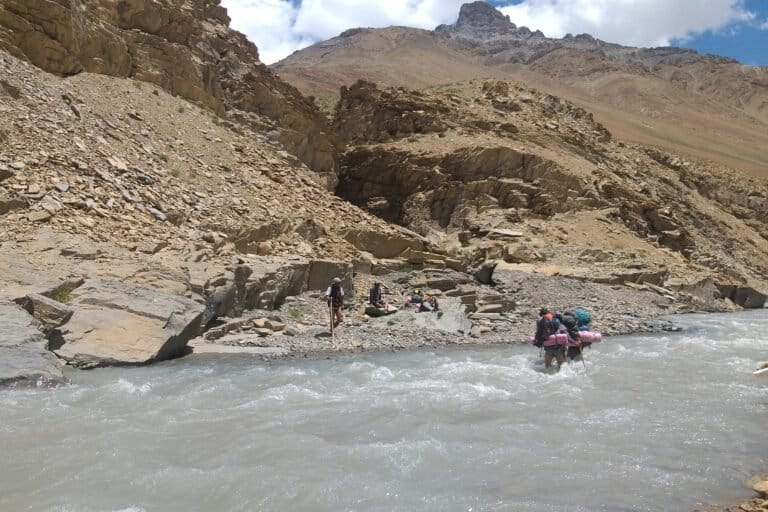 Survey teams walked 4,012 trails to record bear signs, as part of the first large-scale, systematic assessment of brown bear distribution and habitat suitability in Ladakh. Image by Niazul Khan.
The landscape was divided into 10×10 km grids, each further broken into 5×5 km cells to ensure consistent sampling. Survey teams walked 4,012 trails, ranging from about half a kilometre to nearly 7 km, and recorded bear signs using a mobile application called MSTrIPES. Across two years (2019-20), the teams documented 2,530 confirmed brown bear signs, creating a spatial dataset for Ladakh.
To estimate where the bears are likely present, the researchers used occupancy modelling, a method that accounts for the fact that animals may be present but remain undetected. To complement it, they also employed a species distribution modelling approach called MaxEnt that predicts habitat suitability based on environmental conditions at locations where the species is known to occur. Variables including terrain ruggedness, elevation, temperature, land cover and proximity to water, were analysed to understand both local-scale habitat use and broader landscape patterns.
“MaxEnt highlighted the strong influence of climatic variables in shaping bear habitat. This complemented the occupancy results by allowing broader climate-linked refugia that are likely to remain important under future environmental change,” adds Khan.
Key habitat patterns
Across different models, one finding remained consistent: the Himalayan brown bear depends heavily on valley rangelands. Areas such as the Drass, Suru and Zanskar Valleys were repeatedly identified as having the highest probability of bear presence. These valleys offer seasonal vegetation, small mammal prey like marmots, and reliable access to water, critical resources in an otherwise harsh, resource-poor environment.
Terrain emerged as another strong influence on bear distribution. The models show that the species prefers moderately rugged landscapes between 3,000 and 4,500 metres above sea level. Such mid-elevation zones provide ideal terrain for denning, foraging and avoiding human-dominated areas.
Rugged slopes and broken terrain are likely especially important for females with cubs, offering secure denning sites during winter dormancy. These areas also tend to have fewer roads and lower human disturbance, both factors that increase the likelihood of brown bear presence. “In contrast, even moderate increases in the human footprint sharply reduced habitat suitability, confirming the species’ sensitivity to disturbance,” says Khan.
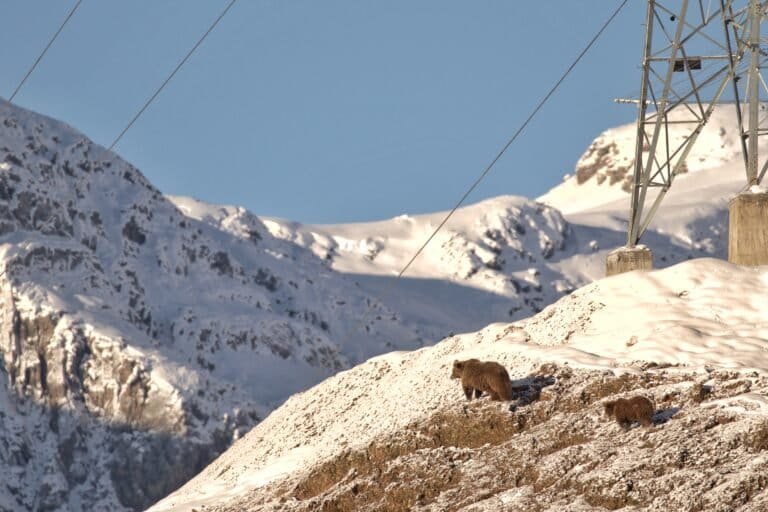 Rugged slopes and broken terrain are considered especially important for female brown bears with cubs, offering secure denning sites during winter dormancy. Image by Niazul Khan.
Temperature-related variables played a key role too in predicting habitat suitability. Areas with high seasonal temperature variation, typical of western Ladakh, offered the most favourable conditions because such contrasts enable vegetation growth, prey movement and the availability of denning habitats. Bears also tended to occupy areas with moderate daily temperature ranges, suggesting that microclimatic stability may help them balance foraging and denning needs in high-altitude environments.
“One of the most striking results was how strongly temperature variation influenced habitat suitability,” says Khan. The researchers caution that under climate warming, such temperature-linked habitat preferences may push suitable conditions upslope into more limited and fragmented areas.
Western Ladakh holds the last major refuges
When viewed together, the results showed western Ladakh as the species’ stronghold. A smaller, more isolated presence was detected in Nubra Valley, but the study indicates that the connectivity between subpopulations may already be weak, potentially isolating groups further.
“The most urgent priority is the protection of key valley systems, such as Drass, Suru, Shargole, and Zanskar, which currently support some of the highest-quality bear habitat but lie largely outside of protected areas,” says Khan. They also face growing pressure from road expansion, military construction, mining and unregulated tourism. Habitat fragmentation may restrict the brown bears’ access to critical feeding and denning sites, because they have large home ranges and move widely across valleys.
Engaging local communities is equally important. Ladakh’s pastoralists often bear the brunt of livestock depredation, and human-bear conflict, reported in the region, adds to conservation challenges. Predator-proof corrals, infrastructure development regulations, improved waste management, regulated grazing and carefully designed ecotourism initiatives could help reduce conflict while safeguarding habitats, the study notes.
“We also need reliable population estimates and information on habitat connectivity between valleys, including the identification of potential corridors. Addressing these gaps through long-term monitoring, genetic studies, and climate-informed modelling will be central to securing the future for the Himalayan brown bear in the Trans-Himalayas,” says Khan.
Read more: Snow leopard survey finds the elusive cat thriving
Banner image: Himalayan brown bears are elusive, largely nocturnal and occur at very low densities, making direct sightings rare. Image by Niazul Khan.
