
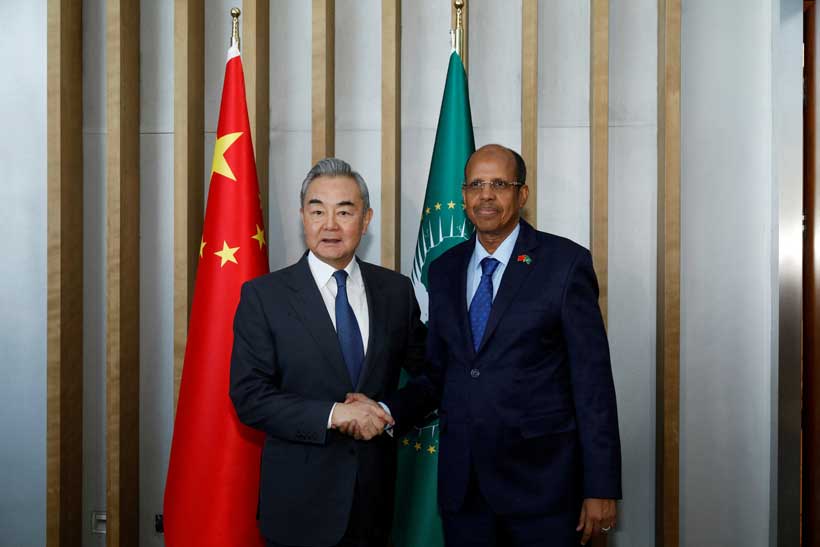
The timing of Chinese Foreign Minister Wang Yi’s visit to the Horn of Africa, East Africa, and Southern Africa, specifically (Somalia, Tanzania, Lesotho, and Ethiopia), at the beginning of 2026 was significant. The visit aimed to promote the building of a China-Africa community with a shared future. Wang Yi’s visit to Somalia marked the first visit by a Chinese foreign minister to Somaliland in decades. This visit was a response to Israeli Foreign Minister Gideon Sa’ar’s official visit to Hargeisa, the capital of the breakaway region of Somaliland, on January 6, 2026. This Israeli visit was the first high-level visit since Israel’s official recognition of Somaliland as an independent state in December 2025. This sparked widespread condemnation from the Chinese government, which stands in solidarity with the legitimate capital, Mogadishu. The visit was seen as having far-reaching objectives that threaten China’s national security and undermine its Belt and Road Initiative. China described Gideon Sa’ar’s visit to Somaliland as “illegal and a blatant violation of Somalia’s national sovereignty and territorial integrity.” China also accused Israel of involvement in the process of dividing Somalia and creating widespread instability in the Horn of Africa. The Chinese Foreign Ministry stated that “Israel’s continued attempts to support Somaliland’s independence represent a dangerous precedent in international relations aimed at tearing apart Somalia’s unity.”
Therefore, in December 2025, China strongly opposed any Israeli recognition of Somaliland as an independent state, describing the move as a violation of the principles of the UN Charter and international law. Therefore, the Chinese Foreign Ministry publicly urged the Somaliland authorities to immediately cease “colluding with external forces for selfish political gains,” a clear reference to Israel. This stems from China’s strategic concerns that Somaliland’s alliance with powers like Israel threatens the “One China” principle and its Belt and Road Initiative. Consequently, China’s firm response to this Israeli recognition of Somaliland came in the form of its support for a policy of “strengthening the Chinese presence in the Horn of Africa and Somalia.” This is a direct response to Israel’s actions, as China is working to bolster its intelligence and military presence in Somalia and the Horn of Africa to counter its adversaries, primarily Israel and the United States.
Recent intelligence and military reports from January 2026, issued by the Chinese Ministry of State Security (which oversees China’s intelligence apparatus), indicate ongoing discussions between Somaliland and Israel regarding the establishment of an Israeli military base in the region. China views this as a direct threat to its influence and that of its allies, such as Iran and several Middle Eastern countries. For China, this represents a threat to the Gulf of Aden and the Bab el-Mandeb Strait and a challenge to the influence of proxies close to China and protecting its network of interests there. China categorically rejects Somaliland’s attempts to present itself as an international partner capable of securing shipping lanes and protecting them from the asymmetric threats posed by Iran through its proxies in Yemen, generously supported by the Israeli Mossad and Tel Aviv.
The Chinese government rejects any legitimization of separatist entities outside the international consensus, such as Somaliland, especially given Beijing’s domestic concerns about the precedents of secession. Beijing views this Israeli recognition of Somaliland as a threat to its security in the Horn of Africa, especially given its significant investments in the region. It also sees it as conflicting with its interests there due to this blatant Israeli interference in the internal affairs of the legitimate and independent state of Somalia. China’s stance against Israeli support for Somaliland’s secession aligns with its firm domestic policy against separatism. All intelligence, military, and intellectual circles in China believe that any leniency on the Somaliland issue could set a precedent for other internal issues, such as Taiwan, Tibet, and Xinjiang.
This Israeli visit to Somaliland is expected to strain Sino-Israeli relations. Beijing considers the Israeli Foreign Minister’s visit to Somaliland an Israeli attempt to undermine the stability of Somalia and the region as a whole. China firmly opposes the secession of Somaliland and strongly supports the territorial integrity of Somalia. This is a consistent position of Chinese foreign policy, which adheres to the principle of non-interference in the internal affairs of other countries. China has supported the Federal Government of Somalia. In January 2026, during Foreign Minister Wang Yi’s tour of the region, China reaffirmed its support for the legitimate Somali capital, Mogadishu, emphasizing that Beijing rejects any attempt to partition Somalia. The Chinese Foreign Ministry has affirmed that Somaliland is an integral part of Somali territory and considers the issue of the region a purely internal matter that must be resolved by the Somali people themselves in accordance with the Somali constitution.
Chinese circles link Israel’s support for Somaliland’s secession to its support for Taiwan’s new multi-layered air defense system, known as T-DOM, and its connection to Israel’s Iron Dome system in the face of China. China views the Somaliland issue with extreme sensitivity because it links the separatist movements there to the situation in Taiwan. Therefore, it opposes any international recognition of the breakaway regions, fearing that this could set a precedent that could be used against it in Taiwan and against its various religious and ethnic minorities. These minorities number 56 officially recognized by the State Committee for Religious Minorities Affairs, which is overseen by the ruling Communist Party of China.
For this reason, intelligence and military circles in Beijing view Gideon Sa’ar’s visit as an Israeli move aimed at disrupting regional balances. This directly contradicts China’s position supporting Somali unity and poses a security and strategic concern for Beijing in the Horn of Africa, a region of vital importance to Chinese interests. China has significant economic and security interests in the Horn of Africa, including Chinese investments in infrastructure and ports. China considers the region’s stability crucial to its Belt and Road Initiative. Chinese circles believe that any escalation or instability in the Horn of Africa surrounding Somalia could threaten China’s investment interests and vital maritime supply lines near the Gulf of Aden. Therefore, China maintains close relations with the Federal Government in Mogadishu and supports it politically and diplomatically. China believes that any move by Israel to recognize Somaliland would weaken the central government in the legitimate capital, Mogadishu, and pose a threat to Chinese interests in the region.
Chinese intelligence agencies analyzed the Israeli Foreign Minister’s visit to Somaliland as an attempt to bolster Israeli influence in a strategic region located at the crossroads of the Indian Ocean and the Red Sea, near vital shipping lanes targeted by the Houthis. Chinese military circles also anticipated that the visit aimed to explore joint Israeli-Somaliland military cooperation to counter security threats in the region surrounding Somaliland and Israel. Consequently, the Chinese government strongly condemned the visit, with relevant circles in Beijing deeming it an “unauthorized incursion” and a violation of Somali sovereignty and national security in the Middle East.
For this reason, China joined Egypt and more than 21 other countries in issuing a joint statement condemning the Israeli visit to Somaliland as a violation of Somali sovereignty. China, along with Egypt, has been one of the strongest international supporters of Somali unity and territorial integrity. It rejects any Israeli diplomatic or economic moves to support the breakaway region of Somaliland. Furthermore, all Chinese intelligence and analytical circles have condemned all investment, trade, and economic deals between Somaliland and Israel, such as port deals that undermine Mogadishu’s sovereignty and aim to legitimize Somaliland’s secession from its motherland.
Accordingly, we can understand this Chinese view of Somaliland as a tool for blatant Israeli and American penetration in the Horn of Africa region. Meanwhile, Somaliland sees its new alliances with the Tel Aviv government as a means to bolster its national security against regional threats, spearheaded by several regional powers currently opposed to Somaliland’s secession from the motherland in Mogadishu.