
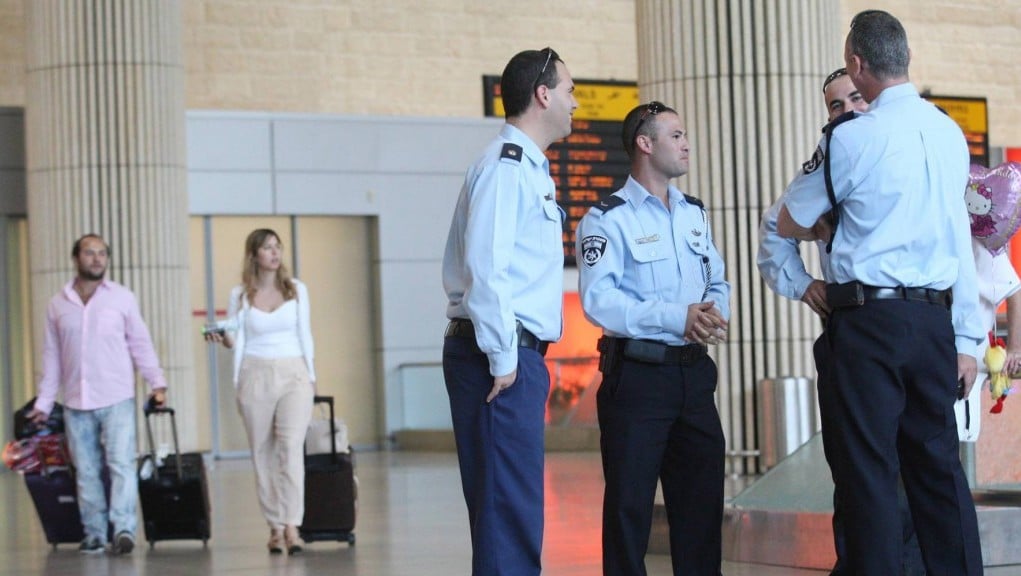
A Jewish American man who had a three-year Israel residency visa was recently refused entry to the country by immigration authorities on the recommendation of the police for being a “left-wing anarchist” and for “nationalistic crime activity.”
Despite the allegations made by the Population and Immigration Authority (PIBA) and the police, neither provided evidence when informing the individual, who spoke with The Times of Israel on condition of anonymity, that he would not be allowed to re-enter the country.
PIBA, a department of the Interior Ministry, also did not state how it defines “anarchist” or “nationalistic crime activity” for the purposes of evaluating entry rights into Israel.
In response to a request for comment by The Times of Israel on the ban, PIBA claimed that his activities “are likely to interfere with the security services, and the purpose of his stay is incommensurate with the visa he has,” without providing any evidence.
The agency refused to say on what basis it found him to be “an anarchist; to delineate what its definition of “anarchist” is; to cite sources for its claim that he has called for the destruction of Israel; to state what “nationalistic crime activities” he had committed; or to state what “anarchist activities” he had participated in.
Get The Times of Israel’s Daily Edition
by email and never miss our top stories
By signing up, you agree to the terms
The decision to refuse him re-entry into Israel is the latest in a series of such incidents and appears to be part of a coordinated effort between the police and PIBA to bar civil rights activists who support Palestinian civilians in the West Bank from conducting peaceful activities in the territory.
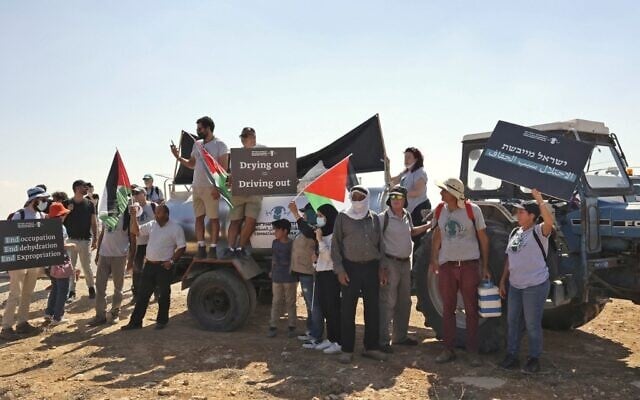
Israelis and Palestinian activists demonstrate over water supplies in the southern area of the West Bank town of Hebron, on September 17, 2021. (HAZEM BADER / AFP)
The man has never been indicted for, or convicted of, “nationalistic crime activity.”
He has appealed PIBA’s refusal to allow him entry to Israel. “My unexceptional case serves only to index a broader entrenchment of fascistic rule, wherein mechanisms of silence are invoked to obscure ongoing violence,” he said. “Colonial order rests on security from potentiality. I join a broad cohort of those preemptively banished for threatening a social order upheld through violence.”
National Security Minister Itamar Ben Gvir, who has authority over the police, said in October last year that the police and PIBA have cooperated in having such activists expelled from Israel.
Later that same month, during the olive harvest season, the police stated that its operations halting the actions of civil rights activists in the West Bank and “preventing harm to the image of the State of Israel around the world,” have been conducted “in accordance with the policies” of Ben Gvir.
According to PIBA, the man was added to a list of foreign nationals banned from entry into Israel in September 2025 on the recommendation of the West Bank district police.
His attorney notes that at least one other activist was added to the list at the same time. PIBA has broad discretion over who may enter Israel, with few clear criteria, although it cannot make arbitrary or discriminatory decisions.
The Law for Entry into Israel, amended in 2025, does, however, stipulate that foreign nationals can denied entry into Israel if they publicly call for a boycott of Israel; deny the Holocaust; deny the October 7, 2023 massacres; or publicly support putting Israeli citizens on trial in foreign courts for war crimes.
The man, who is fiercely critical of Israel’s treatment of the Palestinians, first came to Israel as a visiting research fellow at Hebrew University in 2021 on a tourist visa, and went back and forth to the US for several years.
In January 2025, he took up a visiting researcher position at Tel Aviv University’s Department of Sociology and Anthropology on a student visa, and in June 2025 he obtained an A1 temporary residence visa, which are available to those who are eligible to make aliyah to Israel under the right of return, but have not yet decided to become an Israeli citizen.
The scholar moved to live in the South Hebron Hills region of the West Bank in February 2024 to conduct doctoral research on the relationship between Israeli settlers and the state, and lived in several Palestinian villages in the region.
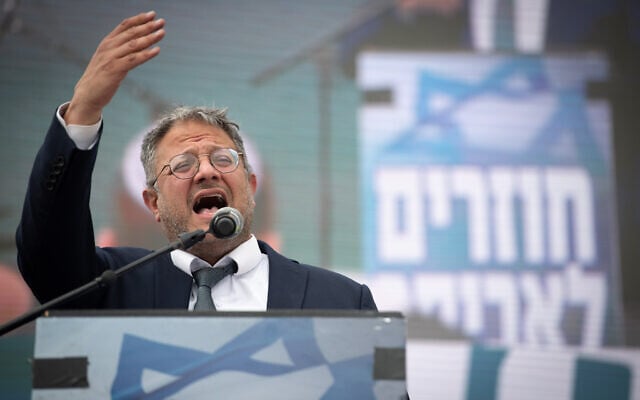
National Security Minister Itamar Ben Gvir takes part in a march to the Evyatar outpost, near the West Bank city of Nablus, during the Passover holiday, on April 10, 2023. (Sraya Diamant/Flash90)
During his time in the region, he participated in “protective presence” activity with Palestinian and Jewish activists, where participants accompany rural Palestinian residents in their agricultural work to document settler violence.
In November 2025, he returned to his native city of Chicago for a visit, but when he came back to Israel on December 2, he was taken aside at Ben Gurion Airport and questioned by a PIBA official about his activities.
The PIBA documentation of the questioning states that he was included on an entry refusal list since he was “an anarchist who calls for the destruction of the State of Israel.”
The document adds that he was put on the entry refusal list on September 11, 2025, on the recommendation of the intelligence unit of the West Bank district police. The police had requested he be put on the list “for nationalist crime activities,” PIBA said.
PIBA did not show any evidence to the man during his questioning at Ben Gurion Airport of either the accusation that he had called for the destruction of the State of Israel or conducted “nationalist crime activities.”
Similarly, PIBA refused to provide evidence of such accusations to The Times of Israel, and the man categorically denies the allegations.
PIBA did note an incident in March 2024, when the man was detained by IDF soldiers from a West Bank territorial defense unit, which mostly consists of mobilized residents of the settlements.
He was detained outside the Susyia military base in the South Hebron Hills after he volunteered to pick up an elderly Palestinian man, who had been detained and taken to the base, and subsequently released.
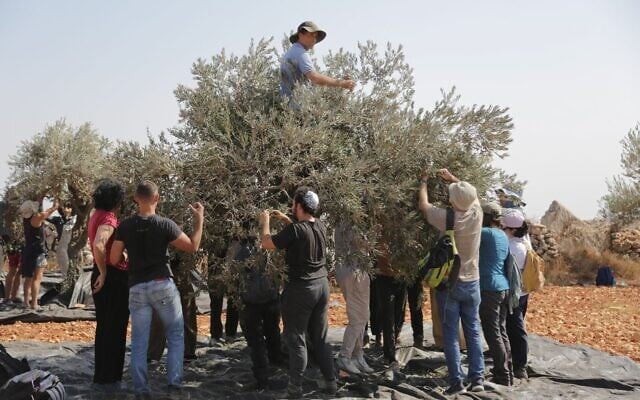
Activists with Rabbis for Human Rights help Palestinian olive growers harvest their olives in the West Bank, October 2025. (Courtesy Rabbis for Human Rights)
The researcher was detained for allegedly filming the base, although he denies he did so. He was taken to the nearby Kiryat Arba police station, where he was not questioned on suspicion of “filming a military base,” but rather for “disturbing the public order.”
After being held for 12 hours in the police station, he was released without charge.
His case is the latest in several similar incidents, in which foreign activists supporting Palestinian civil rights, including Jews, have been deported and banned from Israel.
On October 16 last year, 32 foreign, pro-Palestinian activists were deported from Israel after trying to help Palestinian olive growers harvest their crop in the northern West Bank.
The activists were associated with the Union of Agricultural Work Committees (UAWC) organization, which was banned by Israel in 2021 for its ties to the Popular Front for the Liberation of Palestine (PFLP) terrorist organization.
In a joint statement together with the IDF, the police said that Ben Gvir and acting interior minister Yariv Levin “gave instructions to deport the 32 anarchists.”
The police statement added that “An expedited deportation process of all the activists from Israel has started, in coordination with the Population and Immigration Authority of the Interior Ministry.”
In comments attributed to Ben Gvir in the statement, the minister praised both the West Bank district police for having arrested the activists and “our partners in the Population [and Immigration] Authority for their decisive and professional work that led to the expulsion of dozens of anarchist activists who identified with a terror organization.”
On October 29, 11 activists volunteering to help harvest olives for Palestinian olive growers were detained in the same region of the West Bank, and two of them, both Jewish American women, were also deported by PIBA.
The police said at the time that the West Bank district police was “working determinedly, in accordance with the policies of National Security Minister Itamar Ben Gvir” and on the instructions of the police commissioner “to locate, and stop foreign agents involved in incitement and provocations” which the police said “harm the image of the State of Israel around the world.”
The Knesset Aliyah, Absorption, and Diaspora Committee has held two hearings on the issue, although Ben Gvir unlawfully barred police officials from attending after they were summoned by committee chair MK Gilad Kariv to answer questions about arrest policies in the West Bank.
Following complaints filed by Kariv to the Knesset legal adviser and the attorney general, Ben Gvir lifted the ban.