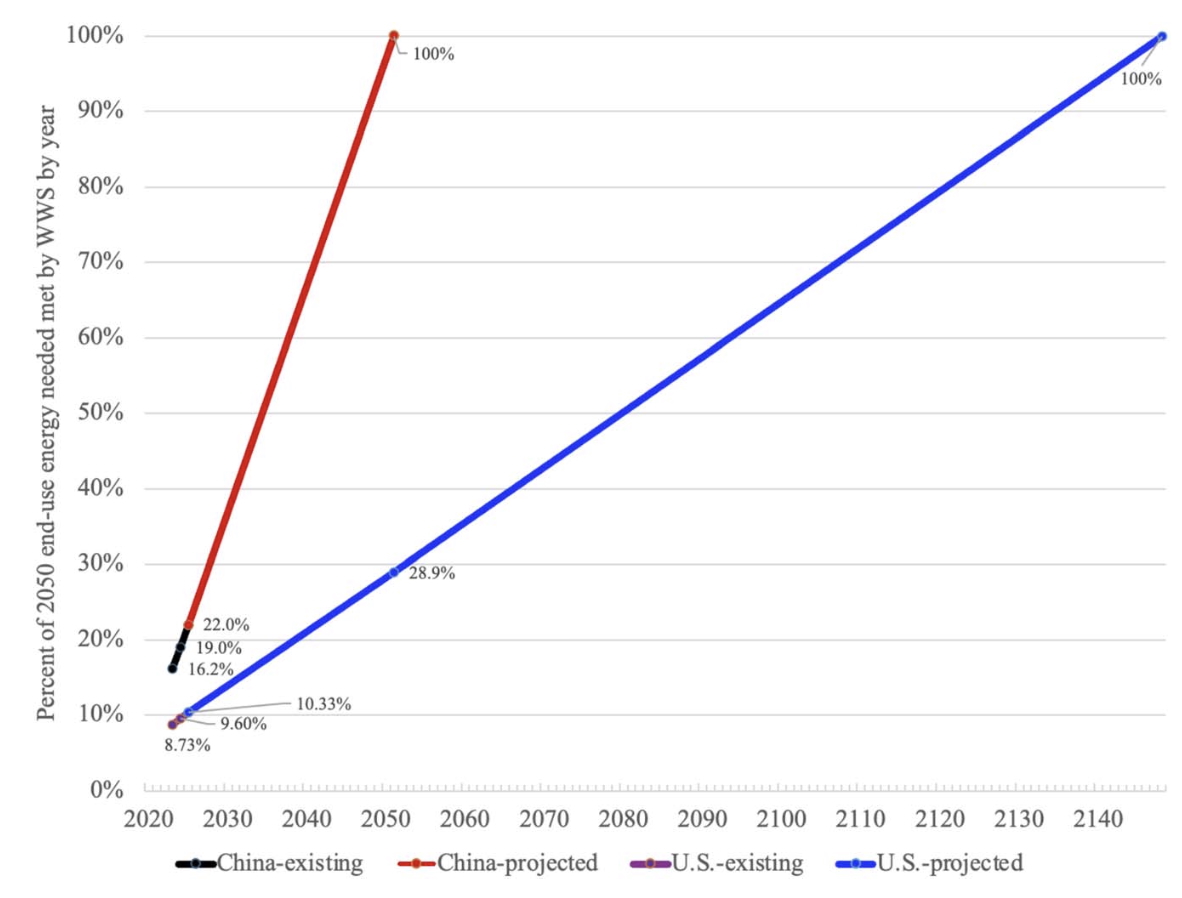
China is outpacing the U.S. toward 100% renewables for all energy uses and is on track to reach that standard by 2051, versus 2148 for the U.S., projects a study of 150 countries by Stanford professor Mark Jacobson.
January 9, 2026
William Driscoll
The U.S. could nearly eliminate its carbon emissions and air pollution by 2148 if it maintained a pace of adding 43 GW of renewables per year, set during the first seven months of 2025, and achieved “near-electrification” of each energy-using sector.
That finding and results for 149 other countries are presented in a paper by Stanford University Professor Mark Jacobson, published in the journal RSC Sustainability.
The “most substantial and encouraging finding,” the paper says, is the “rate by which China is transitioning its energy economy.”
China, which added renewable generating capacity at an annual pace of 397 GW during the first ten months of 2025, could at that pace eliminate carbon emissions and air pollution by 2051 with near-electrification of all energy sectors.
Whether China will electrify transportation, buildings and industry by 2051 is “an uncertainty” but “some recent data appear encouraging,” the paper says, noting that more than half of the vehicles sold in China in 2024 were battery-electric vehicles, and that China is “already the world’s largest market” for electric heat pumps and “has the manufacturing base to ramp that up.”
Given that the U.S. and China have comparable land sizes and the U.S. economy is larger than China’s, the paper says that China’s progress “suggests that the main barriers” to the U.S. achieving a renewables buildout as large as China’s “are social and political, not technical or economic.”
China is installing renewable generation at a rate “almost two orders of magnitude the rate it is installing new nuclear,” and “is also not distracted much by carbon capture, direct air capture, blue hydrogen, biofuels, or biomass.”
Canada, although it is already producing 16% of the renewably-generated electricity it needs to reach 100% renewables across all energy sectors, would reach a 100% standard “beyond the year 2350,” based on the “slow rate” at which it has recently increased renewable generation.
A “potential benefit” of the study, the paper says, is to provide countries with “a realistic sense of their progress” so they may then determine “if faster progress is necessary.”
The examples set by China and several other countries of the 150 countries analyzed “suggest that the world as a whole can succeed in a rapid transition if all countries make a strong social and political commitment to a transition and focus, like a laser, on clean, renewable energy.”
The paper is titled “Projections of when each of 150 countries may eliminate air pollution and carbon emissions from all energy.”
This content is protected by copyright and may not be reused. If you want to cooperate with us and would like to reuse some of our content, please contact: editors@pv-magazine.com.
Popular content