
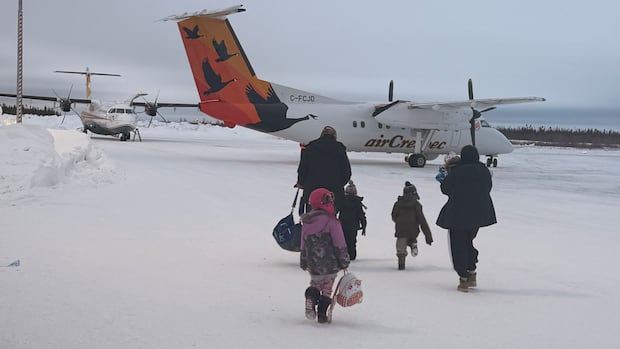
As Kaschechwan First Nation navigates a water crisis, families are having to get by with one case of water bottles per day.
“The problem is some houses have a lot of kids and some houses of like three families in one house and one water bottle case per day,” said Keisha Paulmartin, a 15-year-old from Kaschechwan.
“Sometimes it isn’t enough for each household.”
On Sunday, Jan. 4, Kashechewan First Nation Chief Hosea Wesley declared a state of local emergency because the community’s water treatment and wastewater plants were in a state of disrepair.
In early December, pumps at the water treatment plant failed, which meant chemicals could not be mixed in to treat drinking water. Then, the wastewater treatment plant’s raw sewage intake started failing as well.
“It’s expected for us to use those water bottles for our daily needs,” said Paulmartin. “It just sucks.”
 Sinclair Williams has lived in Kashechewan First Nation for most of his life. (Sinclair Williams/Facebook)
Sinclair Williams also lives in Kashechewan and said the situation is unacceptable.
“These are things that nobody should go through,” he said. “A lot of simple things that any average Canadian takes for granted. Fluid, water, the basic things that every other person uses.”
On Jan. 7 around 35 of the community’s most vulnerable residents were evacuated to Timmins, Ont.
The next day, five more flights were chartered to Kapuskasing, Ont., which will be able to host more than 200 evacuees.
Kashechewan’s leaders are working with the federal and provincial governments for a full evacuation of the First Nation’s 2,300 residents.
There are no permanent roads to Kashechewan, which is located along the James Bay coast. The only way to evacuate people is by air.
More flights weren’t possible on Friday, due to poor weather conditions, but a spokesperson with Indigenous Services Canada told CBC News it’s continuing to co-ordinate a full evacuation.
Regular evacuations
Evacuations have become a way of life for Paulmartin and others in the community.
Because Kaschewan is located in a flood plain, along the Albany River, it floods every spring.
Paulmartin said some of her earliest childhood memories involve evacuations to cities like Thunder Bay and Kapuskasing.
“It’s just another Christmas, another Halloween,” she said. “I guess it’s become pretty normal to us all.”
But even that normalcy can be disruptive.
 Petersen Spence has lived in Timmins for three years but is a member of Kashechewan’s Youth Leadership Group. (Submitted by Petersen Spence)
Petersen Spence grew up in Kaschechwan but moved with his family to Timmins three years ago, when he was 14.
He also remembers leaving his community every spring, and the impact it had on his life.
“I would stay in a hotel for like a good month or so, which is eating the same food, not going anywhere, no entertainment,” he said.
For school, he would receive work packages that he had to complete without any support from teachers or his parents, who were under stress from the evacuation.
Spence said he had to teach himself how to learn when he moved to Timmins and was enrolled in a regular high school.
Like Paulmartin, he’s a member of Kashechewan’s Youth Leadership Group and has been invited to regular meetings about the ongoing water crisis.
In a recent meeting, he said chief and council confirmed the plan is to fly most families to Niagara Falls, Ont., and those with special needs to Kingston. Ont., where they would have access to kitchenettes.
While evacuations are a regular occurrence for people from Kashechewan, Paulmartin said this time feels different.
“This time we actually have like no idea how long it could actually last due to this being such a different problem,” she said.
Feather Metatawabin grew up in Kashechewan but now lives in Timmins. She still has friends and family in the community, and said they are anxious around that uncertainty.
Metatawabin said one of her friends has five kids, including a child with special needs.
During the last evacuation, due to spring flooding, her friend’s family lived in a hotel room with only two beds.
“They were stuck like that for two weeks,” she said. “And she was just telling me that she’s scared to go through that again.”
Indigenous Services Canada confirmed to CBC that workers with a company called Northern Waterworks were deployed to the community to repair the water treatment plant.
The company was able to replace a pump in the lift station and was bringing in additional equipment to complete the repairs.
Indigenous Services Canada hasn’t been able to say when repairs might be completed.