
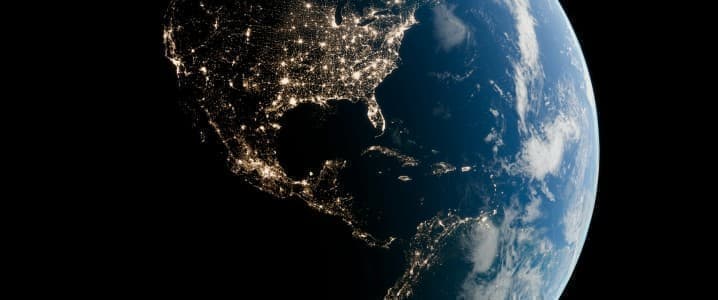
Global economies are increasingly splitting into two opposing camps when it comes to energy policy. While many nations are moving toward electrification and installing record-breaking amounts of clean energy capacity, other nations – most notably the United States, the world’s biggest economy – are installing more fossil fuels than ever before. Put simply, the future of the global energy balance now depends on the results of a high-stakes battle between petro-states and electro-states.
The emergence of artificial intelligence is only raising the stakes. The runaway energy demand of the tech sector is pushing nations around the globe to reconsider their energy plans and priorities, as energy security becomes an increasingly urgent concern. “With AI emerging as the central arena for great power completion, which model will work best at providing the power the new technologies need?” asked a recent op-ed for Wood Mackenzie.
This global divide was stark at last year’s United Nations COP30 climate change conference in Belém, Brazil. While more than 80 nations at the conference supported the suggested creation of a formal road map toward weaning the global economy off of fossil fuels, an opposition group of petrostates, including a large contingency of Middle Eastern nations, pushed back against the idea. The United States, for its part, didn’t even send high-level representation to the landmark event.
But that doesn’t mean that the United States is silent on the direction that energy policy should take on the global stage going forward. Indeed, the Trump administration has been kicking in its tactical efforts to strong-arm other nations into pivoting away from clean energy planning and back toward fossil fuel development.
Set OilPrice.com as a preferred source in Google here.
For many nations, the idea of sticking to a fossil-fuel-powered agenda is a tempting one. Many countries rely on coal, oil, and gas for a significant portion of their revenues, and a clean energy agenda presents a bumpy road for economic development in the short term. For nations that rely on fossil fuel industries for the majority of their revenue and as a jobs-producer for their public, designing a ‘just transition’ is a tall and expensive order, and it’s not clear where that funding will come from.
However, many of those same nations stand to suffer the most from a changing climate. Nigeria, for example, derives between 80 percent and 90 percent of total government revenue and foreign exchange earnings from oil exports. But Africa also stands to lose the most from rising temperatures, and has enormous potential for clean energy buildout thanks to abundant sunshine, among other natural resource riches.
And, on a global level, it’s increasingly apparent that renewables are simply too cheap to fail. “Over the past three decades, advances in technology and a maturing development ecosystem have made renewable energy projects more economical, less risky, and increasingly rewarding for landowners,” reads a recent Yale Insights article. This is particularly true in many developing economies, such as Pakistan, where residential solar offers a critical opportunity for affordable and reliable electricity in rural and off-grid areas.
“Yet,” hedges Yale Insights, “as the [renewable energy] industry has grown more mainstream, it has also become more politicized, adding new challenges to an otherwise thriving sector.” In many cases, it’s difficult to tell where economic realities end and political battle of the wills begins.
“The global energy order is entering a period of profound realignment,” states a 2025 article from The National Interest. “Three fossil-fuel giants (or PetroStates)—the United States, Saudi Arabia, and Russia—are consolidating influence, even as China, the emerging ElectroState, pursues a divergent technological trajectory more aligned with Europe’s green ambitions. The result may be a volatile, asymmetric contest for energy dominance, pitting hydrocarbons against electrons and defining the energy and geopolitical landscape of the next decade.”
By Haley Zaremba for Oilprice.com
More Top Reads From Oilprice.com