
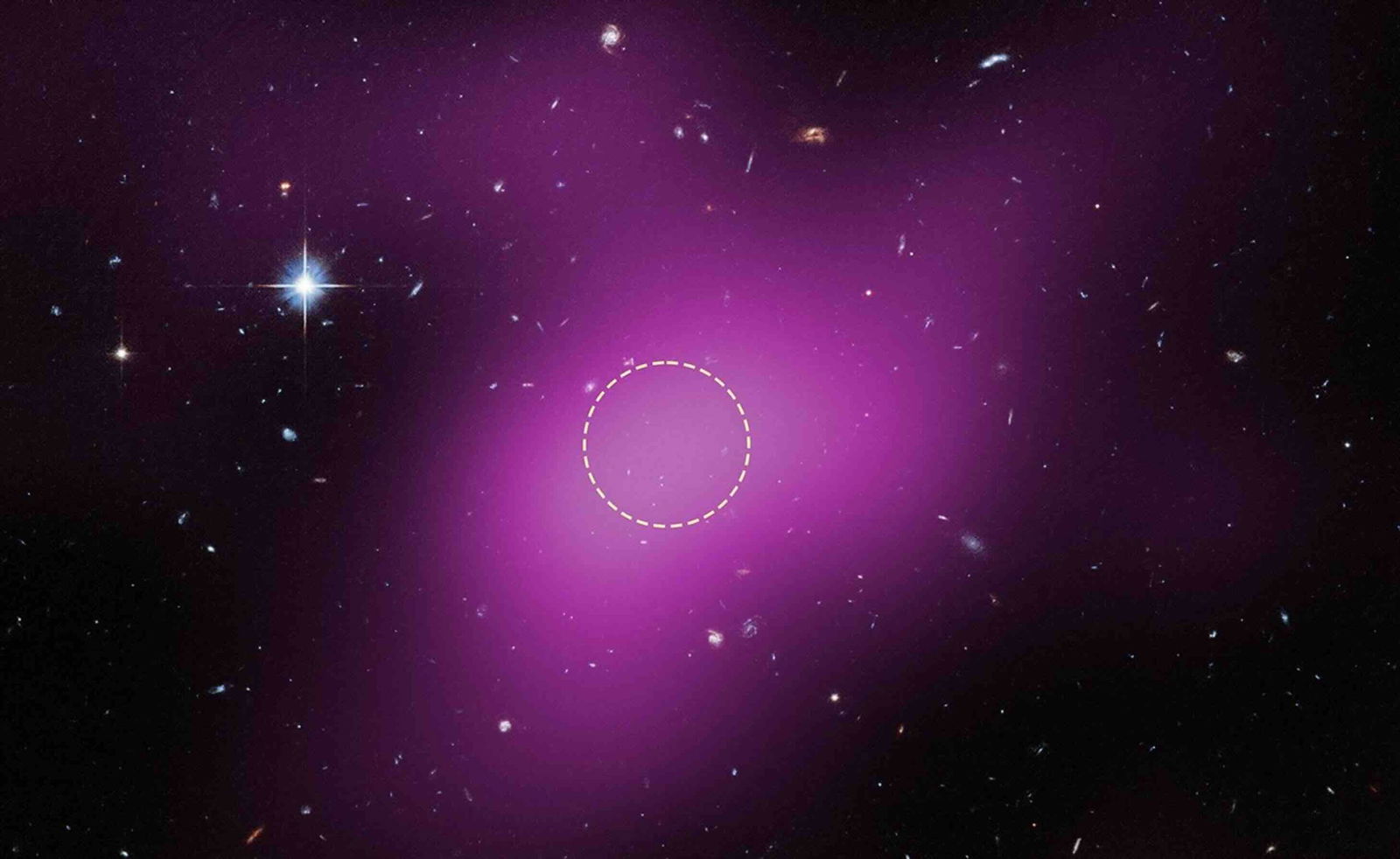
NASA’s Hubble Space Telescope has spotted an astronomical object unlike any previously observed, revealing an unusual remnant of the cosmic past.
The object, which astronomers say is a dark matter cloud void of any stars, but billowing with cosmic gases, has been dubbed “Cloud-9” and represents the first confirmed detection of such an unusual object.
The object’s unique appearance offers astronomers a unique look at the evolution of galaxies early in their formation process and could provide new insights into the mysterious nature of nonluminous dark matter.
“A Tale of a Failed Galaxy”
The absence of stars within Cloud-9 served as a key observation, according to principal investigator Alejandro Benitez-Llambay of the Milano-Bicocca University in Milan, Italy.
“In science, we usually learn more from the failures than from the successes,” Benitez-Llambay said in a statement. “In this case, seeing no stars is what proves the theory right.”
Characterizing Cloud-9 as the cosmic remnant that conveys “a tale of a failed galaxy,” Benitez-Llambay said the discovery offers astronomers a rare glimpse of “a primordial building block of a galaxy that hasn’t formed.”
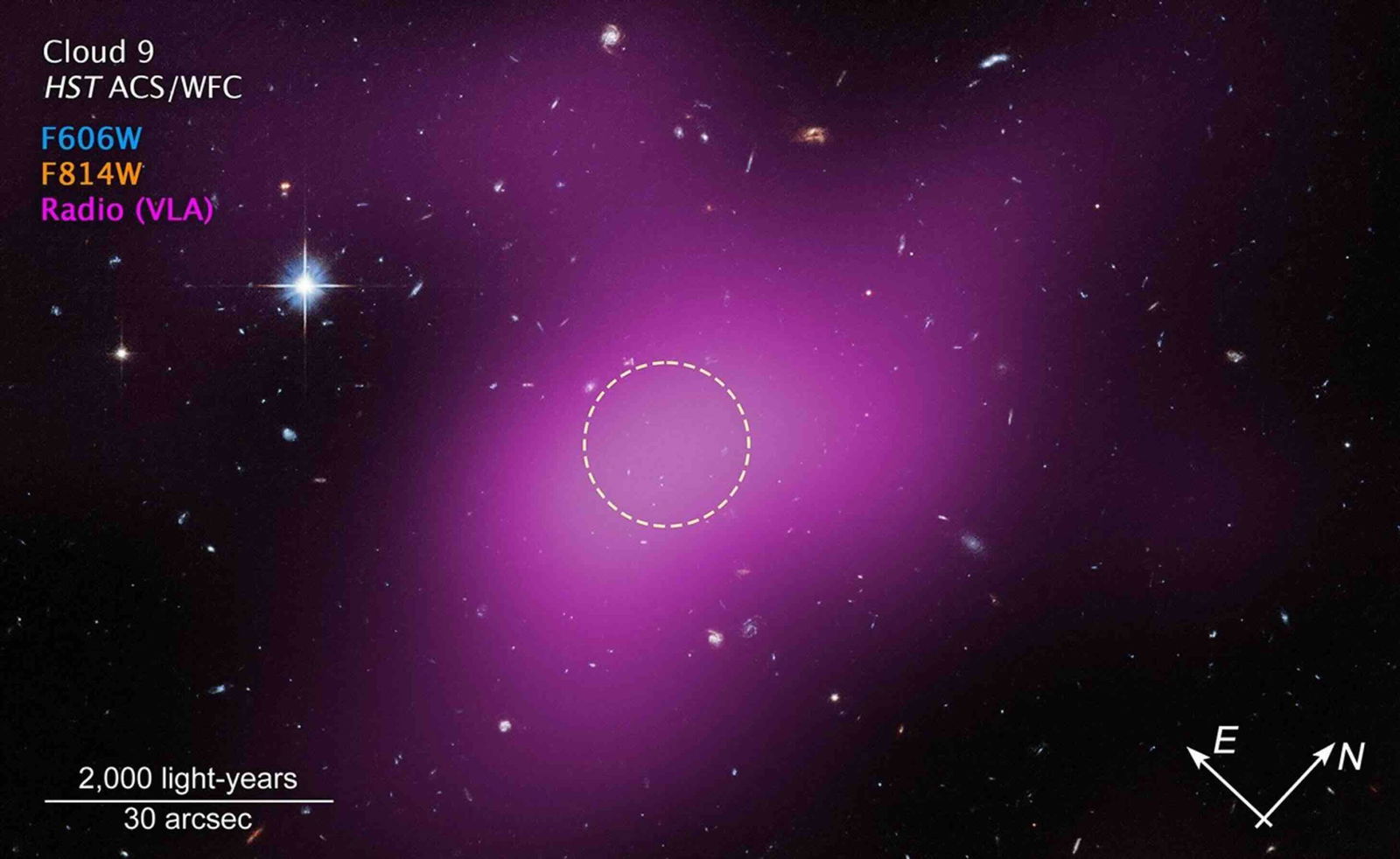 Above: An annotated “compass” view of Cloud-9, which astronomers categorize as a Reionization-Limited H I Cloud (RELHIC), as captured by the Hubble Space Telescope’s ACS (Advanced Camera for Surveys) and the ground-based Very Large Array (VLA) radio telescope (Image Credit: Science: NASA, ESA, VLA, Gagandeep Anand (STScI), Alejandro Benitez-Llambay (University of Milano-Bicocca); Image Processing: Joseph DePasquale (STScI)).
A Cosmic “RELHIC”
Cloud-9 represents a new class of objects known as Reionization-Limited H I Clouds (RELHICs), where “H I” represents neutral hydrogen. Combined, the term was devised by astronomers to convey the presence of a hydrogen cloud that formed early in the universe, and which had not yet produced any stars.
Like cosmic phantoms, these kinds of objects were long hypothesized, but had never been directly observed until now. Before the recent Hubble observations, astronomers may have mistaken Cloud-9 for a faint dwarf galaxy invisible to telescopes on Earth, as they lack the sensitivity required to detect any stars that might have been lurking in its gaseous body.
“With Hubble’s Advanced Camera for Surveys, we’re able to nail down that there’s nothing there,” said Gagandeep Anand of STScI, the lead author of a new study detailing the discovery.
A Window to the Dark Side
“We know from theory that most of the mass in the universe is expected to be dark matter, but it’s difficult to detect this dark material because it doesn’t emit light,” according to Andrew Fox, a member of the discovery team with the European Space Agency’s Association of Universities for Research in Astronomy/Space Telescope Science Institute (AURA/STScI).
Comparing the cosmic relic to “a window into the dark universe,” Fox said that Cloud-9 has offered he and his international colleagues behind the discovery “a rare look at a dark-matter-dominated cloud.”
A New Theory Emerges
According to current theories, RELHICs may represent clouds composed of dark matter that have failed to accumulate the amount of gas required to form stars. Based on its presence alone, astronomers now hypothesize that Cloud-9 may be the first detection of a variety of small, dark matter-rich failed galaxies that are likely found throughout the universe.
These unique structures have likely evaded detection in the past because traditional observation methods make them very difficult to spot, as they are void of bright objects like stars.
Another unique feature about Cloud-9 is that the clouds it possesses are smaller and more uniform when compared to hydrogen cloud formations observed closer to the Milky Way. Cloud-9 is also closer to possessing a perfect spherical shape, which also contributes to its unique appearance.
With a neutral hydrogen core approximately 4,900 light-years in diameter, based on radio signals emanating from the object. This leads astronomers to conclude that Cloud-9 has a mass roughly one million times greater than that of our Sun. If this estimate is correct, that would mean that the dark matter the object possesses would be equivalent to five billion solar masses.

RELHICS in the Dark
Failed galaxies like Cloud-9 are unique, as they represent structures that are quite unlike most astronomers observe in our universe. Their study lends themselves to the study of dark matter, as well as the mysteries surrounding unusual region that are void of stars—a characteristic that makes them difficult to observe due to the presence of more luminous objects nearby.
Although Cloud-9’s discovery first occurred three years ago during the radio survey of the Five-hundred-meter Aperture Spherical Telescope (FAST) in Guizhou, China, the discovery was later confirmed by observations made by the Green Bank Telescope and the Very Large Array facilities in the United States.
Still, Hubble’s keen eye, made possible from its position in space, was required to conclusively rule out the presence of any stars that would have been too faint for even the most powerful telescops on Earth to detect.
Cloud-9’s confirmation marks an astronomical first, and although such objects had been hypothesized to exist, the discovery was still surprising, according to team member Rachael Beaton of STScI, who compared the unique celestial object to an empty cosmic home, of sorts.
“Among our galactic neighbors, there might be a few abandoned houses out there,” Beaton said.
The discovery, revealed in a new paper that appeared in The Astrophysical Journal Letters, was unveiled this at the 247th meeting of the American Astronomical Society in Phoenix, Arizona.
Micah Hanks is the Editor-in-Chief and Co-Founder of The Debrief. A longtime reporter on science, defense, and technology with a focus on space and astronomy, he can be reached at micah@thedebrief.org. Follow him on X @MicahHanks, and at micahhanks.com.