
SMART LIVING:
The government’s 10-year AI development initiative aims to build an AI innovation system and create circles that integrate AI across all aspects of life, Lai said
The government has set a goal of cultivating 500,000 artificial intelligence (AI) professionals by 2040 and plans to inject NT$100 billion (US$3.17 billion) into a venture capital fund to achieve it, President William Lai (賴清德) said yesterday at an AI talent forum in Taipei.
“AI changing the world is no longer a future prospect — it is happening right now,” so cultivating AI talent is extremely important, Lai said.
While many people still have doubts about AI, it has already quietly transformed production methods and lifestyles, he said.
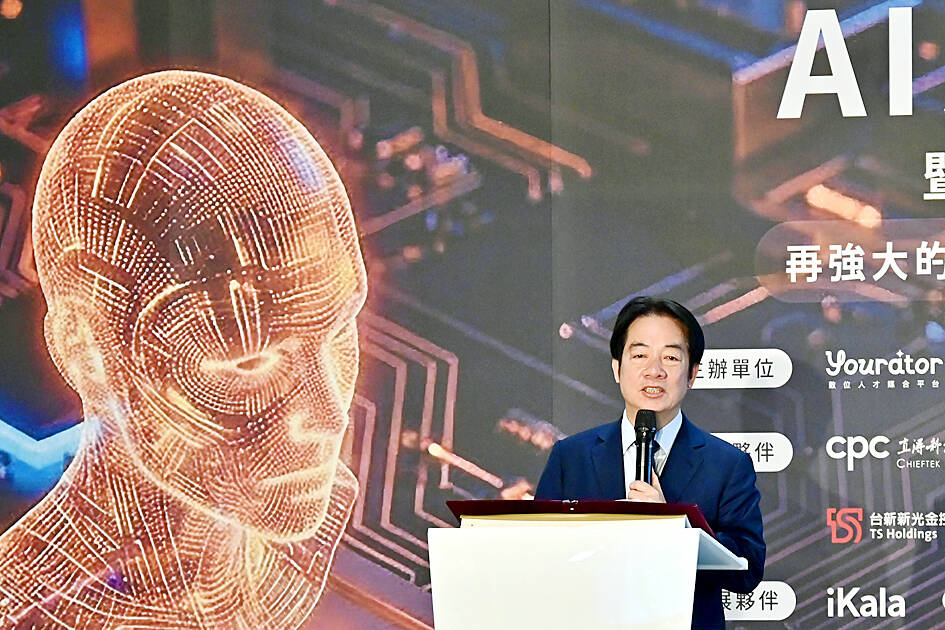
Photo: George Tsorng, Taipei Times
AI is bringing an industrial revolution, meaning a complete overhaul of talent development and ways of living, he said.
“Taiwan is indeed fortunate. Through the efforts of several generations, the technology industry has established a solid foundation and plays a key role in the global high-tech sector,” he said. “Looking back, Taiwan has progressed from mechanization and automation to digitalization. Now it is time to fully promote intelligence.”
“In the past, Taiwan’s hardware manufacturing laid a strong foundation and now the focus is on AI applications to ensure Taiwan maintains a competitive edge in the next generation,” Lai said.
The government’s promotion of AI does not mean it favors specific industries, nor does it mean everyone must learn to code, he said, adding that the goal is to cultivate a population capable of effectively utilizing AI.
The government unveiled its new 10-year AI development initiatives last year, Lai said.
The initiatives include the establishment of a national computing center and the development of critical technologies, such as silicon photonics, quantum computing and robotics, he said.
Its objective is to build an AI innovation and entrepreneurship ecosystem, help small and medium-sized enterprises upgrade and transform, and create intelligent living circles that integrate AI across all aspects of life — food, clothing, housing, transportation, education and entertainment, he added.
National competitiveness would increasingly depend not only on advanced chipmaking capabilities, but also on the ability of Taiwanese to use AI effectively, Lai said.
To this end, the government is rolling out AI training courses for the public sector, and encouraging civil servants and students to acquire AI skills, he added.
Through cooperation between government, industry and academia, Taiwan could use AI to achieve economic transformation, Lai said.
With a larger AI talent pool, the government aims to help small and medium-sized enterprises accelerate digital upgrades and boost their competitiveness, he added.