
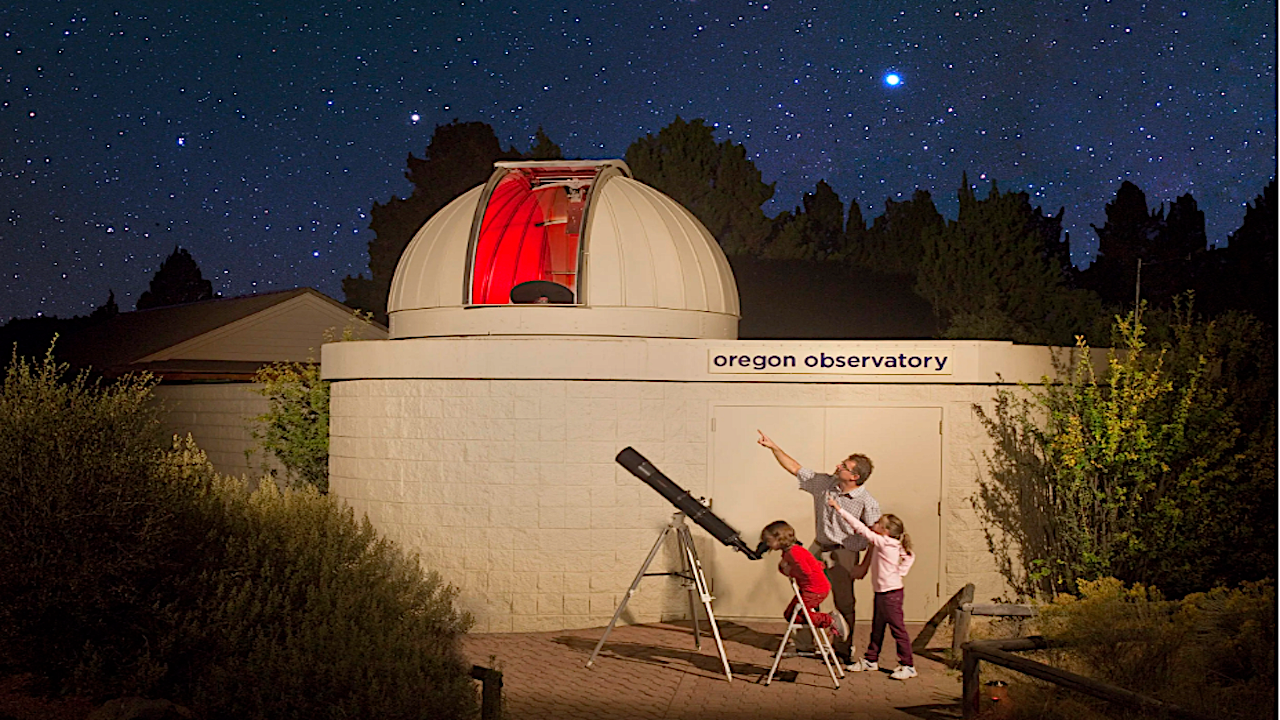
SUNRIVER, Oregon — Perfectly perched amid an expansive plateau of sagebrush, Ponderosa pines, and juniper trees in Central Oregon’s High Desert, the Sunriver Nature Center and Observatory offers exceptional vantage points to observe all the wonders of the heavens.
During a recent visit, I was invited to join Observatory Manager Paul Poncy and visiting guests for a grand tour of the facility, which claims to offer the largest collection of publicly-available telescopes in the United States and is designated by NASA as an International Dark Sky Place.
You may like
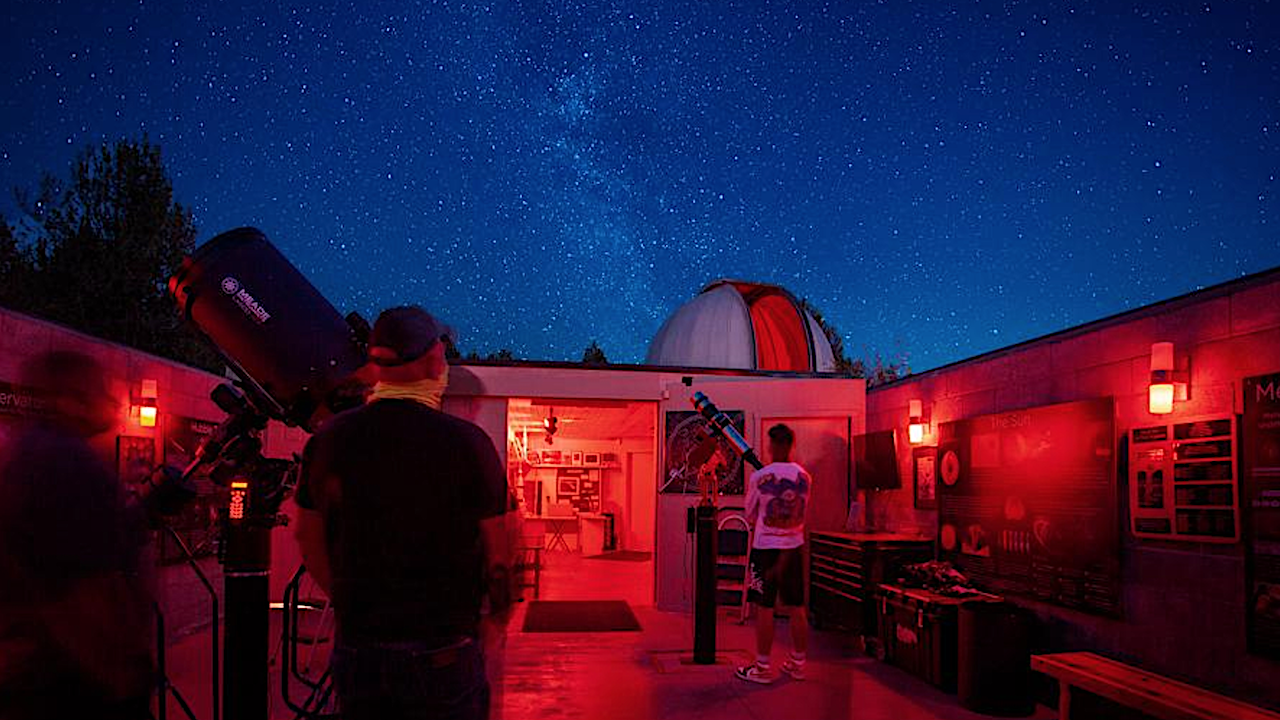
Stargazing in warmer months at the Sunriver Observatory. (Image credit: Sunriver Observatory)
Upon arrival, Paul Poncy greeted me at the crimson-lit check-in podium beside the parking lot where myself and a few dozen visitors were zipped up for the nippy December weather. Everyone was presented with a red-hued plastic glowstrip to attach to wrists or parkas or shoelaces to aid in nocturnal navigation and soon directed down a pathway past the closed Nature Center.
Staff specialist Bradley McLain delivered a pre-show talk inside a meeting room where nearly 50 people, some coughing and sneezing with mild winter colds, watched a slideshow explaining the basic nature and types of galaxies accompanied by some stunning galactic shots captured by the Hubble and James Webb Space Telescopes.
Following the 25-minute informative presentation, we all marched back outside guided by the collective glow of red bracelets and entered the main observatory with its central main telescope and two side-wing rooms with rollback roofs lit around the perimeter with red lamps. In each of the viewing areas exposed to the sky, a half-dozen large white telescopes had been set up beforehand, complete with stepladders to reach eyepieces already zeroed in on a planet or galaxy.
Constructed in 1991 by Larry Pratt, the Sunriver Observatory was helmed by local astronomy legend and NASA Solar System Ambassador Bob Grossfeld for more than three decades. Under Grossfeld’s careful direction this humble little observatory was eventually named the first International Dark Sky Place in Oregon in 2020.

A perfect December night for peering through telescopes! (Image credit: Jeff Spry)
Solar viewing is also an eye-opening daytime activity the center offers, and the staff recently upgraded their primary solar telescope in November by installing a new Lunt Calcium K module to observe different layers of the sun and solar activity on the surface in far greater detail by utilizing this filter.
“The main telescope in the original dome is a Ritchey-Chretien with a 20-inch aperture, and it’s a very flexible telescope,” Observatory Assistant Manager Alex Yeager told Space.com. “It can zoom out pretty well, even though it’s a very long focal-length telescope, so it can range from doing things like the Orion Nebula to doing Saturn.
“Tonight we were able to see a few different types of nebulas like a planetary nebula called the Ring Nebula, then we saw a supernova remnant called the Veil Nebula, the Witch’s Broom portion of it, and then we saw a star-forming region in the Orion Nebula. And the Geminids Meteor Shower was surprisingly large, and those are fun ones because they’re rocky and they burn up for a really long time.”
You may like
In the near-dark, bathed in red lamps like submariners during a torpedo attack, it’s a bit tricky finding the correct eyepiece in each of these intricate devices. More than a few newbie folks incorrectly stared into the spotting scope and were slightly confused why they couldn’t see anything, until one of the student volunteers wearing illuminated name tags corrected us. Yes, I admit it. I was one of those poor souls hopelessly gazing in the wrong spot!
The experience was heightened by the fact that it was a moonless night just 48 hours before an atmospheric river was to descend on Oregon for the next few days with its blanket of rain-bearing clouds which would have made stargazing extremely difficult as might be expected.
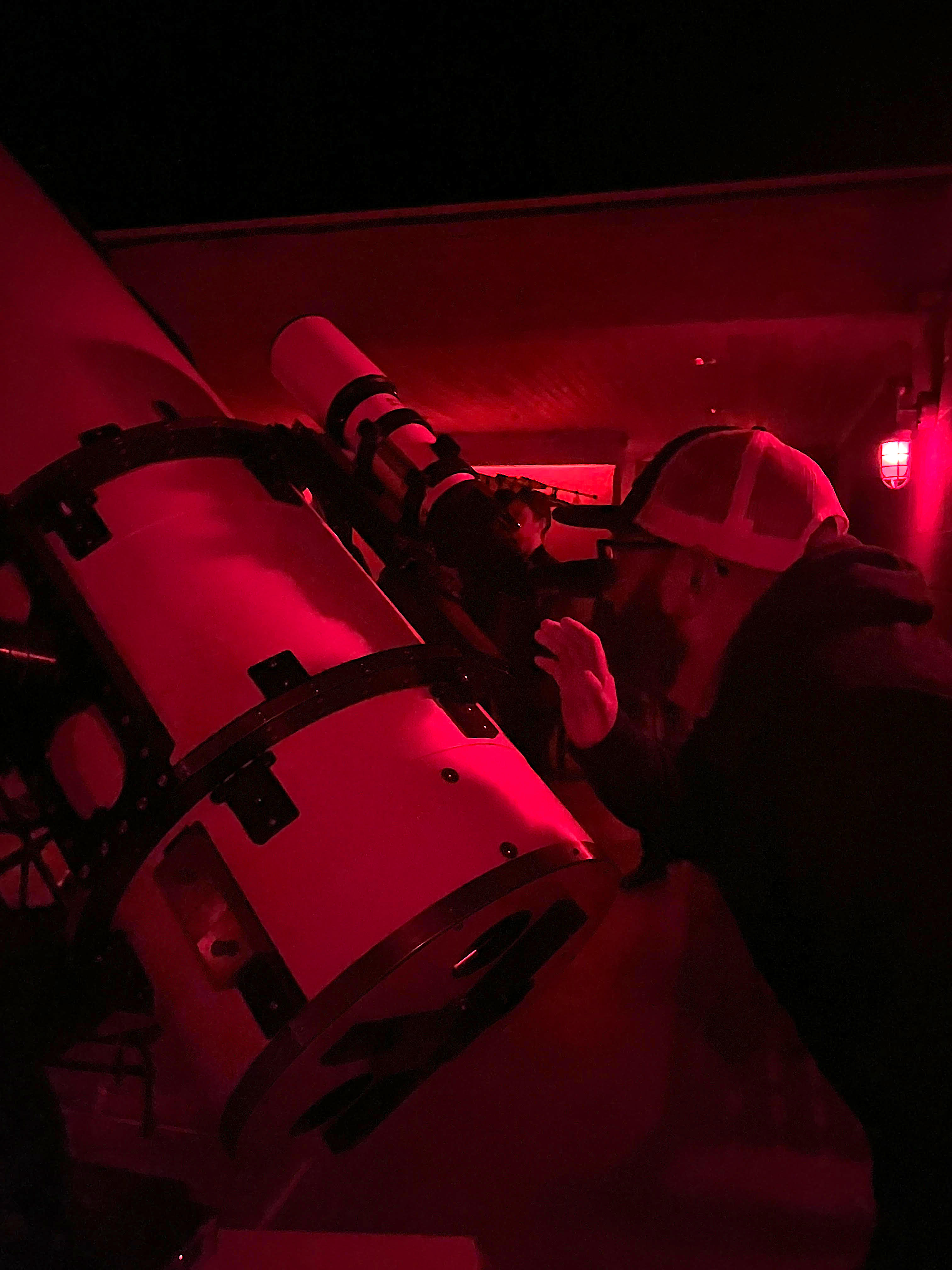
Oops, wrong eyepiece! It’s a common mistake for newcomers! (Image credit: Jeff Spry)
This was also the ideal night to explore the Sunriver Observatory and Nature Center, not just because of the ultra-dry December chill, but Dec. 14 was also the height of the Geminid Meteor Shower and our bundled-up group shuffling from one telescope to the next were treated to more than a dozen shooting stars streaking across the sky, especially during the laser-guided constellation tour hosted by Yeager out on the expansive patio under yawning, wide-open skies.
“Winter can be really nice because we still get clear skies in Central Oregon but a cold crisp night is when you get you best viewing,” he notes. “Planets are starting to rise right now high in the sky so we have a great view of Saturn, and Jupiter is now here at the end of our programs. We also get galaxies coming up like the Andromeda galaxy, the closest galaxy to us, and it’s huge. We’re just approaching to where we can get some of the other showcase galaxies. We’re on the cusp of two seasons so we did get an good example of each type of object.”
With the dreaded light pollution continuing to encroach upon all corners of the globe, the need to preserve dark skies becomes essential to maintain an elemental connection to our universe and our small but significant role in its complex cosmic beauty. As a dedicated student of this scientific field, it’s an issue Yeager remains passionate about.
“You can definitely tell when people come from a place where they can’t see stars,” he adds. “Because even on a night with a moon they’ll look up and be amazed at how many there are. I’ve heard so many times, ‘It’s like they’re in our lap!’ With Sunriver and their lighting practices, that actually started as a way to help out with nature and night pollinators. It was a nice benefit that ended up being good for astronomy. Then light pollution started getting higher and higher. People like looking at the night sky.
“It’s one of the big reasons to come to live and visit Bend. It’s hard to get it back once you lose it. We’re never going to turn Manhattan into a dark sky area. But as Bend and La Pine build up, it’s easier to shield lighting and try to preserve it as much as possible and still be able to see at night.”
As the program came to a close and temperatures continued to drop towards freezing, patrons lined up for one last look. Six-year-old Lucas Kincaid of Molalla, Oregon stood with his family to take a final peek in the hulking main telescope beneath the dome in anxious anticipation, snug in his furry hooded jacket like a hibernating bear cub about to meet the Wonderful Wizard of Oz.
“I saw something blue and also Saturn,” he exclaimed. “I’ve never seen a telescope this big!”
It was an exhilarating evening that was both educational and inspiring in this Season of Lights. If your future travel plans find you in Central Oregon at any time this holiday season or in the new year, a stimulating visit to the Sunriver Nature Center and Observatory is well worth the time. Reservations are required for the Sunriver Observatory’s 90-minute Winter In-Depth Program and more information on prices and year-round times can be found on their official website.