
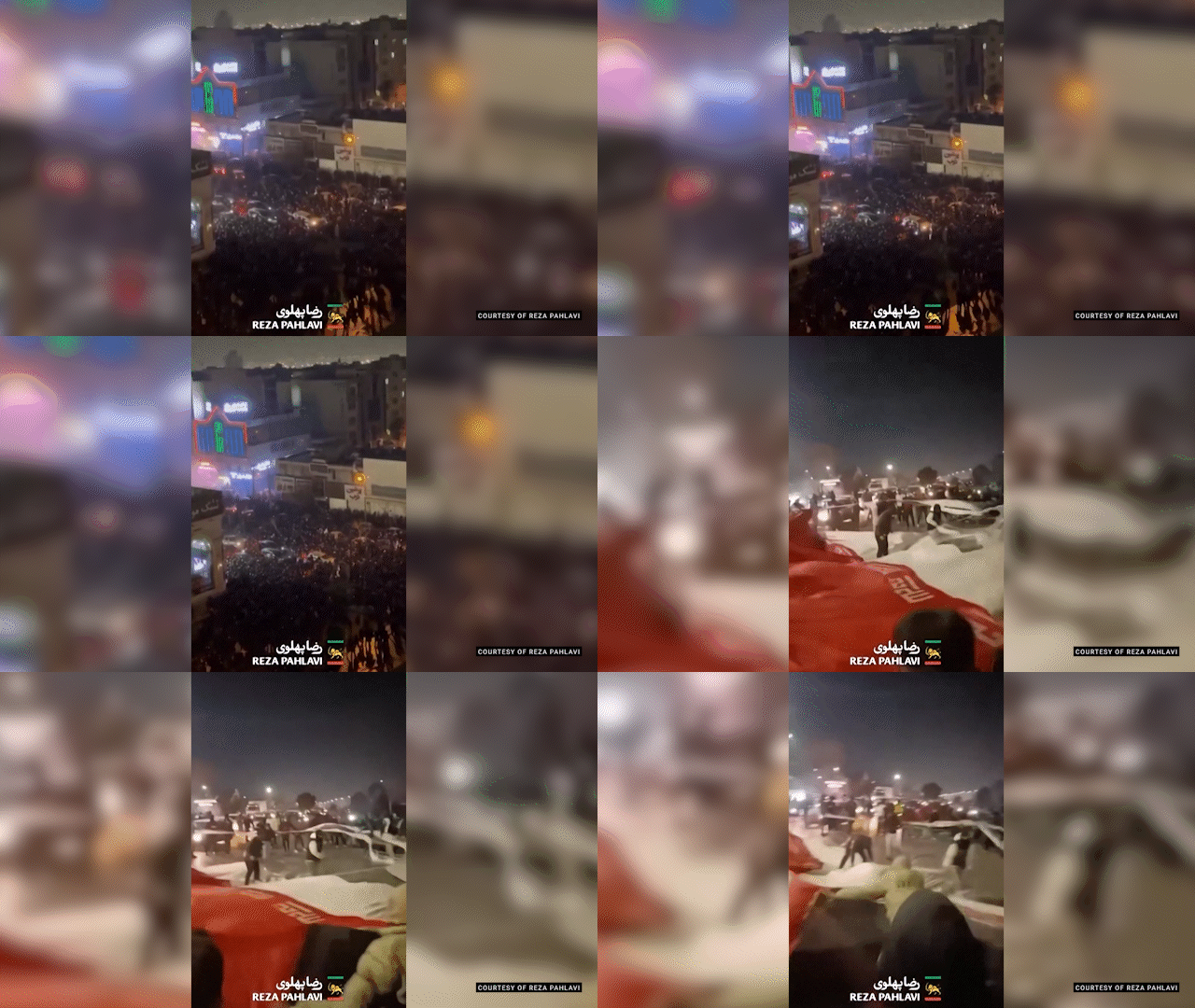
Iran’s internet blackout is entering its fourth day, with connectivity to the outside world still slumped at just one per cent, according to cybersecurity watchdog NetBlocks.
Usage plummeted on the evening of Thursday, the twelfth day of protests.
Tehran previously instigated an internet shutdown to stem discontent during the 2022 protests over the death of Mahsa Amini in custody.
Most information coming out of the country is being transmitted via Starlink satellite connections, according to Press Association reports.
Collapse of regime ‘would mean end of Hamas’
The US ambassador to Israel, Mike Huckabee, has said that if the Iranian regime fell, it would be “the end of Hamas, Hezbollah and Houthis”.
Posting on X, Huckabee wrote: “Should the Iranian people choose to end over 46 yrs of hateful & incompetent rule, it could restore the Persian culture of education, art, music, and strength and the end of Hamas, Hezbollah and Houthis.”
‘Almost 500’ protesters have been killed
A human rights group has said more than 500 people have now been killed in the protests. According to the latest data from US-based human rights agency HRANA, 490 protesters and 48 security personnel have been killed. Approximately 10,600 people have been arrested. The Times has been unable to independently verify these claims.
Iran’s police chief, Ahmad-Reza Radan, previously said that security forces had “escalated” confrontations with protesters.
Radan described those involved in the anti-government demonstrations as “rioters” and said that “significant arrests” had been made overnight. He did not give further details about the number of arrests. The Iranian government has not offered any overall casualty figures for the demonstrations.
Trump to be briefed on how US could respond
President Trump is scheduled to be briefed by senior officials in his administration on Tuesday on specific options to respond to the repression of protests in Iran, according to the Wall Street Journal.
The briefing about possible next steps will include potential military strikes, deploying secret cyber-weapons against Iranian military and civilian sites, imposing more sanctions on the regime and supporting anti-government voices online.
‘Our regime is not normal; it kills’
Turkey has prevented Iranian nationals from protesting outside the Iranian consulate in Istanbul, with the area cordoned off and crowds blocked by police.
Demonstrators gathered under steady rain in Istanbul, where Nina, a young Iranian exile, said she wanted to show solidarity as the protests shaking the Islamic Republic rumble into their third week.
“It’s been 72 hours since we had any news from the country, from our families. No internet or television, we can’t reach Iran anymore,” she said, the Iranian flag and red tears painted across her face.
“The regime kills at random — whether families are on foot or in a car, whether there are children. It spares no one,” she added.
Amir Hossein, a singer from Tehran who has been exiled in Turkey for 20 years, called on the international community to intervene, adding: “Our regime is not normal; it kills.”
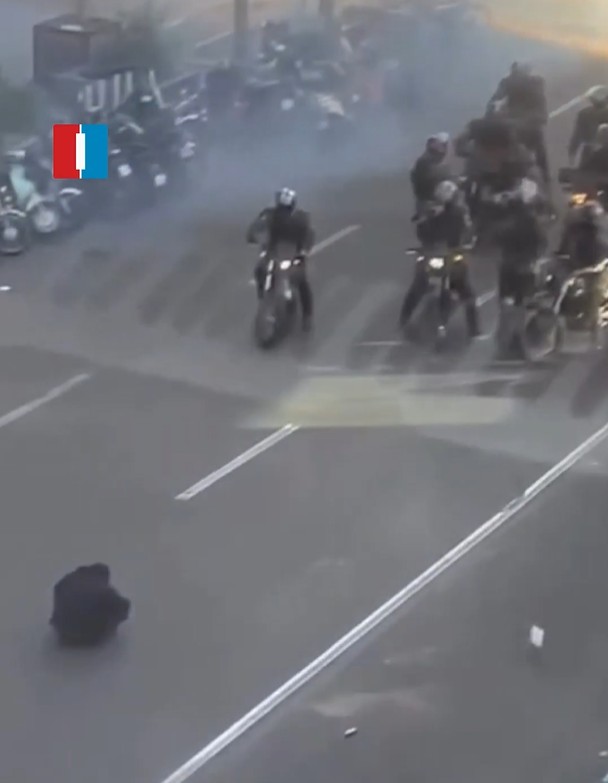
A protester sitting in the road in Tehran faces off against security forces on motorbikes
IRAN INTERNATIONAL
Analysis: regime will fight back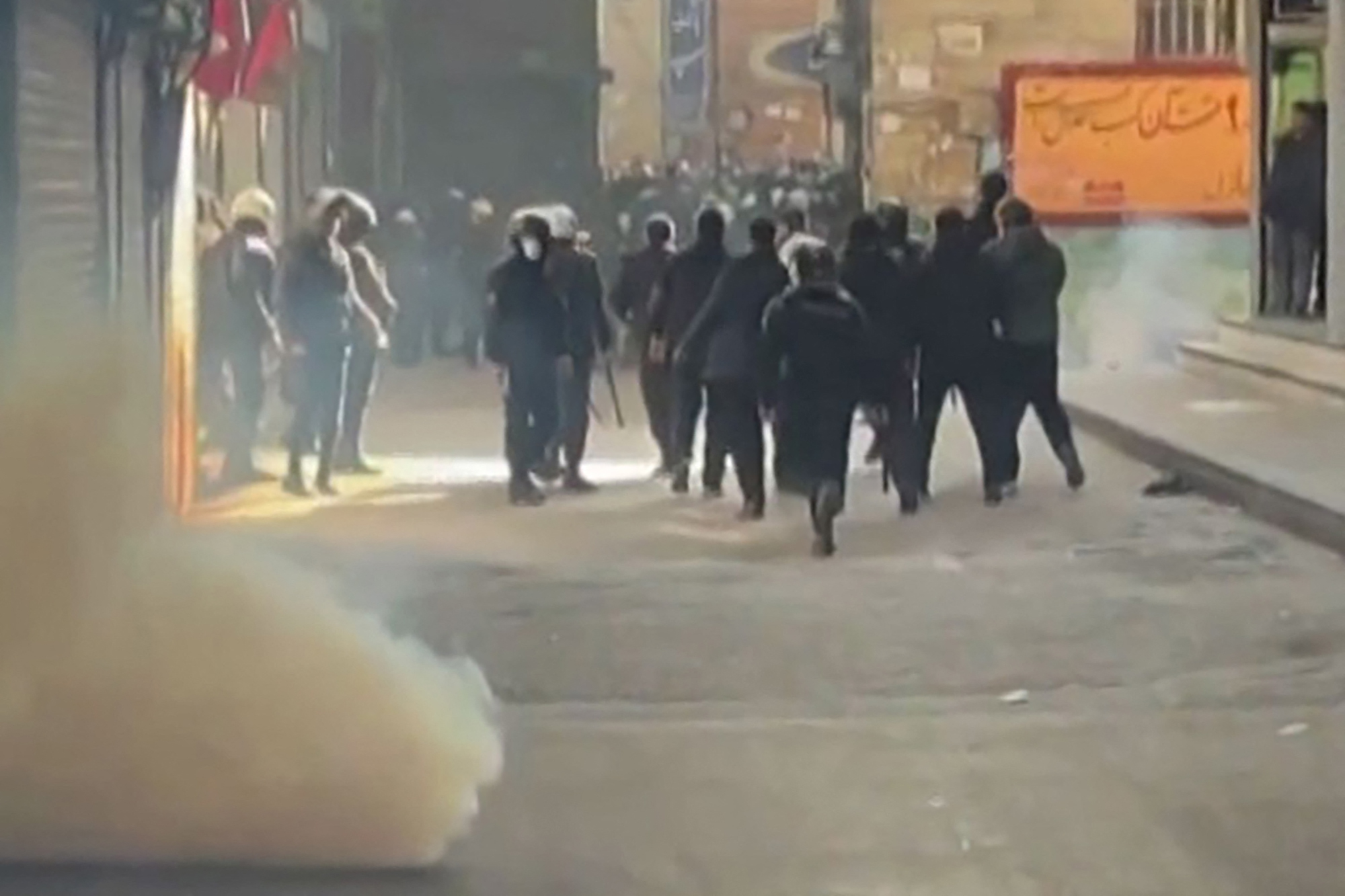
Iranian security forces using tear gas to disperse demonstrators in Tehran bazaar
UGC/AFP/GETTY IMAGES
The Middle East has a long history of surprises, and Iran is no exception. Still, Iran’s political structure is fundamentally different from cases like Syria or Libya. Power is more centralised, institutionalised, and deeply tied to security organs rather than a single leader or family network.
What does seem clear is that the Islamic Republic has rarely faced this level of sustained pressure from society itself. The scale, duration, and geographic spread of unrest point to a regime under serious strain.
That said, pressure should not be confused with imminent collapse. Without significant defections from within the security and political establishment, regime change is difficult to imagine unfolding quickly. The magnitude of force being deployed suggests a leadership that does not intend to concede easily.
A significant part of the establishment believes that regime failure would bring retribution, not transition. That perception narrows [supreme leader] Khamenei’s options. Instead of compromise, it pushes the system toward heavier reliance on coercion. Under those conditions, further crackdowns, potentially even harsher than we have already seen, remain more likely than a negotiated path to change.
Fatemeh Aman is an Iran expert and a former non-resident fellow at the Middle East Institute and senior fellow at the Atlantic Council
Death toll surges to ‘over 400’
The number of people killed in protests has risen to 466, according to the Human Rights Activists News Agency, which is based in the US.
Regime organises counter-demonstration
In a text message shared with The Times, the Iranian government is inviting people to join a counter-demonstration in support of the regime and against the US and Israel on Monday at 2 pm in central Tehran.
A second message sent by Iranian police has advised families to “look after their youth and teenagers”. The text message reads: “Due to the presence of terrorist groups and armed individuals in some of last night’s gatherings and their plot to cause casualties (staged killings), and the firm decision for zero tolerance and decisive action against rioters, families are strictly advised to look after their youth and teenagers.”
The Sunday Times view: Change in Iran offers a glimmer of hope
The 86-year-old Ayatollah Ali Khamenei is one of the longest-serving rulers in the world.
His chief achievement has been the barren triumph of the autocrat: his own political survival, and that of the Islamist insurgency he backed as a much younger man in 1979, when his predecessor, Ayatollah Khomeini, overthrew the Shah, Mohammad Reza Pahlavi. Now the intensifying popular protests across Iran suggest his version of luck may at last be running out.
For many Iranians, his legacy has been one of sustained and extreme repression, of women and dissidents in particular. The regime’s slogans of “Death to America!” and “Death to Israel!” reflect an ideology narrowly focused on hatred and the export of terror to perceived enemies, rather than any positive vision of Iranian success.
• Read in full: Theocratic tyranny faces unprecedented opposition
The US-based Human Rights Activists News Agency, which relies on activists in Iran cross-checking information, has said the death toll in Iran has risen to 203. Of those killed, 162 are protesters and 41 are members of the security forces, it said.
The Iranian government has not offered any overall casualty figures for the demonstrations.
Inform on your neighbours, residents told
The Iranian authorities have urged the public to inform on anti-government protesters in messages relayed from official buildings.
In a video shared with The Times and apparently filmed on Sunday in Nishapur, in the northeastern province of Khorasan Razavi, loudspeakers encouraged people to open their shops and “disappoint the enemy”. It urged the public to take videos of protesters and their leaders and share them with the police so they could be investigated and arrested.
Video shows clashes as security forces ‘escalate’
Security forces have “escalated” confrontations with protesters, the chief of Iran’s police has said. Ahmad-Reza Radan told state TV that those involved in the anti-government demonstrations were “rioters” and said “significant arrests” had been made overnight. He did not give further details.
UK ‘must call Iranian military terrorists’
The British government is facing renewed calls to designate the Islamic Revolutionary Guard Corps as a terrorist organisation after reports of a deadly crackdown on protests.
Laila Jazayeri, director of the Association of Anglo-Iranian Women in the UK, called for the ban at a rally outside Downing Street on Sunday. “The prime minister should proscribe the deadly force IRGC, that is killing people inside Iran,” she said.
Heidi Alexander, the transport secretary, told Sky News the decision was kept “under constant review”, but said she had “no current update” on any decision by the home secretary, Shabana Mahmood.
World ‘marvels at bravery of Iranians’
Israel is “closely monitoring” the situation in Iran, Binyamin Netanyahu said at a cabinet meeting on Sunday.
“The demonstrations for freedom have spread across the country,” he said. “The people of Israel, and indeed the entire world, marvel at the immense bravery of the citizens of Iran.”
It follows reports Netanyahu had held discussions with Marco Rubio, the US secretary of state, about the possibility of military intervention in support of the protests against the Iranian regime.
A show of solidarity in Berlin
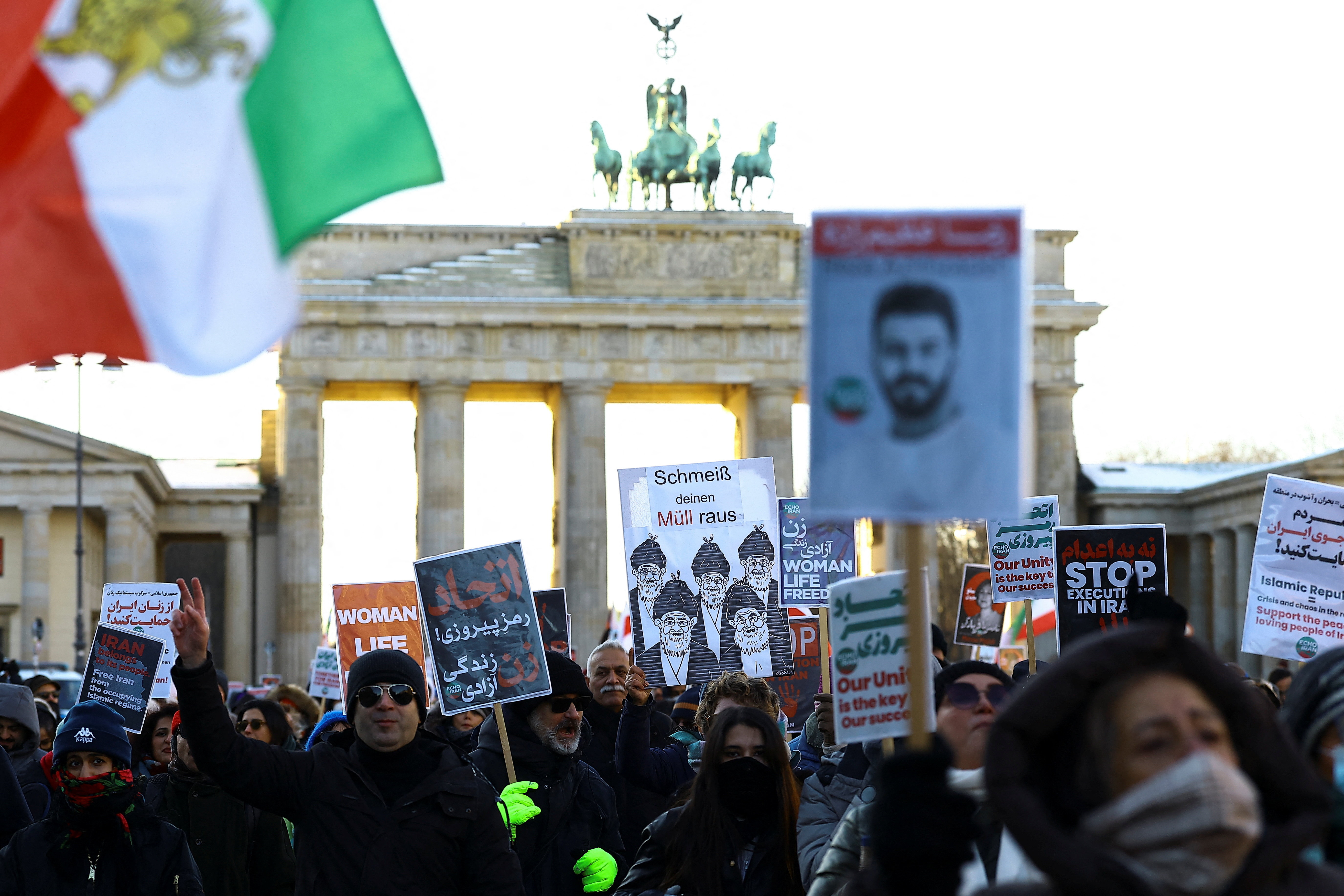
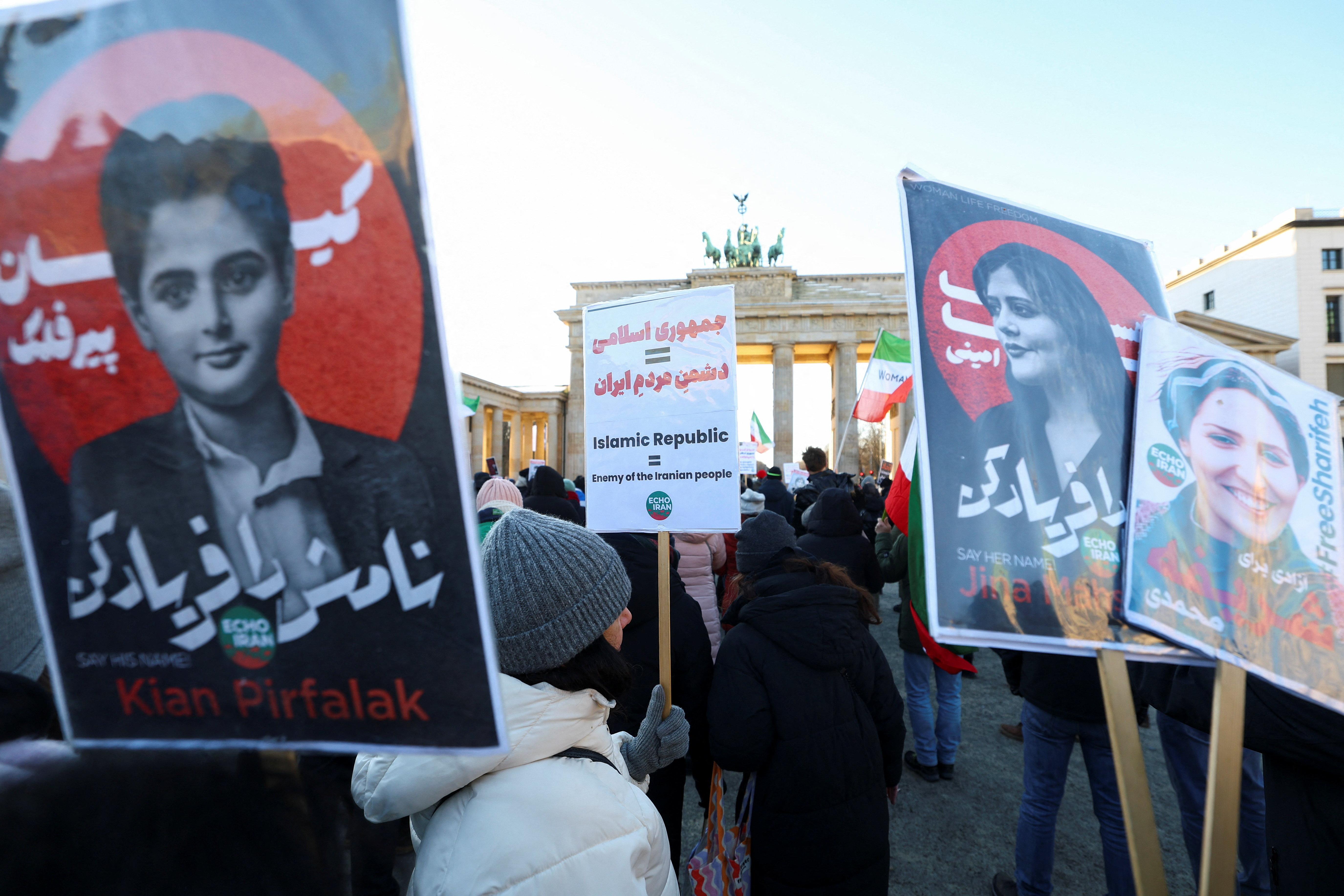
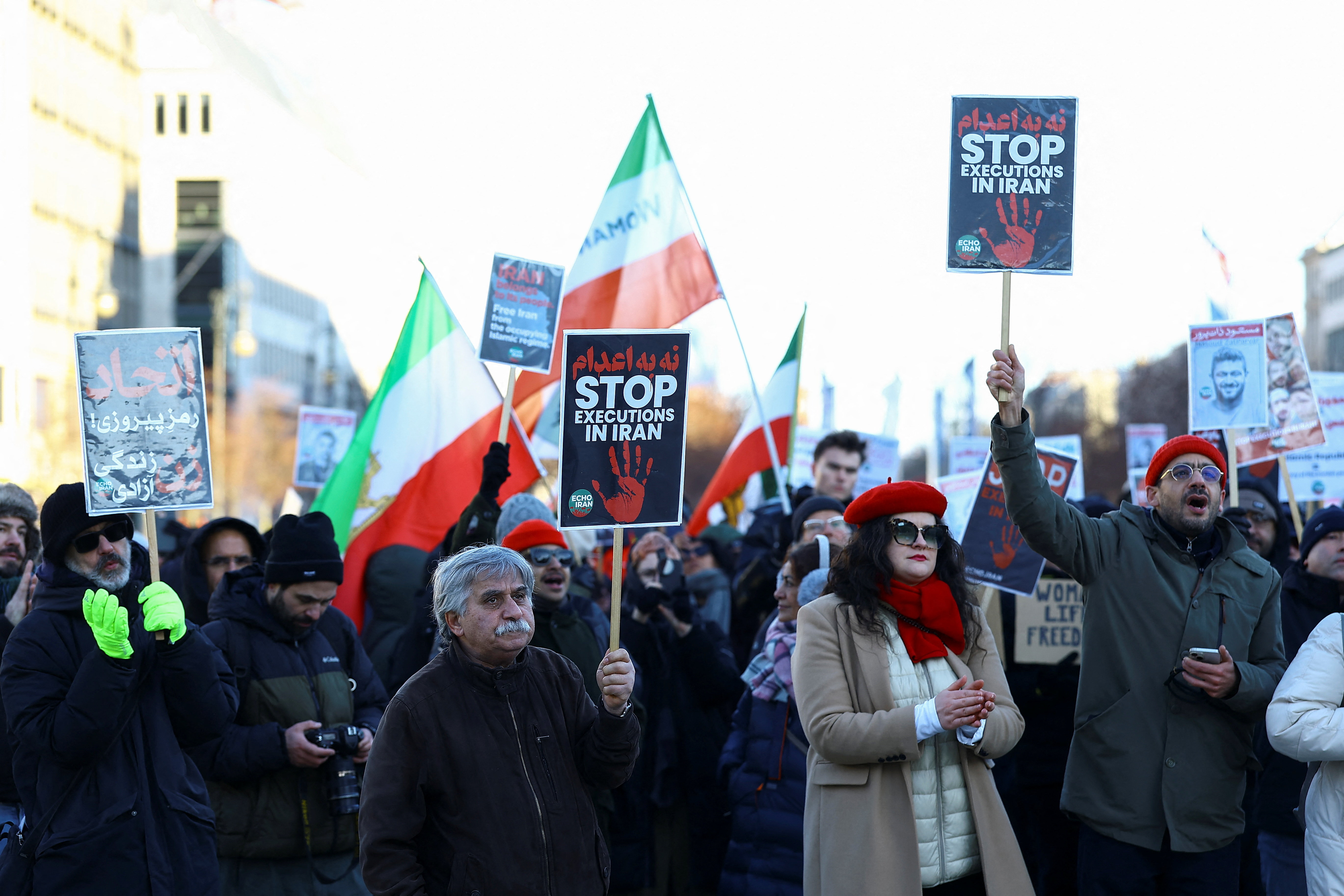
Demonstrators in Berlin showed their support for the protests in Iran over the weekend, under the slogan “Stand for Freedom”.
The rally took place at the Brandenburg Gate, where people waved flags and placards calling on Iran’s Islamic regime to restore the internet and halt executions.

 Protesters gather at No 10
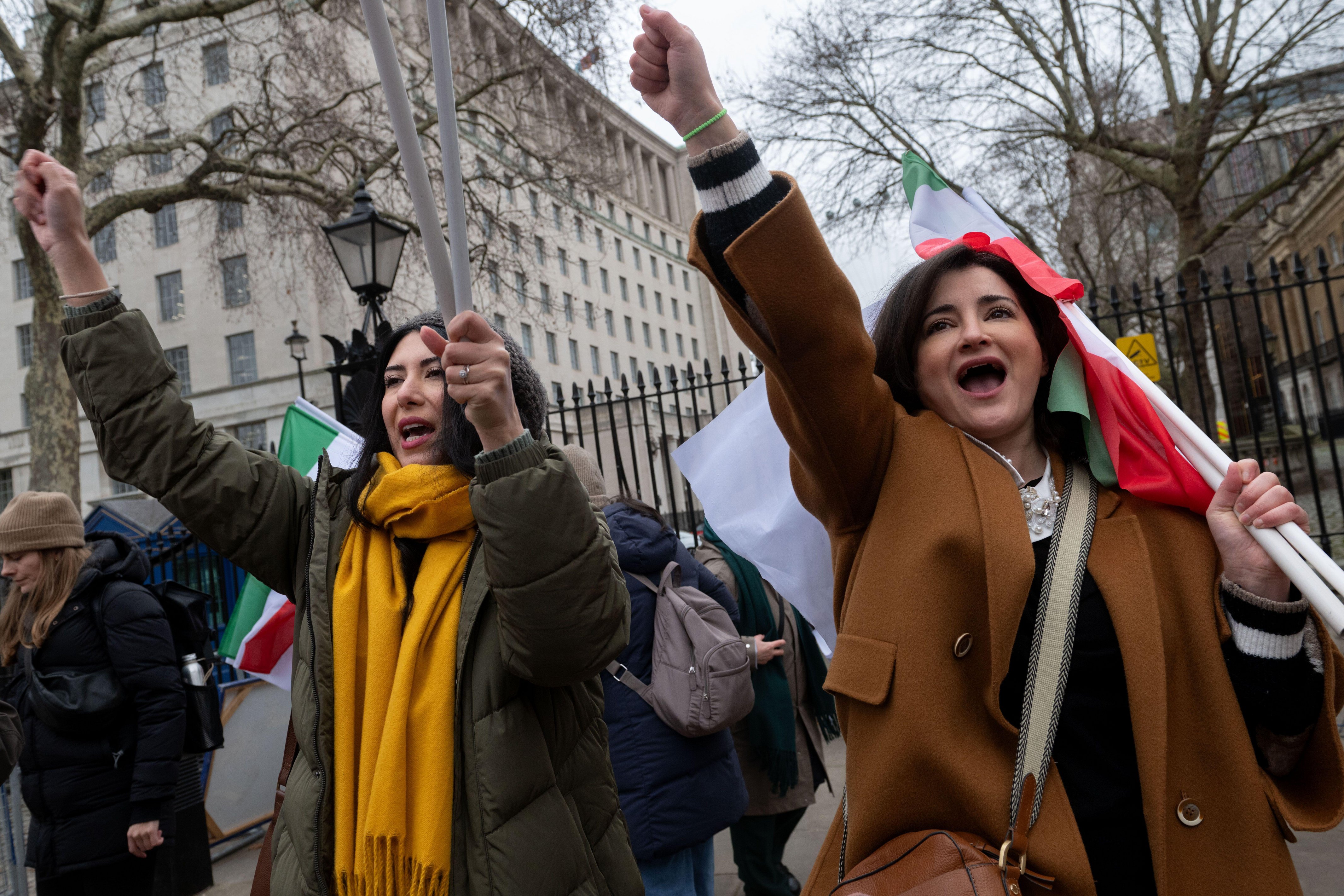
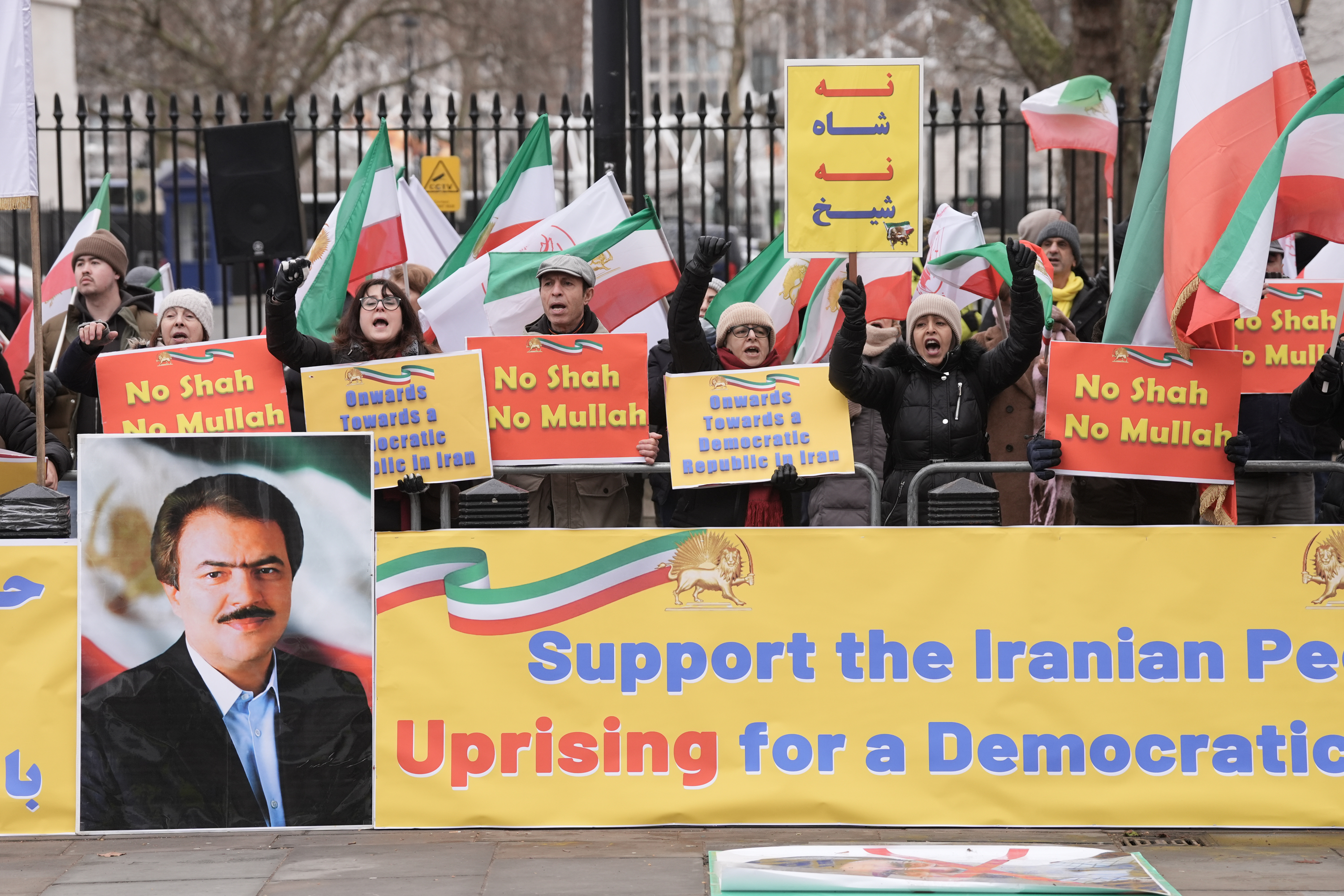
Demonstrators gathered outside Downing Street in London today to show solidarity with the protests in Iran.
The rally was organised by the Association of Anglo-Iranian Women in the UK. Activists held placards and banners calling for “Free Iran” and advocating an “uprising” against the regime. Some also opposed any attempt to restore the monarchy, under the slogan “No Shah, No Mullah”.
THOMAS KRYCH/ZUMA PRESS WIRE


CHRIS J RATCLIFFE/REUTERS
Badenoch ‘would support UK military action’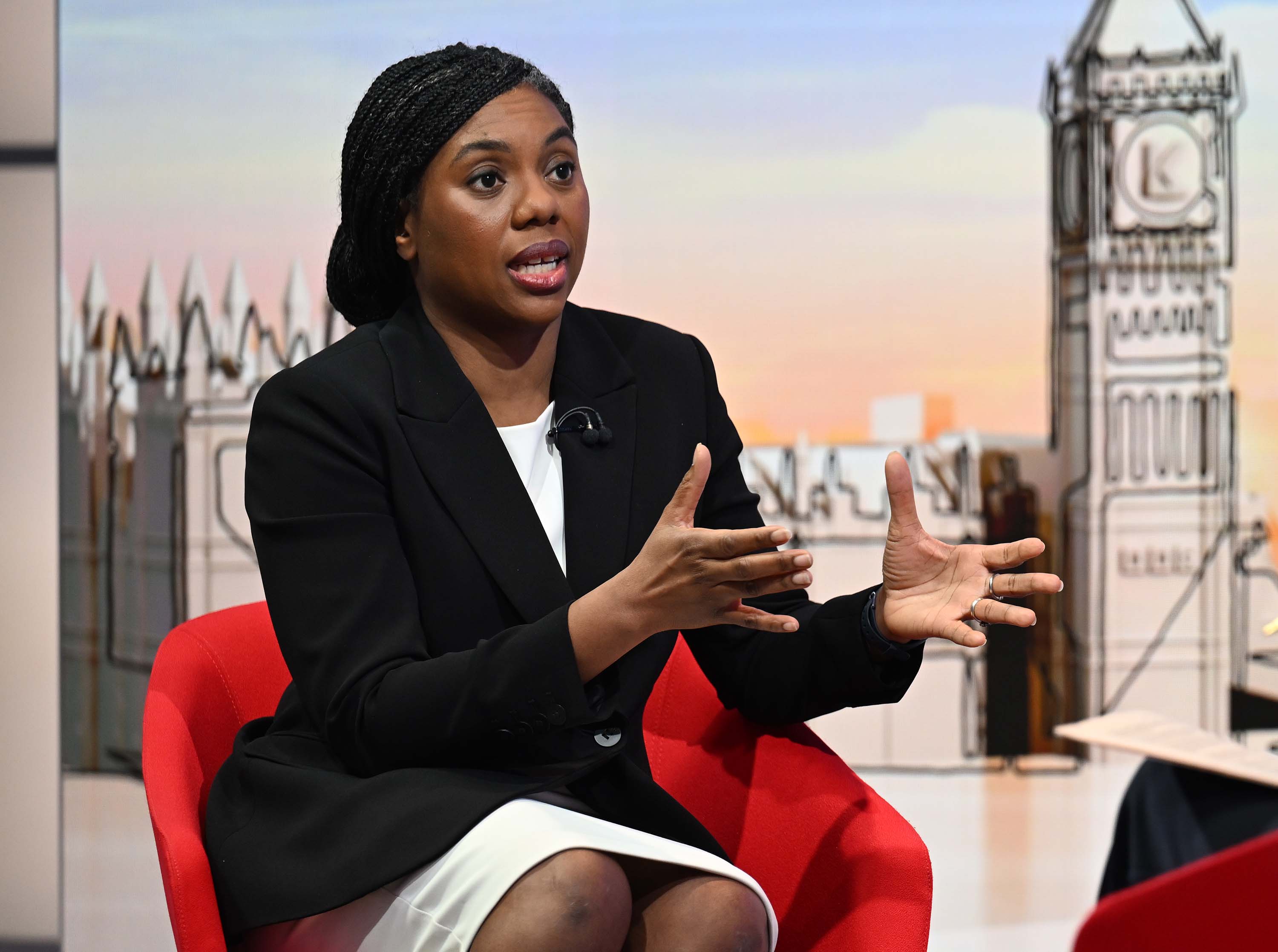
Kemi Badenoch spoke to the BBC this morning
JEFF OVERS/BBC/PA
Kemi Badenoch said she would support UK military action against Iran as part of a coalition of countries including the US.
“You’ve seen the recent RAF strikes, for instance, in Syria,” the Tory leader told Sunday with Laura Kuenssberg on the BBC. “Without over speculating — we are talking about hypothetical situations — we have worked in alliance with other countries. That is the right way to do it, and to make sure that we create a stable Iran.”
She said Iran would “happily wipe out the UK” and added: “I don’t have an issue with removing a regime that is trying to harm us”.
Distraught doctor appeals for help
In an audio recording released online that purports to be from Shiraz, south central Iran, a doctor appeals for help to deal with a number of patients he claims to have received shotgun wounds to the head.
“Guys we can’t make phone calls,” he says in the message shared on social media, which has not been independently verified.
“We need surgeons, we need neurosurgeons … orthopaedic surgeons … ophthalmologists … we need surgeons right now,” the message adds. “We can’t call them to come in, about 20 patients have arrived already, we can’t do anything for any of them. Call the media. Tell them to broadcast this.”
“Hospitals need help”, the unidentified doctor says, before adding of his patients: “All of them were shot in the head.”
Internet ‘more important than bread’
Restoring the internet to Iran is more important than bread, according to a resident in the east of the country.
While online and phone communications with the outside world are blocked by Iranian networks, some citizens close to the border can pick up weak signals from neighbouring countries to send messages out.
In a text message in Farsi, shared with The Times, one said: “Nothing is more important than the internet. Right now [it’s] more important than bread.
The message added: “Unfortunately not much we can do about that unless the US does something.”
US flexes military muscle
Speculation that the US could attack Iran follows military intervention in Syria, where American forces struck targets linked to Islamic State on Saturday.
President Trump directed the bombing as part of Operation Hawkeye Strike in retaliation for a deadly attack on US forces in Palmyra last month.
In his first year back in office, the US leader has ordered strikes on targets ranging from Mexico and Venezuela to Nigeria and Somalia.
• Read more: US bombs more Islamic State targets in Syria
Israel: Iranians deserve freedom
Israel supports the Iranian people in their “struggle for freedom”, the foreign minister has said.
“We don’t have any hostility with the people of Iran,” Gideon Sa’ar said in a video posted online today. “We have a huge problem, which is not only our problem, it’s a regional and international problem, with the Iranian regime, which is the number one exporter of terrorism, radicalism.”
Sa’ar added that he wished the protesters “much success”, adding: “We see the people of Iran and frankly we wish them much success. We support the Iranian people’s struggle for freedom. We think they deserve freedom, a better future.”
Iran and Israel fought a 12-day war in June last year in which Israel, and later the US, attacked Iranian military and nuclear facilities.

Israeli air defence systems intercept Iranian missiles over Tel Aviv last June
MENAHEM KAHANA/AFP/GETTY IMAGES
Pope prays for the victims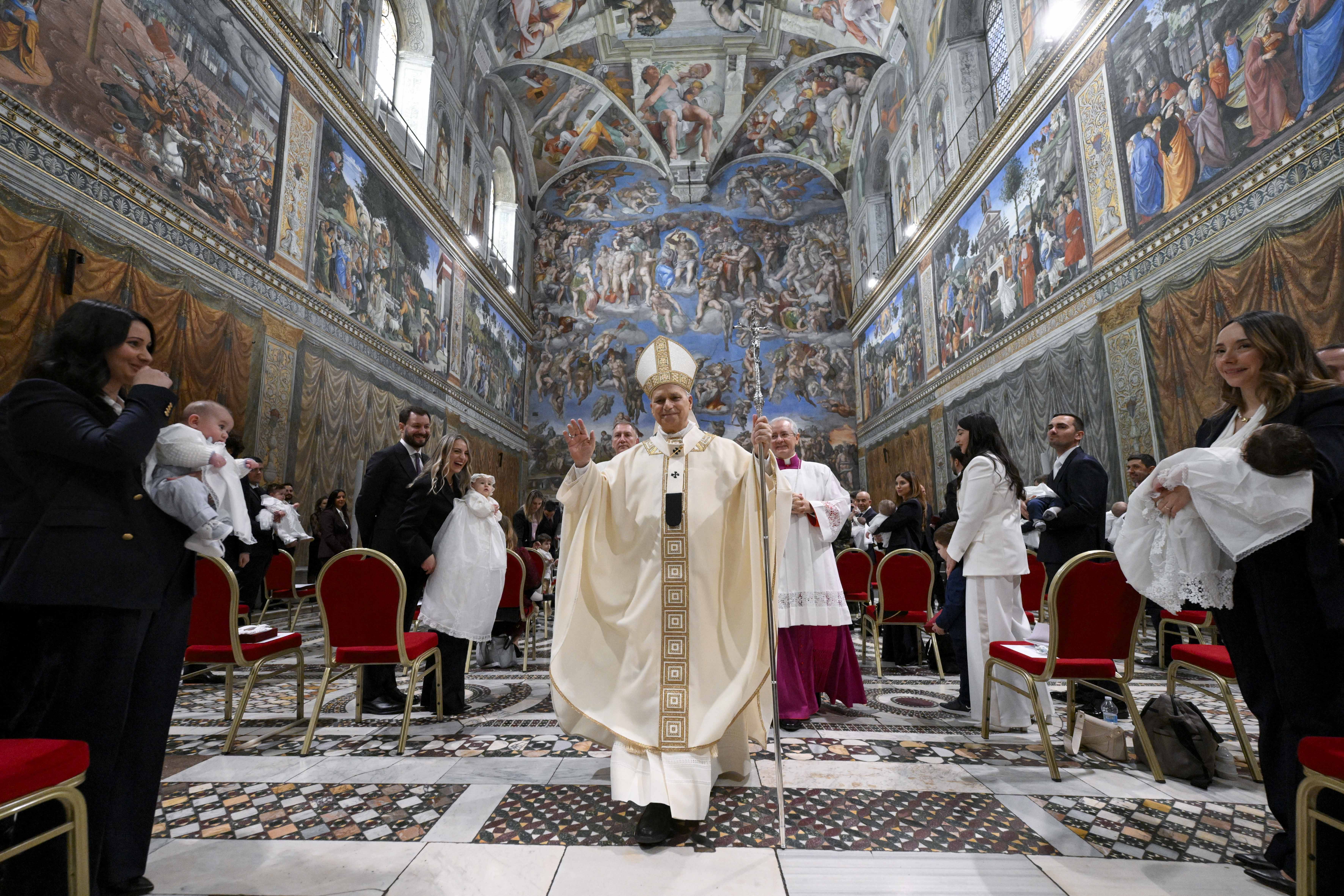
The Pope at the Vatican on Sunday
VATICAN MEDIA/AFP/GETTY IMAGES
The Pope offered prayers for those killed in protests in Iran and in the conflict in Syria during his weekly Angelus prayer on Sunday.
“My thoughts turn to what is happening these days in the Middle East, particularly in Iran and Syria, where persistent tensions are causing the deaths of many people,” he said at the Vatican. “I hope and pray for the patient cultivation of dialogue and peace, for the common good of society as a whole.”
Netanyahu applauds ‘heroic citizens of Iran’
Netanyahu backs Iran protesters
Binyamin Netanyahu has called for Israel and Iran to become “faithful partners” once the regime falls. The Israeli prime minister said before a weekly cabinet meeting this morning that his country sent strength to the “heroic and courageous citizens of Iran”.
“We will do good things together for the benefit of both peoples,” he said. “We all hope that the Persian nation will soon be freed from the yoke of tyranny, and when that day arrives, Israel and Iran will once again become faithful partners in building a future of prosperity and peace.”
Earlier today, Iran’s parliamentary speaker said the Islamic Republic would strike Israel and US targets if there is foreign intervention in the country. Israel is on high alert for any attack, officials said.
Security forces ‘fire tear gas inside hospital’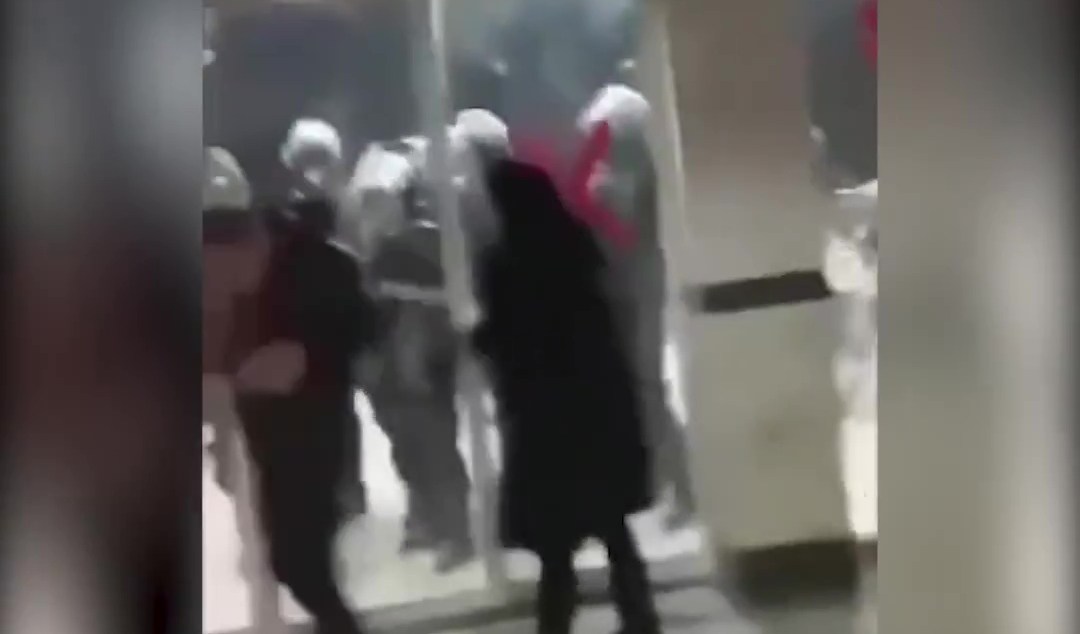
A still said to show security forces attacking Imam Khomeini Hospital in Ilam province
Security forces broke into a hospital, fired tear gas and sought to apprehend injured protesters and remove the bodies of the deceased, witnesses in the western province of Ilam have claimed.
“This tyrannical regime’s deliberate targeting of medical facilities, medics, women, infants and children should be considered a crime against humanity and violation of all human rights norms,” Osama Malik, an international law expert, said.
President accuses US of orchestrating ‘rioters’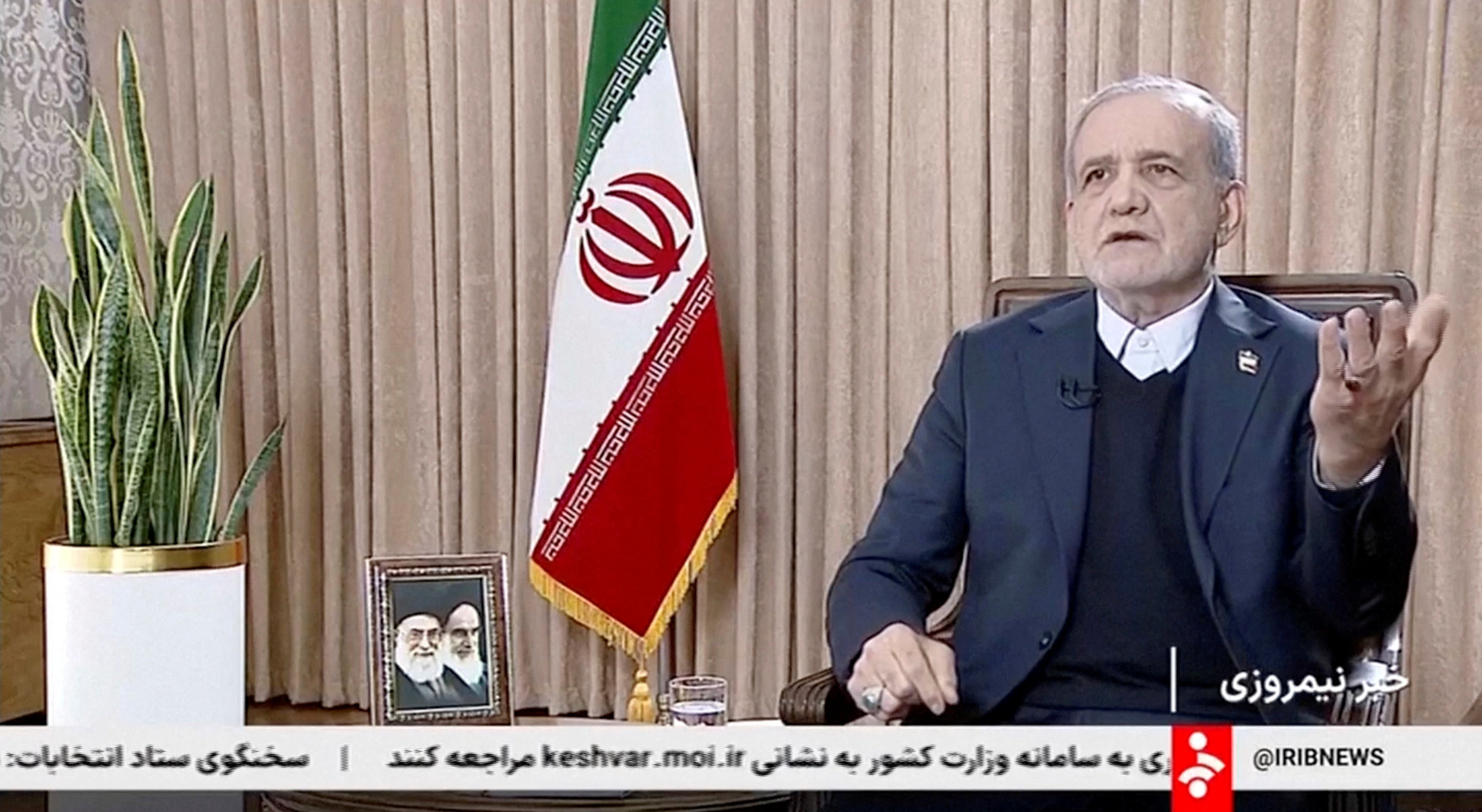
Masoud Pezeshkian on Iranian state TV on Sunday
IRIB/REUTERS TV
The Iranian president, Masoud Pezeshkian, said today that the US and Israel want to “sow chaos and disorder” in Iran by ordering riots, and called upon Iranians to distance themselves from “rioters and terrorists” during a state TV interview.
Pezeshkian also said his government was determined to resolve the Iranian people’s economic problems, and that the establishment was “ready to listen to its people”. As president, Pezeshkian holds some power within the government but can be overruled by Ayatollah Ali Khamenei, a hardliner who has ordered a crackdown.
Almost 200 killed, human rights group says 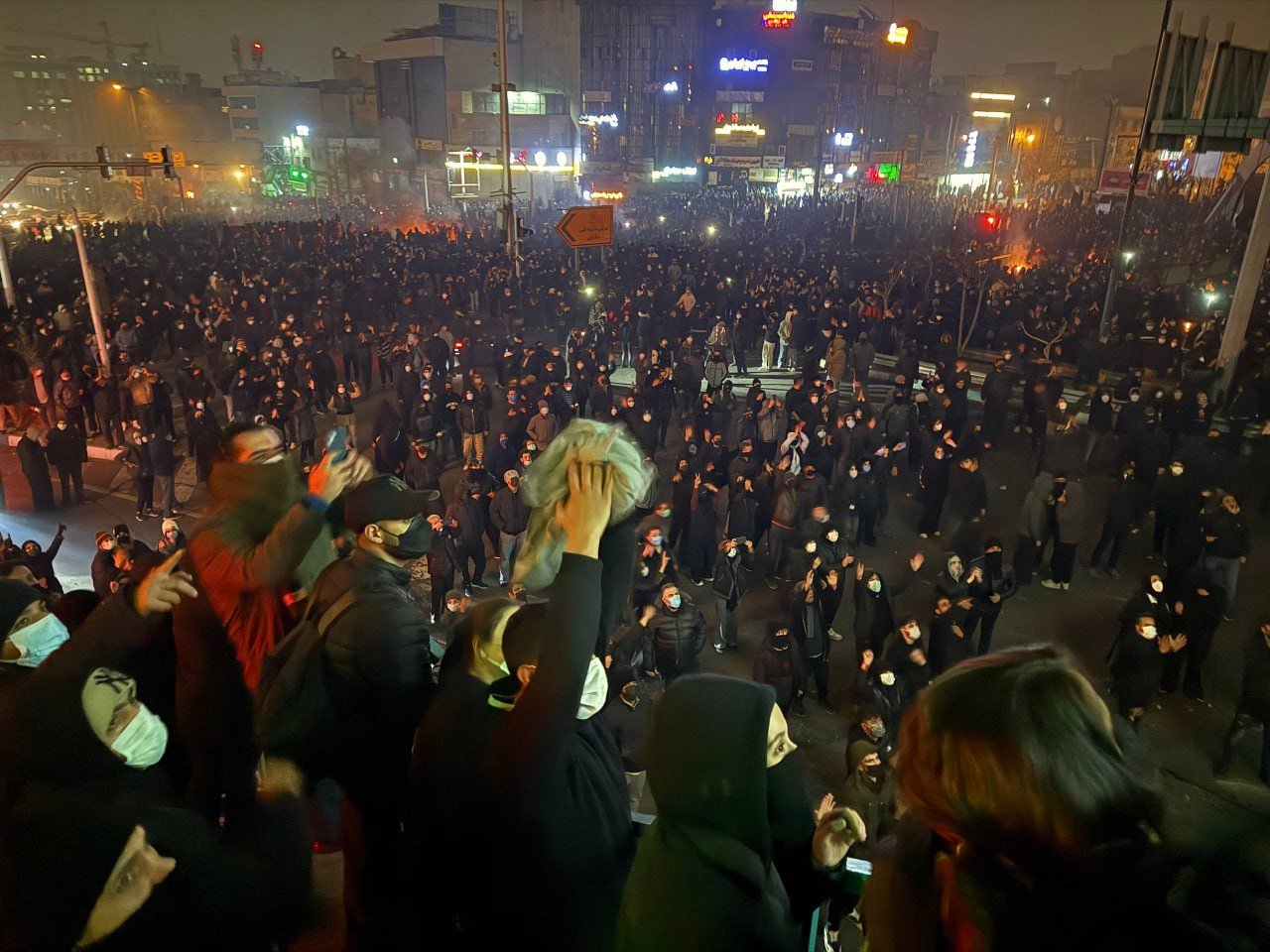
Protests in Iran on Saturday
SHUTTERSTOCK EDITORIAL
At least 192 protesters have been killed in Iran since the start of the anti-regime demonstrations, according to the non-profit group Iran Human Rights.
The true death toll may be much higher. “Unverified reports indicate that at least several hundreds — and according to some sources, more than 2,000 — people may have been killed,” the group said. “Due to the total internet blackout and severe restrictions on access to information, independent verification remains a serious challenge under the current circumstances.”
Horror of Iran’s overwhelmed hospitals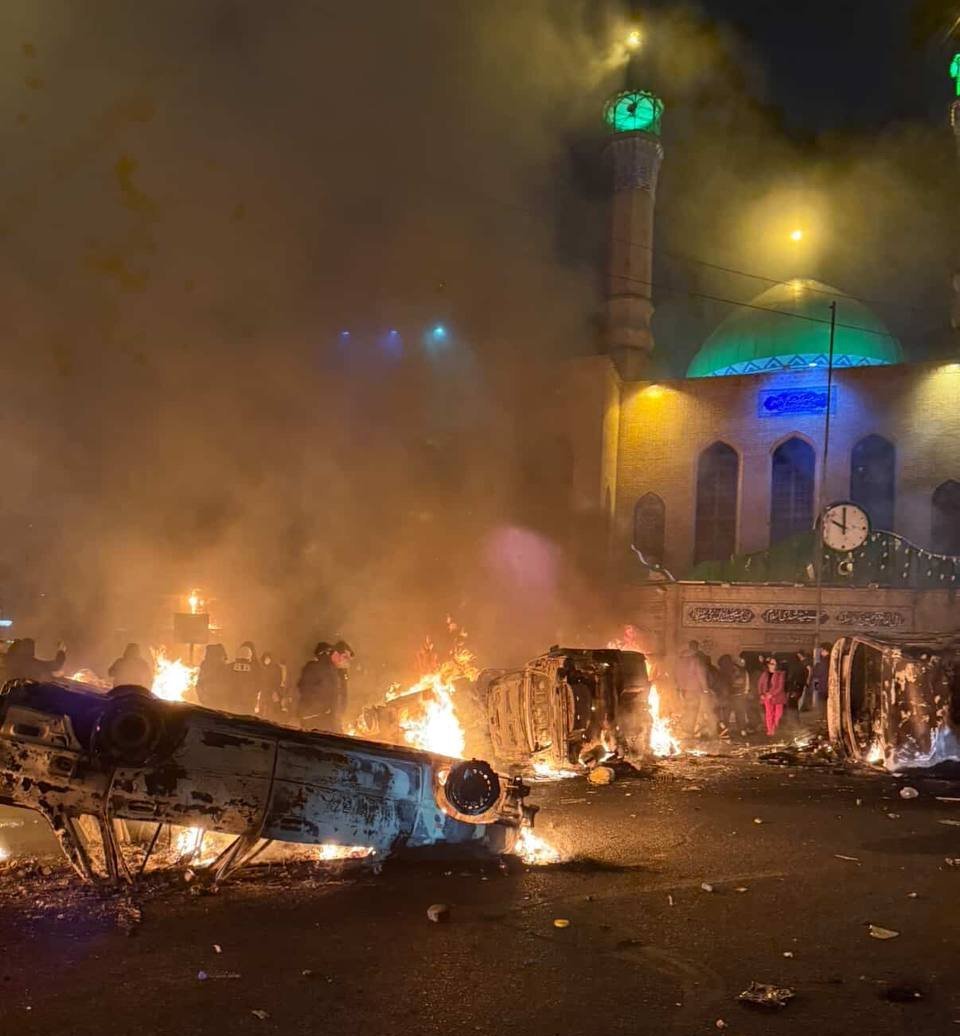
Burning cars in Kaj Square in Tehran as unrest spread
SINAI IMAGES/SHUTTERSTOCK EDITORIAL
These days, “Code 99” rings out again and again over the loudspeakers in Iranian hospitals — the emergency alert reserved for patients brought in with gunshot wounds from protests that have swept the country.
In a hospital in Mashhad, northeast Iran, on Friday night, a doctor tried to resuscitate a 22-year-old woman who had been shot by security forces.
• The chaos and horror inside Iran’s overwhelmed hospitals
“I performed CPR on her three times, but she died,” he said. “They’re shooting with live ammunition.”
‘Bloodbath’ as security forces shoot at anyone in a mask
Protests have spread to almost all of Iran’s towns and cities and a “bloodbath” was reported in the northern city of Rasht.
The forces are “using live ammunition and killing protesters at nighttime … shooting at anyone wearing a mask”, a 24-year-old student told The Times. “We have heard of several acquaintances being killed, and we are searching for their bodies.”
Witnesses who spoke on condition of anonymity said the sound of gunfire filled the air and hospitals were overwhelmed. In a sign that the protests are strengthening, key locations emblematic of the regime were set on fire, including a mosque, a town hall and bases belonging to the basij, a volunteer paramilitary force.
“On Saturday night, people in Mashhad [an eastern city] were shot at with a military rifle, and a young girl was killed right in front of my eyes,” said the student, who circumvented the internet blackout with a private Starlink hub. “The regime is weakening every passing day,” he said, adding that the demonstrations would not stop.
• Read more: Secrets, lies and Starlink — how Iran protesters are defying regime
Student, 23, ‘shot in head from behind’
A 23-year-old college student, Rubina Aminian, was shot dead on Thursday after leaving her campus and joining a protest in Tehran, according to the non-profit Iran Human Rights. Sources close to her family told the centre she was shot in the head from behind at close range.
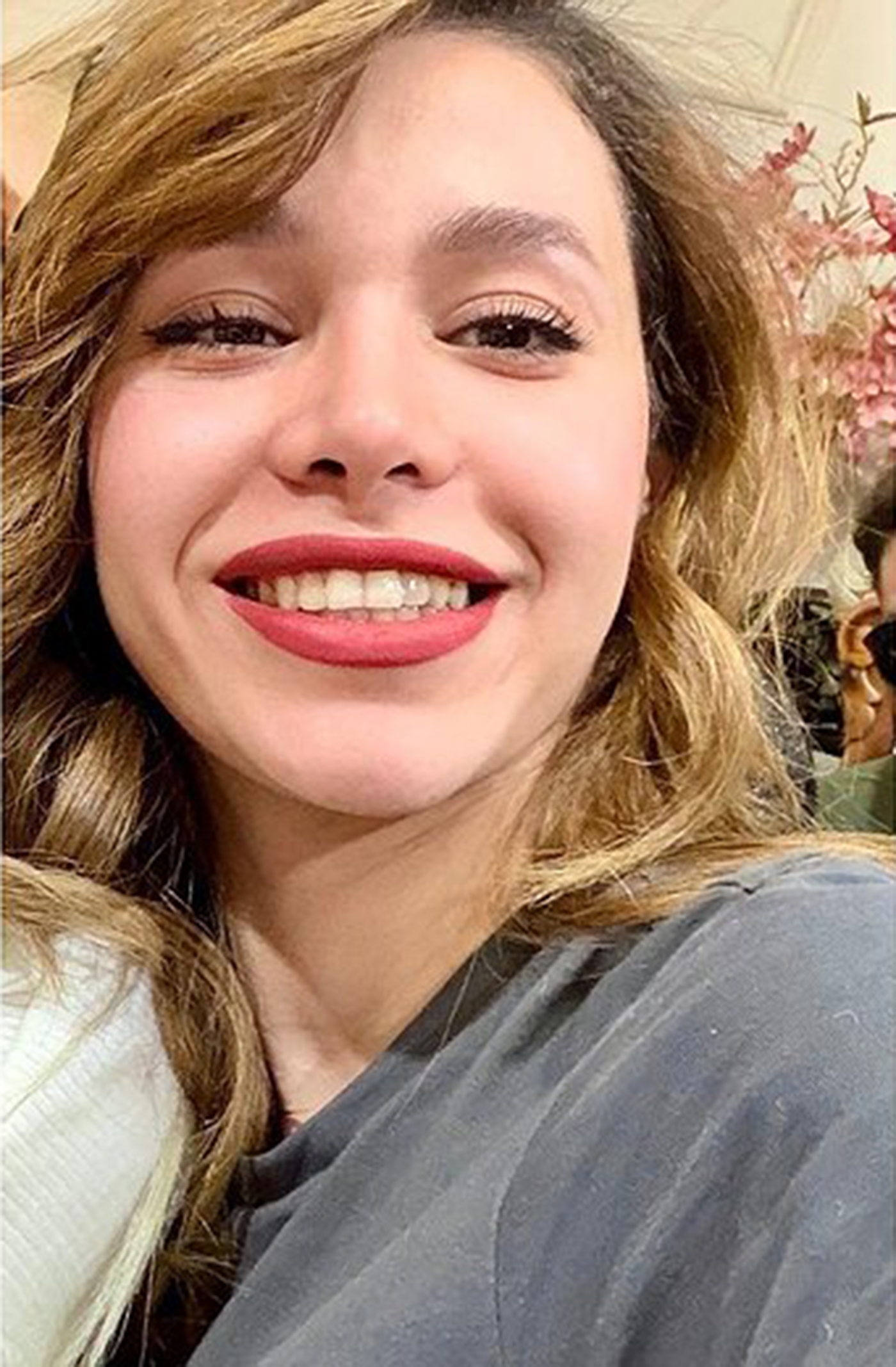
While rights organisations have named dozens of protesters killed, it has been impossible to independently verify the identity or number of fatalities because of an information blackout.
“Most of the dead were young people between the ages of 18 and 22 who were shot in the head by government agents at close range,” according to a statement given to the centre, which added that Aminian’s family were forced to bury her body far from their home after security forces surrounded their house.
Aminian, who studied design and fashion at the Shariati University in Tehran, was described as “full of enthusiasm for life”.
How the Ayatollah has reacted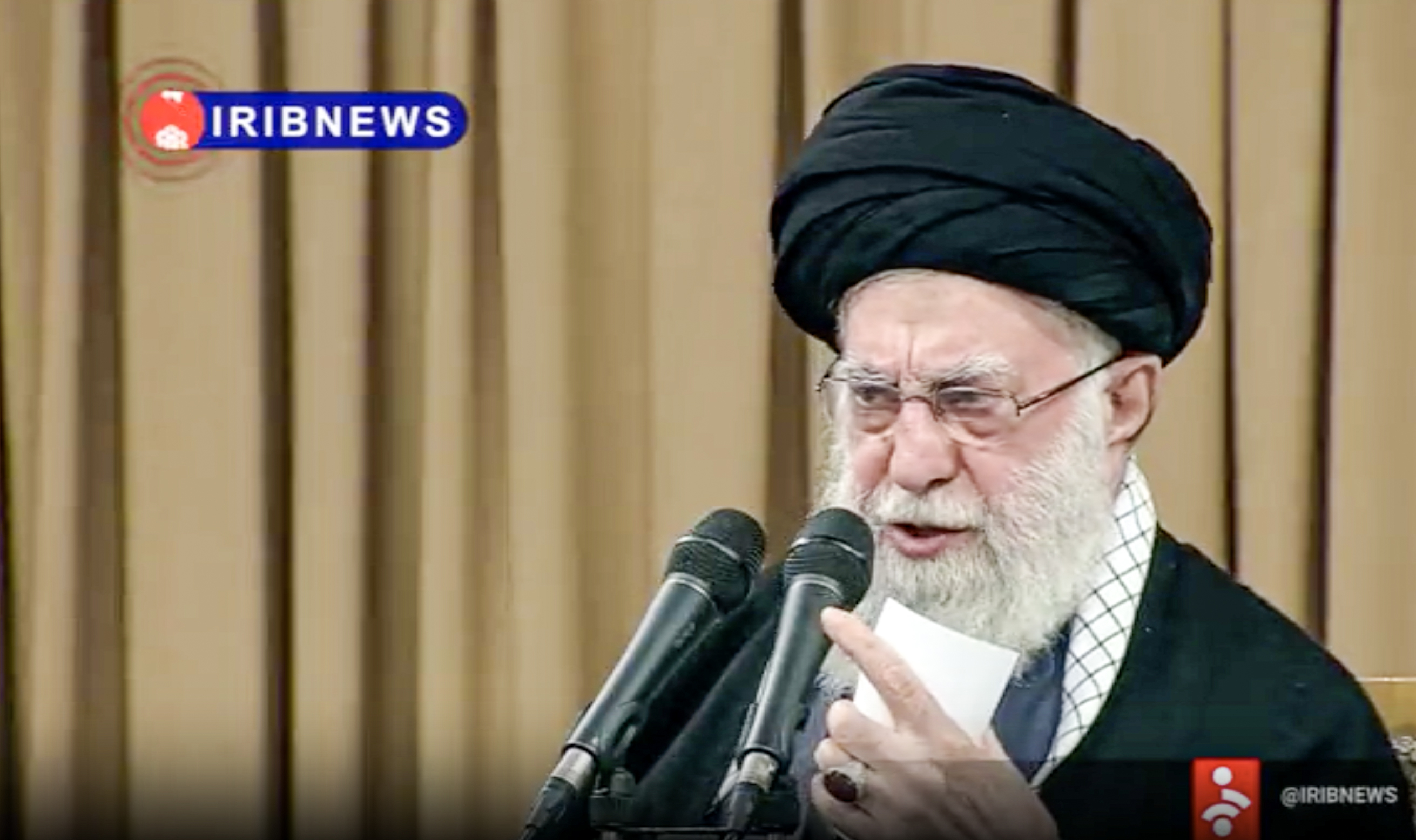
Khamenei on Friday
GETTY IMAGES
Ayatollah Ali Khamenei has accused protesters of acting on behalf of the United States, calling them “vandals” and insisting he would not “back down”.
“Last night in Tehran, a bunch of vandals came and destroyed a building that belongs to them to please the US president,” the supreme leader said in a speech broadcast by state media on Friday. “They want to make him happy. If he knew how to run a country, he would run his own.”
Trump claimed on Thursday that Khamenei was preparing to flee the country, a week after The Times revealed details of a back-up plan in which he would escape to Moscow with an inner circle of about 20 aides and family.
• Read more: Will the Ayatollah step down? Most potent protests yet put him on brink
Iranian-born actress calls for aid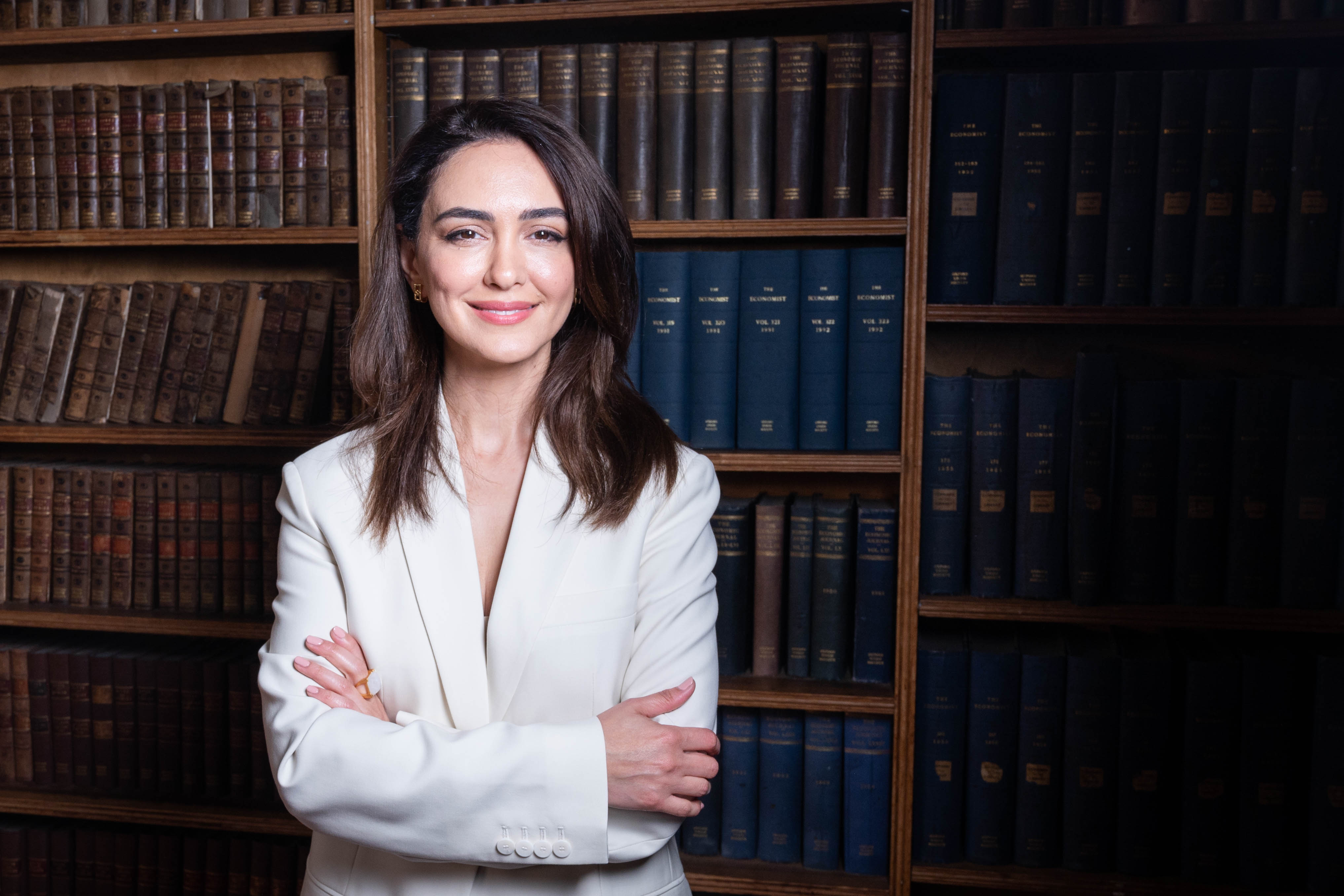
Nazanin Boniadi has appeared in Homeland and Ben-Hur
SHUTTERSTOCK EDITORIAL
The Iranian-born British actress Nazanin Boniadi has called for international support for the protesters facing violent repression.
“We are now three days into an internet blackout,” Boniadi, 45, told Sky News. “The very limited information that I have received has been because of the existence of Starlink terminals and the activation of Starlink recently, and and it’s not good news. Iranians are no strangers to protests and uprisings. They’re risking their lives and as we’re seeing, people are being slaughtered.
“Now we need international support. The last thing we need is for people to be emboldened to go into the streets because they think they’re going to get that support and then that support doesn’t come.”
Mark Urban: protest-led regime change rarely succeeds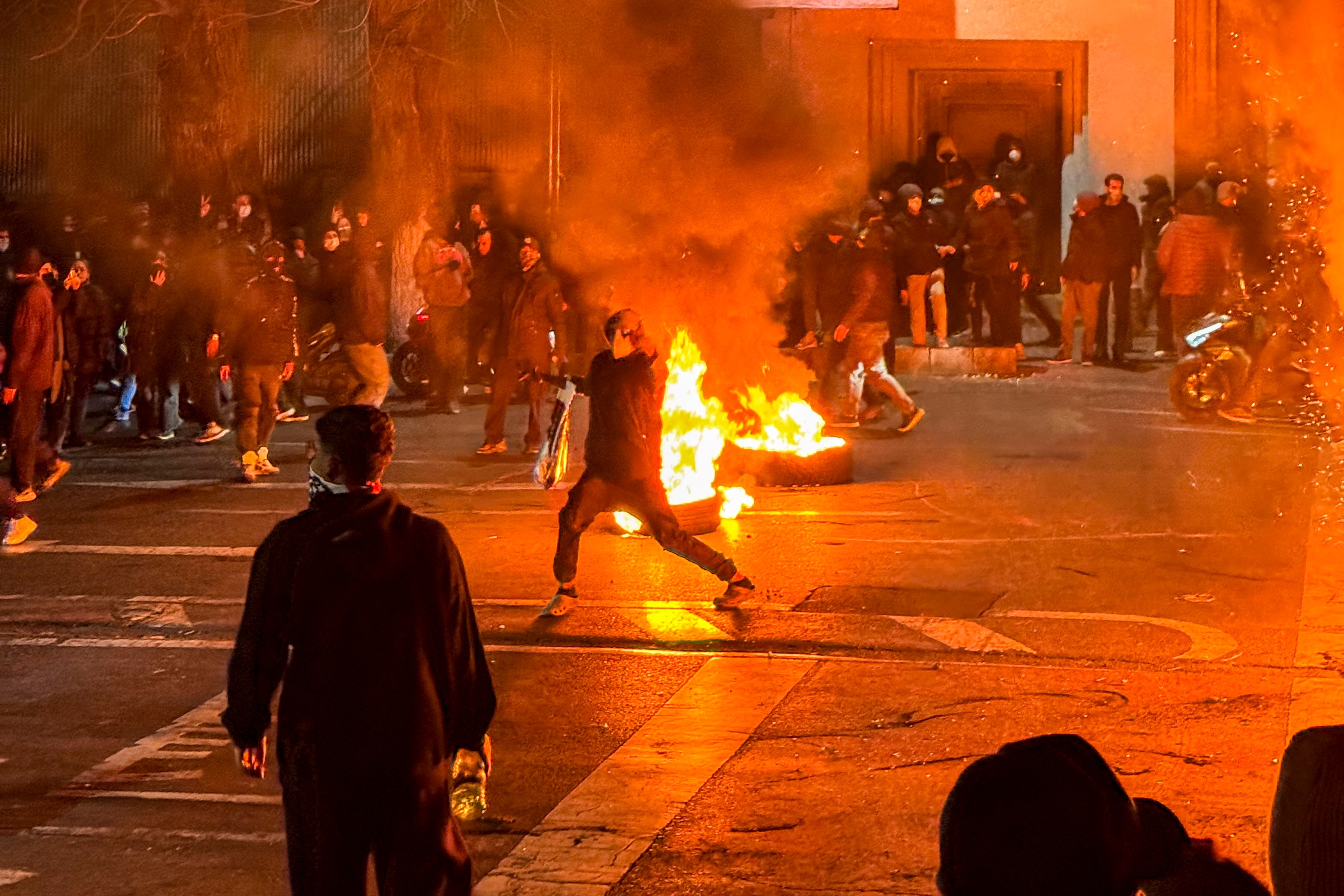
Protesters block a street in Tehran on Friday
MAHSA/MIDDLE EAST IMAGES /AFP
On Saturday, Reza Pahlavi, the exiled son of Iran’s last shah, told protesters their aim should be to “bring the Islamic Republic and its worn-out and fragile repression apparatus to its knees”. He urged a general strike, saying: “The goal is to prepare for seizing the centres of cities and holding them.”
After two weeks of protests, opponents of the Iranian regime believe power may be within their grasp. But it is not clear whether the country is building towards a revolution or a renewed and harsher form of repression.
• Read in full: A free future for Iran looks unlikely
Protest at No 10 after ‘Iranian Spider-Man’ stunt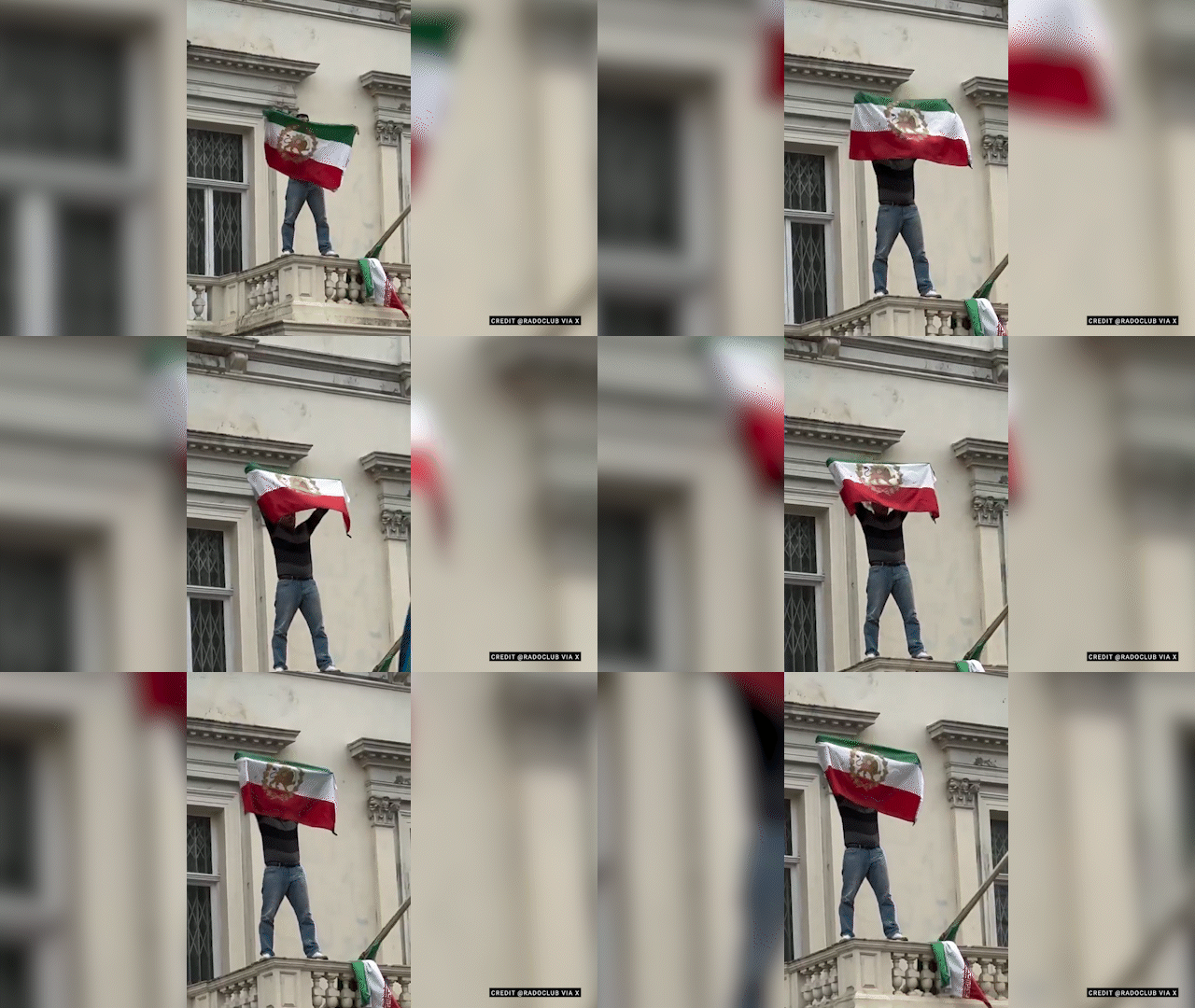
A protester waved the pre-revolution flag of Iran from the embassy in Kensington
The Association of Anglo-Iranian Women in the UK is due to hold a rally outside 10 Downing Street this morning in solidarity with the protesters in Iran.
It follows a demonstration outside the Iranian embassy in London on Saturday, when an activist removed the Iranian national flag from a balcony and temporarily replaced it with the pre-revolution flag bearing the lion and sun emblem used by opposition groups in the country. The acrobatic protester was dubbed the “Iranian Spider-Man” on social media.
• Read in full: Demonstrator tears down regime flag at London embassy
Why is Iran protesting now?
Demonstrators in 1979, when the Shah was overthrown
KEYSTONE/GETTY IMAGES
The mass protests in Iran are the largest in the country for more than 15 years and threaten to topple the Islamic regime led by Ayatollah Ali Khamenei.
Demonstrations began in the bazaars of Tehran on December 28, fuelled by anger over economic hardship. They have swollen into unrest involving hundreds of thousands of people across the country’s 31 provinces.
The protesters have cause for pessimism: each popular movement since the Shah was overthrown in the 1970s has brought talk of regime change — then a brutal response.
• Read in full: A timeline of unrest since the 1979 Islamic Revolution
Jason Cowley: Trump has emboldened Iranians
How serious is Trump about striking Iran? The regime would be foolish to disregard his threats. They have emboldened the protesters — a reversal of Iranians’ longstanding loathing of foreign intervention.
“Maduro is the newest person to find out that President Trump means what he says,” Marco Rubio, the US secretary of state, said in reference to the capture last weekend of the Venezuelan president. In January last year, while discussing Iran in a Senate confirmation hearing, Rubio said: “I don’t know of any nation on earth in which there is a bigger difference between the people and those who govern them.” That comment resonated among Iranians.
• Read in full: The Ayatollah’s strategy has spun out of control since October 7
Blackout cuts Iranians off from rest of world
An internet blackout has limited Iranians’ communication with the outside world for more than 60 hours now, the online monitor Netblocks said on Sunday. Images from Saturday appeared to show that street lighting was switched off in some areas where protesters gathered.
The blackout has caused the shutdown of companies, banking, airlines and pharmacies, and led to a cash shortage as ATMs and debit cards are affected.
The last time Iran imposed an internet blackout was during protests in 2019, when it covered up what Amnesty International said was violent suppression in which 321 people were killed.
Watch: son of deposed shah commends ‘revolution’
Reza Pahlavi commends protesters’ “courage”
The exiled son of the shah has said Trump is “ready” to help protesters. Reza Pahlavi said Trump had “observed” their “indescribable courage” and wanted to assist them.
Pahlavi, who was training as a fighter pilot in the US in 1979 when the revolution swept away his father’s monarchy, told protesters not to “abandon the streets” and that he would “soon be by [their] side”.
“My heart is with you,” he said in Farsi. Many protesters have called for the return of rule by a shah. After Israeli strikes last year that killed several senior senior generals, Pahlavi, who lives in Washington, declared he was prepared to help lead a transitional government. “This is not about restoring the past,” he has said. “It’s about securing a democratic future for all Iranians.”
• Read more: Who is Reza Pahlavi? The crown prince urging Iranians to protest
What is the UK’s position?
Britain wants to see a “peaceful transition” of power in Iran, a cabinet minister said this morning.
“The British government has always viewed Iran as a hostile state,” Heidi Alexander, the transport secretary, told Sky News. “We know that they pose a security threat in the Middle East and beyond and we know that they have been a repressive regime in terms of their own population. And so I think the priority, as of today, is to try and stem the violence that is happening in Iran at the moment.
“It’s a concerning situation there and we would like to see anything that happens in future involving a peaceful transition where people can enjoy fundamental freedoms and we see proper democratic values back in the heart of Iran.”
Iran will retaliate with ‘death to America’ if attacked
Uproar in the Iranian parliament
Iran has vowed to retaliate against both Israel and the US if it is attacked.
Mohammad Baqer Qalibaf, the speaker of parliament, said on Sunday morning: “In the event of a military attack by the United States, both the occupied territory and centres of the US military and shipping will be our legitimate targets.” MPs are said to have responded by chanting “Death to America”.
Trump threatens to intervene
President Trump has threatened to attack Iran if it kills protesters and it was reported on Saturday night that the US and Israel had discussed possible intervention.
In a post on his Truth Social platform on Friday, Trump said: “Iran is looking at FREEDOM, perhaps like never before. The USA stands ready to help!!!”
Trump was briefed with a series of different options for strikes against Iran, including on non-military sites in the capital, Tehran, according to The New York Times. Marco Rubio, the US secretary of state, spoke to Binyamin Netanyahu, the Israeli prime minister, on Saturday and discussed the possibility of US intervention, a US official told Reuters.
Biggest protests for years
Crowds gathered in Punak Square in Tehran despite the crackdown
SHUTTERSTOCK EDITORIAL
The demonstrations over the past fortnight have been the biggest in Iran for years and have left at least 116 people dead.
They began in the bazaars of Tehran over the economy before expanding across the country. Some protesters are calling for the restoration of the monarchy, which was overthrown in the Islamic Revolution of 1979. Reza Pahlavi, the exiled son of the last shah, has encouraged the protests.
According to activists and civil rights groups, Iran has tried to suppress the uprising with live fire, tear gas and mass detentions.