
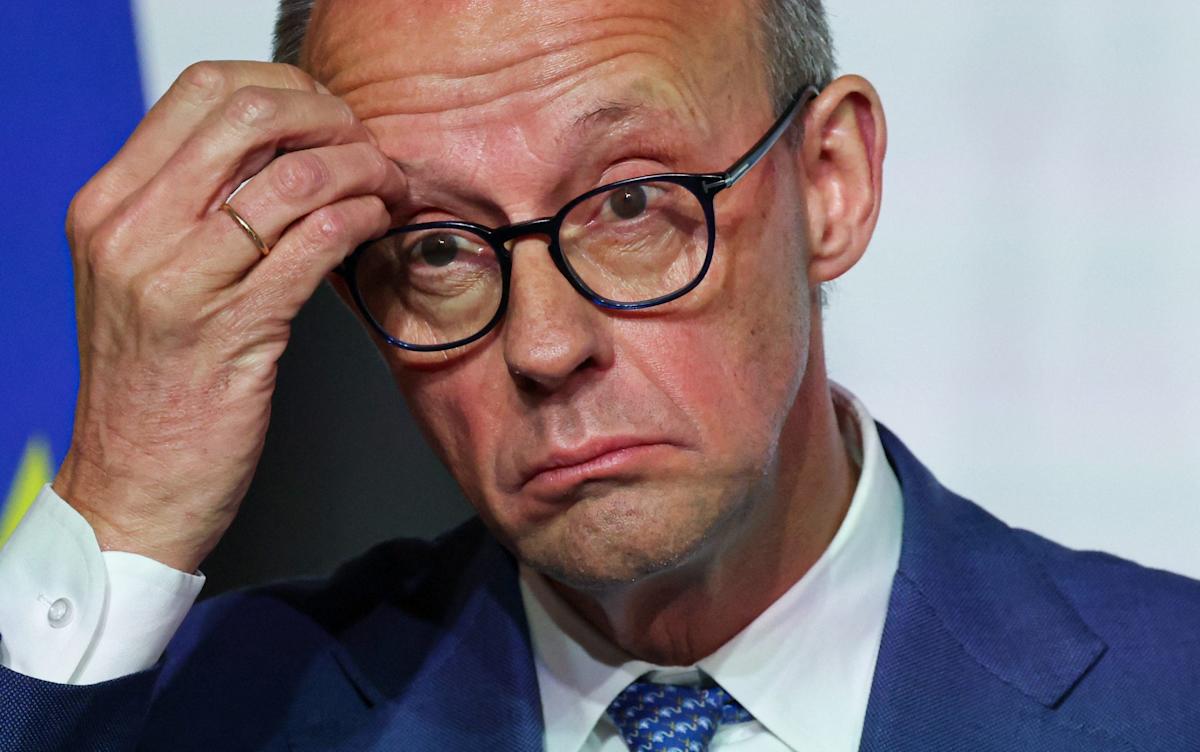
 Friedrich Merz, the German chancellor, says his country’s ‘industry is very critical in some places’ – Ludovic Marin/AFP via Getty Images
Europe’s sick man is in a critical condition.
Germany’s economy has barely grown since 2022 when Vladimir Putin ordered 200,000 soldiers across the Russian border into Ukraine.
Four years on and the country has partly managed to wean itself off its dependence on Russian oil and gas – but with unemployment now close to three million and big losses in key industries like carmaking as Donald Trump’s trade war wreaks havoc on its manufacturing industry, Europe’s biggest economy now faces an identity crisis.
Friedrich Merz, the German chancellor, outlined the near-term challenges in a letter to his coalition partners in the Bundestag last week. He warned it was do or die for swathes of industry.
“The situation of German industry is very critical in some places,” he warned.
“Industry giants as well as considerable numbers of mid-sized and small businesses are facing major challenges, in many companies jobs are being lost.”
Greg Clark, the former UK business secretary, noted in 2017 that it takes people in Germany four days to make what people in the UK take five days to produce. It was a jibe at Britain’s dire productivity levels.
But Merz warned last week that the country’s productivity growth is “no longer good enough”.
He blamed “changed global economic conditions” as well as high labour costs and red tape for holding back growth.
b’
1001 No end in sight for growth woes
‘
Recent data suggests this weakness is set to continue for the foreseeable future.
Despite Berlin’s much-lauded spending spree on defence and infrastructure, the country’s central bank lowered its growth forecast for 2026 to just 0.6pc. The Ifo, a think tank, predicts a similar expansion of just 0.8pc.
Others are more optimistic, with signs that the country’s €500bn (£430bn) stimulus package is starting to bear fruit.
Holger Schmieding, the chief economist at Berenberg Bank, notes that domestic orders are starting to pick up even though exports continue to be weak.
Berenberg also expects the economy to expand by a meagre 0.7pc this year, with government spending accounting for more than half of this increase.
Schmieding believes growth will strengthen to 1.3pc in 2027 as the stimulus reaches “full force” and consumers and businesses start to spend more.
However, he adds that Germany’s decision to change its constitution to allow unlimited debt financing for defence spending above 1pc of GDP would not be the game-changer for growth that some claim it to be.
“Some companies will struggle to fill all the new orders for tanks and drones and to upgrade as many railway tracks as they could with their rising backlog of orders,” he said.
Story Continues
Germany has another problem. Its workers are ageing, fast.
The International Monetary Fund recently warned that Germany’s working-age population was on course to decline more sharply than any other G7 economy over the next five years, with almost 30pc of the current workforce due to retire by 2036.
This presents not only challenges for balancing the books but exacerbates the country’s skilled worker shortage.
b’
1001 Employment growth has stalled
‘
As well as more training, economist Peter Bofinger – who has served as one of Germany’s so-called wise men on the Council of Economic Experts – worries that policymakers will focus too much on subsidising old industries instead of supporting new ones.
“The problem is we don’t have a vibrant digital sector,” he says.
“We also don’t have a very strong financial services sector like the UK, so much of our prosperity depends on manufacturing – and of course this is now under attack from China, which is able to produce the same things that we produce but more cheaply.”
His worry is that MPs will focus too much on energy subsidies at the expense of innovation.
“Innovation is a bright spot in the somewhat grey and foggy picture of the German economy,” he says, with official data suggesting that jobs linked to research and development are increasing.
b’
1001 R&D roles on the rise
‘
Bofinger says Germany has a golden opportunity as it more than doubles its military spending to hit Nato’s spending target of 3.5pc of GDP.
“In my view, the joker in the pack is the defence industry which has historically supported all sorts of technological innovation,” he says.
This is the same advice offered by Paolo Surico, of the London Business School, whose work has influenced policymakers on both sides of the Atlantic.
Surico argues that some of the best innovations and inventions have come from investment in defence, including GPS and even the internet.
He cites the example of penicillin, which was discovered by accident by Sir Alexander Fleming, the Scottish scientist, in 1928.
It was only developed more than a decade later when Vannevar Bush – then adviser to Franklin Roosevelt, the US president, during the Second World War – asked companies to scale up the drug for use by the American army.
Pfizer, then a chemicals company, rose to the challenge and used technology to produce enough penicillin for every allied soldier to carry a dose of the antibiotic on D-Day.
A pharmaceutical giant – and one that developed the Covid vaccine – was born.
Surico argues that ploughing money into research and development as well as guns and soldiers would be a better use of government cash and an investment in the future.
b’
1001 Investment remains weak
‘
For this reason, he suggests repeating defence tactics of old – such as Ronald Reagan’s 600-ship navy strategy in the 1980s – is likely to be less effective in a world where brain power can deliver more economic benefits than firepower.
“You can create two kinds of deterrent,” says Surico. “The Reagan one that builds ships, or the [John F] Kennedy [space race] one that arrives first to the Moon.
“My argument is that the Kennedy deterrent generates much more prosperity than the Reagan one.”
Bofinger hopes that Germany can stop clinging on to its past.
“What we have right now are traditional demand-side Keynesian policies of more spending for infrastructure and some tax cuts, which is why most people believe that this year we have around 1pc growth to get out of this stagnation,” he says.
However, he warns that the sugar rush will not last: “The biggest threat to the German economy is the government pumping too much money trying to support old industries that will die sooner or later.”
Bofinger says Germans need to take a leaf out of Joseph Schumpeter’s playbook. The economist coined the phrase “creative destruction” in the 1940s to emphasise that innovation causes the death of established businesses because it also creates new opportunities.
“At the moment, we have too much Keynes and not enough Schumpeter,” he says. “Of course, innovation doesn’t come out of thin air, it really needs financial funding – and that’s the way Germany can develop its economy.”