

The government, with Justice Minister Yariv Levin in the driver’s seat, is currently pushing forward a blitz of legislative action to further advance its judicial overhaul agenda, designed to loosen legal restraints on government decisions, actions and policies.
Having already passed in March last year a law greatly increasing political influence over the selection of judges, and thus the judiciary itself, the latest tranche of coalition legislation would dramatically erode the power of legal officials and institutions to check executive power, before legal motions against government action can reach the courts.
Among the pieces of legislation being advanced to achieve these goals is a bill to make the attorney general a political appointee and strip the position of its authority to interpret the law for the government; a bill asserting political control over ministerial legal advisers; a bill giving a politician, the justice minister, control over the department for investigating police officials; and a bill making the military’s top lawyer subject to the authority of the chief of staff, among others.
In addition, the government will bring to a vote in the Knesset plenum this week a motion to the agenda declaring that the High Court of Justice cannot issue orders against amendments to Basic Laws legislated by the government.
That motion is targeted at petitions currently before the High Court calling on it to annul the politicization of the judicial selection process. It also seeks to undermine the court’s landmark decision in January 2024, annulling a law passed by the government the previous year to ban the use of the judicial standard of reasonableness. Such a motion would not have the force of law, but could be used as a political cudgel against the court.
Get The Times of Israel’s Daily Edition
by email and never miss our top stories
By signing up, you agree to the terms
Finally, the fierce rhetoric by government ministers and coalition MKs in recent weeks, including calls to disobey the court, appears designed to delegitimize the court and possibly prepare the ground for actually outright disobeying court orders.
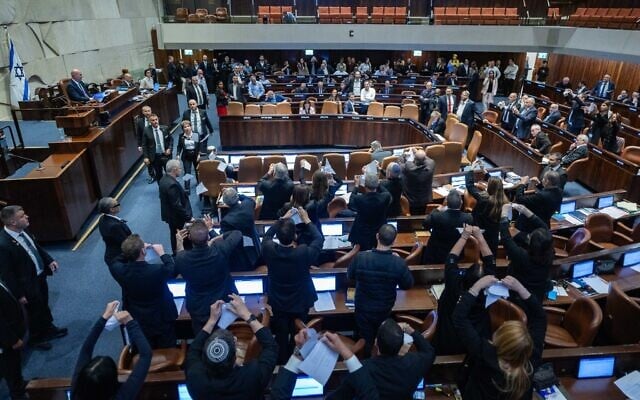
A Knesset plenum session, December 24, 2025. (Yonatan Sindel/Flash90)
The various pieces of legislation are all at different stages of the legislative process, but Levin has declared that he is intent on dismantling the legal system “brick by brick.”
It remains to be seen how much of this judicial overhaul agenda can be approved in committee and passed by the Knesset plenum in the three or four readings every piece of legislation needs to become law, before the government runs out of time, one way or another.
Bill to reduce power of attorney general and split the role
The Constitution, Law and Justice Committee is currently marking up a bill for its first reading in the Knesset plenum that would drastically reduce the powers of the attorney general and split the role, creating a new prosecutor general position, alongside the attorney general.
Splitting the role is not necessarily controversial if it were to be done thoughtfully.
But key provisions of the bill would give the government total control over appointing the attorney general and allowing it to fire the serving attorney general at the beginning of a new administration, making it a highly political appointment essentially subordinate to the will of the government. At present, a public, professional committee headed by a former Supreme Court justice appointed by the serving Supreme Court president recommends a candidate for attorney general to ensure that their first loyalty is to the law, not the government.
The bill also stipulates that the government would no longer need to view the attorney general’s legal positions as binding, meaning it would be at liberty to totally disregard their decisions, rendering the role practically meaningless, and essentially giving the government free rein to do as it pleases regardless of the law, unless and until the High Court weighs in.

Attorney General Gali Baharav-Miara attends a meeting of the Knesset Constitution, Law and Justice Committee, April 27, 2025. (Yonatan Sindel/ Flash90)
Bill subordinating ministerial legal advisers to the minister
Last week, the Knesset approved in a preliminary reading a law that would remove ministerial legal advisers, who tell ministers whether their actions, decisions and policies are legal or not, from under the authority of the attorney general.
Instead, legal advisers would be subordinate to the directors general of the ministries in which they serve, who are themselves political appointees of the minister.
Critics have argued that this would inevitably increase political pressure on the advice provided by the legal adviser regarding the minister’s policies and actions, and reduce the neutrality of such advice, in essence giving ministers a freer hand in terms of adherence to the law.
Bill giving justice minister control over police internal affairs
A bill that would give the justice minister control over the Department for Internal Police Investigations (DIPI) is set for its first reading in the Knesset plenum. A date has not yet been set, but it could be as early as this week.
DIPI, which is responsible for conducting criminal probes into police officers, currently operates under the State Attorney’s Office and is professionally and organizationally subordinate to it, while the head of the agency is appointed by a professional committee of the Civil Service Commission.
The new legislation would have the DIPI director appointed via a five-member committee, with the justice minister having control over a majority of members.
The DIPI director would serve for a six-year term, but could be fired by the same committee.

Head of the Judea and Samaria Police District’s investigations and intelligence department Commander Avishai Muallem arrives at the Department for Internal Police Investigations in Jerusalem, December 11, 2024. (Chaim Goldberg/Flash90)
Justice Ministry officials have expressed concern that the changes to DIPI’s structure would compromise its independence and politicize it, due to its subordination to a political figure, the justice minister.
Bill subordinating IDF military advocate general to the chief of staff
The government on Sunday gave its backing for a bill that would make the army’s top lawyer operationally subject to the Israel Defense Forces chief of staff.
Currently, the military advocate general is subject to the law only, and is free to conduct investigations and prosecutions without any interference at all from the rest of the IDF’s senior officers, guaranteeing independence when dealing with illegal actions committed by the military.
The new legislation, which is yet to be approved in a preliminary reading, would put the military advocate general under the direct authority of the IDF chief of staff. The chief of staff would have authority over the MAG’s actions and the exercise of their authority, as would be able to direct the MAG’s policies.
The bill’s first reading in Knesset before passage to committee could be as early as this Wednesday.
You appreciate our journalism

You clearly find our careful reporting valuable, in a time when facts are often distorted and news coverage often lacks context.
Your support is essential to continue our work. We want to continue delivering the professional journalism you value, even as the demands on our newsroom have grown dramatically since October 7.
So today, please consider joining our reader support group, The Times of Israel Community. For as little as $6 a month you’ll become our partners while enjoying The Times of Israel AD-FREE, as well as accessing exclusive content available only to Times of Israel Community members.
Thank you,
David Horovitz, Founding Editor of The Times of Israel