
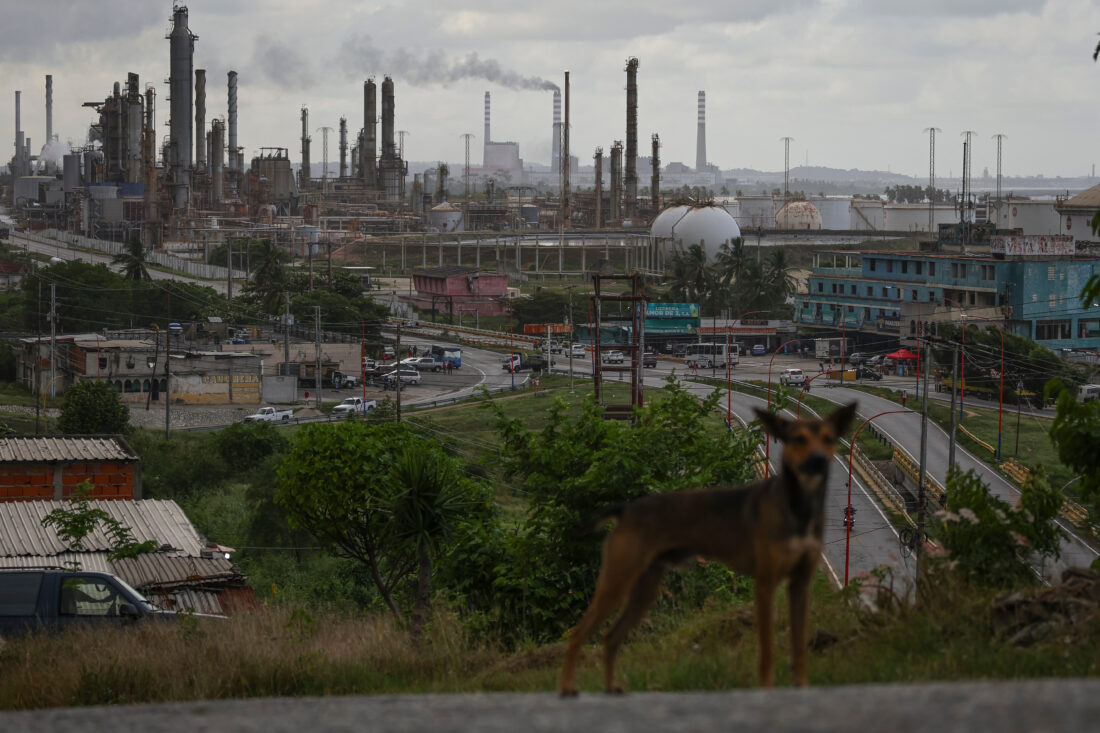
 View of the El Palito refinery of the Venezuelan state oil company PDVSA in Puerto Cabello. Photo by: Jesus Vargas/picture-alliance/dpa/AP Images
Venezuela holds the world’s largest oil reserves—a staggering 300 billion barrels—but there’s a vast distance between theoretical wealth and actual profit, says UC Berkeley Haas labor economist David Levine.
In this interview, Levine provides a sobering reality check on the “stranded” chemistry of Venezuela’s heavy crude, the risky investment required to restore broken infrastructure, and the devastating brain drain that scattered the nation’s best engineers to competitors around the world over the past two decades. From the country’s history of treating foreign capital like a “piñata” to the global shift toward renewables, Levine argues that investing in Venezuela remains a massive strategic gamble.
Levine is the Eugene E. and Catherine M. Trefethen Chair in Business Administration at the Haas School of Business. His research focuses on understanding and overcoming barriers to improving health and economic well-being in poor nations.
Haas News: How do you view the actual economic potential of Venezuela’s 300 billion barrels of oil today?
David Levine: When I heard about the Trump Administration’s actions in Venezuela, I assumed there was money to be made from what we’ve all read are the world’s biggest oil reserves. So I wanted to do a quick estimate of how much money we were talking about. I was surprised that the answer is not very much, and not easily. I want the people of Venezuela to prosper, but it’s not obvious how this will happen.
Venezuela’s oil reserves are largely “stranded” by chemistry. Most of it comes out of the ground with the consistency of cold peanut butter. To even move it through a pipe, you must mix it with costly imported diluents (such as naphtha), which adds roughly $15 per barrel to your costs before you’ve even reached a port. And when it gets onto a tanker, it’s still some of the hardest crude on the planet to turn into something useful. It requires specialized equipment and it emits a lot of carbon for each gallon of gasoline or other useful product. Because it requires complex “coker” refineries to process, it currently sells at a $12–$20 discount compared to global benchmarks like Brent.
“Venezuela’s oil reserves are largely ‘stranded’ by chemistry. Most of it comes out of the ground with the consistency of cold peanut butter.”
—Professor David Levine
Haas: In the past, Trump actually called it garbage oil and the “worst oil probably anywhere in the world.”
DL: I hadn’t seen that line, and it’s not entirely inaccurate. It’s not actually garbage—it has economic value. Once it’s turned into gasoline, it’s just gasoline, but it’s really expensive to do that. And at $60 a barrel, it’s not very economical to ramp up production quickly in spite of the incredible potential for sheer output.
Haas: On Friday, President Trump told American oil executives that he expects their companies to invest $100 billion to restore Venezuela’s broken infrastructure. Do you think that amount would do it?
DL: Nobody knows exactly what it takes to restore Venezuela’s power grid plus the entire energy infrastructure for pumping and distribution. We don’t know whether it’s $75 billion or $150 billion, but I think we can safely say it’s going to be a number with that many zeros. Generations ago, Venezuela was producing more than three times as much oil as it does now, but it would be very hard for it ever to get up to that level. Even doubling production from one to two million barrels a day is going to take an enormous investment.
The above-ground risks are also staggering. Even with Nicolás Maduro in U.S. custody, the nation now is at risk of ongoing civil war, gang violence, or continued conflict with the United States. Beyond civil unrest, Venezuela has a history of nationalizing assets when prices are high and begging for help when they are low. And Venezuela need not nationalize, it can just increase the fees and taxes it charges.
Fiduciary duty makes it hard for a CEO to explain to shareholders why they are sinking billions into a jurisdiction that has historically treated foreign capital as a piñata.
“Fiduciary duty makes it hard for a CEO to explain to shareholders why they are sinking billions into a jurisdiction that has historically treated foreign capital as a piñata.”
—David Levine
Even if Venezuela were politically stable, it’s a very scary place to invest. It’s hard to think that an oil company exec can look at that spreadsheet and tell their shareholders, “This is the highest risk-adjusted return I have on the planet.” Right next door in Guyana, there’s enormous new discoveries of light crude. There’s not an imminent civil war. There’s not this level of political instability. I think it just would require a very different model than most economists use to make Venezuela a profitable $100 billion investment for major oil companies.
Haas: You’re a labor economist. Let’s talk about human capital. What has happened to Venezuela’s human capital over the past couple decades?
DL: Maduro’s dictatorship was a human rights catastrophe and an economic catastrophe, and the result was that almost all of the skilled population left the country. And in the oil sector, many of them are highly skilled engineers, and they’re now working in the oil industry in Houston, Bogotá, Brazil, or Calgary. The oil companies there are operating with a skeleton crew. And for a massive sector of the economy, you need an entire pipeline of skilled people (no pun intended). You need good schools, you need vocational schools, you need on-the-job training, you need mentors with decades of experience. All of that is long gone in Venezuela. That’s not something you can replace in a year or two. All this took a generation to destroy, and it will take at least ten or 15 years to rebuild the human capital that left Venezuela.
“Maduro’s dictatorship was a human rights catastrophe and an economic catastrophe, and the result was that almost all of the skilled population left the country…All this took a generation to destroy, and it will take at least ten or 15 years to rebuild the human capital that left Venezuela.”
—David Levine
Haas: What was your calculus on how long it would take oil companies to turn a profit?
DL: If oil stays at $60/barrel, a new massive project in Venezuela’s Orinoco Belt might never hit a risk-adjusted break-even. The exception would be if the U.S. government provides unprecedented sovereign guarantees, meaning a taxpayer subsidy guarantees the investments. This approach means it might be profitable for the oil company, but not profitable for the nation because United States taxpayers are at risk.
The story changes if oil prices return to $100 for a decade or more, and we cannot rule out new technologies that substantially reduce the cost to pump and refine Venezuela’s heavy crude. But it’s very hard to see the medium-term trends making Venezuela into a serious oil exporter on a significantly larger scale than they are today. We live in a world where almost all the net new power coming online is from renewables, and where an increasing share of vehicles are electric, so persistently higher oil prices are not likely. Furthermore, investing $100 billion in the highest-carbon-intensity oil on earth when carbon taxes remain a possibility is a massive strategic gamble.
It’s possible that the price of Venezuela’s heavy crude will rise for a decade or more far above current levels, but it’s at least as likely that the already-unfavorable economics of that investment will worsen over time.