
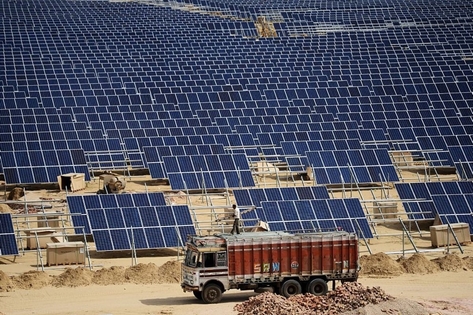
India recorded a landmark year in clean energy expansion during 2025, with non-fossil fuel installed capacity surging to 266.78 GW, Union Minister of New and Renewable Energy Pralhad Joshi announced yesterday.
The achievement represents a 22.6 per cent increase from 2024’s 217.62 GW, with 49.12 GW of new non-fossil capacity commissioned throughout the year.
Solar power emerged as the standout performer, jumping from 97.86 GW in 2024 to 135.81 GW in 2025—a remarkable 38.8 per cent growth that underscores its pivotal role in India’s renewable energy strategy.
Wind energy capacity also climbed steadily from 48.16 GW to 54.51 GW, registering a 13.2 per cent increase and demonstrating the diverse sources powering the nation’s green transition.
The capacity addition of 44.51 GW through November 2025 nearly doubled the 24.72 GW installed during the corresponding period in 2024, with solar installations contributing 34.98 GW and wind adding 5.82 GW.
Total renewable energy installed capacity reached 253.96 GW by November 2025, marking a 23 per cent increase compared to 205.52 GW in November 2024.
Joshi attributed the record growth to decisive policy direction and sustained implementation, noting that India’s clean energy transition gathered unprecedented momentum during the year.
The expansion strengthens the country’s path towards energy security, climate responsibility and a self-reliant green economy, with investments estimated at nearly Rs 2 trillion supporting the capacity additions.
India crossed the 100 GW solar milestone in January 2025 and achieved another landmark in June when non-fossil fuel sources accounted for 50 per cent of cumulative installed electric power capacity—five years ahead of its 2030 target under the Paris Agreement.
The government maintains its target of reaching 500 GW of non-fossil fuel capacity by 2030 as the clean energy sector continues its strong expansion trajectory.
Please click here to add Swarajya as your preferred and trusted news source on Google