
Unlock the Editor’s Digest for free
Roula Khalaf, Editor of the FT, selects her favourite stories in this weekly newsletter.
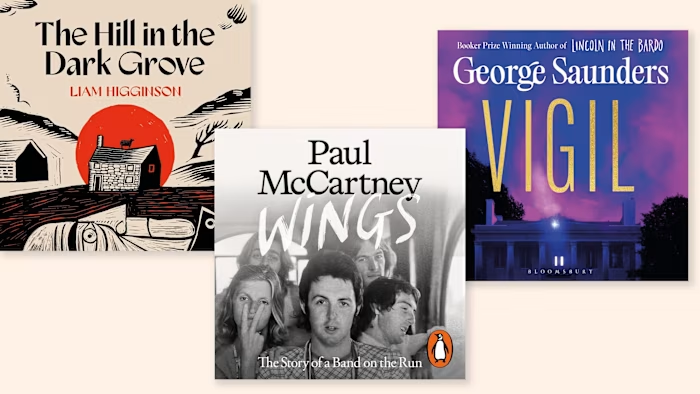
It’s cold out there, and for all but the most adventurous of us, listening to the story of someone excavating a burial mound in remote and inhospitable territory is probably preferable to doing it oneself. If so, Liam Higginson’s intriguing debut novel, The Hill in the Dark Grove (Picador, 10 hrs), provides just the right combination of action, reflection and tension to accompany you through a long winter night. Set in Eryri — or Snowdonia, as the non-Welsh would have it — the narrative takes us into the lives of husband and wife Carwyn and Rhian, who farm sheep against the imposing backdrop of Yr Wyddfa, their isolation punctuated by wealthy incomers (“super Ruperts”) and the occasional hapless tourist who has underestimated their ability to navigate the landscape (“Have you ever been snowed in? I bet it’s like The Shining,” as one cluelessly puts it).
Actor Richard Elfyn reads exceptionally well: a Welshman himself, he incorporates Higginson’s default use of Welsh place names and other vocabulary by making it feel natural rather than a barrier. Most importantly, he blends the novel’s deep commitment to its setting — both material reality and the rhythms and changes experienced throughout the calendar year that forms its timeframe — with a lively, intriguing interest in the folklore and fantasy underpinning the characters’ lives. And even as Carwyn’s devotion to uncovering the stone circle that he has discovered on their land appears to tip into a darker form of obsession, bringing up themes of land and belonging and destabilising his and Rhian’s long marriage, Elfyn retains an impressively controlled and measured tone.

In a brief sideways glance, if you this sounds to your taste, you might also enjoy the recently published Bog People: A Working-Class Anthology of Folk Horror (Penguin Audio, 7 hrs 20 mins), in which editor Hollie Starling brings together writers including AK Blakemore, Jenn Ashworth and Natasha Carthew for a festival of uncanniness that also sheds light on the class origins and contours of British horror writing.
And to continue the spooky theme, there is Olga Ravn’s terrific The Wax Child (Penguin Audio, 4 hrs 34 mins), in which a 17th-century Danish witch trial is seen through the eyes of a doll created from beeswax by a child whose mother has been condemned to death. Martin Aitken’s translation is superbly read by Freya Miller, who captures precisely the most lurid and grim details of a real historical episode while also bringing to life its fearsome psychological charge.

As with Higginson’s Welsh tale, narrative control is one of the keys to the success of Daniyal Mueenuddin’s This Is Where the Serpent Lives (Bloomsbury, 11 hrs 58 mins). This time the scope is panoramic, encompassing multiple characters, strikingly varied geographical, financial and social milieux and critical moments in the history of Pakistan. Mueenuddin’s first book, the accomplished short-story collection In Other Rooms, Other Wonders, made clear his talent for compressing complex and weighty themes into apparently constrained tableaux; 17 years later, his first novel draws on short-form discipline to create a work of mosaic structure and expansive power.
Mueenuddin himself reads the overlapping stories of street child Yazid, abandoned at a Rawalpindi tea-stall which he subsequently transforms into his own going concern, his friend Zain, the wealthy military family Yazid later works for, and the servant boy who becomes a protégé of sorts.
As one might expect, this is a writer’s rendition rather than an actor’s, unshowy and comparatively low-key — but it is also mesmerising; there is a plangent, melancholy tone to the way episodes and stories unfold, illuminating individual fallibility, appetite and idiosyncrasy in one moment, alluding to the turbulence of political and national life in the next. There is an acknowledged echo of canonical European novels here — of Tolstoy and Dickens — as well as of the eventful, teeming sagas of Indian and Pakistani literature, the different traditions and storytelling modes blending to make the whole truly gripping.

In an entirely different vein, you might have noticed the popularity of Paul McCartney’s Wings: The Story of a Band on the Run towards the end of last year. Just before Christmas, an audio version was released (Penguin, 13 hrs 12 mins), with additional contributions from McCartney’s daughters Mary and Stella and a new introduction by the man himself. For fans, particularly of the completist variety, it’s an attractive package: a formidable array of interviews curated by editor Ted Widmer and performed by an ensemble cast to describe exactly what McCartney did in his post-Beatle years.
Looking a little ahead, several other tempting listens beckon. A little later this month, Departure(s), the latest — perhaps final — book by Julian Barnes, will hit the shelves, with the author narrating the audio version of a characteristically erudite, entertaining and deft blend of fact, philosophy and fiction. Barnes is an excellent reader of his own work — wry, humorous and urbane — and it’s quite something to think of him closing the curtain on such a distinguished career. I’m also immensely looking forward to Vigil by George Saunders, having found the multi-voiced performance of his Booker Prize-winning novel Lincoln in the Bardo an aural marvel; in Vigil, Saunders once again returns to the shadowy zone between life and death, as an oil tycoon refuses to go gently into that good night.

And a final, somewhat topical note for future listening. If you’ve been watching The Traitors on TV, you might have noticed crime writer Harriet Tyce demonstrating a talent for uncovering devious plots and smoking out suspicious characters; and reportedly, her performance has done sales of her books, of which I’ve long been a fan, no harm at all. February sees the publication of her new novel, Witch Trial, the audio book of which is read by Angus King, the voice behind Douglas Stuart’s Shuggie Bain, and which revolves around a murder conducted in the crucible of a social media frenzy, perhaps the contemporary version of Olga Ravn’s source material. It doesn’t take a criminal mastermind to work out that it might do rather well.
 New reading for 2026
Books from Amitav Ghosh, Maggie O’Farrell, John Lanchester and others — here are some of the top titles of the year ahead
Join our online book group on Facebook at FT Books Café and follow FT Weekend on Instagram and X