
From near-daily Israeli strikes to a political deadlock over Hezbollah’s disarmament and deepening economic and financial distress, Lebanon is engulfed in a cascade of tangled crises, all made worse by mounting fears of yet another devastating war with Israel.
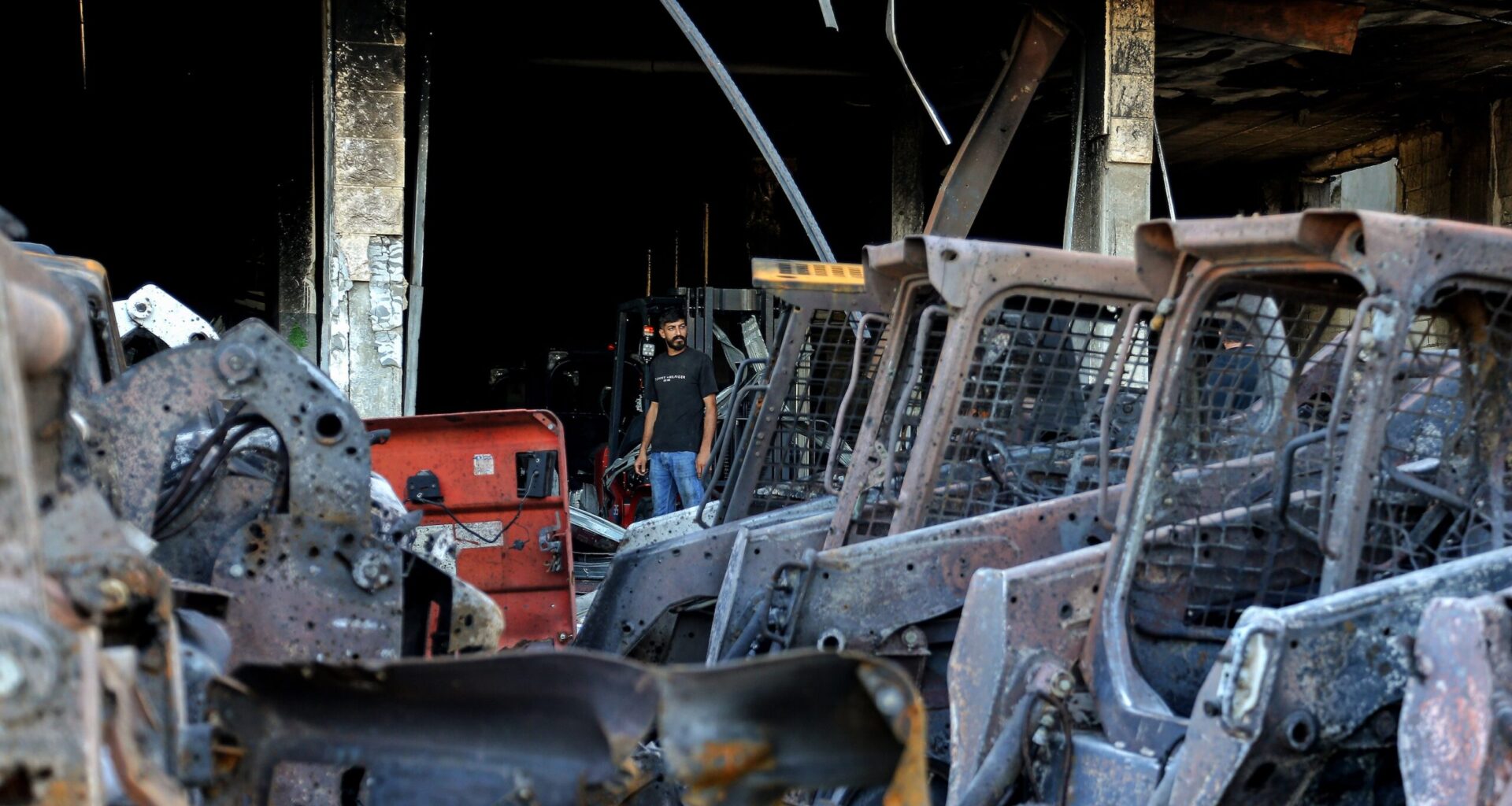
While all Lebanese are affected, the country’s Shi’a community has borne a disproportionate share of the burden. Last year’s war displaced hundreds of thousands of people from their homes in the south, the east, and Beirut’s southern suburbs, leaving neighborhoods and villages destroyed, with reconstruction impeded by the lack of funding and repeated Israeli attacks on building equipment. At the same time, Hezbollah, the main political force representing the community, has seen its influence impacted by the conflict, leaving the Shi’a population increasingly isolated in a new political reality marked by heightened sectarian tension and deepening distrust.
When it assumed power in February 2025, the Lebanese government announced four priorities: Hezbollah’s disarmament; reconstruction; economic and legal reform; and Israel’s withdrawal from Lebanese land. These priorities are seemingly contingent on one another. For instance, unlocking reconstruction funds is conditioned on progress toward disarmament, while achieving Israeli withdrawal requires a shift in the United States’ unwavering backing of Israel. At the same time, American and Israeli officials alike have been justifying continued escalation in Lebanon, saying the Lebanese army’s plan and progress to disarm Hezbollah is “far from sufficient.” The US response to the conflict’s aftermath has included proposing a demilitarized “economic region” in South Lebanon’s border regions and enforcing a normalization process, both of which lack broad public support.
This complex political and economic context has further polarized the political discourse in Lebanon and intensified the isolation, and consequent frustration, of the Shi’a population. To safeguard social cohesion, the Lebanese government must work even harder to further integrate this community rather than treat its marginalization as an inevitability. The government has a crucial role to play: building bridges with local players in South Lebanon, aggressively countering sectarian incitement—whether targeting Shi’a or other communities—and providing a more nuanced and comprehensive national vision.
For an intimate local connection between state and periphery
Hezbollah’s main argument for retaining its weapons is the protection of South Lebanon. Yet the group’s military maneuvers and foreign policy since October 8, 2023, have been detrimental to the country and South Lebanon. Instead of ending the war in Gaza and enhancing Lebanon’s regional standing as it intended, Hezbollah revived Prime Minister Netanyahu’s domestic standing in Israel, destroyed Hezbollah’s military and intelligence capacity, and displaced hundreds of thousands of people.
Despite such outcomes, a segment of the Shi’a population accuses the current Lebanese government of bending to the US and of reluctance to protect the south following the war. This sentiment has been further amplified by widely-circulating fake news, incitement of inter-sectarian tension, and a media discourse that frames the government as a beneficiary of Israeli occupation.
In such a context, worsened by unrestricted Israeli aggression and the dominance of “power politics” on regional affairs, the question arises: How can the Lebanese army disarm Hezbollah without alienating the population in South Lebanon? Using brute force to pursue that goal is both contentious and conflicted, particularly at a time when the army cannot afford either a confrontation with Israel that it would likely lose, or a full escalation against Hezbollah that risks further internal fracture. How, then, can authorities escape this dilemma all the while responding to the needs of the Shi’a constituency?
One answer lies in local politics.
The government cannot persuasively govern South Lebanon from Beirut, nor can it afford to ignore the region’s local political dynamics. It needs to engage with the personal networks and economic interests which make up the social fabric of the region’s administrative and political core. It also needs to directly compete with Hezbollah’s client-patronage networks, which provide its constituency with key medical and educational services, as well as party-sponsored and financed employment.
In the short term, the government should leverage its international legitimacy to lobby for support programs and grants which will help fund development efforts in the south. In the long term, it must invest in sustainable local development, including reliable energy and water provision, as well as the creation of an enabling environment for micro-businesses and startups.
In parallel, government officials should increase their public presence in Lebanon’s southern border areas, openly challenge Israel’s impunity, and forge ties with independent public figures from that region
In parallel, government officials should increase their public presence in Lebanon’s southern border areas, openly challenge Israel’s impunity, and forge ties with independent public figures from that region. One such figure is Tarek Mazraani, an engineer from the south whom Israel publicly threatened for mobilizing local residents and insisting on the population’s return and reconstruction of the region.
Another embodiment of effective local politics is the case of Ousama Saad, a parliamentarian from Sidon, a city 40 kilometers south of Beirut. Historically aligned with Hezbollah and its allies both politically and electorally, Saad has gradually distanced himself from the group since 2019. He has openly criticized its sectarian paradigm and strategic choices while maintaining much of his support base, which holds sympathies for Hezbollah. For example, in a speech delivered on September 16, 2025, Saad called on the state to play its part in protecting South Lebanon while also maintaining that Hezbollah hand over its arms. Saad’s ability to navigate this shift can largely be attributed to his strong involvement with Sidon’s municipality and local institutions, carefully developing strong communal ties and credibility.
Winning the media: Countering hate speech and sectarian incitement
While the Lebanese government has urged external actors to respect the state and the Lebanese army as capable institutions, it has failed to meaningfully engage in the domestic debate, particularly between the two poles that dominate the traditional and social media discourse: Hezbollah and the Lebanese Forces, the largest Christian party in Lebanon.
Hezbollah presents a narrative of perpetual victimhood for Lebanon’s Shi’a population, coupled with an understanding of resistance which has not been able to coexist with the legacies and stories of other political forces and confessional communities. This was clearly demonstrated by the gratitude Hassan Nasrallah displayed for the Syrian regime at a time when its occupation of Lebanon was being challenged in 2005. On the other hand, the Lebanese Forces champions a discourse which goes beyond simply opposing Hezbollah’s hegemony. It actively advances an “us” (Christians) versus “them” (Shi’a) narrative, further entrenching sectarian polarization rather than fostering constructive debate or cross-communal cooperation as a means of addressing Hezbollah’s role. Thus, hate speech today is the most dominant political language informing public debate in the country.
While the government is taking part in institutional and policy conversations, positioning itself as a neutral actor in the face of sectarian consolidation, it has not actively sought to counter sectarian incitement through a straightforward, bold, and secular communication strategy in the face of polarizing commentary.
A clear illustration of this dynamic emerged in September 2025, when Hezbollah projected images of Nasrallah and its other assassinated leaders on the Pigeons’ Rock, one of Beirut’s most symbolic landmarks. This act was perceived as sectarian posturing, given that the site lies in a predominantly Sunni area whose residents largely oppose the group and accuse it of assassinating former Prime Minister Rafik Hariri.
The government’s unsuccessful attempt to ban the projection was likewise interpreted through a sectarian lens. Although Prime Minister Nawaf Salam justified the ban on the basis of legal procedures and regulations governing the use of public spaces, critics framed it as an attempt to suppress the public presence of Lebanon’s biggest Shi’a leader. Salam’s mundane discourse about permits, projectors, and licenses was overtaken by the loud noise of sectarian politics, a game in which Hezbollah—just like other large sectarian political parties—retains a structural and discursive advantage.
Furthermore, two weeks prior to the commemoration of Nasrallah’s assassination, state officials and political parties, particularly Christian-majority forces, celebrated Bashir Gemayel’s legacy. Gemayel was the former leader of the Lebanese Forces and a major right-wing Christian warlord during the civil war. He was elected as president in 1982 before his assassination only a couple weeks later. While often portrayed as a symbol of Lebanese nationalism by supporters, his legacy remains contested, marked by documented massacres and exclusionary rhetoric that continue to reinforce a singular vision of Lebanese history.
In truth, celebrating the legacies of either Gemayel or Nasrallah—both rooted in war and division—offers little in the way of a constructive path forward. The government can opt for an alternative approach. What Lebanon needs today are symbols, stories, and causes that speak directly to people’s day-to-day lives, evoking emotional connections to their continuous struggles.
The government can openly counter the profiling of Lebanese Shi’a, particularly residents of the south, through media engagement and an effective digital presence, while simultaneously rejecting Hezbollah’s portrayal of other constituencies as “traitors.” In parallel, the government should elevate the debate to the global stage, articulating in both English and Arabic a clear, sovereign, and unified Lebanese position against Israel’s unrelenting aggression in South Lebanon.
More importantly, the tools and tactics employed by the government need to change. Written statements are frequently and deliberately distorted by the government’s political opponents. Put simply, they are not effective in communicating with the public. The government needs to better navigate technology and the attention economy as sectarian parties do.
New way of doing politics
The state needs to pursue a multi-dimensional roadmap through which alternative causes and stories can help solidify cross-sectarian solidarity, as opposed to the single-issue contention accompanied by the Hezbollah disarmament dilemma and the heated debates which have informed the country’s sharp divisions since the civil war.
In that sense, the government cannot limit itself to rejecting and countering sectarian narratives: it has to champion alternative issue-specific causes and movements, especially those that have been sidelined over the past four years by the dominant narratives pushed by traditional political parties. For example, when commemorating the civil war, the state should center the wives and mothers demanding accountability and justice for the families of the disappeared, instead of memorializing warlords and political leaders who destroyed the country and later assumed power. The government must also highlight the legacy of the country’s peace movement, as opposed to reaffirming the legacy of those who profited from the war, politically and economically.
The conversation in Lebanon needs to shift from inter-sectarian tension to cross-sectarian mobilization. The fallout from the 2019 financial collapse, which hurled most of the population into economic limbo, is one clear embodiment of such shared struggle. The government can seriously and publicly challenge the interest groups—banks and politicians—that caused the crisis and are now trying to circumvent financial accountability and a fair redistribution of losses.
Ultimately, winning over the Shi’a population will neither come through coercion nor technocratic neutrality. Their trust needs to be earned through genuine and effective engagement. Moving beyond a public discourse that pits Hezbollah appeasement against hawkish sectarian confrontation, Lebanon would benefit from a government that can protect those most marginalized, all while challenging sectarian parties’ claims and opposing narratives.
Karim Safieddine is a Lebanese organizer and researcher from Lebanon, particularly engaging with the Mada Network and secular clubs.