
Published: 13 January 2026
I’ve been visiting Northern Ireland since the early 1990s and I always saw it as a very unspoilt part of the UK, it’s magnificent in terms of its natural resources and it has some exceptional species.
— Chris Packham
The BBC’s much-loved Winterwatch is back for 2026 – and this year marks an exciting new chapter. For the first time ever, the programme’s main, live base will be broadcast from the beautiful Mount Stewart estate on the shores of Strangford Lough in Northern Ireland.
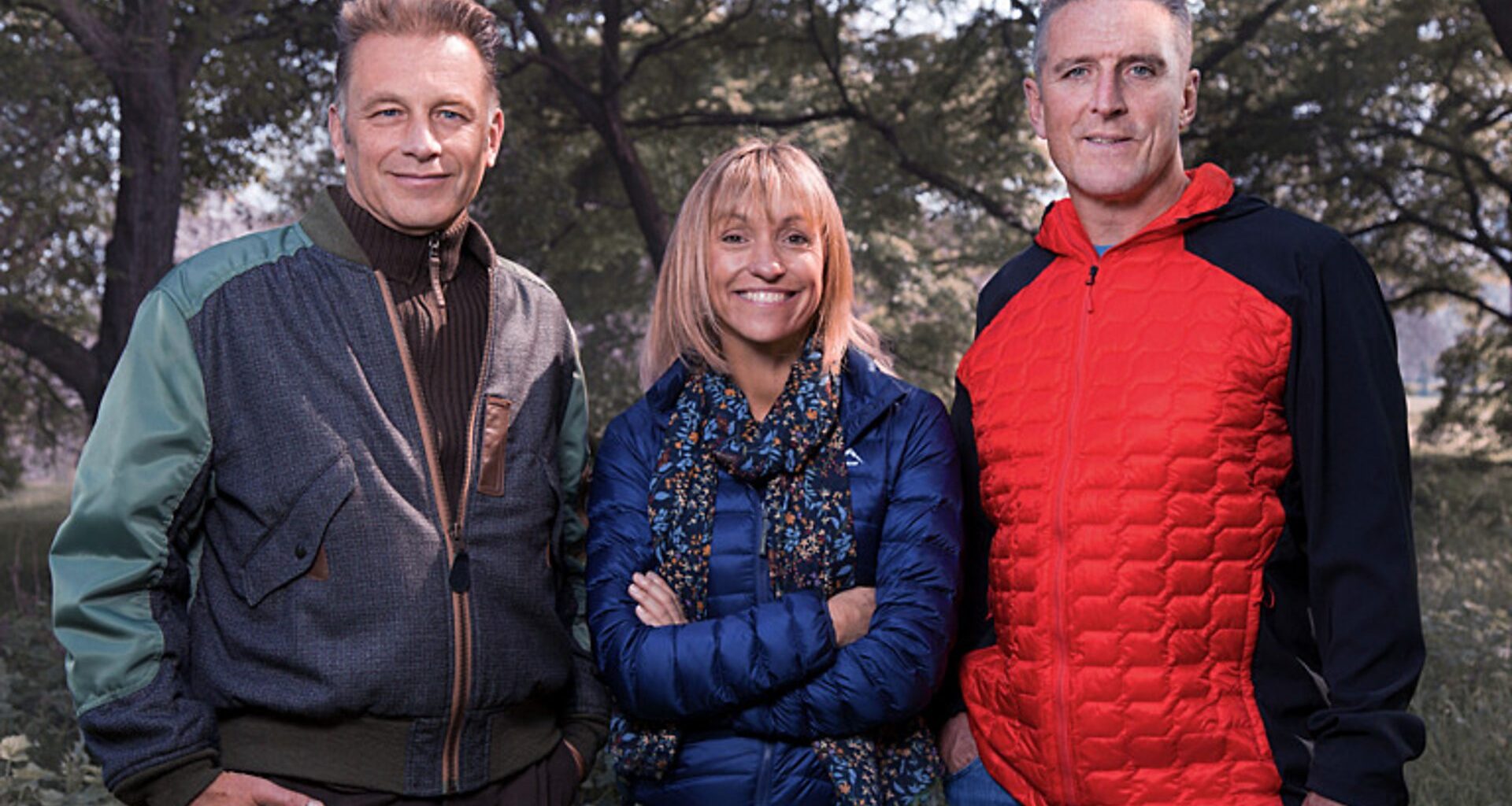
Fronted by Chris Packham, Michaela Strachan and Iolo Williams, Winterwatch 2026 promises a spellbinding celebration of the natural world at its most dramatic. The series once again continues to inspire and captivate, giving viewers an intimate look at the wonder of winter wildlife across the UK.
Across the series, Chris, Michaela and Iolo will guide the audience through the topical wild stories shaping the UK winter, from climate-driven changes in migration, to the challenges local species face in a warming world. Expect innovative live camera rigs, creative storytelling, and discussions that shine a light on the beauty and vulnerability of our wildlife.
This year, Winterwatch returns to BBC Two & iPlayer from Tuesday 20 January – Friday 23 January at 7pm, across four nights.
Why Mount Stewart?
Mount Stewart, cared for by the National Trust, is a wildlife treasure trove and Winterwatch is ready to showcase it like never before. Its mild, microclimate, ancient woodlands, rich wetlands and proximity to the beautiful Strangford Lough, create the perfect stage for a winter spectacular. Expect a dazzling cast of species and a host of seasonal behaviours as animals power through the toughest months of the year. Whether under crisp frosts or storm-laden skies, Mount Stewart teems with life.
What to expect from Mount Stewart’s wildlife
Dawn and Dusk Dramas
Viewers can look forward to the haunting silhouettes of long-eared owls as they scan the woodlands at dusk, and the ghostly glide of barn owls patrolling open fields once darkness falls. With the use of our thermal cameras, we’ll be watching their winter hunting strategies in real time.
Woodland Characters on the Move
Pine martens are making a quiet comeback in Northern Ireland and Mount Stewart is home to a healthy population, so we’re expecting them to be out in abundance. Winterwatch will be ready to capture these elusive, charismatic predators on camera, as they go about their winter antics. The pine martens share the estate’s mixed woodland with charming red squirrels, whose energetic dashes between ancient trees will be captured by our remote cameras. We’ll follow their food-stashing tactics and see how they outsmart both winter and their competition.
Strangford Lough’s VIP Winter Visitors
Neighbouring the estate, Strangford Lough becomes a winter sanctuary for thousands of migratory waterbirds. During this season, we can anticipate the arrival of various waterfowl including vocal flocks of Brent geese, elegant whooper swans paddling through icy shallows and large gatherings of wigeon, teal and shelduck feeding across the mudflats. We’ll bring viewers the drama of their daily routines, from dawn feeding frenzies to twilight roosts.
Hidden Lives Beneath the Woodlands
Infrared cameras will give audiences unprecedented access to badgers, revealing how they conserve energy, maintain their setts and navigate the cold nights. Winterwatch will be on the lookout for playful cubs and the social politics of sett life.
Aerial Hunters and Coastal Clashes
The local skies are patrolled by impressive winter raptors, so we’ll be keeping our eyes peeled for buzzards circling over the estate, sparrowhawks ambushing garden birds and, if luck is on our side, the iconic red kites gliding through winter thermals. Otters have been seen on the shoreline of the lough and make their way through the estate’s waterways, so the Watches cameras will be poised to capture them in action.
Pre-filmed stories
To celebrate winter beyond Northern Ireland and across the UK, Winterwatch will also showcase a range of pre-recorded films that document the season and the diverse species that inhabit our shores. We’ll be celebrating the passionate people going the extra mile to preserve and protect threatened wildlife.
Films include:
A stoat story – masked mustelid
The Yorkshire Wolds in winter can be a lively place. Temperatures plummet, and the vast cast of characters that call this landscape home, do all they can to survive the season. But there is a bandit on the loose, a stoat that will steal from her neighbour’s larder and prey on the other residents.
Winter beech copse
In the rolling hills of Dorset, with its steep slopes of chalk grassland, one natural feature rules the landscape … the beech copse. Perched at the summit of exposed hilltops, these small clusters of trees provide precious places for our winter wildlife to refuel and find refuge. From long tailed tits feeding on invertebrates in the branches, to earthworms making the most of the leaf litter and the robins and red kites that forage for the worms, there’s a whole web of life at work here. And this cast of characters have chosen wisely – beech trees have a remarkable ability to bend and flex, withstanding the worst of the winter storms, without breaking. The trees in the copse might be few, but they are a mighty mini habitat.
Goldcrests
Winter can be a tough time for the country’s smallest bird. Facing bad weather, limited food supply, and cold nights. But a city park in Bath could have all they need to see them through the season. The goldcrest must make use of its tenacity to beat the odds and find enough food to make it through the night.
Stentor
Winter can transform our landscapes – especially when wet weather arrives. When floodwaters rise, what was a mosaic of pasture and meadow, can quickly become a patchwork of muddy puddles. Easily overlooked, these puddles actually contain an incredible variety of microscopic life. From bearlike tardigrades feeding on fragments of moss, to a remarkable single celled organism called a Stentor that stretches and squeezes through the waterlogged soil. If damaged, this tiny changeling can regenerate at speed, if split in two, two brand new individuals will form. This muddy puddle is a place where the truth really is stranger than fiction!
Lira’s Mull adventure
Lira Valencia swaps the concrete jungle of London for the wilderness of Mull as she searches for some of the iconic species synonymous with the Scottish island. Along the way, she discusses some of the behavioural differences that can be observed between urban vs rural populations and encounters more than she bargained for.
Klay Blake
Nature guide Klay Blake revisits the place where he first fell in love with UK wildlife, especially birds: urban wetland reserve Far Ings on the banks of the Humber estuary. He loves the way that wetlands like this come alive with wildfowl and waders in the winter, and revels in the species he discovers from moorhens to marsh harriers. While soaking up the sights and sounds of the reserve, he reflects on how, growing up just outside of London, UK wildlife was never on his radar. It was when he visited this urban reserve, whilst at the University of Hull, that his life path changed. Now he’s on a mission to help others get out and experience our winter wildlife wonders.
Biofluorescence
We set wildlife camera operator Ben Harris and Winterwatch researcher Seth Daood the challenge of filming an incredible natural phenomenon in a temperate rainforest… at night! Heading into Ty Canol National Nature reserve as the sun was setting, our intrepid crew had to navigate this lush, precious habitat armed with UV torches and some very long lenses. They discovered an abundance of tiny wonders which, when viewed under the UV light, glow in a range of kaleidoscopic colours – a phenomenon known as bio-fluorescence. The challenge for Ben was then to get the perfect shot so we can see these incredible species in a whole new light!
Billy Heaney – Safe Harbour
We follow zoologist Billy Heaney on his annual pilgrimage to Islay to see some sensational seasonal visitors – geese. Billy shares why these birds are so important to him at a time of year when the days are growing shorter and why Islay provides a refuge for him as well as the geese. It is also a chance for him to celebrate the endangered Greenland white fronted geese that find safe harbour here throughout the winter.
Mindfulness moments
As audiences have grown to know and love the magic of wildlife in winter, there will be a moment in every episode when viewers can unwind and immerse themselves in moments of pure natural beauty. Every night the programme will offer 90 seconds of wildlife moments with no music and no presenter comments – just natural sound and glorious pictures of our very best wild places.
Q&A with Chris Packham
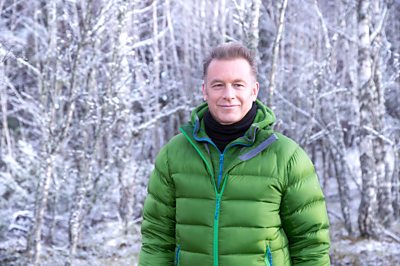
It’s the first time the series has been broadcast live from Northern Ireland, what can we expect?
I’ve been visiting Northern Ireland since the early 1990s and I always saw it as a very unspoilt part of the UK, it’s magnificent in terms of its natural resources and it has some exceptional species. Obviously since that time, some things have got worse but some have got better and so we’re going to celebrate those things that have improved. It’s got incredible coastal regions and loughs and a wonderful range of species, some of which we don’t see frequently across the UK so very excited to be heading there.
Are there any animals you particularly love seeing at this time of year?
Yes, it’s those animals which remain active in the wintertime and so we have cameras set up on our badgers set which we’ll be looking at. We hope to see red squirrels and pine martens, seeing how they interact with one another. Be interesting to see how that might play out in the UK, if we are able to successfully encourage the spread of pine martens. At the moment we’re hoping for everything to be covered in snow, so that’ll be beautiful for us, so let’s see what happens. In terms of top of the list, it would be pine martens for me as you don’t see them very often.
Are there any new animals to Winterwatch or new behaviours we can expect in this series?
The great joy of our live programmes is that there’s always something new and you don’t know what it’s going to be and that’s part of what keeps us coming back to it. The team never tires as we keep turning up not knowing what to expect and of course we have any number of plans but inevitably something crops up which you don’t expect to see. Looking at Winterwatches past we’ve had foxes killing stoats on our thermal cameras, fantastic owl action so who knows what we’ll see!
You continue to champion the importance of biodiversity and protecting the natural world, is there anything viewers can do to help support their local wildlife?
If you’re fortunate enough to have a garden, now is really the time to make sure it is a proper, resilient resource for wildlife. That means it needs to be capable of withstanding extreme wet and extreme dry conditions. We have predictions for a very hot year coming up, so making sure there are wet spaces in there, if you can add a pond, no matter how small it doesn’t matter. A constant source of water is invaluable to wildlife of all kinds. Providing shelter for animals if you have that capability is equally as important. Within our communities many of our natural areas are under threat, so I would urge viewers to cast their minds back to the days of lockdown where so many people found respite and solace in those green spaces in their communities. We must do everything we can not to forget that and protect them going forwards.
There are some lovely mindful moments we can expect in this series, how can viewers connect more to nature in their daily lives?
It’s a question of concentrating on that very task of connection, it’s about making sure you are conscious that you are connecting with nature and that means putting the phone away or stopping a conversation. It means trying to fully engage as much as possible with nature for as much time as you can afford. Focusing on one aspect of nature makes it easier, so rather than just walking through a wood and thinking this is lovely, it’s about focusing on the simple aspects, such as listening to the bird song, the wind in the trees, the colours of the leaves and connecting in a very intense way. The more intense the longer lasting those benefits are, so focus on those simple aspects or whatever is applicable in your space.
Q&A with Michaela Strachan
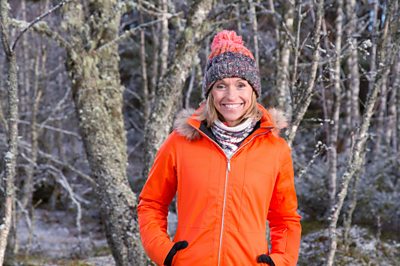
It’s the first time the series has been broadcast live from Northern Ireland, what can we expect?
Expect a winter celebration of the natural world. Expect a variety of wonderful wildlife and woolly hats. Expect to be inspired and entertained. Expect science, storytelling and humour. That’s of course what you would expect from any Winterwatch, but having Northern Ireland as our base camp, is a first, and a new location is always exciting. Red squirrels will no doubt be part of our Winterwatch starring cast, along with pine martens, as both are doing well around the National Trust’s Mount Stewart Estate where we will be based.
We’ll be right next to Strangford Lough, so plenty of opportunity to film wintering birds who arrive in their 1000s, Brent geese, pintails, wigeon, teal, Slavonian grebes and whooper swans. Hopefully otters will make their entrance too. As well as badgers, Irish hares, long eared owls, buzzards, red kites, sparrowhawks to name just a few.
Are there any animals you particularly love seeing at this time of year?
I love a noisy show, so really hoping we’ll get an aerial spectacle from some of the many flocks of wintering birds. Around 80,000 spend the winter around Strangford Lough including internationally important numbers of geese, redshank and knot, so there’s a good chance of enjoying a winter performance.
Red squirrels are always a treat and no doubt will also turn out a top performance.
Are there any new animals to Winterwatch or new behaviours we can expect in this series?
Who knows? I think in every single Watch we see something that surprises us, that’s the absolute joy of doing the programme, the unpredictable scripts that wildlife writes for us. It’ll be great to be able to film pine martens live throughout the week. It’s been six years since we we’ve been able to feature them on our live cameras, so that will be a treat. We’re going to try out one of our infamous behaviour experiments that involves a big hamster wheel! Sounds a bit nuts, but it’s all based on an actual scientific study that was done, so hopefully we can learn something new from that. Or maybe not! Sometimes these experiments don’t go to plan and we find that the wildlife just hasn’t read the script! But I’m feeling optimistic.
You continue to champion the importance of biodiversity and protecting the natural world, is there anything viewers can do to help support their local wildlife?
We’re always keen to inspire viewers to get out into the natural world, visit your local wild space or nature reserve. Stay curious, observe from a distance, always respect the wildlife you want to see. Do what you can to help look after and protect your local wildlife, from making your garden more wildlife friendly to joining a local wildlife group, to campaigning for more protected wild spaces. Think about your actions and how they affect the natural world. Question your habits and decisions, make changes in your life that will make a difference.
There are some lovely mindful moments we can expect in this series, how can viewers connect more to nature in their daily lives?
I think first of all, many of us have to make a conscious effort to disconnect from our screens and social media. Not completely but make it less of a default habit. Our minds are bombarded with information from social media, a lot of it we don’t need and the constant flow of posts can make people anxious and unfocused. Put aside time to get out into nature, we all know that we feel better for it, so start to make that the default instead!
Q&A with Iolo Williams
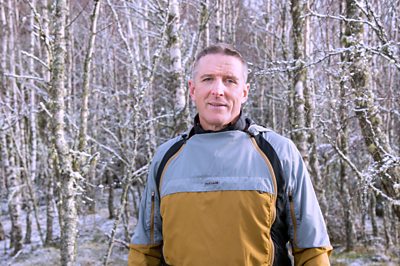
It’s the first time the series has been broadcast live from Northern Ireland, what can we expect?
We can expect an array of winter wildlife. We will be looking at red squirrels, which are always lovely to see, hopefully pine martens too, and we’re also hoping to follow Badger sets. I had a peek at some of the wildlife at Mount Stewart in spring, so I’m looking forward to going back there and also spending time on Strangford Lough. We’ll hopefully see waders and wildfowl and some Brent geese, birds that have come all the way from Arctic Canada. So, it’ll be an amazing array of wildlife that we’ll be bringing to the audience.
Are there any animals you particularly love seeing at this time of year?
Yes, over there I’m hoping to see the pine marten. Obviously, we hope we will have them on camera for people to see at home, but I would love to actually see one. I’ve seen one in Scotland and I’ve seen one in Wales but I’ve never seen one in Northern Ireland, so I’m really hoping that I personally get to see a pine marten.
Are there any new animals to Winterwatch or new behaviours we can expect in this series?
It’ll be interesting to see if we get any interaction between pine martens and red squirrels. There’s a lot of research that shows that pine martens will target grey squirrels and that helps the recovery of the red squirrel population, but in this area, there are no greys, so I’m hoping we get to see some interaction between pine martens and red squirrels.
You continue to champion the importance of biodiversity and protecting the natural world, is there anything viewers can do to help support their local wildlife?
If you’ve got a garden, I would start there. One of the best things you can do is dig a pond, doesn’t matter if it’s a small pond, even an upturned top of a bin, an old sink, or anything like an old bath make for great wildlife sanctuaries. If you can create a pond in your garden, it provides a habitat for all kinds of invertebrates, newts, frogs and toads plus it’s valuable drinking water and birds can clean their feathers. The other thing is just don’t be tidy, far too many people keep their gardens too tidy. Leave a wild area or leave the whole thing wild if you’re able to create a meadow rather than a lawn. Leave piles of branches, leaves and sticks, they’re brilliant for things like hedgehogs. So yes, I would say start at home with your garden if you can.
There are some lovely mindful moments we can expect in this series, how can viewers connect more to nature in their daily lives?
I would urge everybody, doesn’t matter where you live, to spend 15 minutes a day in your local park, your garden, local woodland, whatever it is, just sitting down, looking, listening and smelling what’s around you. It’ll do everybody a power of good. I think one of the reasons mental health issues continue to rise is that we’ve lost touch, we’ve lost that connection to nature. Whether it’s nature in a city, in a town, in the country, it doesn’t matter. We need to reconnect and reboot.
Follow for more