
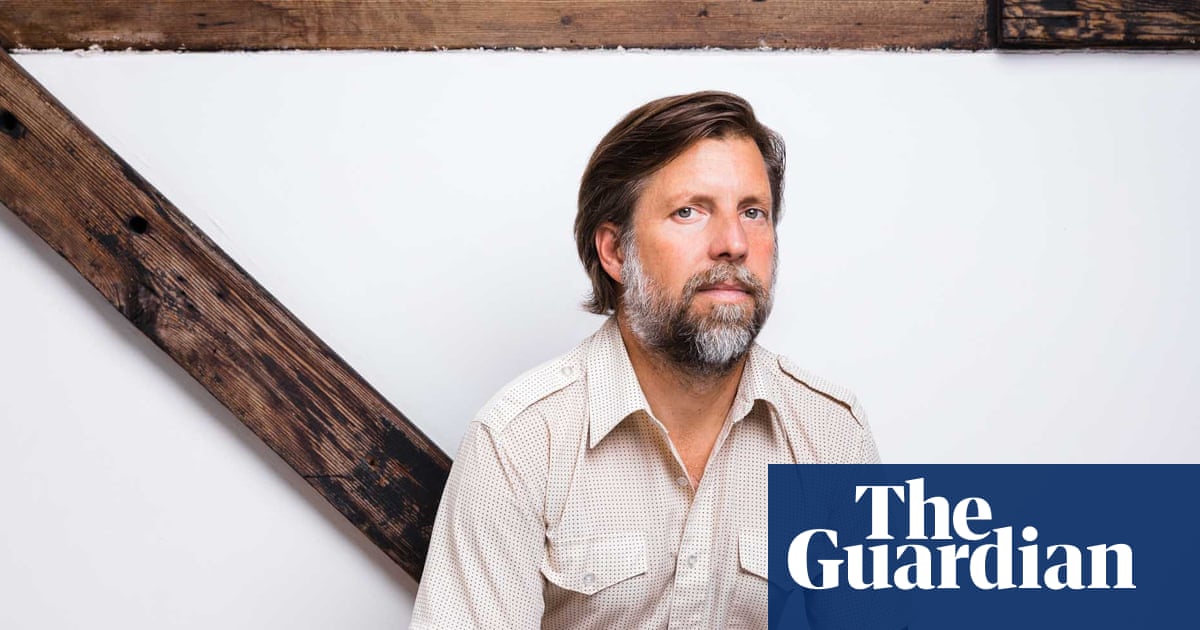
In the last stages of writing his book, Breath, James Nestor was stressed. “Which was ironic when writing a book about breathing patterns and mellowing out,” he says. The book was late; he’d spent his advance and was haemorrhaging even more money on extra research that was taking him off in new, potentially interesting, directions – was it really necessary, he wondered, to go to Paris to look at old skulls buried in catacombs beneath the city? (It was.)
Then a couple of months before the book’s May 2020 publication date, the Covid pandemic hit, and Nestor was advised to wait it out. He couldn’t afford to. “One of the main motivations for releasing it at that time was to get that [on-publication] advance,” he says. “But I’ll be honest, I didn’t want to release it. I said: ‘How are you going to promote a book that can’t be sold in stores, that I can’t tour for?’” He expected, he says, “absolutely zero to happen”.
But it turned out that a book that reminded people of the power of breathing – in the midst of a respiratory illness pandemic – was what the world wanted. It has since sold more than 3m copies.
Five years on, Nestor has updated the book with a revised preface, and other new material including his latest enthusiasm: testing the air quality of hotel rooms and planes, some of which, according to his readings, contain alarmingly high levels of CO2. He has learned a lot since the 2020 publication, he says, from all the letters sent by readers and additional experts he has spoken to. The popularity of “breathwork”, or breathing exercises, as a wellness trend has taken off, but it hasn’t yet become mainstream.
Not yet mainstream … Breathwork has taken off as a wellness trend.
Photograph: Mariia Vitkovska/Getty Images
Nestor used to believe breathing was binary. “You’re doing it, you’re alive; you’re not doing it, that’s bad news.” The author is at home in Portugal where he now lives, speaking calmly – perhaps this is what more than a decade of breath research does – over Zoom. He has spent the morning working on his next book, which is nearly finished, though he won’t say what it’s about.
Before he became interested in breathing, Nestor was living in San Francisco and plagued by recurrent respiratory problems, getting mild pneumonia most years. He went for dinner with a friend, a doctor, and she told him his breathing was off. “I guess I was breathing through my mouth. She could hear me across the table, really laboured breaths, and she suggested I go to a breathwork class.”
For his first experience of Sudarshan Kriya, a rhythmic breathing technique, Nestor somewhat reluctantly joined a group in a dusty old house in the bohemian Haight-Ashbury area of the city. The experience, he says, was “absolutely revelatory”. Sitting on the floor in a draughty room, Nestor sweated from head to toe (the practice is believed to generate energy). “It was not subtle. It was extreme, almost violent, which I liked, because it showed me that there was something extremely powerful here.” For the next few days he felt lighter, less anxious. “I felt so completely different, and I do every time I do this breathwork practice.” He does it online most weeks now; each session is about 45 minutes, with 25 minutes of intense breathing. “I love it. I love that energy.”
Nestor grew up in California and, after college, worked as a copywriter for many years, writing articles in evenings and weekends, before he became a full-time freelance journalist. Around the time he started regularly going to that breathwork class, he took an assignment in Greece to write about freedivers, who could dive to great depths while holding their breath for several minutes. “That’s when I knew that there was a deeper story to be told about [breathing], watching these people do this thing that is supposed to be impossible.”
‘I love that energy’ … Composite: Guardian Design; Cravetiger/Getty Images
His interest in breath wasn’t about becoming superhuman. “I think just being able to breathe normally is something so few people do, and that sounds crazy until you look at the stats, and you start counting how many people have asthma, they snore, have sleep apnoea.”
Nestor calls breathing the missing pillar of health. We know the importance of diet, exercise and sleep, but breath, he says, tends to get ignored. What does good breathing look like or feel like? “You don’t see it. It is subtle, soft. You don’t see it in the chest, in the shoulders. You don’t see any wincing in the face. The mouth is closed. If you look at a monk meditating, it’s a beautiful thing. It’s silent, clean. There should be no sound from your breathing, and no movement other than a slight expansion in the abdominal area. What does it feel like? It feels like your body is able to operate at peak efficiency.” Most people breathe “into” their chests, he says, rather than their belly (you can test by placing your hand on your abdomen when you inhale). “It’s extremely inefficient, and it’s also sending messages to your brain that you are stressed, and creates a vicious cycle.”
Slow breathing appears to have benefits, including calming the nervous system. Nestor writes about “resonant” or “coherent” breathing: a pattern of a 5.5 second inhale and 5.5 second exhale, which is also almost exactly 5.5 breaths a minute. Ancient cultures as diverse as Buddhists and Native Americans were on to this, Nestor writes, with chants and prayer cycles following this pattern.
What about the benefits, or potential pitfalls, of deep breathing? I’m confused by Nestor’s findings. “You should be,” he says. “You’re going to hear different things from different breathworkers. I believe that a slow, deep breath is extremely beneficial for the body, for blood pressure, for the nervous system and more. Some people in Buteyko schools [a method to regulate overbreathing] never take a deep breath – it’s always very light. I don’t really agree with that. I think we have this physiology; we’re built to take a deep breath, as long as it’s in tune with whatever we’re doing. You’re just reminding yourself of what you’re already built to do.”
Unlike diet, sleep and exercise, we ignore breathing because it doesn’t depend on us taking much notice of it. But we should, and we used to, says Nestor. Breathing was part of spirituality. “You can go into any ancient culture, from the Greeks to Hebrews, Christians, Hindus, Buddhists, Chinese – I can go on and on – and breathing was foundational to their health. It’s only in the industrial era, in the past few hundred years in the west, that we’ve started ignoring it, just like we started ignoring our diet, eating industrialised foods.”
And that food – the soft, processed, easy-to-eat kind – has changed the shapes of our skulls, according to researchers. Without having to chew on tough meat, raw vegetables and whole foods (and with fewer babies getting the jaw workout that breastfeeding promotes), modern human jaws are not developing as our ancestors’ did, or those in more traditional societies.
Have we forgotten how to breathe properly in the west? Illustration: Getty Images
“This was one of the most revelatory things I found late in my research, which is why I had to go back and redo everything,” says Nestor. (It was what took him to those catacombs in Paris.) “All you have to do is look at ancient skulls. They have straight teeth. They look like a different species. I have crooked teeth, [wore] braces, had [tooth] extractions – everyone I know did, too. You start questioning: how did this happen? Most people have crooked teeth. No other animal on Earth has chronically crooked teeth. It absolutely affects how you breathe, because crooked teeth are a sign that your mouth is too small. And if that mouth is too small for teeth, it’s going to be too small to breathe easily and freely.”
If I gave my children a bone to gnaw on every day, would they develop better facial structures, and breathe easily throughout their lives? Nestor smiles. Maybe not a bone, he says. “But better habits, 100%.” He wore a palate-expanding device, similar to a retainer, every night for a year. “Not a pleasant thing to do, [but] it absolutely changed me. It opened up my airways. I built new bone in my face.” Nestor suggests that early interventions such as myofunctional therapy – which uses exercises to retrain the muscles in the face, especially the tongue – could work, but this is still considered by the NHS to be an alternative therapy and lacks good evidence as a treatment for sleep apnoea.
Many of the people Nestor writes about in his book are a little eccentric, to say the least. There’s Carl Stough, a choirmaster who started treating emphysema patients in the 50s and went on to coach the US Olympic running team, but whose strange bodily manipulations and breathing exercises died with him. Or the Swedish breathing researcher Anders Olsson, who huffs carbon dioxide from a tank.
Nestor visited the late orthodontist John Mew at his self-built castle in East Sussex, and his son Mike, also an orthodontist but more famously a social media star whose “mewing” videos – in which people are encouraged to stick their tongue to their upper palate, claiming it will improve face shape – have been watched by millions. In November 2024, Mike Mew was suspended from the dentists’ register for inappropriate treatment of two child patients and making misleading claims on YouTube, which he is appealing.
This is before we even start thinking about the breathwork practitioners who promise cures for everything, or a higher state of consciousness. Why does this field seem to attract fairly fringe people?
“Most started off on a very traditional path, and then they started piecing together that things weren’t quite right, and then they shift gears. If you look at [orthodontist and researcher] Marianna Evans, she was a traditional dentist, and then things just weren’t adding up for her.” The dentistry that took off in the 70s and 80s – which Nestor and his peers received – was about extracting teeth to accommodate others. “Shouldn’t we be expanding [their mouths]? Maybe she’s considered fringe, but I don’t think so any more.” The Mews, he acknowledges, are fringe: “100%, and it has less to do with what they’re promoting and [more] how they’re promoting it.”
Olsson, his friend and fellow “pulmonaut”, to use Nestor’s word, is a “bit fringe-y”, too. “He’s more an experimenter, along with me. But the vast majority of the actual researchers and doctors in that book are people who are very much a part of the medical community and started seeing things in a different way.”
The growing popularity of breathwork is still associated with esoteric thinking. “Which is fine if people are into that,” Nestor says. He prefers to think of it as “your body being allowed to do what it’s naturally designed to do.”
Breath: The New Science of a Lost Art by James Nestor is available now (Penguin Life, £10.99)