
Refresh
2026-01-13T08:43:52.432Z
Tuesday, Jan. 13: The Wintermaker (after dark)
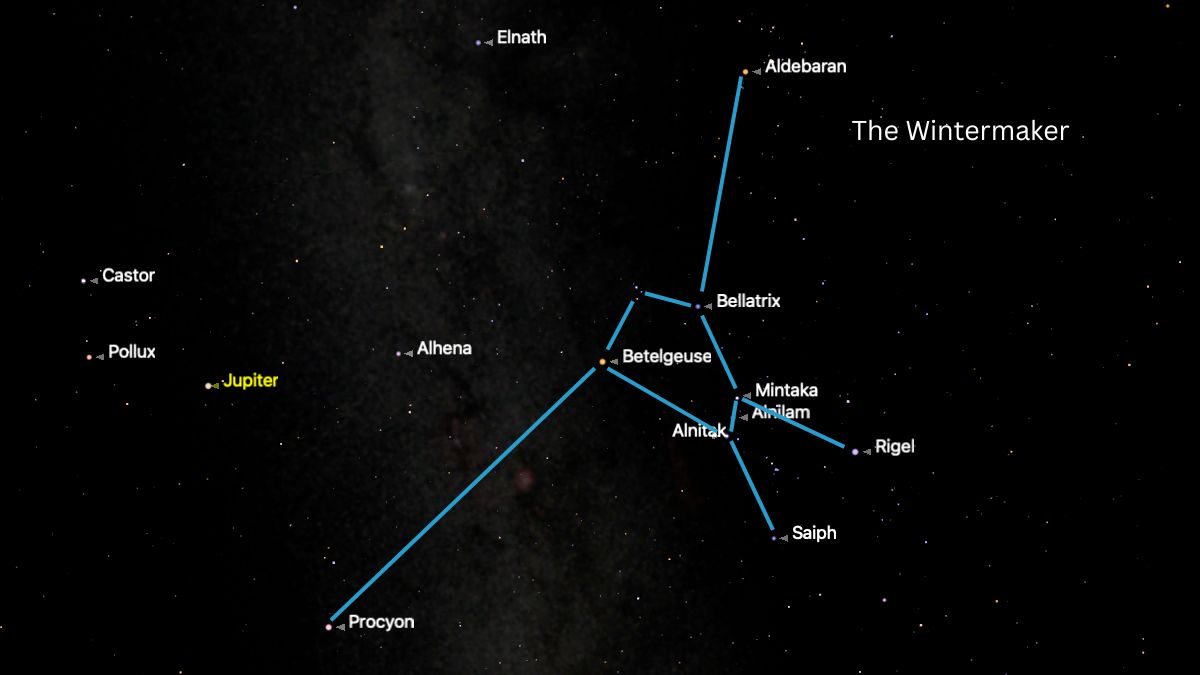
See the Wintermaker on Jan. 13. (Image credit: Starry Night/additions by Jamie Carter using Canva)
After dark, look south for Orion’s three equally spaced belt stars, framed by bright Betelgeuse above and Rigel below. To many Indigenous peoples, this familiar pattern is more than a hunter. The Navajo know the figure as Átsé Ets’ózí, the First Slim One, while in Ojibwe culture it expands into Biboonkeonini, the Wintermaker, by adding Aldebaran in Taurus and Procyon in Canis Minor to form a giant figure whose arms are outstretched. These stars dominate the night in the coldest months, and among the Ojibwe and other tribes, their stories were traditionally told only in winter, when the Wintermaker stood high in the sky. — Jamie Carter
Also read: The Native American night sky: 7 starry sights to see
Wednesday, Jan. 14: Waning crescent moon and Antares (before dawn)
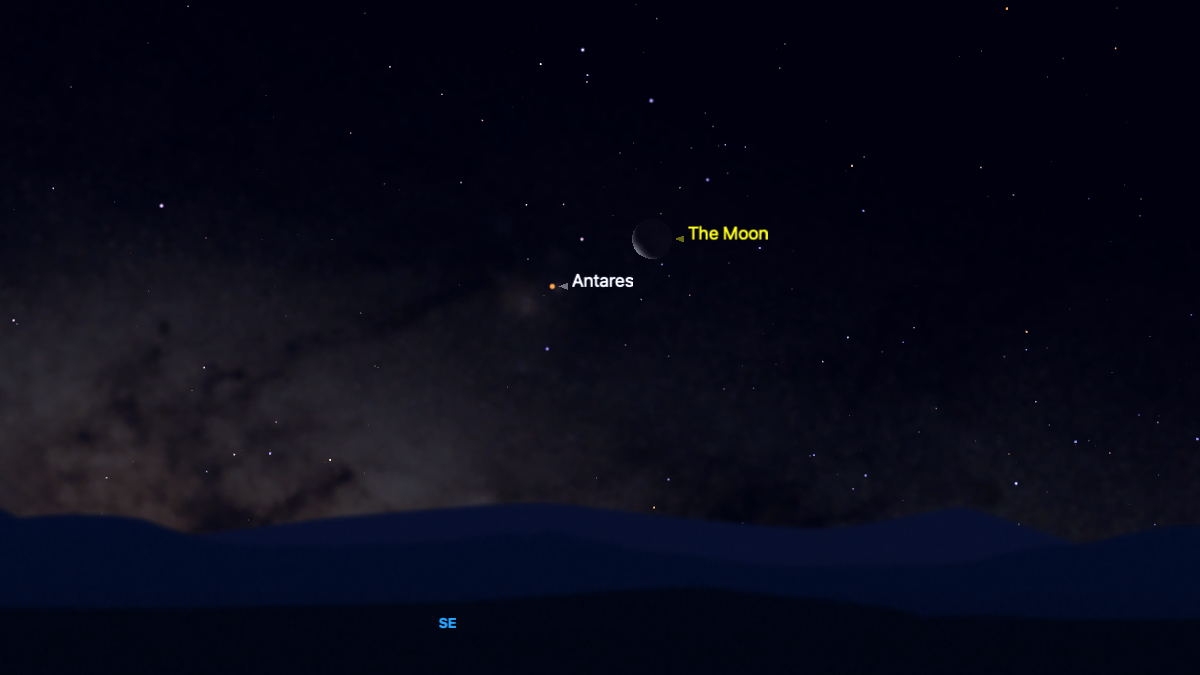
See waning crescent moon and Antares on Jan. 14. (Image credit: Starry Night)
Look low in the southeast before dawn on Jan. 14 to spot a delicate, 17% illuminated waning crescent moon a few degrees from bright star Antares — the supergiant star that forms the red heart of the constellation Scorpius. Note the contrast between the moon‘s pale light and the warm orangey glow of Antares. It’s a somewhat unexpected sight in midwinter, because Scorpius is a summer constellation, but Earth‘s tilt means the pre-dawn sky shows us stars from the opposite season. You’re essentially looking ahead to the stars that will dominate the evening sky in six months. For those who want to learn the night sky in double-quick time, the lesson is simple — get up earlier! — Jamie Carter
2026-01-12T09:55:19.121Z
Monday, Jan. 12: The Winter Hexagon (after dark)
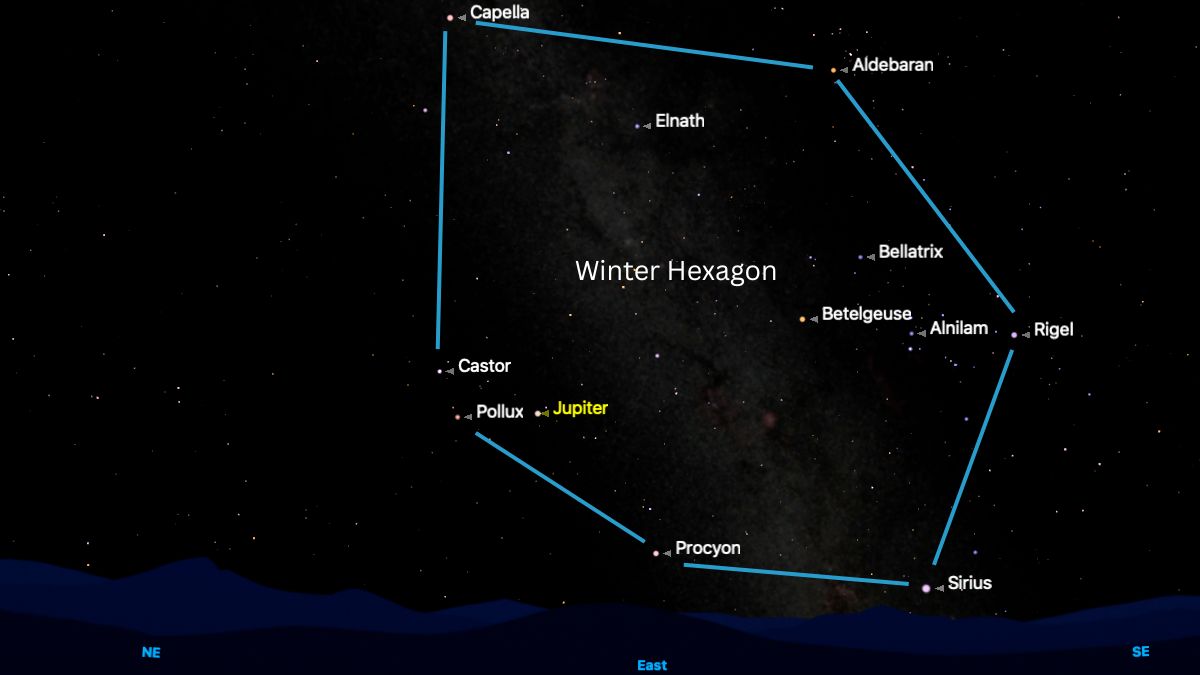
See the Winter Hexagon on Jan. 12. (Image credit: Starry Night/additions by Jamie Carter using Canva)
On midwinter evenings, the entire southern sky is framed by one immense pattern: the Winter Hexagon. Start low in the southeastern sky with Sirius, the brightest star in the night sky, then move up going clockwise to white Procyon, in Canis Minor. From there, hop to golden Pollux in the constellation Gemini, which can be found shining close to Jupiter, then up to Capella high overhead in Auriga. Next, slide across to Aldebaran — the orange eye of Taurus — and then down to blue-white Rigel in Orion, before returning to Sirius.
This giant loop of stars encloses much of the winter Milky Way and several famous constellations, making it a superb way to learn the night sky. In Dakota culture, it’s called Çan Hd/Gleska Wakan (Sacred Loop), Inipi/Initipi (Sweat Lodge) and Ki Inyanka Ocanku (Racetrack), though the Pleiades is often used instead of Aldebaran. — Jamie Carter
2026-01-09T09:20:17.950Z
Night sky for tonight and the weekendFriday, Jan. 9: The circumpolar sky (after dark)
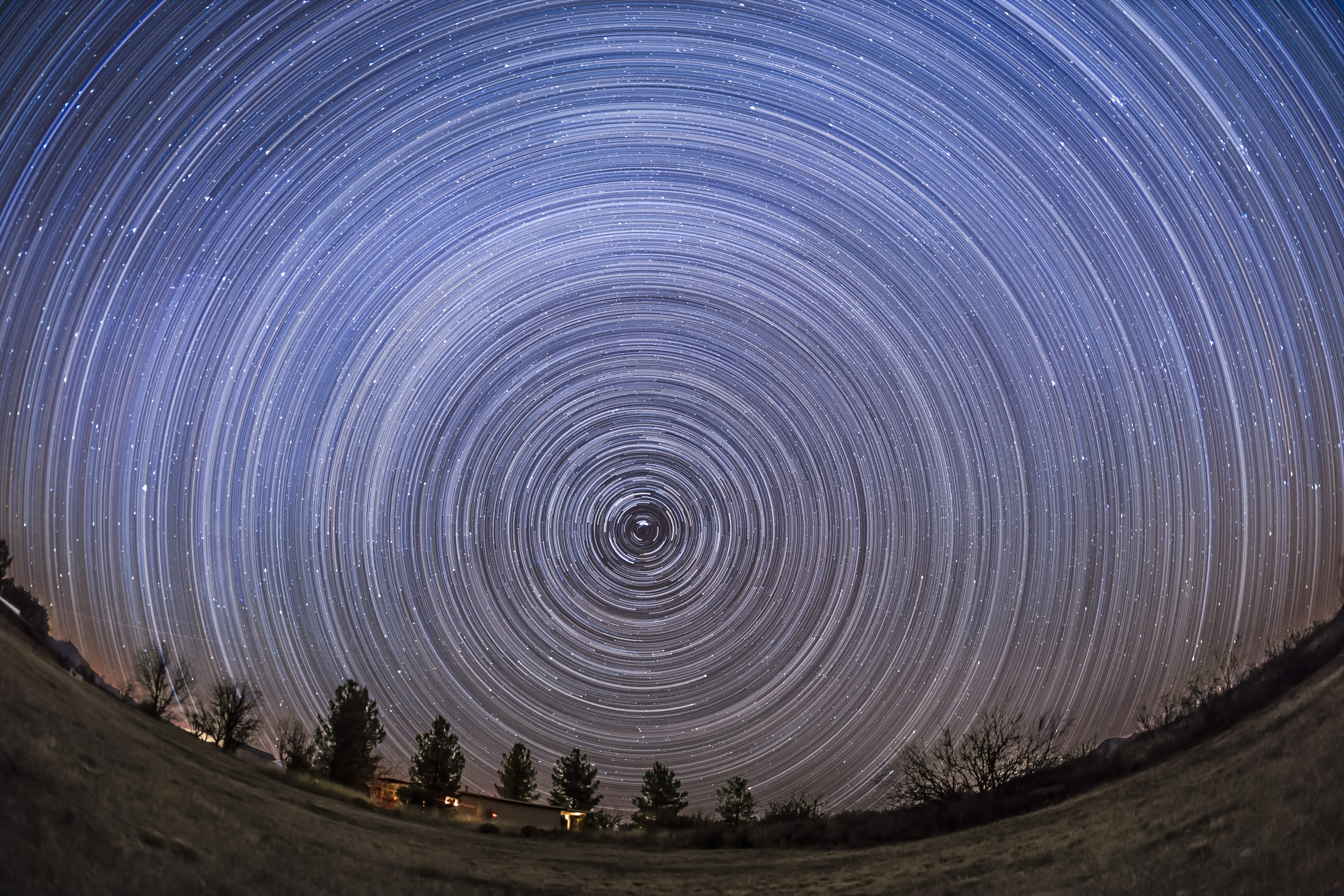
See the northern sky revolve on Jan. 9. (Image credit: Photo by: Alan Dyer /VW PICS/Universal Images Group via Getty Images)
Turn to the north after dark, and you’ll see stars that never set — the circumpolar constellations — which form the backbone of the Northern Hemisphere night sky. The familiar shape of the “Big Dipper” asterism, which forms the core of the larger constellation of Ursa Major, can be found low on the northeastern horizon in the hours following sunset on Jan. 9. Look to its upper left to find the ‘M’ shape of the constellation Cassiopeia.
These two easily identifiable star patterns will appear to slowly circle Polaris, the North Star, which lies between the two stellar formations. Polaris marks the point in the sky almost directly above Earth‘s north pole. As a result, it hardly moves, while the entire night sky seems to rotate anticlockwise around it. — Jamie Carter
Saturday, Jan. 10: Jupiter at opposition (after dark)
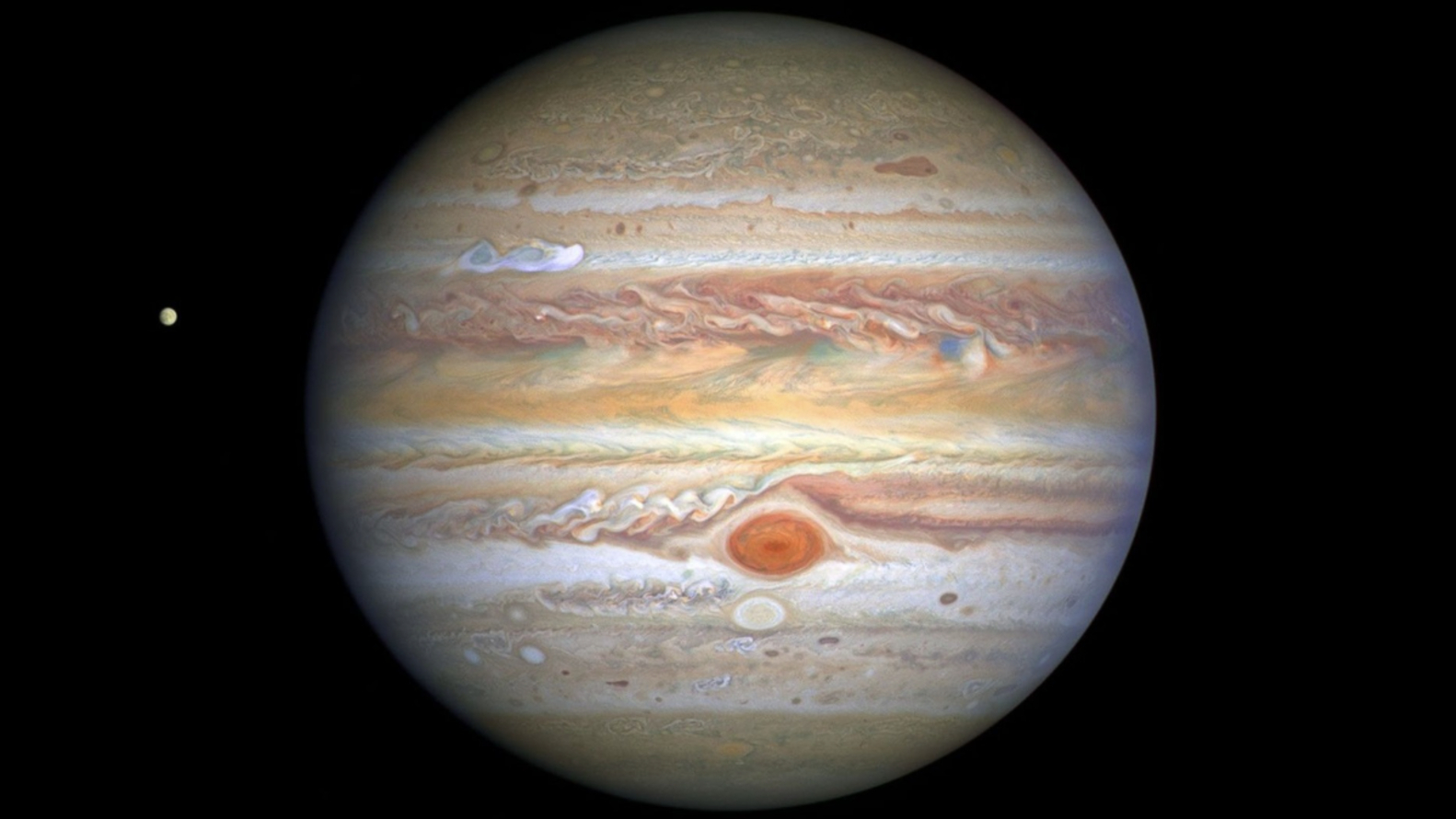
See a bright Jupiter on Jan. 10. (Image credit: NASA, ESA, STScI, A. Simon (Goddard Space Flight Center), and M.H. Wong (University of California, Berkeley) and the OPAL team)
Tonight is all about mighty Jupiter. The giant planet reaches opposition in the early hours of Jan. 10, standing opposite the sun in our sky and shining at about magnitude -2.7 in the constellation Gemini, just to the right of the star Pollux. Brighter than any star in the night sky, Jupiter is already rising in the east at sunset. Around midnight, it rides high in the south, mimicking the path of the summer sun. It sets in the west as the glow of dawn rises in the east. Opposition brings Jupiter to its closest approach to Earth in its orbit, so its disk is slightly larger and brighter than usual. With Saturn visible in the southwest after dark, it’s an excellent night for naked-eye planet spotting. — Jamie Carter
Saturday, Jan. 10 and Sunday, Jan. 11: Last quarter moon and Spica (before dawn)
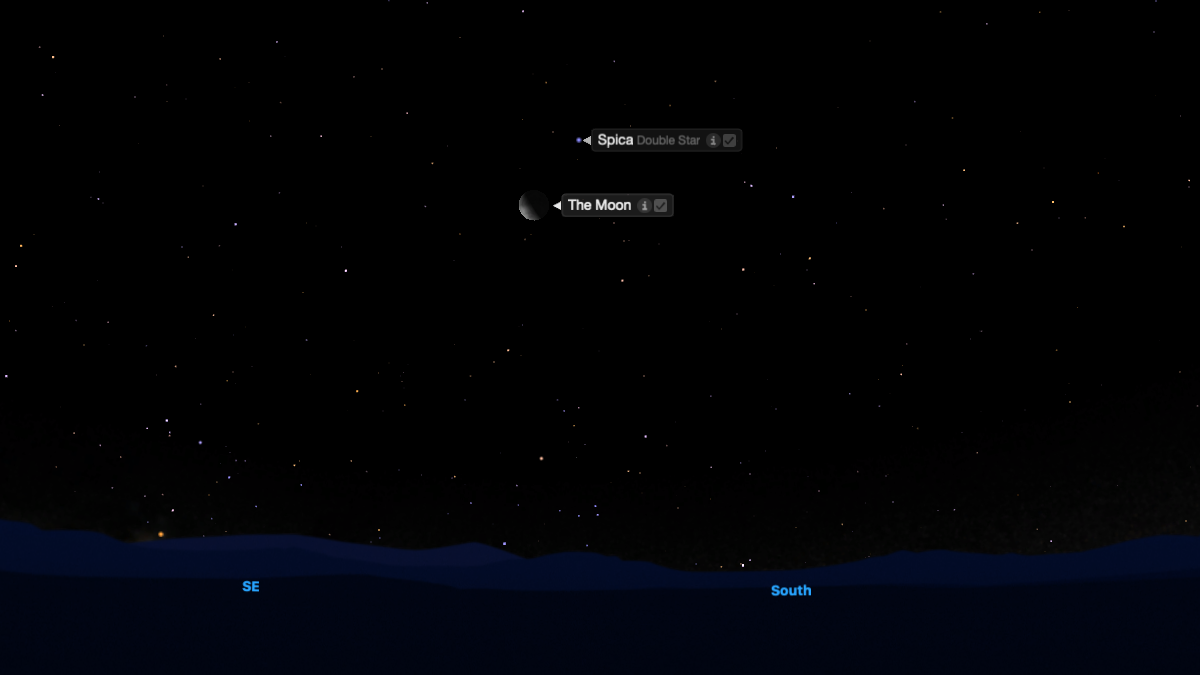
See a last-quarter moon and Spica on Jan. 10 and 11. (Image credit: Starry Night)
Early risers across two mornings are rewarded with a graceful pairing in the south. Before dawn on Saturday, Jan. 10, a half-lit last-quarter moon shines with Spica, the brightest star in Virgo. Come Sunday, Jan. 11, a 42%-illuminated crescent moon, now on the wane, will sit about five degrees below it. This fine pre-dawn view today has another dimension for skywatchers, as the moon‘s illuminated side points roughly toward where the sun will soon rise. — Jamie Carter
2026-01-08T08:38:42.497Z
Thursday, Jan. 8: The “Hole in the Sky” (after dark)
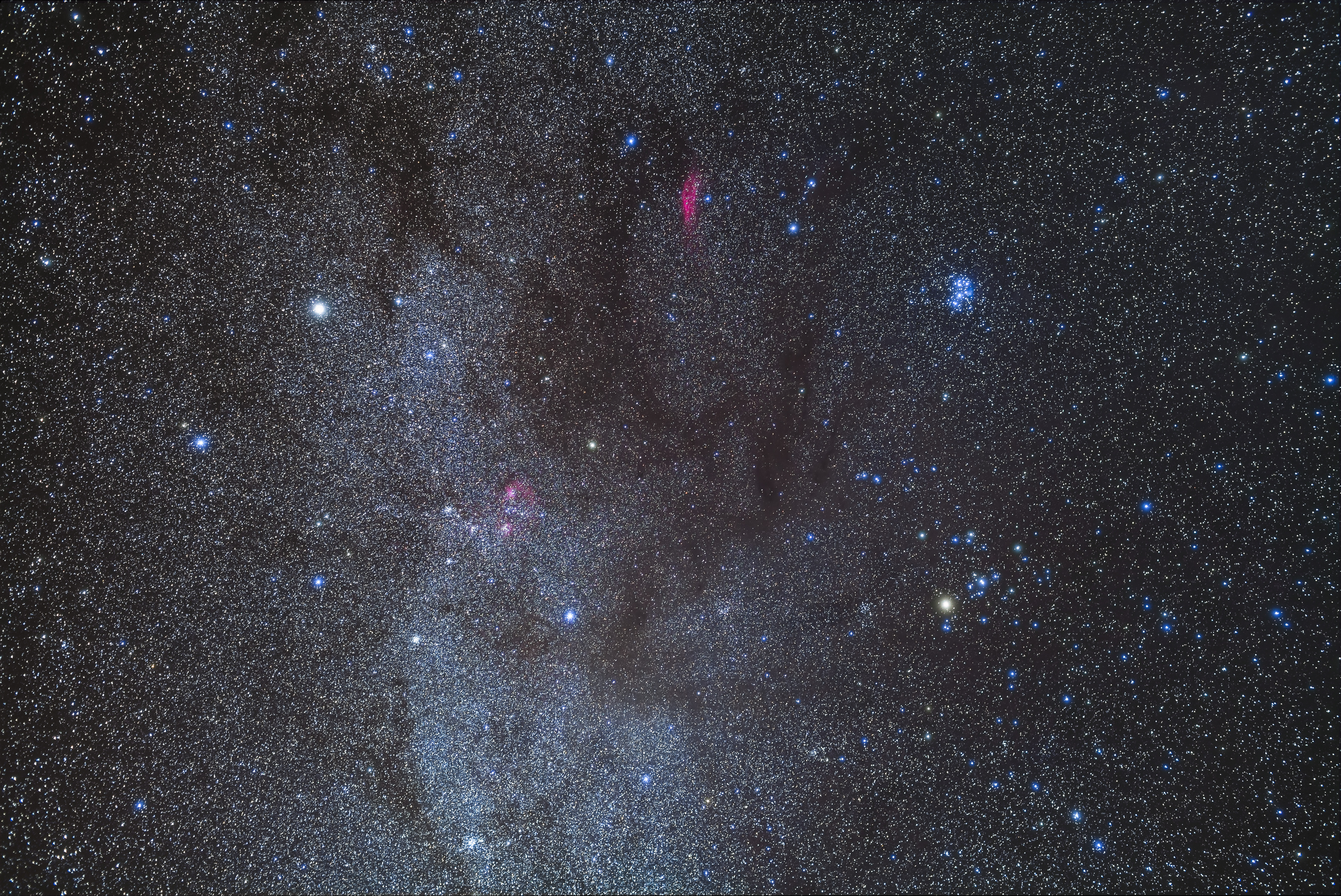
See the Pleiades on Jan. 8 (upper-right in this image) (Image credit: Photo by: Alan Dyer/VW Pics/UIG via Getty Images)
Tonight, look just above the big “V” that represents the face of the celestial bull in the constellation Taurus to find a tight knot of stars that has been known to cultures spread across the millennia of human existence. This is the Pleiades star cluster (M45), also called the Seven Sisters. To the naked eye, it resembles a tiny dipper. In Ojibwe culture, it’s Bugonagiizhig, the “Hole in the Sky,” imagined as a spiritual doorway between Earth and sky. For the Dakota, Lakota and Nakota, it’s the Seven Girls. The Navajo call it Dilyéhé and link its seasonal visibility to planting and harvest times. How many individual stars can you pick out? Most people see six, but if your eyesight is excellent, you may find seven. — Jamie Carter
2026-01-07T09:01:21.988Z
Wednesday, Jan. 7: Taurus constellation and the “big V” (after dark)
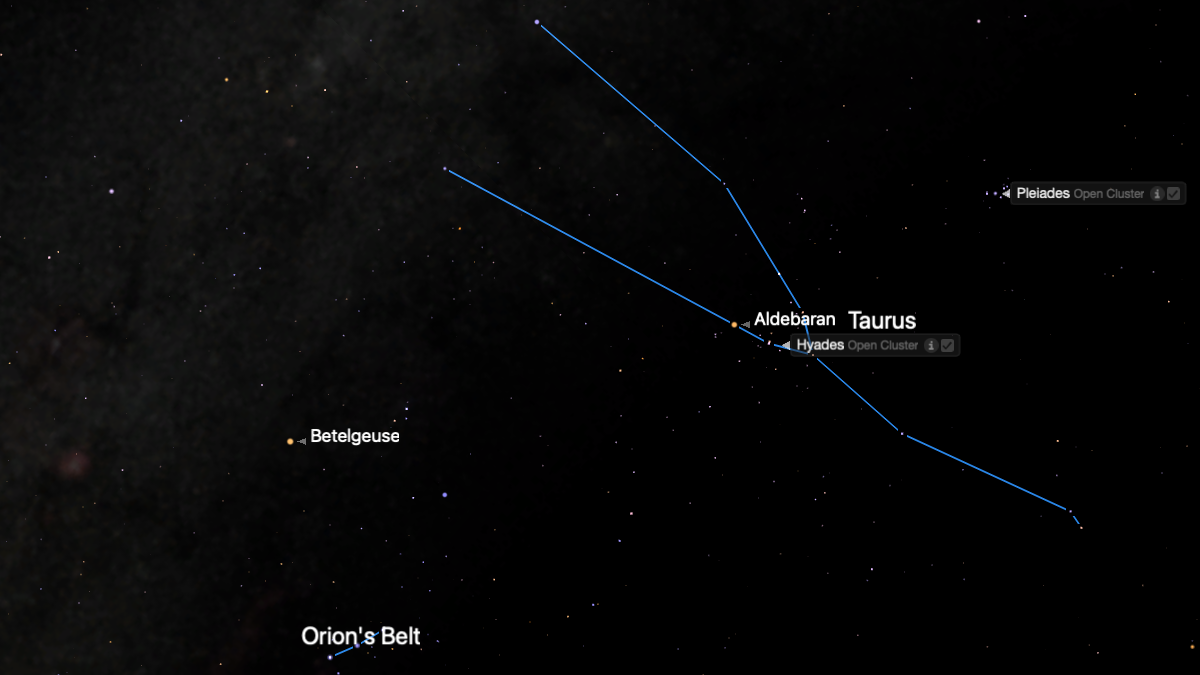
See Taurus on Jan. 7. (Image credit: Starry Night)
After dark, face southeast to meet the ancient constellation Taurus, the Bull. Start with the bright orange star Aldebaran, marking the Bull’s fiery eye. Surrounding it is a distinctive “V” formation of stars — the Hyades open cluster — outlining the Bull’s face. This shape is one of the easiest star patterns to learn and once you recognize it, you’ll see it every clear winter night. Aldebaran itself lies in front of the Hyades, like a glowing eye superimposed on the Bull’s head. Take a few minutes to trace the V, taking account of what’s nearby — the Pleiades (above) and Orion’s Belt (below). — Jamie Carter
2026-01-06T09:52:25.229Z
Tuesday, Jan. 6: Waning gibbous moon and Regulus (after dark)
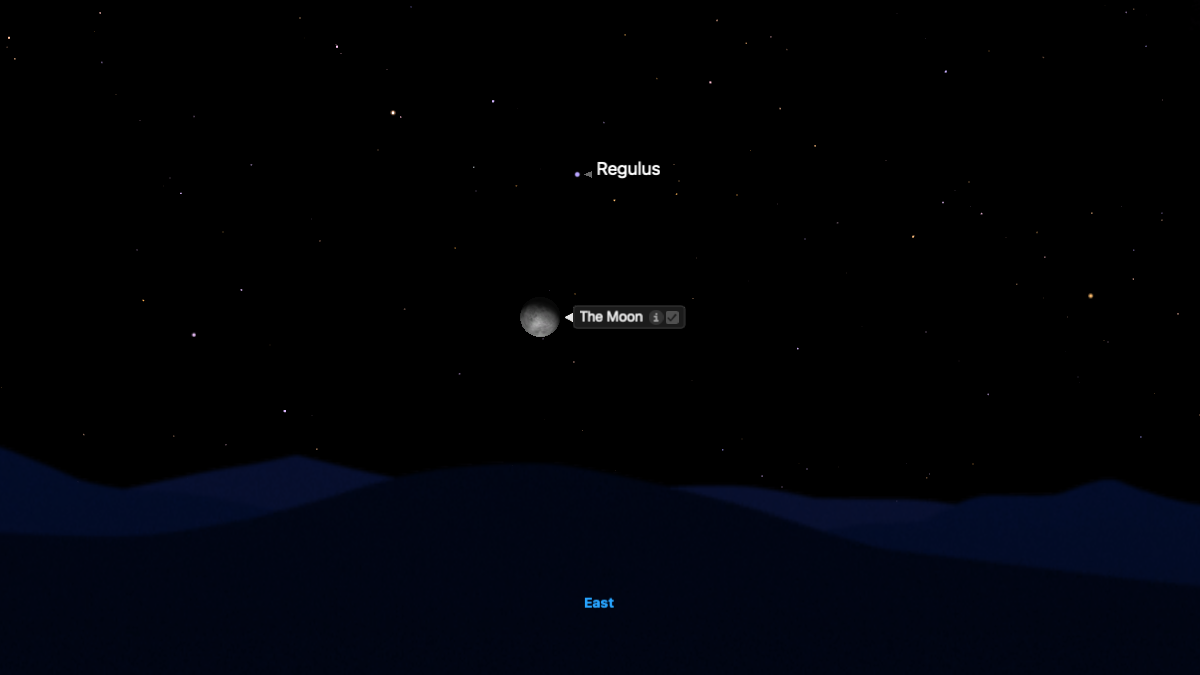
See a waning gibbous moon and Regulus on Jan. 6. (Image credit: Starry Night.)
Look to the east roughly two hours before midnight tonight to see a bright waning gibbous moon, now 82%-illuminated, rise with a prominent speck of starlight ahead of it. That bright point represents the gargantuan star Regulus, the “heart” of the great lion represented in the constellation Leo.
Regulus shines about six degrees ahead of the moon after dark for most of North America. Earlier in the day, at about 10:19 a.m. EST (15:20 GMT) on Jan. 6, the moon passed just half a degree from Regulus — about the diameter of the moon — while it was below the horizon for North American observers. As the night wears on, the pair will arc high into the southern sky.
In behind-the-scenes news from the solar system, Venus reaches superior conjunction today, as its orbit carries it past the far side of the sun relative to Earth, rendering it lost in the glare of our parent star. — Jamie Carter
2026-01-05T13:11:26.717Z
Monday, Jan. 5: Winter and Summer Triangles (after dark)
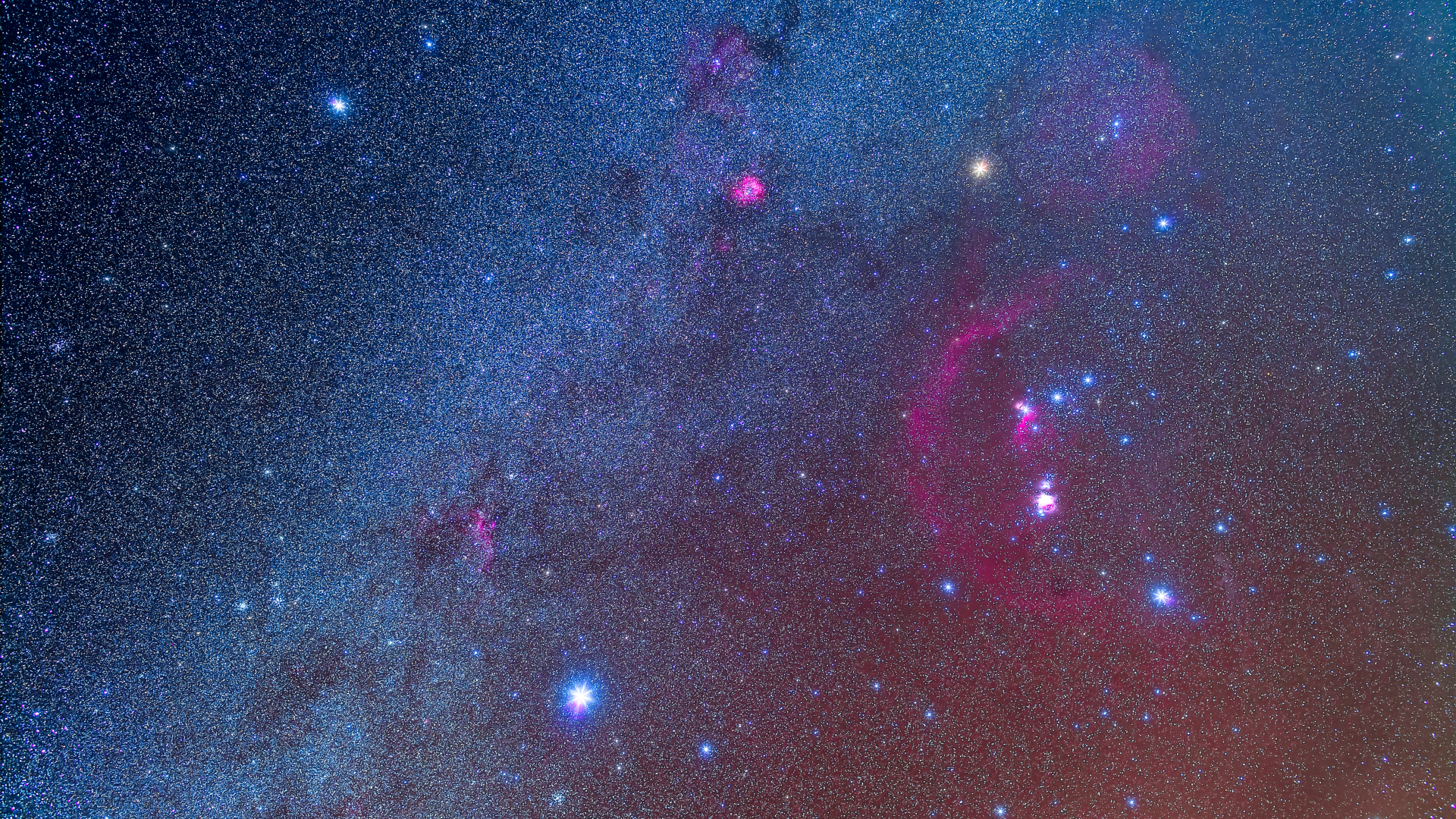
See the Winter Triangle on Jan. 5. (Image credit: Alan Dyer/Stocktrek Images via Getty Images)
Step outside after dark to find two great stellar triangles that help mark the changing of the seasons in the Northern Hemisphere. First, look west to find the fading Summer Triangle, with bright Vega high in the west, Deneb to its lower left and Altair lower toward the horizon. It will soon be gone until August.
The Winter Triangle, meanwhile, can be found rising in the east, made up of the red star Betelgeuse in the constellation Orion, the brilliant Sirius below in Canis Major, and Procyon in Canis Minor. The hazy band of the Milky Way runs through both triangles. Watching the Summer Triangle sink as the Winter Triangle ascends is a simple way to track Earth’s journey around the sun. — Jamie Carter
2026-01-02T11:03:36.325Z
Night sky for tonight and the weekendFriday, Jan. 2: A late afternoon moon (before sunset)
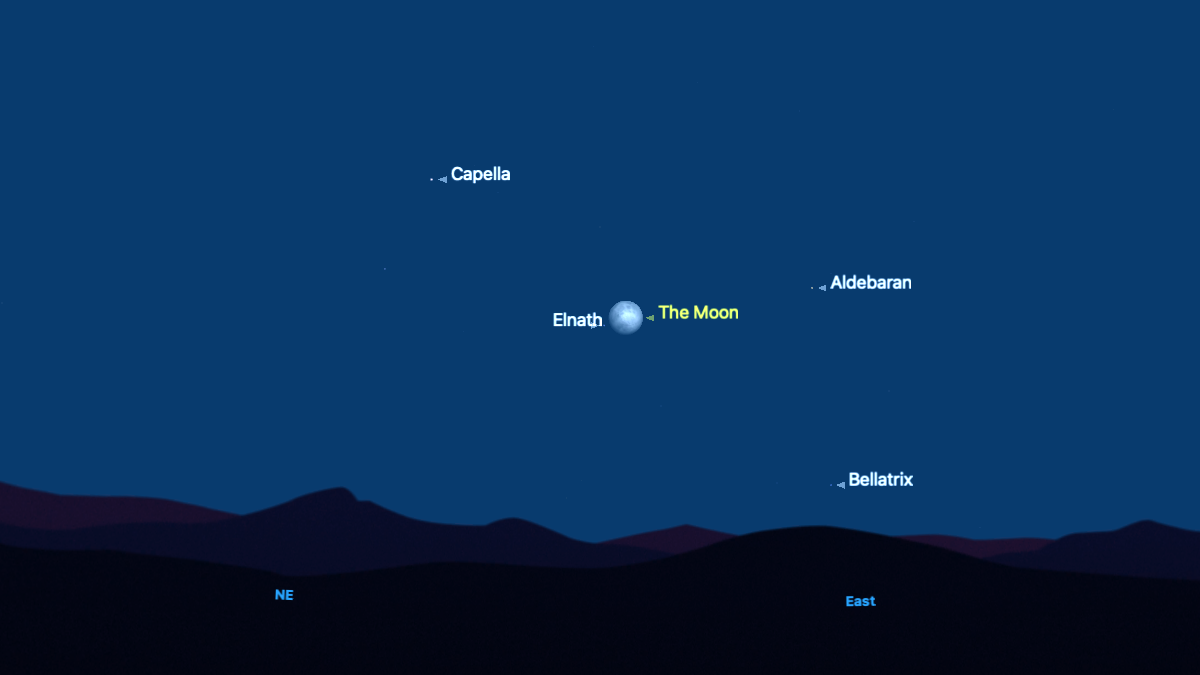
See an afternoon moon on Jan. 2. (Image credit: Starry Night)
During the week of the full moon, it’s possible to see it long before sunset. Look to the east an hour before the sun goes down, and you’ll see a 99%-illuminated waxing gibbous moon in daylight, which will quickly brighten into an impressive yellowish orb after sunset as dusk kicks in. — Jamie Carter
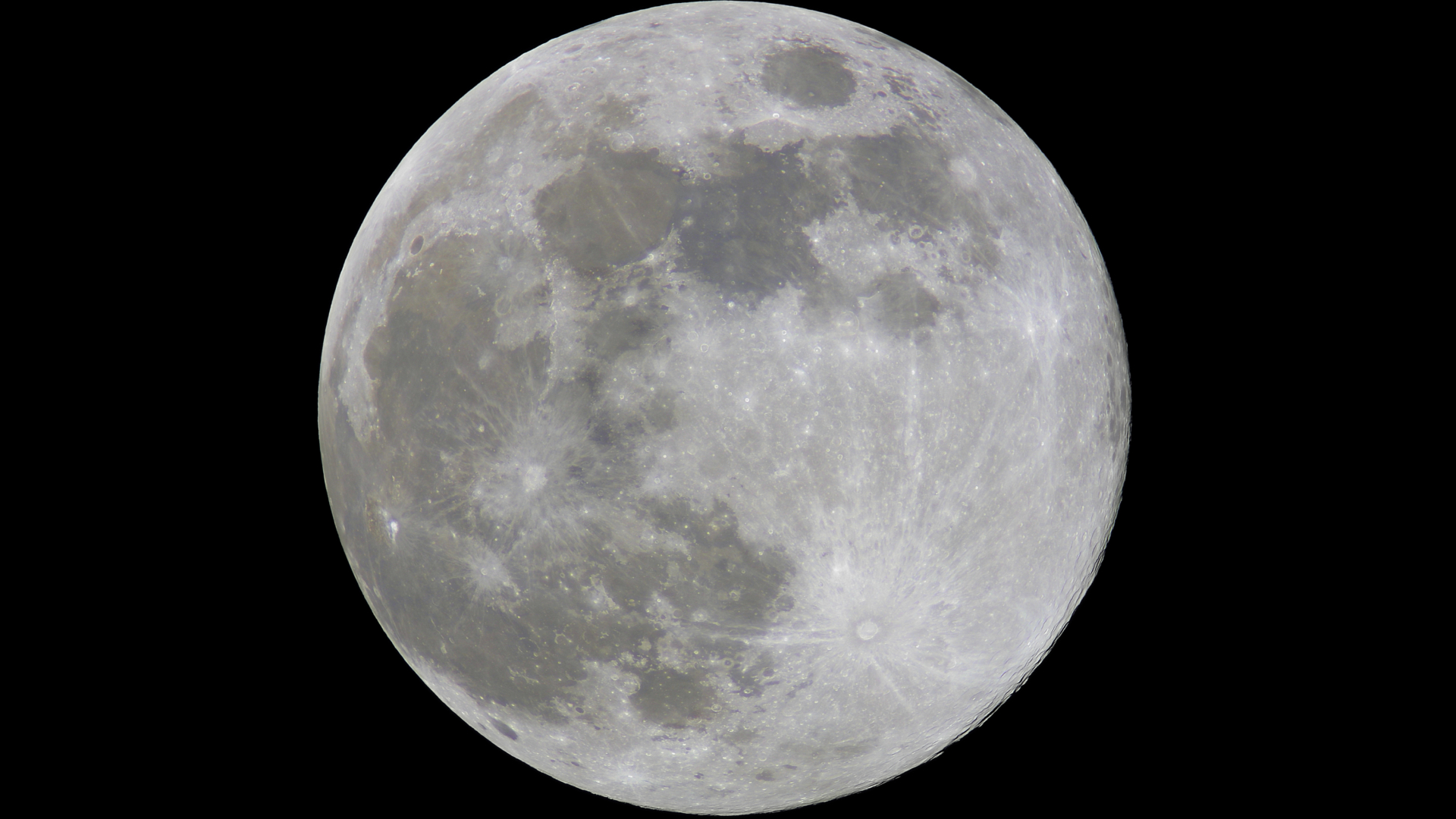
Saturday, Jan. 3: Full ‘Wolf Moon’ on Perihelion Day (after dark)
(Image credit: Christophe Lehenaff via Getty Images)
The moon reaches its full phase at 5:03 EST (1003 GMT) this morning. Saturday night is a great opportunity to watch the first full moon of the year dominate the evening sky as it rises in the west between Jupiter and bright star Pollux. The full “Wolf Moon” comes on the same day as Earth reaches its perihelion (closest point) to the sun. It’s a reminder that the Northern Hemisphere is experiencing winter because it’s currently tilting away from it, not because of Earth’s distance from the sun. — Jamie Carter
Sunday, Jan. 4: Quadrantid meteor shower peaks (early hours)
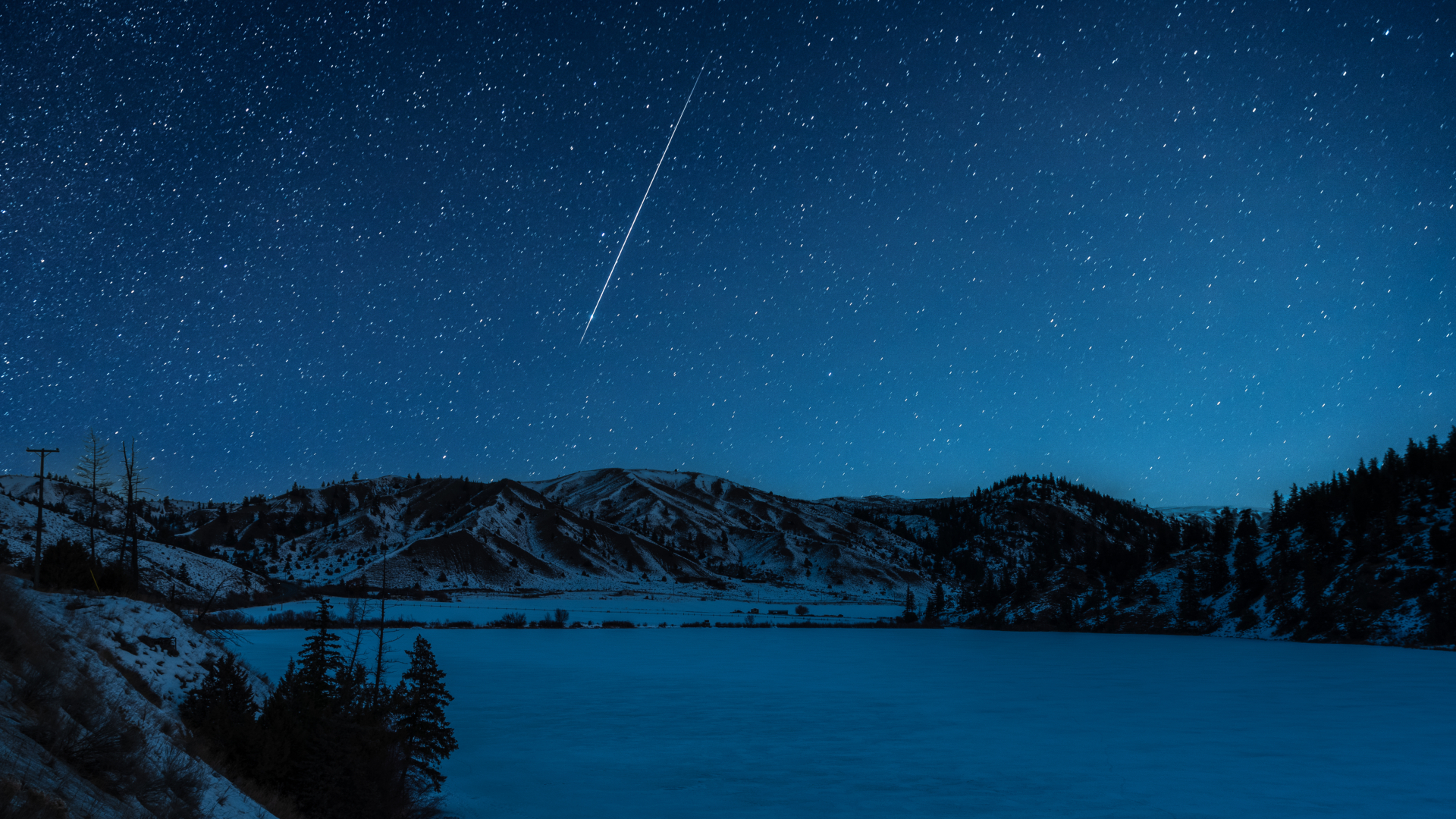
See Quadrantids on Jan. 4. (Image credit: Peter Olsen Photography via Getty Images)
With a bright moon just past full dominating the night sky, the Quadrantid meteor shower isn’t expected to be anything special this year. However, with up to 120 shooting stars per hour possible, it’s a good time to wrap up warm and go stargazing for an hour — you may spot one if you keep the bright moon behind you and out of your line of peripheral vision. Quadrantids are caused by dust and debris left in the inner solar system by an object called 2003 EH1, an asteroid with comet-like origins. Quadrantids appear to radiate from the constellation Boötes, while the shower’s odd name comes from a now defunct constellation, Quadrans Muralis. — Jamie Carter
2025-12-31T15:51:19.866Z
Wednesday, Dec. 31: Moon closest to the Pleiades (after dark)
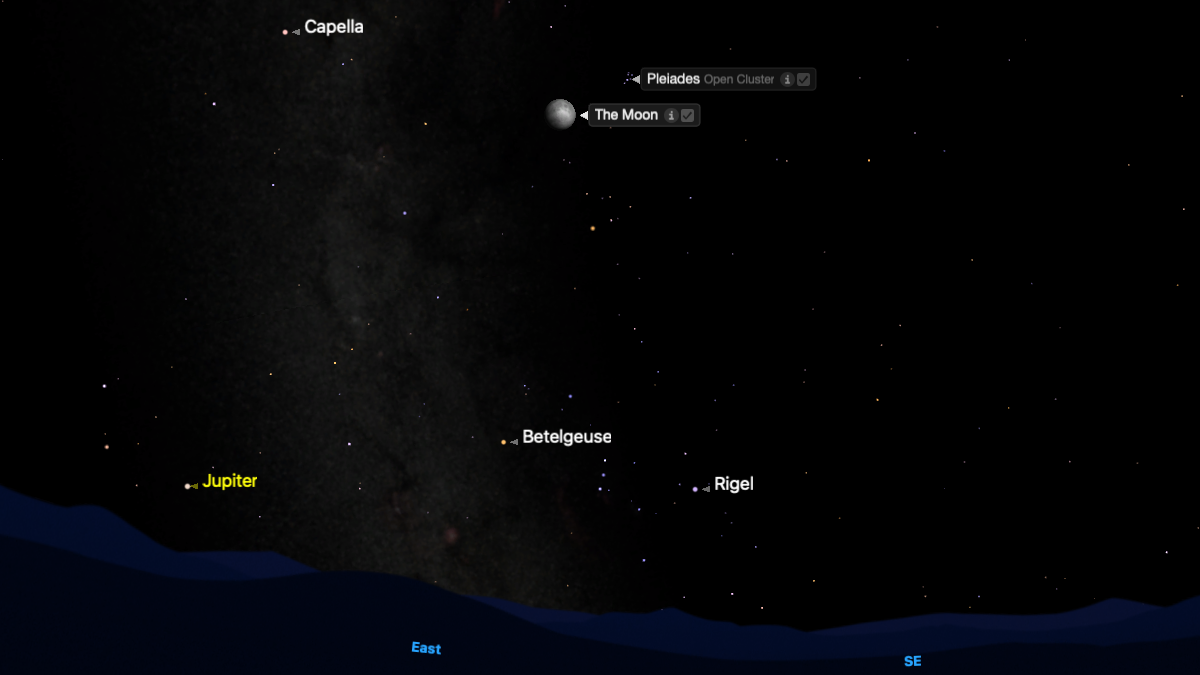
See the moon close to the Pleiades on Dec. 31. (Image credit: Starry Night)
A 99%-illuminated full moon slides alongside the Pleiades tonight in the constellation Taurus, starting around 8:45 p.m. EST.
For observers in North America, the moon will get to within a degree of the individual stars in the cluster.
The view of a full moon surrounded by the tiny glimmer of the Pleiades is worth seeing, despite the strong moonlight.
— Jamie Carter
2025-12-30T15:33:56.172Z
Tuesday, Dec. 30: Moon approaches the Pleiades (after dark)
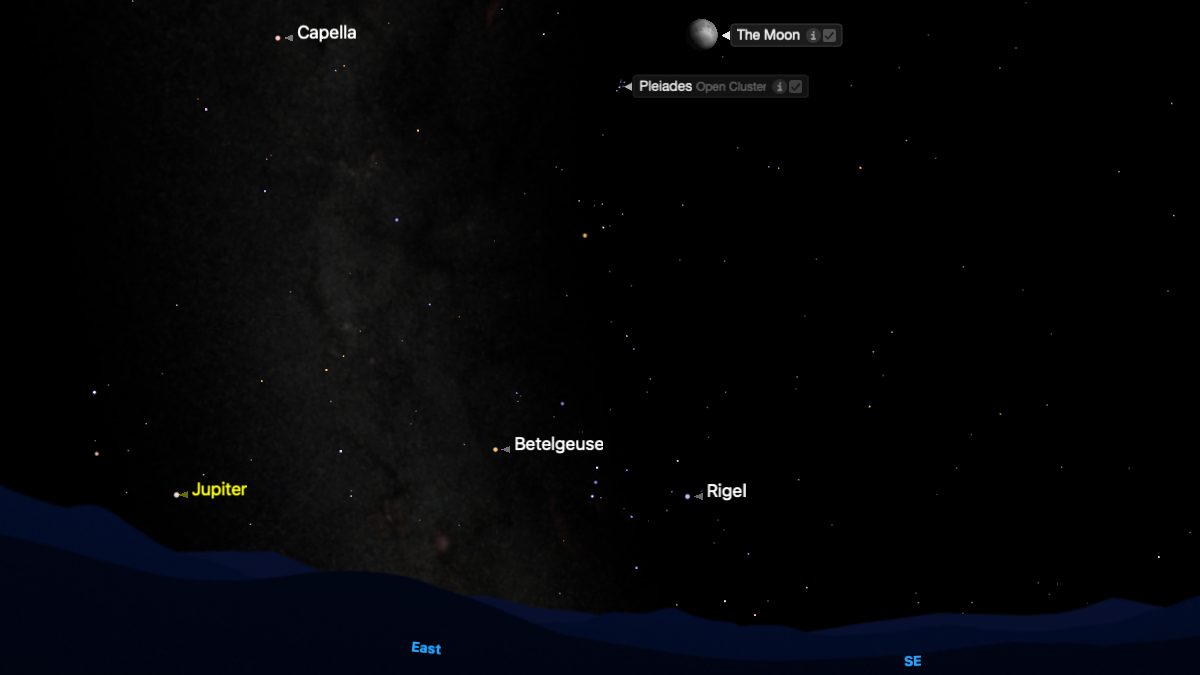
(Image credit: Starry Night)
The 83%-illuminated waxing gibbous moon approaches the Pleiades (M45), one of the jewels of the winter night sky. One of the closest — and surely the most impressive — open clusters to the solar system, its seven bright stars (though most people can only see six) lend it the name “Seven Sisters.”
The duo will be easily visible together in the eastern night sky.
— Jamie Carter
2025-12-29T15:51:20.937Z
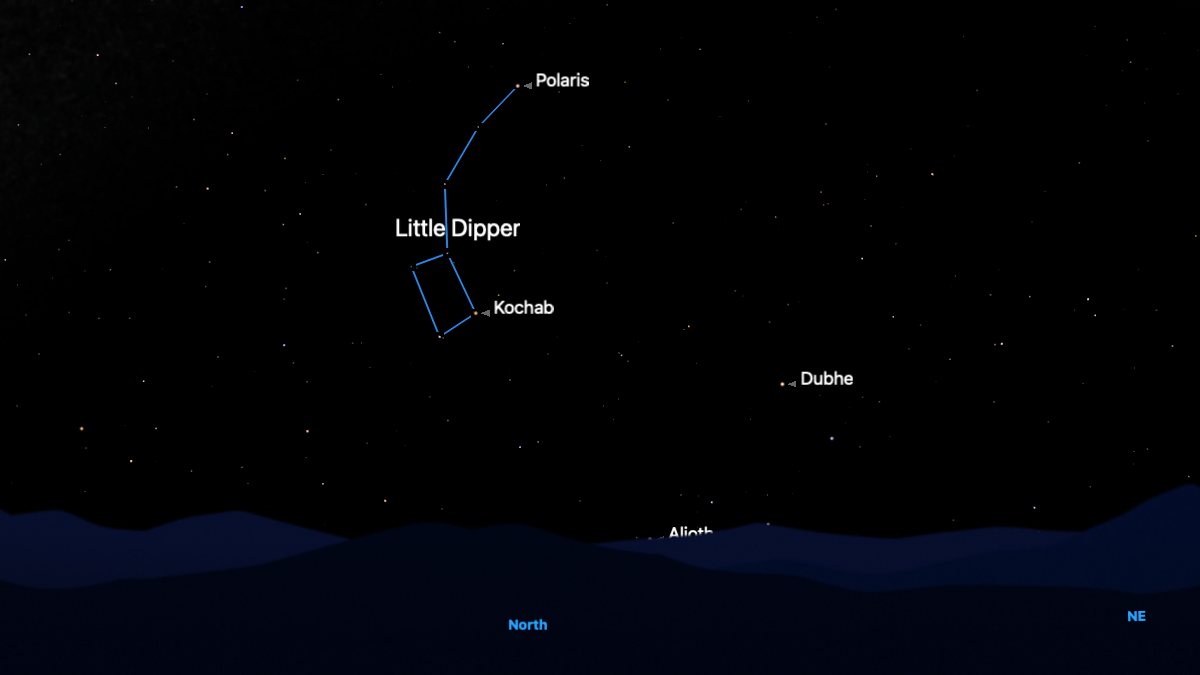
Monday, Dec. 29: Ursa Minor constellation (after dark)
(Image credit: Starry Night)
Ursa Major, “The Great Bear — and its chief shape, the Big Dipper — gets a lot of attention, but what about its sidekick?
With Ursa Minor hidden in the haze of the horizon at this time of year, it’s the best time to look for Ursa Minor, “The Little Dipper,” due north. Its main bright star is Polaris, the North Star, one of seven stars that, with Kochab in the bowl, are the next brightest. — Jamie Carter
2025-12-26T17:24:04.366Z
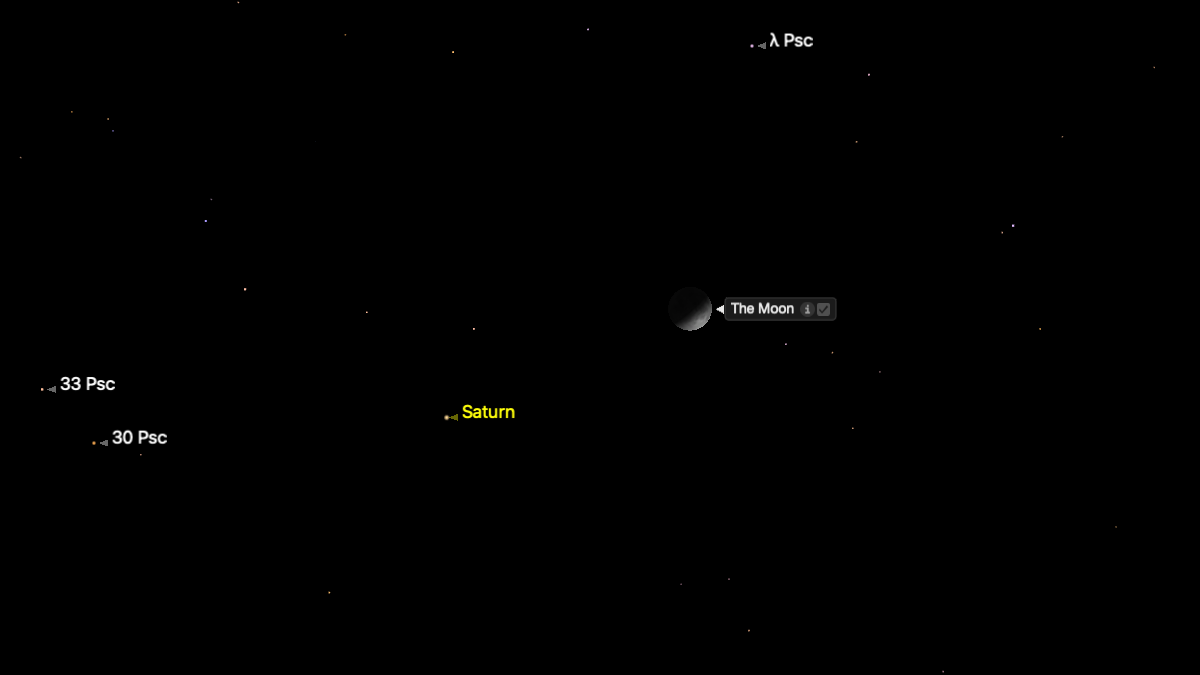
Friday, Dec. 26: Moon with Saturn (after dark)
At dusk, the 41%-illuminated waxing crescent moon appears less than three degrees from Saturn high in the south, with bright star Fomalhaut below, in the constellations Pisces. The contrasting colors — Saturn’s golden light and the moon’s brightening silver — make an easy naked-eye pairing.
— Jamie Carter
See the moon with Saturn on Dec. 26. (Image credit: Starry Night)
2025-12-24T09:46:39.877Z
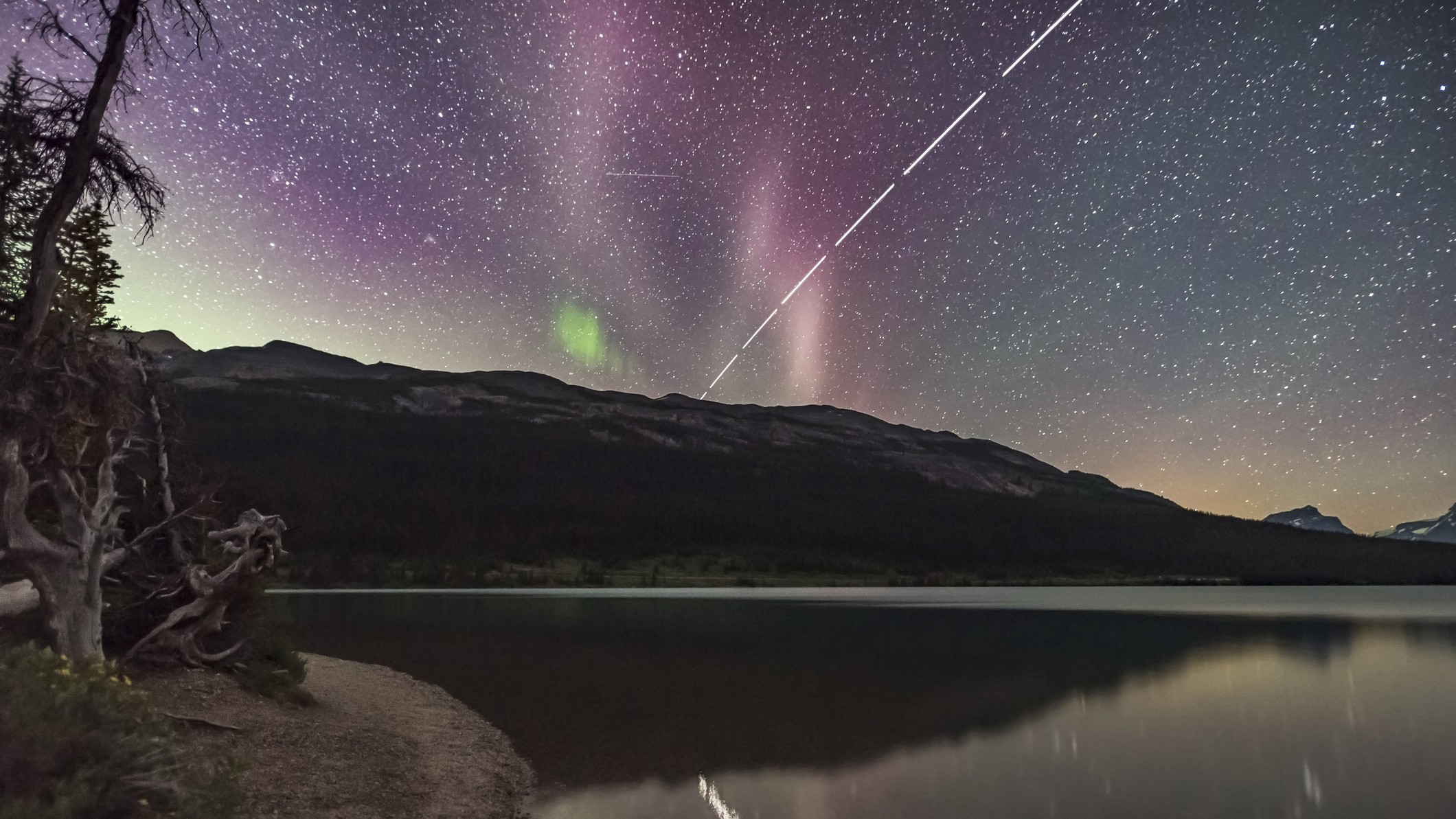
Wednesday, Dec. 24: A crescent moon — and space reindeer? (after dark)
(Image credit: Alan Dyer/Stocktrek Images via Getty Images)
A lovely 21%-illuminated waxing crescent moon will be visible on Christmas Eve, shining in the southwest after dark against the stars of Aquarius. For a bonus festive sight, check NASA’s Spot The Station for any scheduled flybys of the International Space Station, which is now just past its 25th birthday. It appears as a surprisingly bright, steady light gliding silently across the sky in a few minutes … and could easily be mistaken for Santa’s sleigh being pulled by reindeer. — Jamie Carter
2025-12-23T07:54:13.340Z
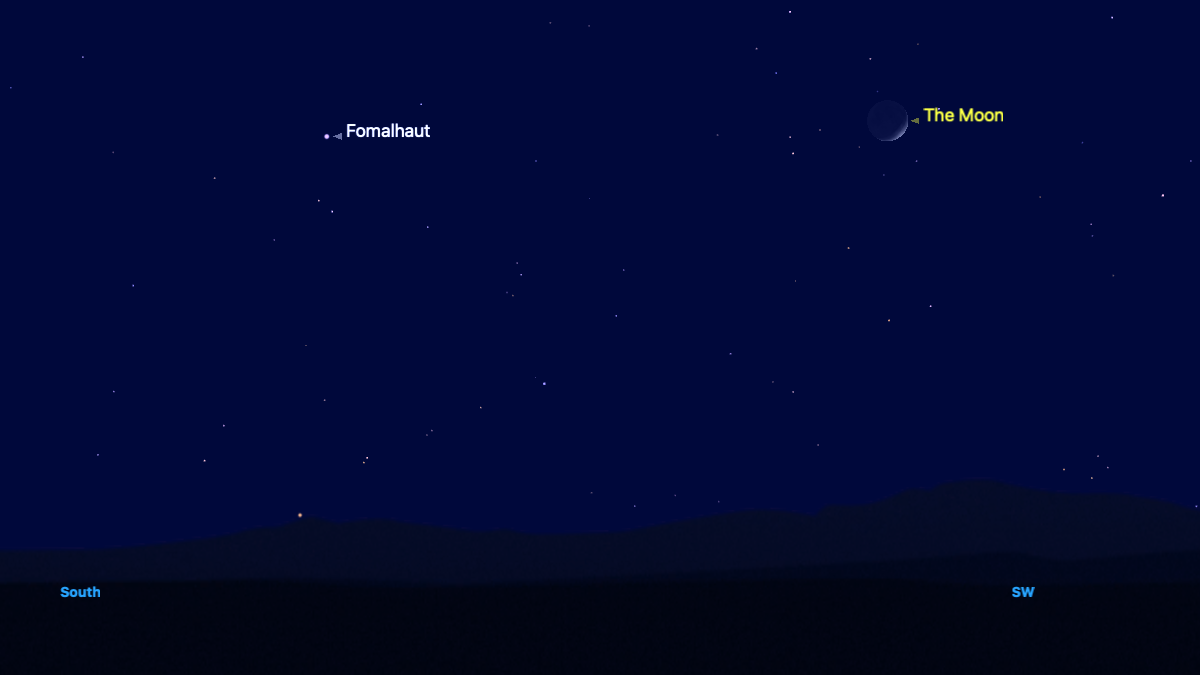
Tuesday, Dec. 23: Crescent moon and Earthshine (after sunset)
Don’t miss the delicate crescent moon tonight. (Image credit: Starry Night)
A 14%-illuminated waxing crescent moon will hang low in the southwest tonight, soon after sunset, still in Capricorn, with bright star Fomalhaut to its left side. It will remain in the night sky for a little longer tonight. — Jamie Carter
2025-12-22T10:16:26.323Z
Monday, Dec. 22: Crescent moon and Earthshine (after sunset)
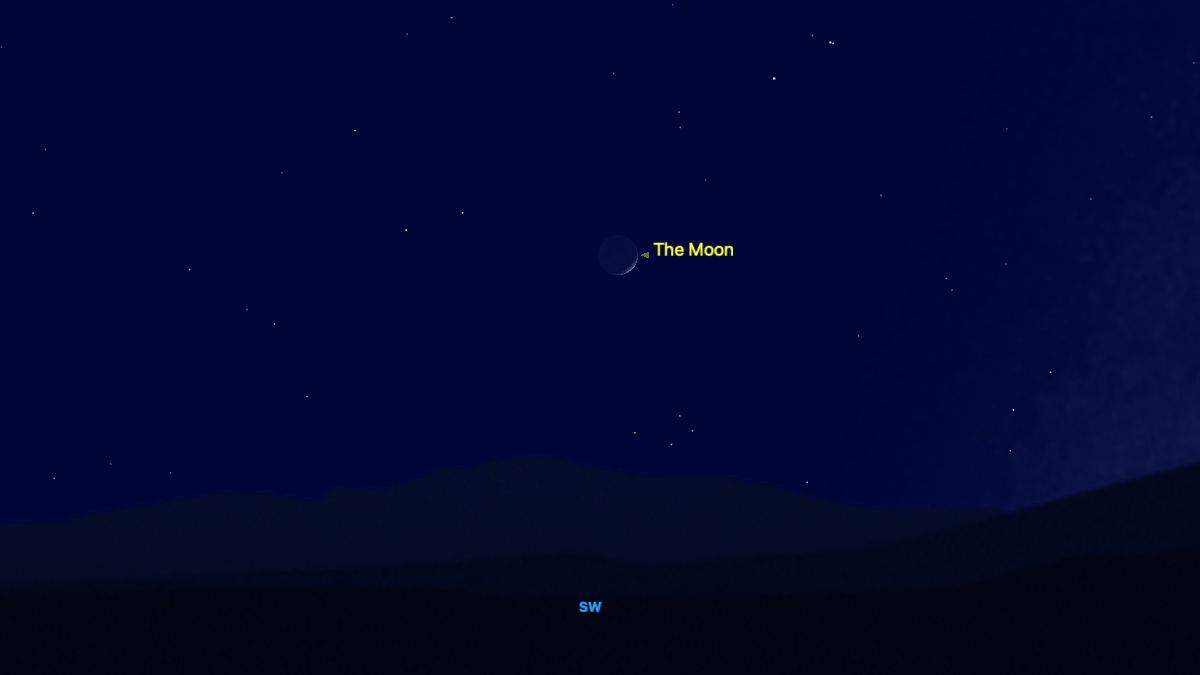
Look for Earthshine tonight (Dec. 22)/ (Image credit: Starry Night)
Look to the southwest just after sunset, and you’ll see a 7%-illuminated waxing crescent moon shining in front of the stars of the constellation Capricorn. Look out for Earthshine on its night side. — Jamie Carter
2025-12-19T10:37:17.993Z
Night sky for tonight and the weekendFriday, Dec. 19: New moon and the winter Milky Way (after dark)
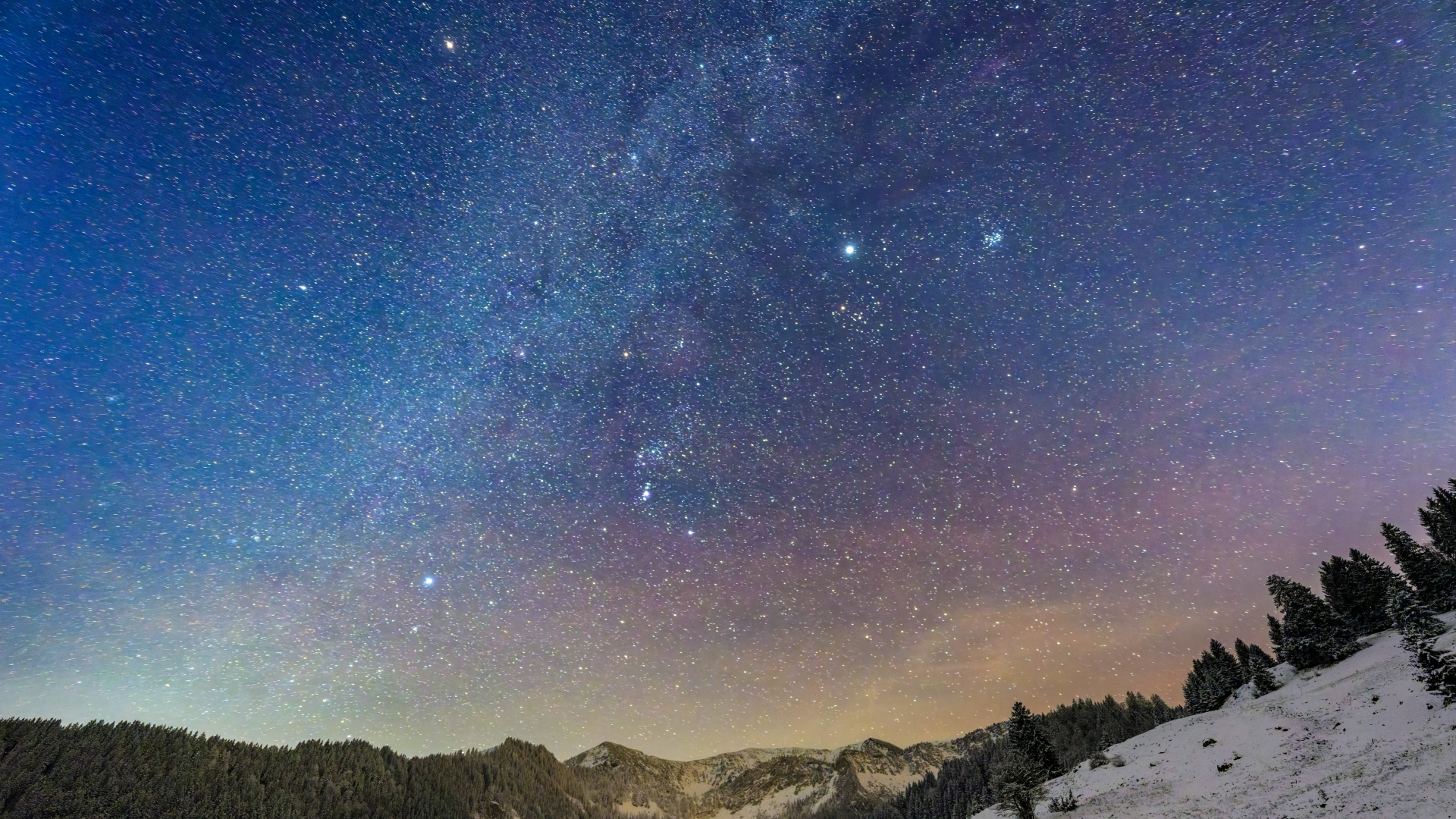
See the new moon’s dark sky on Dec. 19. (Image credit: Westend61 via Getty Images)
The moon turns new at 8:43 p.m. EST on Dec. 19 (0143 a.m. GMT on Dec. 20), giving stargazers the darkest skies of the month. Astrophotographers often obsess about the Milky Way‘s bright core, which is at its most visible during the summer months from the northern hemisphere, but the winter Milky Way — looking away from its center — is almost as impressive. From rural locations, the Milky Way faintly arcs from Cassiopeia to Orion, providing a stunning reminder of the vast galaxy that we inhabit. — Jamie Carter
Saturday, Dec. 20: Jupiter as the ‘Christmas Star’ (after sunset)
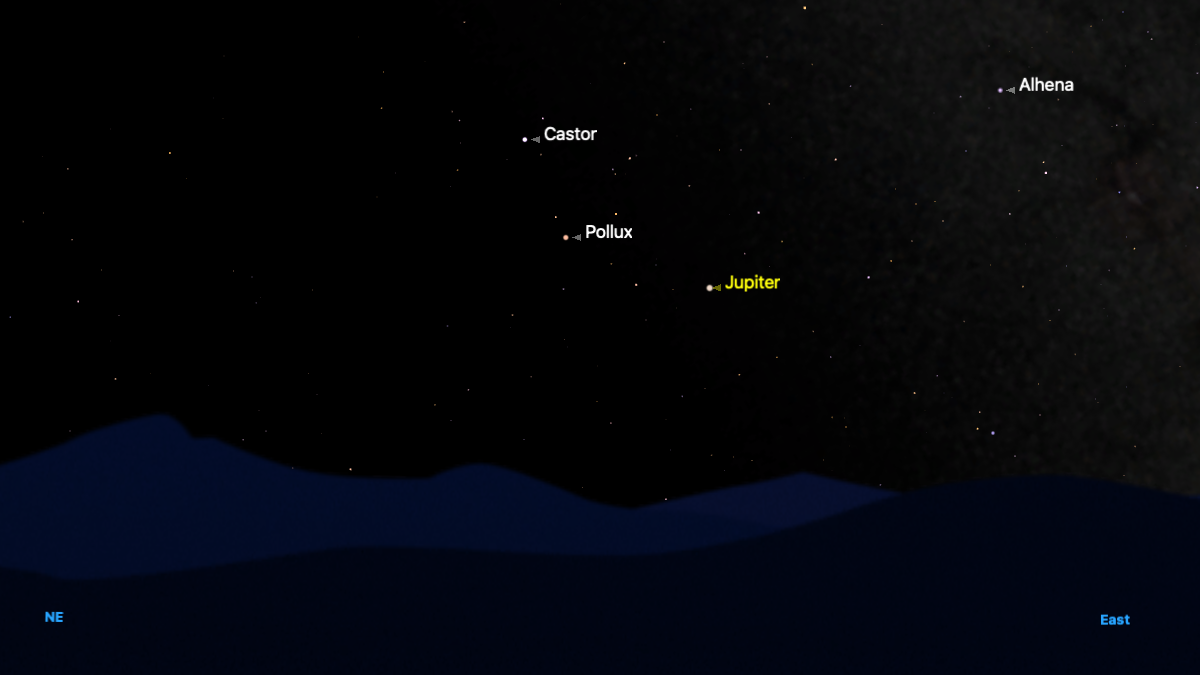
See Jupiter rising in the east on Dec. 20. (Image credit: Starry Night.)
Was Jupiter the ‘Christmas Star’? According to the Bible, a star appeared in the sky at the time of the birth of Jesus Christ in Jerusalem, causing a group of wise men to “follow yonder star” to worship him. Was it a planet? The source of this Christmas legend is unclear. The 17th-century German astronomer Johannes Kepler — he who laid down the laws of planetary motion — pondered whether it may have been a very close conjunction of Saturn and Jupiter in the year 7 BC. Tonight, Jupiter alone makes a play for the title, shining at magnitude -2.6 as it appears in the east about 90 minutes after sunset and remains visible for the rest of the night. It will shine alongside the two brightest stars in the constellation Gemini, Castor and Pollux. — Jamie Carter
Sunday, Dec. 21: Young moon on the solstice as Ursids peak (after dark)
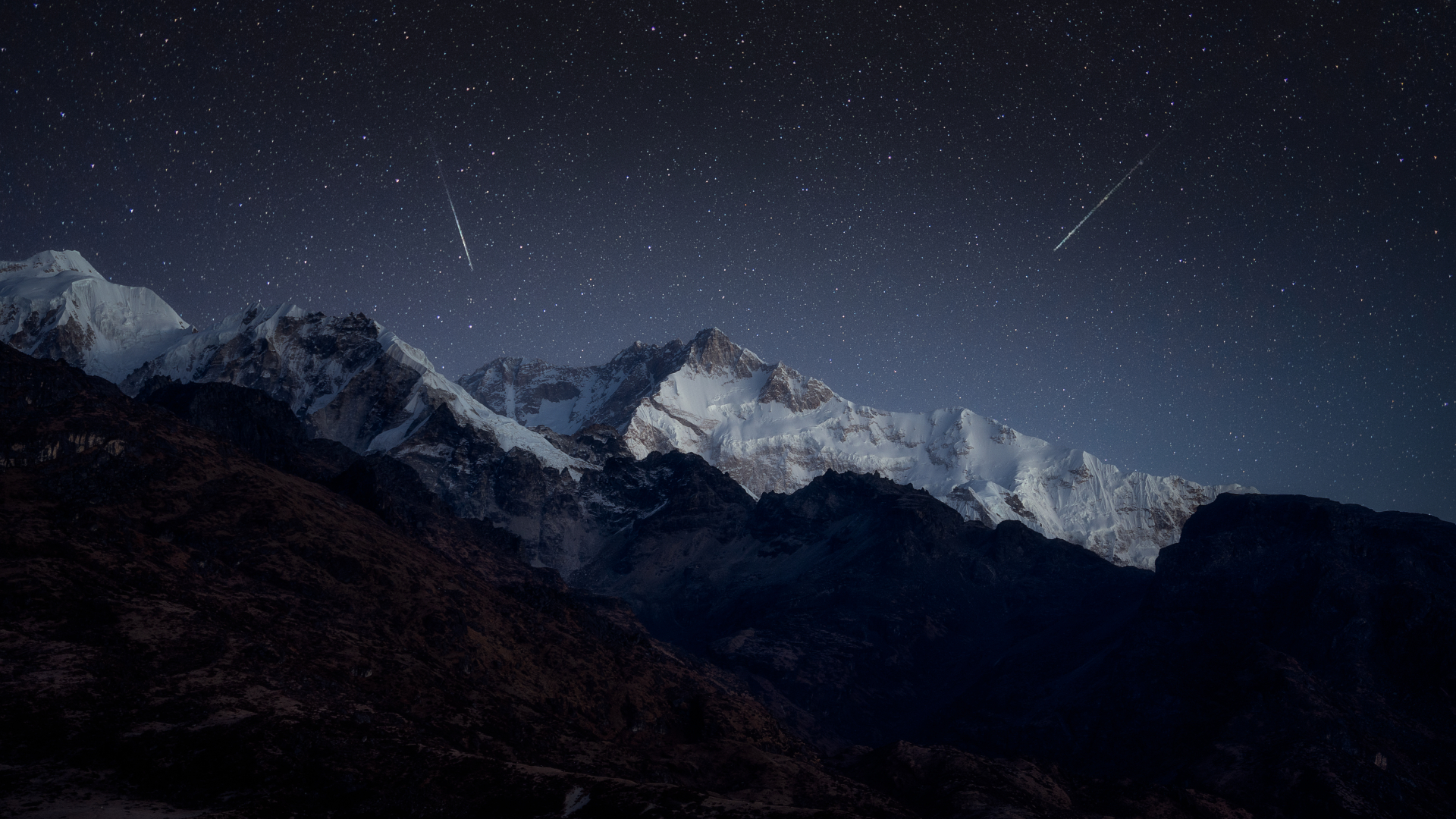
See the Ursid meteor shower and solstice on Dec. 21. (Image credit: Saptarshi Mandal / 500px via Getty Images)
Winter begins in the Northern Hemisphere at 10:03 a.m. EST (1503 GMT). Hours later, a 4%-illuminated waxing crescent moon will be visible in the southwest, just after sunset. It will set soon after, leaving the night sky dark for the peak of the Ursid meteor shower. Expect about 10 shooting stars per hour, which come from dust and debris left in the inner solar system by comet 8P/Tuttle. Meteors will appear to radiate from between the Big Dipper and the Little Dipper in the northern sky. — Jamie Carter
2025-12-18T10:28:00.403Z
Thursday, Dec. 18: Orion’s Sword (after dark)
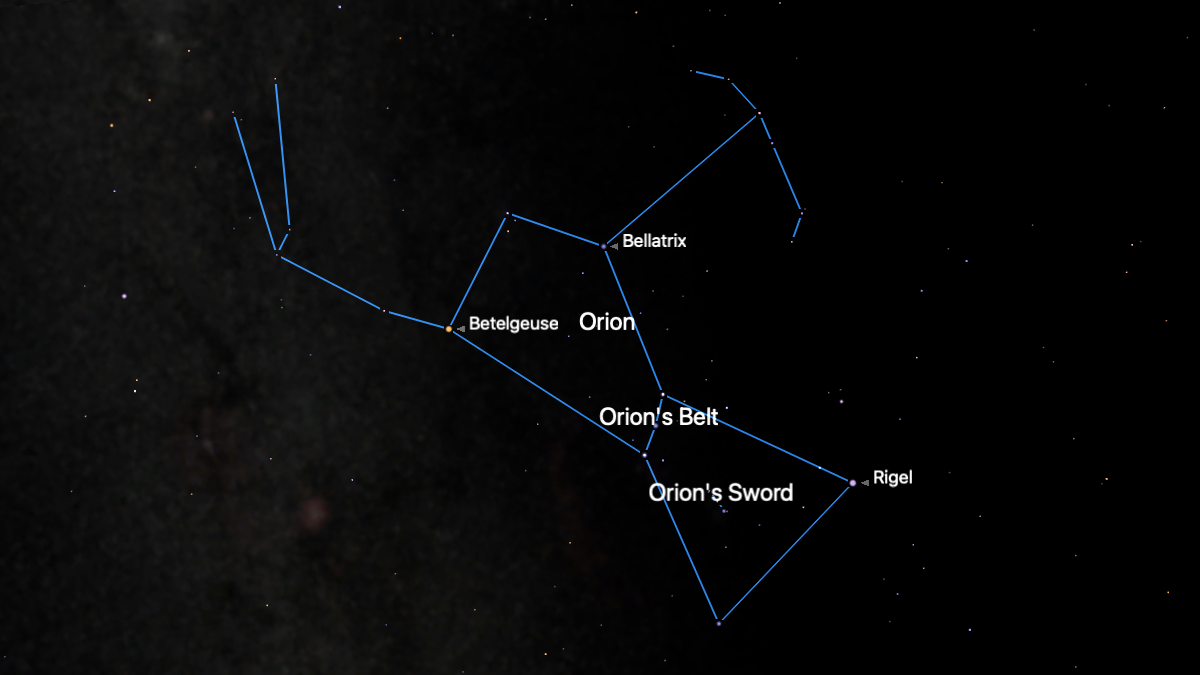
See Orion’s Sword on Dec. 18. (Image credit: Starry Night)
Anytime after dark is great for looking more closely at one of the jewels of the winter night sky. Look below Orion’s Belt — which will be visible in the southeast after sunset — for a short vertical line of faint stars known to astronomers as Orion’s Sword.
A soft haze of light may be visible surrounding the middle star. This is the Orion Nebula (M42), the closest large star-forming region to the solar system, which orbits within the Milky Way at just 1,500 light-years from Earth. — Jamie Carter
Please follow our community guidelines.”>
You must confirm your public display name before commenting
Please logout and then login again, you will then be prompted to enter your display name.
Logout