
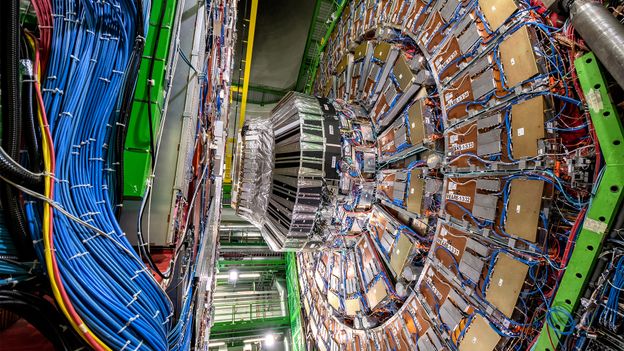
“[We] want to be one of the technology leaders with this heat exchanger so we started developing it together with Cern,” says Stefan Brohm, lead business engineer at Swep, a manufacturer of heat exchangers – devices that move heat from one fluid to another, for example. Different kinds of heat exchanger are used in fridges, heat pumps, cars and even aircraft engines to transfer heat around. In this case, Swep’s heat exchangers will – once the LHC upgrade is finished – help to cool down parts of the LHC’s Atlas experiment to -45C (-49F) in an effort to reduce electronics noise associated with radiation, explains Aleksa.
The specific heat exchanger Swep developed for the LHC upgrade allows for the use of carbon dioxide as a refrigerant. Although a greenhouse gas, carbon dioxide is much less potent than the refrigerant used in the previous system in question, so the changeover is an improvement in terms of sustainability.
Other parts of the LHC require much lower temperatures than Atlas
Having developed the new heat exchanger for Cern, Swep says the same device also has applications in industrial and commercial cooling – such as in supermarket chill cabinets. “It opens up possibilities for other systems,” says Brohm. Various other companies have separately developed their own carbon dioxide heat exchanger technology as part of a general trend towards less climate-damaging refrigerants.
Yifeng Yang, director of the Institute of Cryogenics within Engineering and Physical Sciences at the University of Southampton in the UK, says that many fridges, including some of the cooling equipment at the LHC, utilise the vapour compression cycle, in which a refrigerant absorbs heat and is then compressed, which raises its pressure and temperature so that the heat can be transferred elsewhere. By doing this again and again, you can cool down a room – or a giant experiment.