
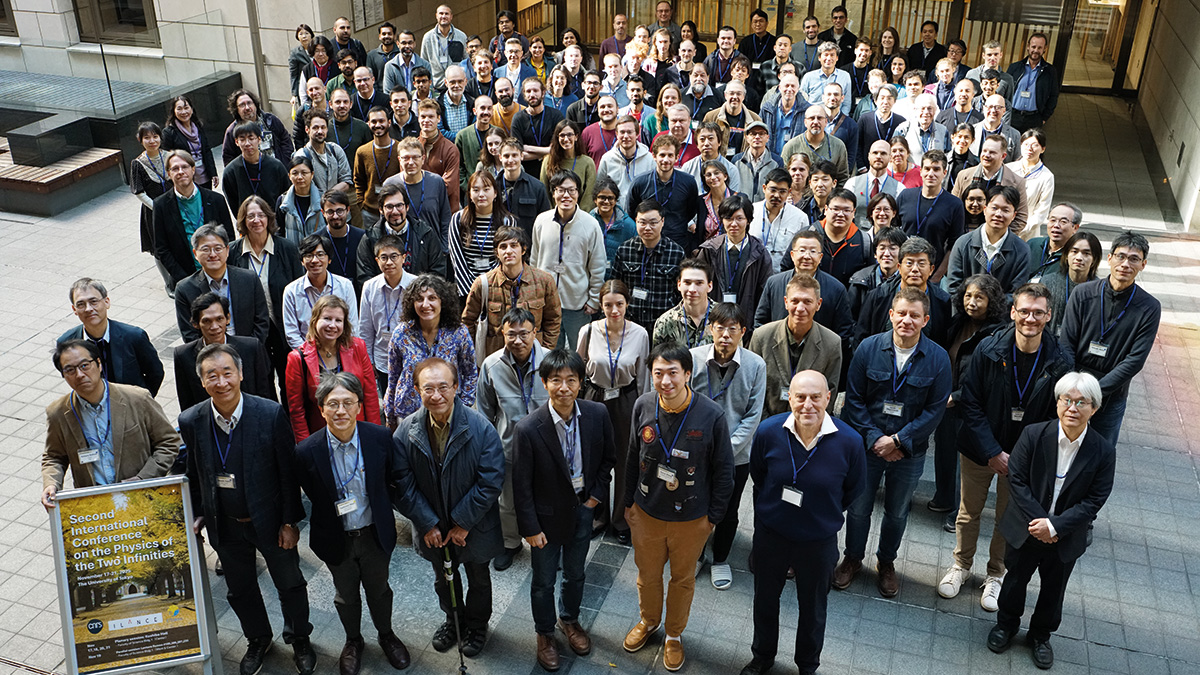
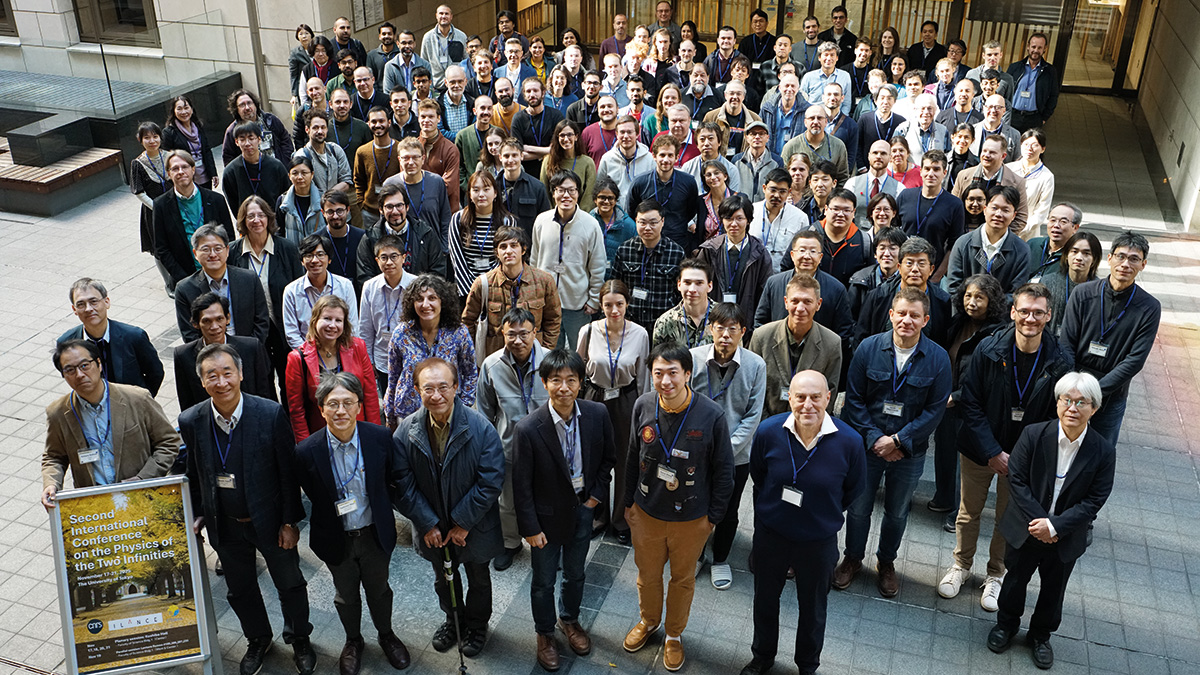
Across the universe About 200 researchers gathered in Tokyo to discuss physics at the largest and smallest scales. Credit: ILANCE
From 17 to 23 November, the second International Conference on Physics of the Two Infinities (P2I) gathered nearly 200 participants on the historic Hongo campus of the University of Tokyo. Organised by the ILANCE laboratory, a joint initiative by CNRS and the University of Tokyo, the P2I series aims to bridge the largest and smallest scales of the universe. In this spirit, the 2025 programme drew together results from cosmological surveys, particle colliders and neutrino detectors.
Two cosmological tensions will play a key role in the coming decades. One concerns how strongly matter clumps together to form structures such as galaxy clusters and filaments. The other involves the universe’s expansion rate, H0. In both cases, measurements based on early-universe data differ from those conducted in the local universe. The discrepancy on H0 has now reached about 6σ (CERN Courier March/April 2025 p28). Independent methods, such as strong lensing, lensed supernovae and gravitational-wave standard sirens, are essential to confirm or resolve this discrepancy. Several of these techniques are expected to reach 1% precision in the near future. More broadly, upcoming large-scale cosmological missions, including Euclid, DESI, LiteBIRD and the Legacy Survey of Space and Time (LSST) – which released its world-leading camera’s first images in June – are set to deliver important insights into inflation, dark energy and the cosmological effects of neutrino masses.
The dark universe featured prominently. Participants discussed an excess of gamma rays from the galactic centre detected by the Fermi telescope, which is consistent with the self-annihilation of weakly interacting massive particles (WIMPs) and may represent one of the strongest experimental hints for dark matter. Recent analyses on more than 40 million galaxies and quasars in DESI’s Data Release 2 show that fits to baryon acoustic oscillation distances deviate from the standard ΛCDM model at the 2.8 to 4.2σ level, with a dynamical dark energy providing a better match. Euclid, having identified approximately 26 million galaxies out to over 10.5 billion light-years, is poised to constrain the nature of dark matter by combining measurements of large-scale structure, gravitational-lensing statistics, small-scale substructure, dwarf-galaxy populations and stellar streams. Experiments such as XENONnT and PandaX-4T are instead pursuing a mature direct-detection programme.
Future colliders were a central topic at P2I. While new physics has long been expected to emerge near the TeV scale to stabilise the Higgs mass, the Standard Model remains in excellent agreement with current data, and precision flavour measurements constrain many possible new particles to lie at much higher energies. The LHC collaborations presented a flurry of new results and superb prospects for its high–luminosity phase, alongside new results from Belle II and NA64. Looking ahead, a major future collider will be essential for exploring and probing the laws connecting particle physics with the earliest moments of the universe.
The conference hosted the first-ever public presentation of JUNO’s experimental results, only a few hours after their appearance on arXiv. Despite relying on only 59.1 days of data, the experiment has already demonstrated excellent detector performance and produced competitive measurements on solar-neutrino oscillation that are fully consistent with previous results. This level of precision is remarkable, after barely two months of data collection. Three major questions in neutrino physics remain unresolved: the ordering of neutrino masses, the value of the CP-violating parameter and the octant of the mixing angle θ32. The next generation of experiments, including JUNO, DUNE, Hyper-K and upgraded neutrino telescopes, are specifically designed to answer these questions. Meanwhile, DESI has reported a new, stringent upper limit of 0.064 eV on the sum of neutrino masses, within a flat ΛCDM framework. It is the tightest cosmological constraint to date.
The LHC collaborations presented a flurry of new results and superb prospects for its high–luminosity phase
New data from the JWST, Subaru and ALMA telescopes revealed an unexpectedly rich population of galaxies only 200–300 million years after the Big Bang. Many of these early systems appear to grow far more rapidly than predicted by the ΛCDM model, raising questions such as whether star formation efficiency was significantly higher in the early universe or whether we currently underestimate the growth of dark-matter halos (CERN Courier November/December 2025 p11). These data also highlighted a surprisingly abundant population of high-redshift active galactic nuclei, with important implications for black-hole seeding and early supermassive black-hole formation. A comprehensive review of the rapidly evolving field of supernova and transient astronomy was also presented. The mechanisms behind core-collapse supernovae remain only partially understood, and the thermonuclear explosions of white dwarfs continue to pose open questions. At the same time, observations keep identifying new transient classes, whose physical origins are still under investigation. Important insights into protostars, discs and planet formation were also discussed. Observations show that interstellar bubbles and molecular filaments shape the formation of stars and planets across a vast range of physical scales. More than 6000 exoplanets have today been detected, from hot Jupiters to super Earths and ocean planets, many without counterparts in our Solar System.
With more than 150 new gravitational-wave (GW) candidates now identified, including extreme ones with rapid spins and highly asymmetric component masses, GW astronomy offers outstanding opportunities to investigate gravity in the strong-field regime. Notably, the GW250114 event was shown to obey Hawking’s area law, which states that the total horizon area cannot decrease during a black-hole merger, providing strong confirmation of general relativity in the most nonlinear regime. Next-generation observatories such as the Einstein Telescope, Cosmic Explorer and LISA will allow detailed black-hole spectroscopy and impose tighter constraints on alternative theories of gravity.
Even if the transition to multi-messenger astronomy began in the late 20th century, the first binary neutron-star merger, GW170817, remains its landmark event. An extraordinary global effort – more than 70 teams and 100 instruments pointed at the event for years – highlighted several historic firsts: the first gravitational-wave “standard siren” measurement of the Hubble constant, the first association between a neutron-star merger and a short gamma-ray burst, the first observed kilonovae confirming the astrophysical site of heavy-element production, and the first direct test comparing the speed of gravity and light. Very-high-energy gamma-ray astronomy (HESS, MAGIC and VERITAS) also reported impressive results, with more than 300 sources above 100 GeV observed, and bright prospects, as the Cherenkov Telescope Array Observatory (CTAO) is about to start operations.