
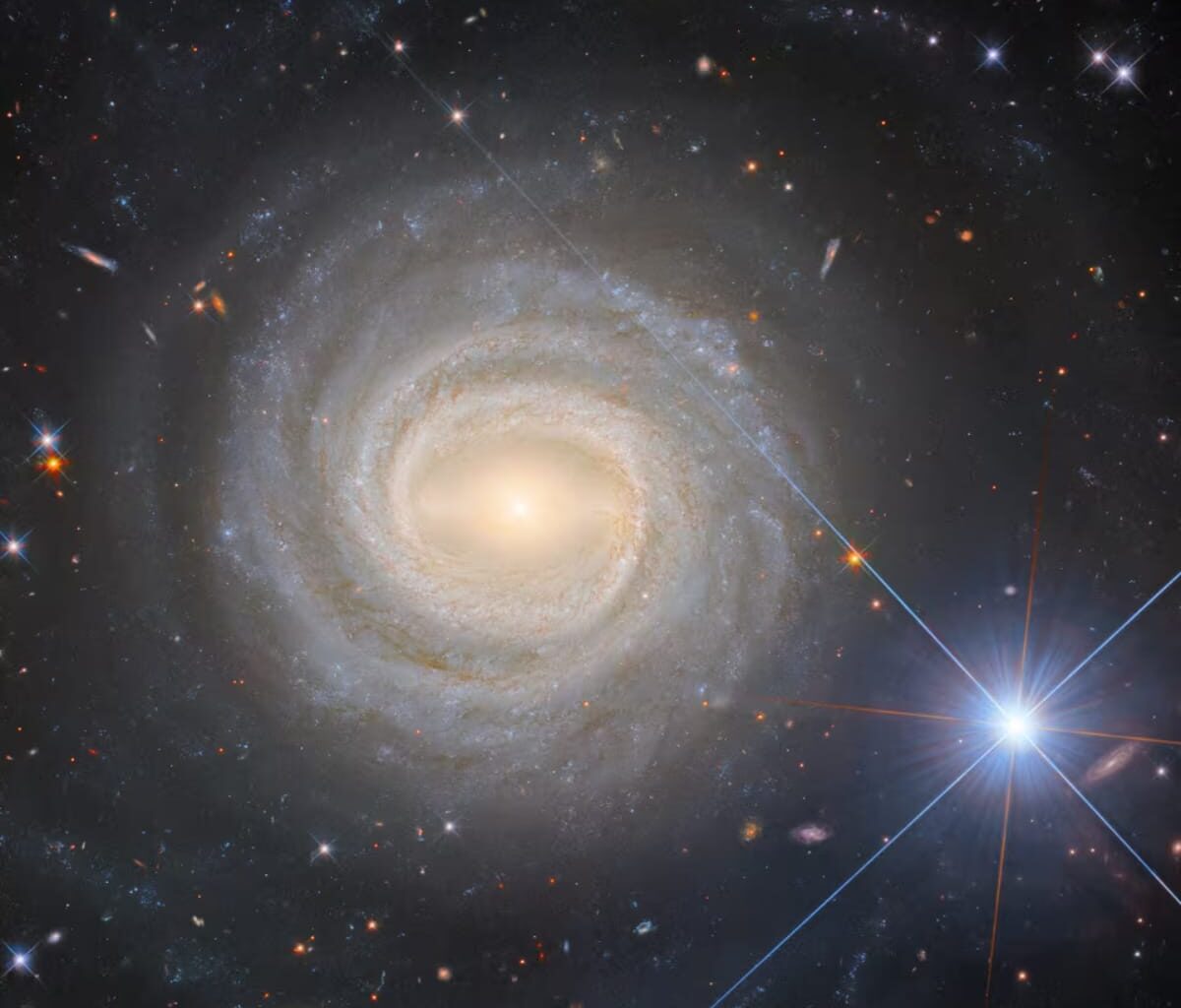
NGC 3783 is one of the most beautifully shaped spiral galaxies ever observed. You might imagine a calm, graceful swirl of stars in deep space. But don’t be fooled—astronomers just witnessed a storm of staggering power erupting within it.
This stunning spiral galaxy—much like our own Milky Way—was recently captured by the Hubble Space Telescope. Located roughly 155 million light-years away, it’s become the focus of a groundbreaking discovery by researchers from the Space Research Organisation Netherlands (SRON).
In a study published in Astronomy & Astrophysics, the team explains how they used both the European Space Agency’s XMM-Newton Space Telescope and the X-Ray Imaging and Spectroscopy Mission (XRISM, a collaboration between JAXA, ESA, and NASA) to investigate NGC 3783 and its central black hole. What they found was astonishing: a brilliant burst of X-rays that vanished almost instantly—followed by winds blasting out matter at nearly 60,000 kilometers per second.
“It’s almost unimaginable,” said the researchers. For context, that’s about one-fifth the speed of light.
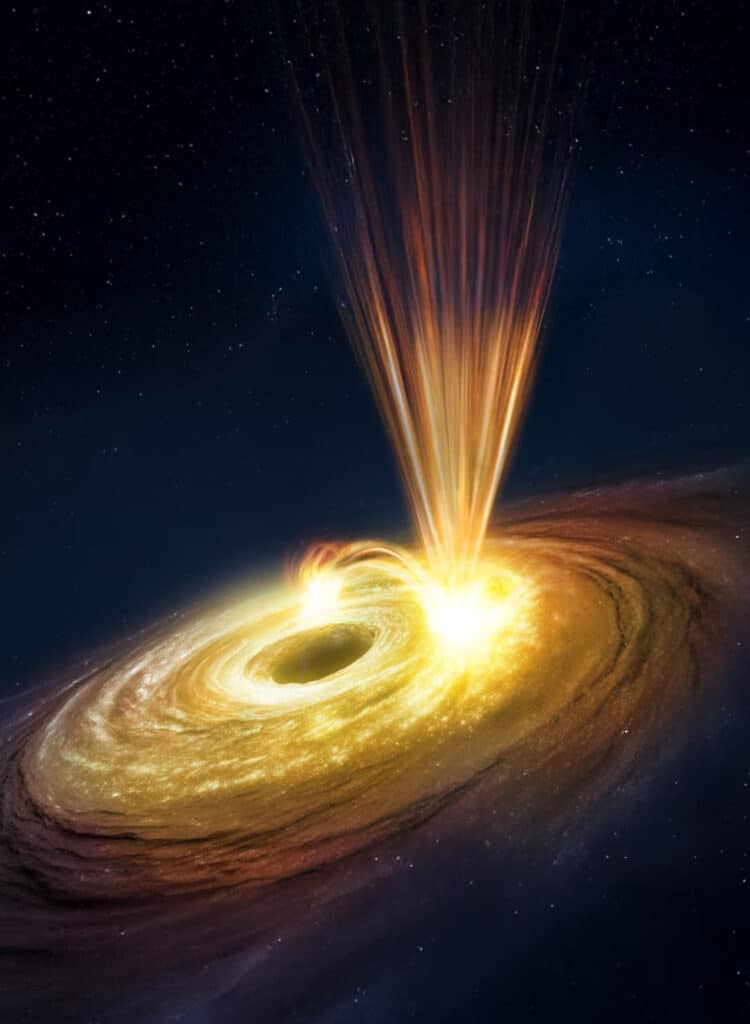
Here, an artist’s impression of the black hole at the heart of NGC 3783, which astronomers studied using the XMM-Newton space telescope and the X-Ray Imaging and Spectroscopy Mission (XRISM). © ESA
A violent magnetic event
The black hole at the galaxy’s core is a true heavyweight—roughly 30 million times the mass of our Sun. It feeds on nearby gas and dust, energizing an incredibly bright, active region at the heart of the spiral. Astronomers call these areas active galactic nuclei, or AGN. They emit every kind of radiation imaginable and shoot out intense jets and winds across space.
According to the SRON scientists, especially violent winds formed around NGC 3783’s black hole when its magnetic field suddenly “untwisted,” releasing tremendous magnetic energy.
Fun fact: the XMM-Newton Space Telescope has been operating since 1999, exploring some of the hottest and most extreme parts of the cosmos. XRISM joined it in September 2023, designed to study how matter and energy move throughout the Universe. Both telescopes observe in X-rays, revealing details invisible to optical instruments.
These cosmic tempests may sound distant, but they’re not entirely alien. Our own Sun sometimes unleashes similar events—massive solar flares that hurl scorching clouds of matter into space, known as coronal mass ejections (CMEs). On November 11, one of these blasts reached speeds of about 1,500 km/s. That’s modest compared to the 60,000 km/s winds seen around NGC 3783’s black hole, but the physics behind them is surprisingly familiar.
🆕 @ESA_XMM & XRISM observed an extraordinary blast from a supermassive black hole💥
They spotted a bright X-ray flare erupting from the gigantic black hole lurking within NGC 3783. As it faded away, fast winds emerged, raging at speeds of 60 000 km per second.… pic.twitter.com/m3xBeGZKkX
— European Space Agency (@esa) December 9, 2025
From a supermassive black hole to our Sun
“By observing an active supermassive black hole, XMM-Newton and XRISM have revealed a brand-new phenomenon—ultrafast winds triggered by an eruption,” explains Erik Kuulkers, project scientist for XMM-Newton at ESA. “These winds resemble those we see from the Sun. Fascinatingly, this suggests that solar and high-energy processes might operate in remarkably similar ways throughout the Universe.”
Yet the interest in AGNs goes beyond pure curiosity. Astronomers know that these turbulent regions play a critical role in shaping their host galaxies and even in the birth of new stars. Understanding how magnetism in AGNs generates such powerful winds could be key to decoding the grand story of how galaxies evolve across space and time.

Nathalie Mayer
Journalist
Born in Lorraine on a freezing winter night, storytelling has always inspired me, first through my grandmother’s tales and later Stephen King’s imagination. A physicist turned science communicator, I’ve collaborated with institutions like CEA, Total, Engie, and Futura. Today, I focus on unraveling Earth’s complex environmental and energy challenges, blending science with storytelling to illuminate solutions.