
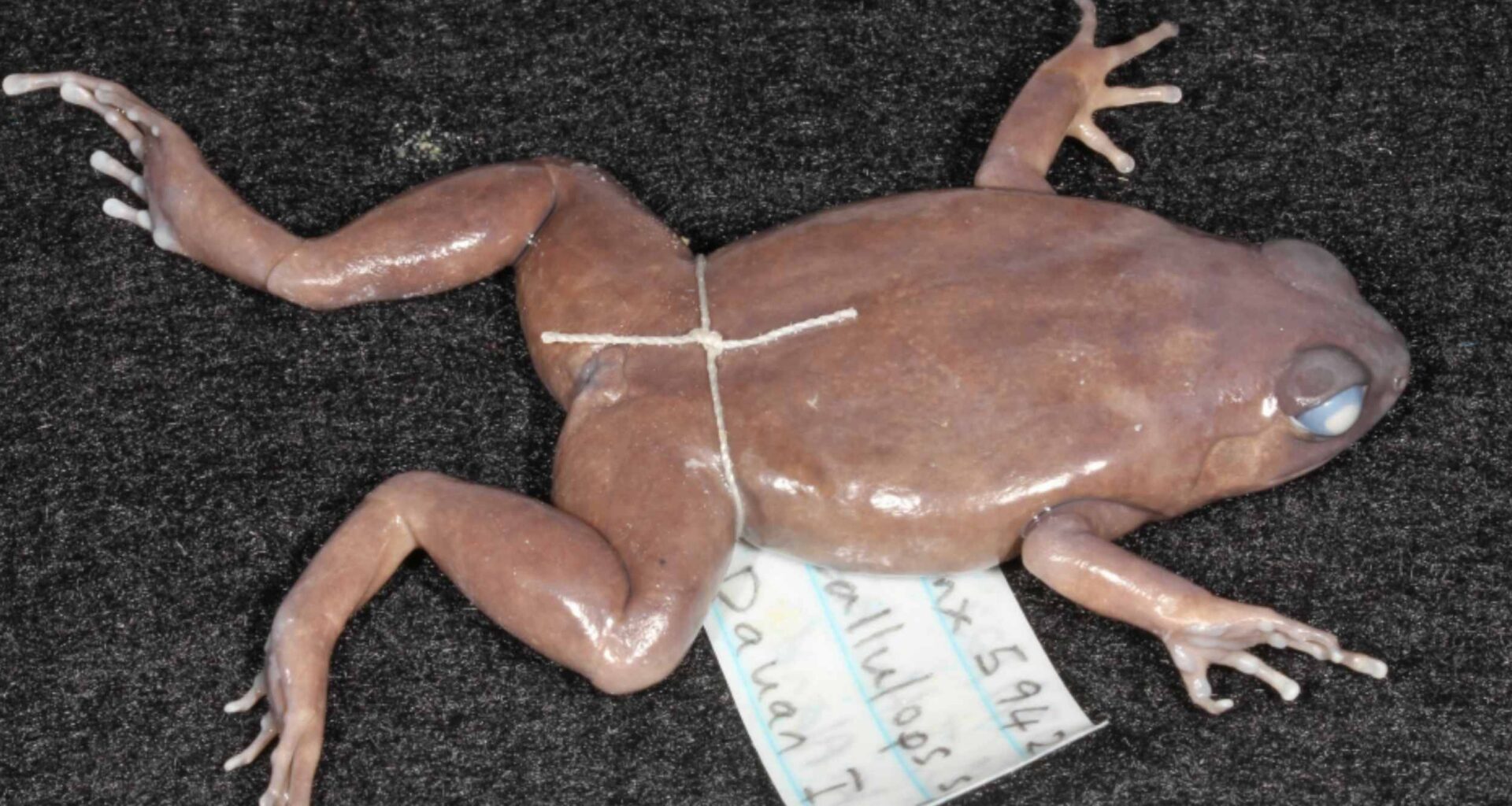
A detailed survey of Dauan Island in Australia found three animal species that are new to science – two frogs and a gecko.
Records show Dauan Island is about 1.4 square miles in size with a surface is built from piled granite rather than broad plains.

Rain in the Torres Strait can trigger sudden choruses, and careful listening sometimes flags an unfamiliar call pattern.
The survey was led by Conrad J. Hoskin, a terrestrial ecologist at James Cook University (JCU).
His research focuses on how isolated rock and rainforest pockets help small vertebrates survive when surrounding landscapes become hotter and drier.
Dauan Island granite boulders
Mount Cornwallis rises to 968 feet and marks Australia’s northernmost Great Dividing Range peak.
Deep rock gaps trap damp air, and slow airflow keeps temperatures steadier than the exposed surface during dry spells.
Because Dauan sits about 7 miles from New Guinea, a few missing habitats can decide which species persist.
The gecko appears first
Early in the survey, a long-legged gecko moved across the boulders, matching a hunch that reptiles waited there.
Later work described Nactus simakal as endemic, found naturally in just one place, and its banded pattern and genetic differences marked it distinct.
A species confined to one island has little room to dodge storms, disease, or new predators.
Two voices in the rain
Nighttime rain brought two frog calls from the boulder slopes, and their rhythms did not match known species.
“Sure enough, they were species new to science,” said Hoskin. Those recordings became a guide for collecting specimens, because a call alone rarely proves a new frog species.
Sorting lookalike species
Careful taxonomy, the science of naming and classifying life, depends on matching measurements and calls to known species.
Researchers measured frogs with calipers and compared audio recordings, then checked a short gene sequence to confirm each genus.
With only a handful of specimens, the descriptions stay cautious, and future surveys could reveal more hidden diversity nearby.
The gobakula frog’s niche
Cracks between granite blocks hold the larger frog, Callulops gobakula, which spends nights calling from narrow rock gaps.
Adults reach about 2 inches long, and toe discs help them grip rock edges while retreating fast.
Any disturbance to the boulder habitat could threaten the whole population, because no nearby islands share this terrain.
Toe pads and climbing ability
Oversized toe pads stand out on the Choerophryne koeypad, a frog barely 0.8 inches long.
“It’s very small, about the size of my fingernail, but super loud,” said Hoskin. Because females and juveniles were not found, breeding sites and population size remain uncertain even after the call recordings.
How microhylids raise young
Both frogs belong to the microhylid family, a group of mostly small, land-breeding frogs, and their closest kin live in New Guinea.
Eggs are laid in moist places and hatch as tiny froglets, because embryos develop inside the egg instead of water.
That life cycle makes dry seasons risky, since exposed eggs can desiccate quickly unless sheltered by damp rock crevices.
Habitats on the Dauan Island map
Distribution maps put the nearest Callulops records about 124 miles north of Dauan island. Comparable gaps appear for Choerophryne, with the closest records roughly 174 miles north in New Guinea ranges.
If their nearest kin live far north, what let these lineages persist on Dauan while mainland habitats became drier?
During past ice ages, lower sea levels connected parts of Australia and New Guinea, letting rainforest species move across.
Later warming and regional drying replaced many wet forests with savanna, so moisture-dependent frogs disappeared from broad lowlands.
Dauan may have kept survivors because its rocks offered cooler hideouts when wetter habitats retreated north.
Cool crevices as refuges
Deep boulder piles can form litho-refugia, rock refuges that buffer temperature and moisture, even when the air above is harsh.
Shade and stacked rock slow evaporation, and water seeping downward keeps humidity high where frogs rest between wet nights.
Because such formations are rare nearby, losing one boulder field can erase an entire local branch of evolution.
Invasive ants as looming threat
Island endemics face extra risk when pests arrive, so biosecurity, steps that block harmful species, becomes a daily concern.
Yellow Crazy Ants, Anoplolepis gracilipes, can overwhelm native food webs, and a review describes broad impacts on islands.
The International Union for Conservation of Nature (IUCN) criteria treat very small ranges as Vulnerable, so one invasion could be decisive.
Lessons from Dauan Island
Local language shaped the names gobakula and koeypad, which mean boulders and rocky mountain in Kalaw Kawaw Ya.
Tying names to local knowledge can support stewardship, yet visitors and researchers still need rules that protect fragile habitats.
Sound, rock, and climate together explain why Dauan holds unusual species that were missed until careful fieldwork.
Continued surveys and tight biosecurity will matter most, because small populations can vanish quickly when a single threat spreads.
—–
Like what you read? Subscribe to our newsletter for engaging articles, exclusive content, and the latest updates.
Check us out on EarthSnap, a free app brought to you by Eric Ralls and Earth.com.
—–