
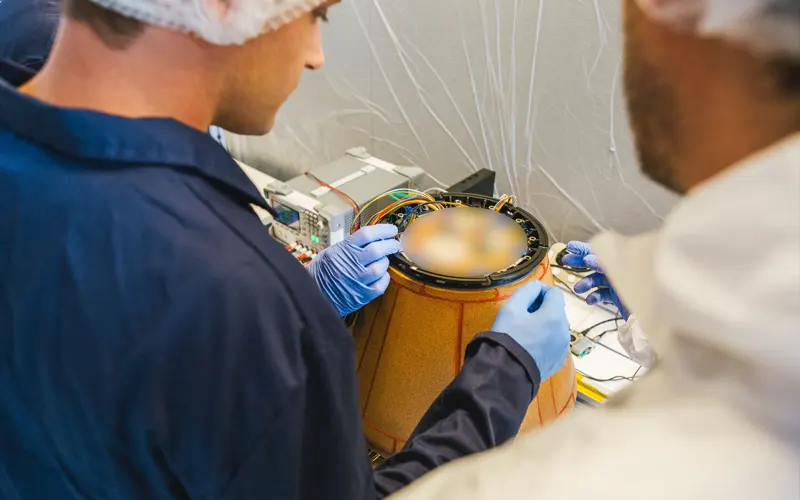
 Credit: Orbital Paradigm
A small reentry capsule demonstrator developed by Spanish space logistics startup Orbital Paradigm survived the failure of its PSLV launch vehicle on 12 January and successfully transmitted 190 seconds of flight data.
Valencia-based Orbital Paradigm was founded in 2023 and is developing a reusable capsule called Kestrel that will be able to host payloads of up to 120 kilograms in orbit for as long as three months and then successfully return them to Earth. The company expects to conduct monthly flights of its capsule in the 2030s.
As part of the development roadmap for Kestrel, the company is producing subscale demonstrators that are used to derisk key systems. The first of these demonstrators is KID, the Kestrel Initial Demonstrator, which was developed in less than a year with a budget under €1 million.
The KID demonstrator was launched aboard a PSLV rocket on 12 January from the Satish Dhawan Space Centre in India. During the third-stage burn, an anomaly occurred that resulted in the loss of the vehicle, the mission’s primary passenger, and all but one of 15 secondary payloads. According to an Orbital Paradigm press release, the survival of its little demonstrator came as a surprise.
“When we understood that the launch was non-nominal it was a bit of a hit for us,” explained Orbital Paradigm CEO Francesco Cacciatore. “We worked really hard to develop the KID capsule and its technology from scratch, with very constrained resources and time, to de-risk the next steps. We had the trust of our customers and their payloads onboard, and it seemed we wouldn’t be able to put what we did to the test. I think the launch livestream was still ongoing when the team saw that we had 190 seconds of flight data transmitted and received. We needed a few minutes to realize it was real data and not a glitch.”
Despite KID springing from the burning wreckage of the PSLV launch vehicle and managing to transmit data while enduring forces beyond its design specifications, the company still considers the flight a failure. According to the company, customer data was scheduled to be transmitted later in the flight, and the capsule did not have enough time to complete this key element of the mission before ocean impact.
“KID was tested beyond its design envelope, and it worked. Separation, power-on, and data transmission, even after reentry, all performed well despite degraded conditions,” explained the company in a 13 January update. “Based on initial analysis, it seems that we achieved 4 out of 5 launch milestones, albeit through an off-nominal profile. The failure to deliver customers’ data prevents us from declaring the mission a success.”
Despite this, the company has stated that it will move forward with a larger, more advanced demonstrator that it expects to launch in early 2027.
Keep European Spaceflight Independent
Your donation will help European Spaceflight to continue digging into the stories others miss. Every euro keeps our reporting alive.