
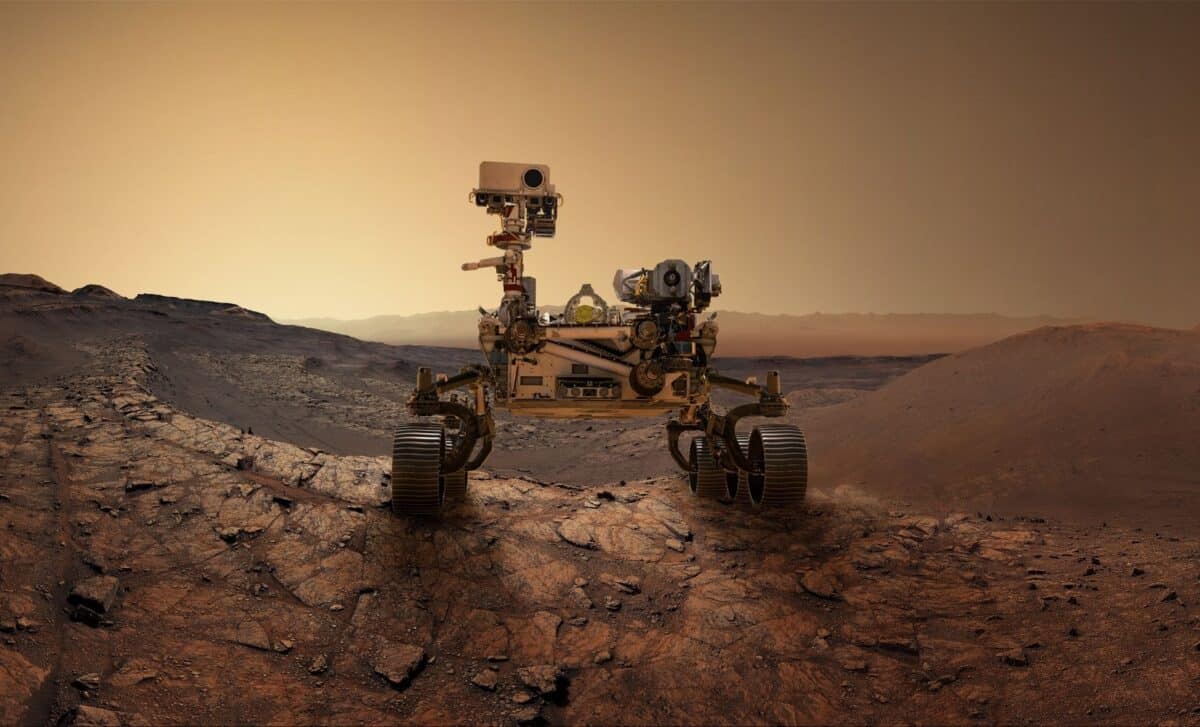
In a stunning reversal for planetary science, NASA’s high-profile Mars mission to bring rock samples back to Earth has been canceled following a severe funding cut by the U.S. Congress. The decision halts over a decade of planning and development on what was considered one of the agency’s most ambitious interplanetary endeavors.
Originally designed as a multi-agency campaign between NASA and the European Space Agency, the Mars Sample Return (MSR) mission was poised to deliver an unprecedented scientific breakthrough: returning carefully selected Martian samples for analysis in Earth-based laboratories. The samples, already collected by the Perseverance rover, are now stranded on the Martian surface with no mission currently planned to retrieve them.
A Complex Architecture Now Abandoned
According to reporting from ScienceAlert, the plan relied on several spacecraft working in sequence, with tight coordination between a lander, helicopters, and an orbital return vehicle. In the baseline scenario, Perseverance would deliver its cache of rock and dust samples to a lander carrying a small rocket. If Perseverance could not complete the handoff, a pair of specially designed helicopters would retrieve the tubes and transfer them to the lander instead. The rocket would then launch the samples into Martian orbit, where a second spacecraft would capture them and bring them back to Earth.
Many of the mission’s components were already in development, with designs and prototypes progressing. Still, NASA said the program was entering “tough territory,” citing major uncertainty over both cost and technical feasibility. Those risks, combined with broader budget pressure, left Mars Sample Return (MSR) vulnerable when funding cuts became necessary.
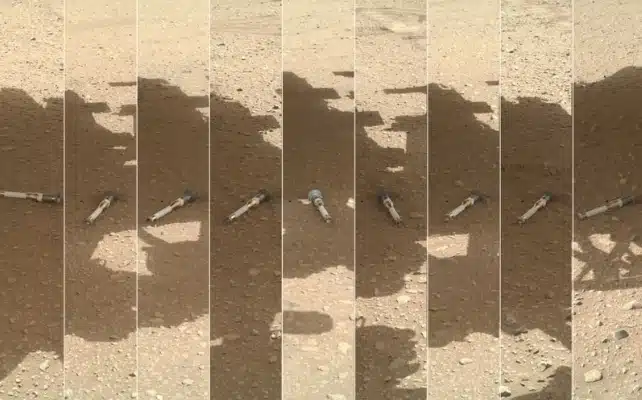 Perseverance’s stored samples are still waiting to be collected on Mars. Credit: NASA/JPL-Caltech/MSSS
Perseverance’s Samples Left In Limbo
The Perseverance rover, which landed on Mars in 2021, has so far gathered 33 sealed sample tubes, each containing carefully chosen materials selected for their scientific relevance.
“Ten of the samples depicted here – including one atmospheric sample and one witness tube – were deposited in January 2023 at the rover’s sample depot at a location dubbed “Three Forks” within Jezero Crater. The other 23 samples collected thus far remain aboard the rover,” as explained by NASA’s statement.
Those sample tubes are now sitting on the Martian surface, with no clear retrieval plan on the table. As the same source notes, they’re unlikely to deteriorate anytime soon because Mars is cold and extremely dry. NASA officials haven’t completely closed the door on a future return effort.
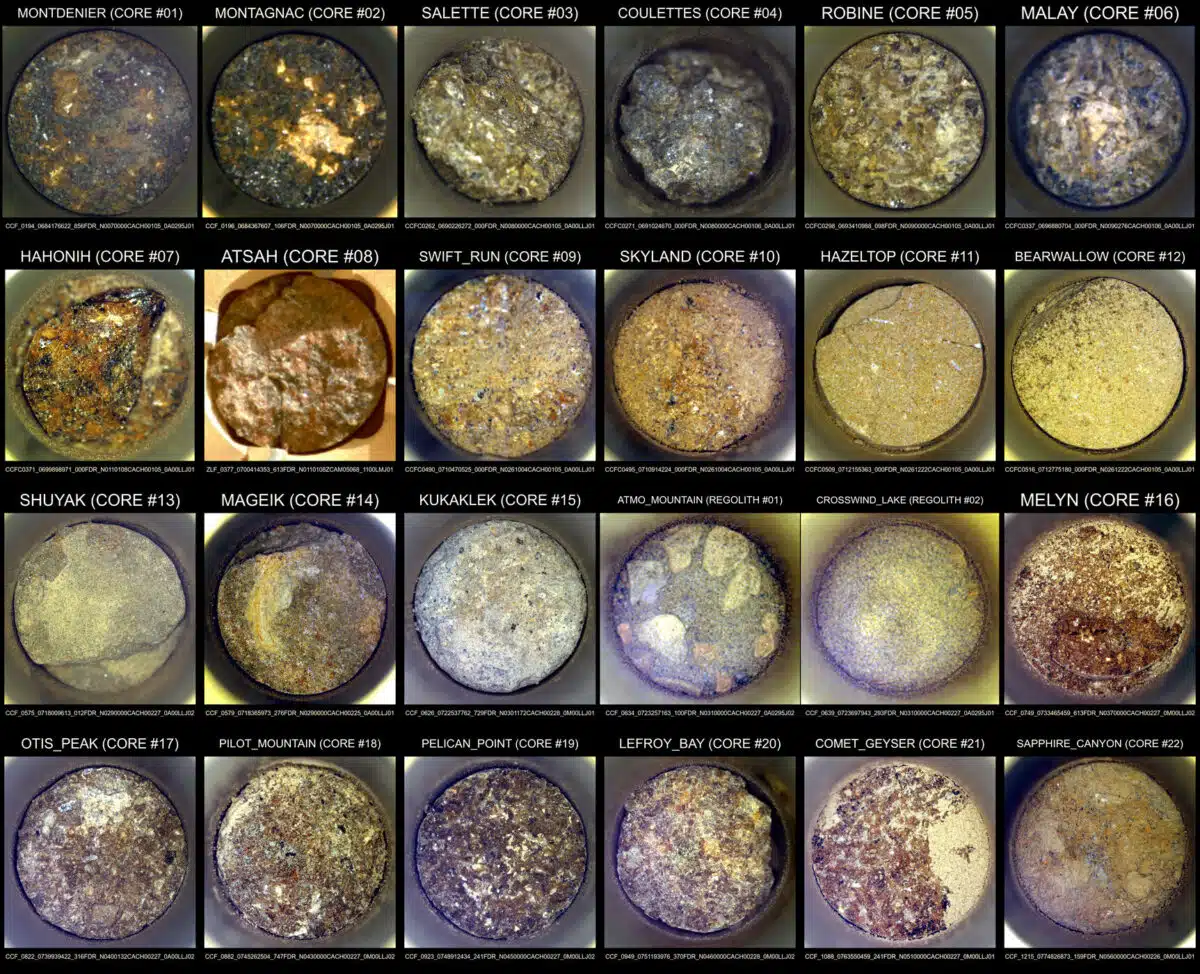 A look at the core samples collected so far. Credit: PNAS
Other Nations May Seize the Moment
NASA’s abrupt exit from the MSR race could have geopolitical implications. As reported by the same source, China is already preparing for its own Mars sample return mission. Though less technically sophisticated than NASA’s detailed plan, the Chinese mission could now become the first to return material from the Martian surface to Earth.
Unlike the curated and targeted sampling performed by Perseverance, China’s approach is described as more of a “grab-and-go” effort. Still, success in such a mission would represent a significant milestone for China’s space program and shift the balance in global space science leadership.
The mission’s termination has been particularly disheartening for scientists involved, many of whom spent years developing the project.