
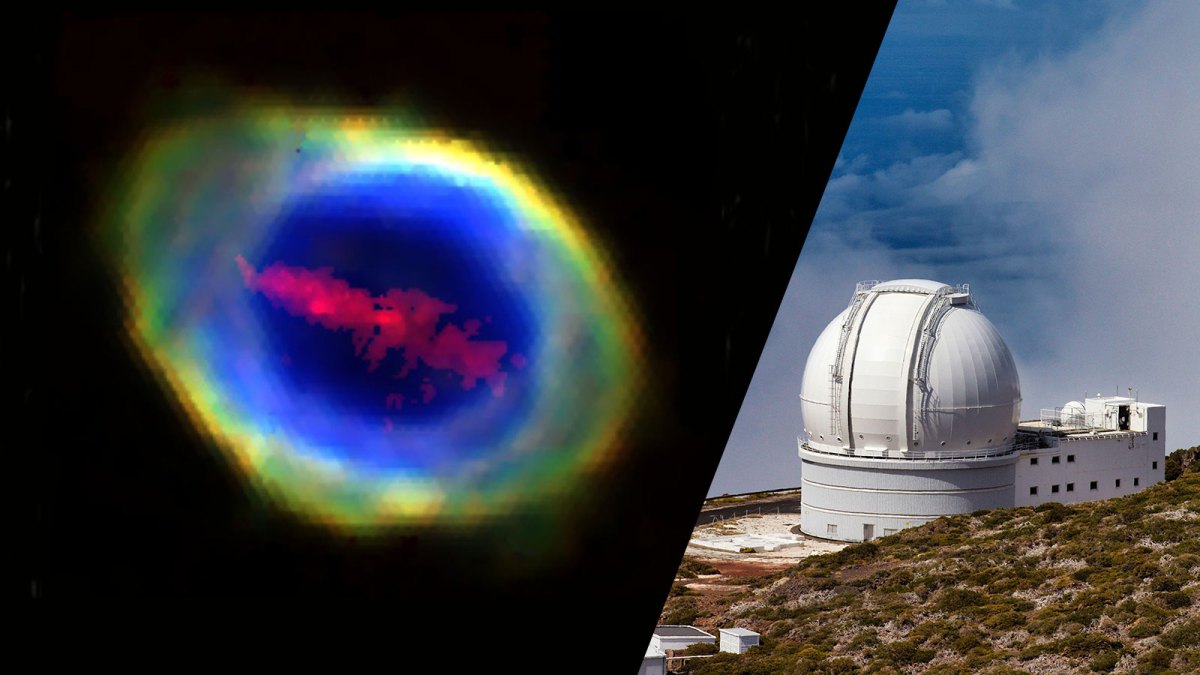
Scientists have discovered a massive and mysterious “bar” of iron in outer space that may offer a glimpse of what will eventually happen to the Earth.
The bar-shaped cloud of iron atoms is almost four trillion miles long. If you could drive across it at 70mph, the journey would take more than eight million years.
It was discovered inside the Ring Nebula, a spectacular ring-shaped cloud of gas about 2,400 light years away, by a team led by astronomers at Cardiff University and University College London (UCL).
• Watch: Nasa astronauts return to Earth after evacuation from space
According to the researchers, the total mass of iron atoms in the structure is comparable to the mass of Mars. The Ring Nebula, first spotted in 1779 in the northern constellation of Lyra by the French astronomer Charles Messier, is a colourful shell of gas thrown off by a dying star. Our sun is expected to go through a similar process in several billion years’ time.
How the iron bar formed is unknown. One possible scenario is that it is the remains of a rocky planet that was vaporised when its star expanded at the end of its life. If true, it could show us Earth’s ultimate fate. Iron accounts for roughly a third of the Earth’s mass and is the chief constituent of the planet’s core.
Dr Roger Wesson, the lead author of the study, who is based at UCL’s department of physics and astronomy and Cardiff University, said: “It would be very surprising if the iron bar in the ring is unique.
• Discovery of newborn planet gives glimpse into formation of Earth
So hopefully, as we observe and analyse more nebulae created in the same way, we will discover more examples of this phenomenon, which will help us to understand where the iron comes from.”
The discovery was made using a new instrument installed on the William Herschel Telescope (WHT) on the island of La Palma in the Canary Islands. Called Weave, or WHT Enhanced Area Velocity Explorer, the instrument is designed to study the light from stars, nebulae and galaxies in greater detail than previously possible.
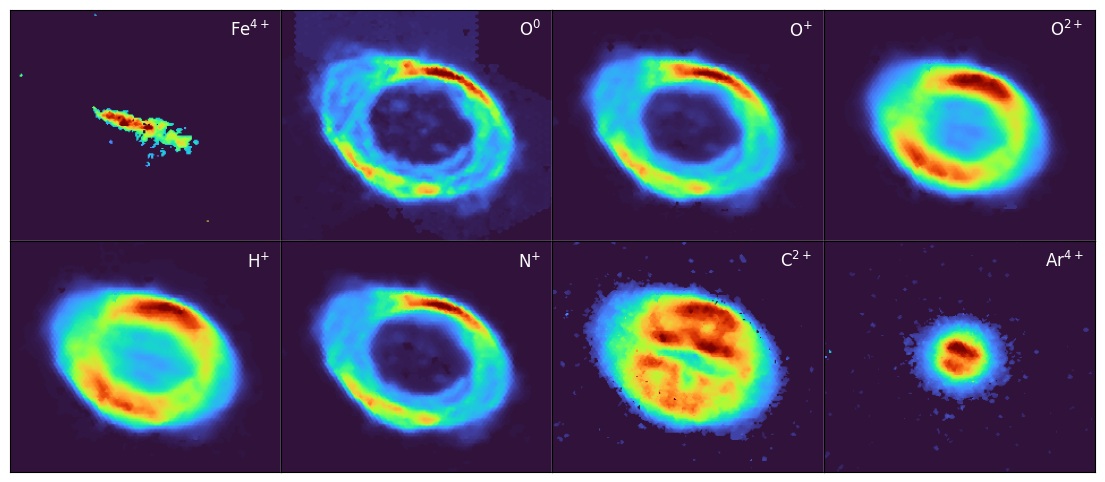
Images of the Ring Nebula produced using Weave data, with the iron “bar” in the top left
ROGER WESSON ET AL/MNRAS
For this research, astronomers used a special element of Weave called the Large Integral Field Unit. This allowed the scientists to split the light from every point across the Ring Nebula into its component colours, or wavelengths.
By analysing the entire nebula at once the team could map where different chemical elements are located. This allowed the previously hidden bar of ionised iron to stand out clearly for the first time.
Professor Scott Trager, of the University of Groningen, said: “The discovery of this fascinating, previously unknown structure in a night-sky jewel, beloved by sky watchers across the northern hemisphere, demonstrates the amazing capabilities of Weave. We look forward to many more discoveries from this new instrument.”
The sun is about halfway through its life and is expected to shine for another five billion years. When its nuclear fuel begins to run out, it will swell into a red giant, growing so large that it will engulf the inner planets. Mercury and Venus will almost certainly be destroyed, and Earth may be swallowed as well.
Even if Earth escapes being consumed, the intense heat will boil away its oceans and strip it of any remaining atmosphere. Eventually, the sun will shed its outer layers into space, forming a glowing cloud of gas while its core cools and fades as a “white dwarf”.