

It’s a cliché to call China’s rapid economic growth a “miracle”. You’ve heard all about the 800 million people “lifted out of poverty” and the fishing villages turned into mega-cities. Across the developing world, Beijing markets its economic model — dubbed “the Beijing Consensus” — to envious governments hoping for a bit of that Chinese magic.
But was it so miraculous after all? In The Great Heist, the veteran CIA officers David R Shedd and Andrew Badger argue that the real reason for China’s success is foul play. “The purported miracle of China’s economic growth wasn’t due to enlightened [Chinese Communist Party] state policy planners. Rather it was the fruit of cold hard theft on a scale never seen before in the global economy.”
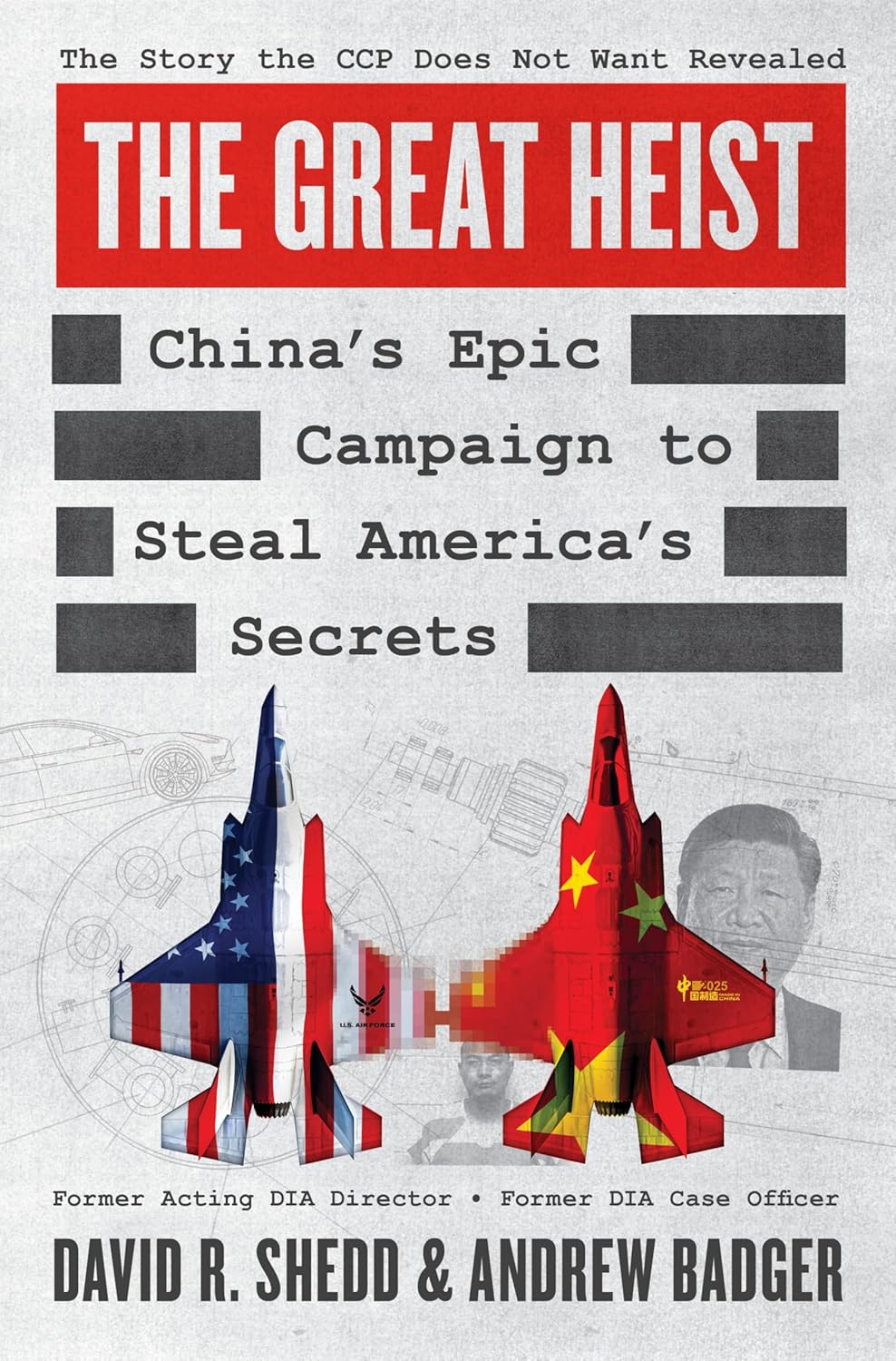
The Great Heist is a lengthy rap sheet of all the cases where Chinese state and corporate actors have stolen intellectual property from American companies. Shedd and Badger paint a picture of an all-powerful ministry of state security (MSS) that enlists the help of all and sundry to steal American research to help the motherland and its businesses. The examples of wrongdoing span the fields of electric cars, semiconductors, telecoms, AI, weaponry, chemicals, industrial agriculture, on and on.
The experience of General Electric Aviation seems typical: an ethnically Chinese employee downloading proprietary information and handing it directly to an MSS handler. At other times the transfering of critical knowledge is done in the open — such as when the turbine company HT Blade, a joint venture with a Texan co-founder, was effectively taken over by state-owned Chinese companies.
• Why China is winning the new espionage Cold War
But the authors go beyond illustrating the extent of Chinese industrial espionage. They overstretch their thesis, arguing that egregious intellectual property (IP) theft is the “single most critical contribution to China’s rapid economic ascent and military buildup”. This requires them to overlook the other, more important reasons behind China’s remarkable rise.
Let’s recap. In 1976, the year that Mao Zedong died, China’s GDP was less than a tenth of America’s, its exports accounting for about 1 per cent of global trade. Mao’s death allowed a band of Chinese leaders, led by Deng Xiaoping, to begin economic reforms. Gone were the mass political movements, the state-allocated housing, the communally farmed fields. In their place came private enterprise, foreign investors and, from the grassroots to the elites, an almost rabid devotion to making money. Fifty years later, China is unrecognisable. It is the world’s second-largest economy and the largest exporter of goods.
Espionage certainly doesn’t explain the early years of China’s economic success story. The first decades were based on cheap, labour-intensive but tech-light manufacturing. In that, the country was following the bog-standard, well-trodden routes to development taken by Japan, South Korea and Taiwan. This was the sort of industry that didn’t require industrial espionage. For many of the following years, it was investment in property or in building bridges and roads that caused the bulk of Chinese growth. China has also invested much more of its GDP back into its economy than other developing countries. This is a much less sexy story, but one that is well documented by the International Monetary Fund and the World Bank.
Only recently have high-tech industries become central to Beijing’s national power, and even now it’s not clear that their success is enough to reinvigorate Chinese growth, which has slowed this decade as a result of the meltdown in property and construction.
• Chinese hackers infiltrated critical British infrastructure
No doubt IP theft has served as an accelerant for some companies, potentially saving years of research and development for such companies as Huawei, which has been accused of reverse engineering and copying contractors’ production lines and codes.
But the authors fail to trace how that specifically translates into market dominance, compared with the many other factors that companies face. Even armed with cutting-edge IP, to convert that into commercial success still requires local supply chains, cheap and accessible labour, friendly regulations and generous subsidies. China produces almost half of all the world’s top AI talent. Its leading companies aren’t just succeeding by copying what has been done before, but are genuinely pushing forward the technological frontier.
The authors’ case may be stronger on the military side, where a stolen design can translate more directly into capability. But is China’s military prowess really solely explained by a succession of thefts rather than decades of sustained spending, Russian arms purchases, and the building of a physical industrial base?
• Chinese cars could be banned from armed forces over spying fears
The authors are also guilty of being unhelpfully imprecise when using the word “China” variously to refer to small traders or local government hedge funds, as if they were equally arms of the MSS. But where it sticks to state espionage, The Great Heist is a compelling and disturbing assessment of the MSS playbook. As a warning to western companies about the treachery and coercion that can come with the territory of doing business with China, it is genuinely valuable. I trust spies to know spies.
As former intelligence officers, not economists or sinologists, Shedd and Badger understandably see the world through the lens of espionage. But they miss the bigger picture — how does the US and the West compete with a country that is investing, educating and innovating? By reducing China to a country of thieves and copycats, The Great Heist risks underestimating what makes the country such a formidable competitor.
The Great Heist: China’s Epic Campaign to Steal America’s Secrets by David R Shedd and Andrew Badger (Harper £25 pp368). To order a copy go to timesbookshop.co.uk. Free UK standard P&P on orders over £25. Special discount available for Times+ members