
Disclaimer: Early release articles are not considered as final versions. Any changes will be reflected in the online version in the month the article is officially released.
Author affiliation: Centers for Disease Control and Prevention, Atlanta, Georgia, USA (C.Q. Pratt, A.F. Dalton, E.H. Koumans, A. Agedew, F. Coronado, E.A. Lundeen, R.C. Woodruff, S. Saydah); Harvard Pilgrim Health Care Institute & Harvard Medical School, Boston, Massachusetts, USA (J.P. Block); Weill Cornell Medicine, New York, New York, USA (M. Weiner); The University of Texas Southwestern Medical Center, Dallas, Texas, USA (L. Cowell); University of Pittsburgh School of Medicine, Pittsburgh, Pennsylvania, USA (J.D. Arnold)
Stroke and thrombotic events are known sequelae of respiratory viral illnesses, including influenza and COVID-19 (1–5). Since the onset of the COVID-19 pandemic, studies have documented an increased risk for embolic events, including ischemic stroke, in the first 30 days after a COVID-19 infection, with a >2-fold greater risk compared with people without COVID-19 (6,7). Several studies have found the risk for ischemic stroke is higher in those with severe acute illness (8,9). Among children, who have fewer strokes and thromboembolic events, 2 studies found an increased risk for stroke after COVID-19 (10,11). Although the mechanisms remain under investigation, the hypothesized pathophysiology that leads to increased stroke and thromboembolic events among patients with COVID-19 include endothelial cell damage (12,13), a viral-triggered exaggerated immune response and cytokine storm (14), and persistent microthrombi formation and fibrin amyloid microclots (15,16).
Limited information exists on stroke and thrombotic events in the postillness period beyond 30 days after COVID-19 infection. Many patients with risk factors for stroke, such as hypertension, high cholesterol, and smoking, might recover from COVID-19 but experience an elevated risk for thrombotic events beyond 30 days. In addition, whether the risk for stroke and thrombotic events in the months after SARS-CoV-2 infections is similar to that for other respiratory viruses (e.g., influenza) is unknown (17,18). Further, previous studies have focused on earlier SARS-CoV-2 variants (19,20), some of which were conducted before recommendations for thromboprophylaxis during hospitalization for COVID-19 (21), widespread use of COVID-19 treatments, or COVID-19 vaccination (19,22). Determining the incidence of stroke and thrombotic events in patients with COVID-19 or acute respiratory illnesses (ARI) in the 31–365 days after illness could help clarify long-term risk among patients with COVID-19 and point to possible interventions for prevention. We investigated incidence of thromboembolic events and stroke in the 31–365 days after COVID-19 diagnosis, both overall and by patient hospitalization status.
We used data from the National Patient-Centered Clinical Research Network (PCORnet), a national research network containing comprehensive electronic health record data from healthcare systems across the United States (23). We examined the overall incidence of thromboembolic events and stroke, as well as the specific incidence of ischemic stroke, deep vein thrombosis (DVT), hemorrhagic stroke, transient ischemic attack (TIA), and cerebral venous sinus thrombosis (CVST), in the 31–365 days after COVID-19 diagnosis, overall and by patient hospitalization status, for the period April 1, 2022–April 30, 2023. We then used the incidences after an acute respiratory illness (ARI) in the same period as a comparison group. Because of a nonbillable diagnosis code being mistakenly used in the initial data pull, pulmonary embolism (PE) was not included in the analysis. Therefore, a patient with only a PE and no DVT diagnosed in the electronic health record (EHR) would not have been included in this analysis.
PCORnet provides data infrastructure to support distributed research across participating healthcare systems (24). PCORnet uses a Common Data Model to enable data interoperability and centralized querying of longitudinal EHR data by using modular statistical programs. Queries were performed at each participating healthcare system by using patient-level EHR data; results were transmitted to investigators in aggregated tabular format. Patient-level data were stored behind institutional firewalls.
This activity was included in a larger surveillance program funded through a cooperative agreement by the Centers for Disease Control and Prevention (CDC) and was deemed exempt from review under the public health surveillance provision of the Common Rule by the Harvard Pilgrim Health Care institutional review board. The design and analysis adhere to the Strengthening the Reporting of Observational Studies in Epidemiology reporting guidelines (25). This activity was reviewed by CDC, deemed not research, and was conducted consistent with applicable federal law and CDC policy (See e.g., 45 C.F.R. part 46.102(l)(2), 21 C.F.R. part 56; 42 U.S.C. §241(d); 5 U.S.C. §552a; 44 U.S.C. §3501 et seq).
We selected the period April 1, 2022–April 30, 2023, to account for potential temporal confounding caused by changing treatment and prevention availability and changing predominant SARS-CoV-2 variants. We included patients who were >5 years of age; had COVID-19 or other ARI during April 1, 2022–April 30, 2023; had no evidence of pregnancy in the prior year; and had evidence of an encounter in the healthcare system in the 30–540 days before the COVID-19 or ARI diagnosis. An encounter with the healthcare system from 30–540 days prior was required to attempt to capture patient medical history, including prior strokes or thrombotic events. We stratified data by age, sex, race (American Indian or Alaska Native, Asian or Native Hawaiian or Pacific Islander, Black or African American, multiple races or other, White, or missing), and ethnicity (Hispanic, non-Hispanic, unknown, other, or missing).
Patients with COVID-19 were identified by a positive antigen or PCR laboratory record with a positive, detected, or presumptive positive result; receipt of a COVID-19 medication (monoclonal antibodies, nirmatrelvir/ritonavir, molnupiravir, or remdesivir); or COVID-19 diagnostic codes U07.1 or U07.2 from the International Classification of Diseases, 10th Revision, Clinical Modification. Patients with ARI were identified by an ARI or influenza diagnostic code (Appendix Table 1), receipt of oseltamivir or baloxavir, and no COVID-19 diagnosis from 365 days prior through 14 days after ARI diagnosis. Patients diagnosed with ischemic stroke, DVT, hemorrhagic stroke, TIA, or CVST in the 18 months before COVID-19 or ARI diagnosis were excluded from the cohorts when measuring the respective outcomes to better capture incident cases rather than prevalence or recurrent cases (26,27).
Among COVID-19 and ARI patients, cohorts were created on the basis of hospitalization status, whether or not a stroke or thrombotic event occurred, and the postacute period of focus. We calculated the incidence of any stroke or thrombotic event and the disaggregated categories of ischemic stroke, DVT, hemorrhagic stroke, TIA, or CVST in the time intervals after COVID-19 or ARI diagnosis: 31–90 days, 91–180 days, 181–365 days, and 31–365 days. Results were stratified according to patient hospitalization status (hospitalized vs. nonhospitalized from 1 day before through 16 days after COVID-19 or ARI diagnosis to reflect the period of acute illness). We chose those time intervals to characterize the postacute phase of illness (31–90 days), to remain consistent with the definition of long COVID (having symptoms for >90 days after COVID-19 diagnosis) (28), and to determine when events are most likely to occur (e.g., 91–180 days vs. 181–365 days). We used χ2 testing to assess significant differences at p<0.05.
We calculated the incidence of any event per 10,000 patients. We calculated each ischemic stroke, DVT, hemorrhagic stroke, TIA, and CVST event among patients with COVID-19 or ARI and stratified by hospitalization status and time from acute COVID-19 or ARI diagnosis. Within each period, we calculated the 30-day incidence. We calculated incidence ratios and 95% CIs on the basis of the normal distribution to compare the risk for stroke or TIA after COVID-19 versus ARI. We indicated significance at p<0.05 by using Z-test to assess the differences of proportions.
A total of 1,132,355 patients were diagnosed with COVID-19 and 2,301,209 patients with ARI (Appendix Table 2) during the study period. A higher proportion of patients who had COVID-19 were in older age groups (p<0.0001 by χ2 test) and had more chronic conditions (p<0.0001 by χ2 test) compared with patients who had ARI. Among patients diagnosed with COVID-19, the most common age groups were 50–64 (25.8%) and >65 years (32.5%); 5–17 years (34.0%) was the largest age group among patients with ARI. There was a greater percentage of females in both the COVID-19 (60.4% vs. 39.6% male) and ARI (59.8% vs. 40.2% male) cohorts. The most common race among patients with COVID-19 and ARI was White (COVID-19, 70.7%; ARI, 69.3%), followed by Black or African American (COVID-19, 14.5%; ARI, 15.1%). Most patients were non-Hispanic (COVID-19, 73.6%; ARI, 71.1%). The most common conditions in both COVID-19 and ARI patients in the 18 months before diagnosis were hypertension (COVID-19, 38.6%; ARI, 23.2%), hyperlipidemia (COVID-19, 30.2%; ARI, 17.4%), and diabetes (COVID-19, 16.8%; ARI, 10.4%) (Appendix Table 2).
A total of 17,606 patients with COVID-19 and 21,871 patients with ARI experienced an event (ischemic stroke, DVT, hemorrhagic stroke, TIA, or CVST) in the 31–365 days after COVID-19 or ARI diagnosis (Appendix Table 3). Adults >50 years of age were most of the patients with COVID-19 (88.2%). There was no significant difference between hospitalized (88.4%) and nonhospitalized (88.1%) COVID-19 patients >50 years of age (p = 0.63). Adults >50 years of age were most of the patients with ARI (83.5%), and this age group also represented most hospitalized patients (85.4%) (p<0.0001). Combining hospitalized and nonhospitalized patients, patients >50 years of age made up a greater percentage of COVID-19 patients (88.2%) than ARI patients (83.5%) in the same age group (p<0.0001).
Among both COVID-19 and ARI hospitalized patients who experienced an event in the 31–365 days after acute illness, underlying hypertension (COVID-19, 82.1%; ARI, 81.8%), hyperlipidemia (COVID-19, 60.0%; ARI, 60.1%), diabetes (COVID-19, 45.6%; ARI, 43.2%), coronary artery disease (COVID-19, 41.6%; ARI, 42.1%), and chronic kidney disease (COVID-19, 46.3%; ARI, 41.7%) were all more common than among nonhospitalized patients (p<0.0001) (Appendix Table 3). When comparing all COVID-19 patients who experienced an event in the 31–365 days after acute illness to all ARI patients who experience a stroke or thrombotic event within 31–365 days after acute illness, a history of chronic kidney disease (p<0.0001), hyperlipidemia (p = 0.0019), and alcohol abuse (p = 0.0103) were statistically more common among COVID-19 patients. We found no significant difference between the percentage of COVID-19 and ARI patients with a history of coronary artery disease (p = 0.6835), diabetes (p = 0.9171), or hypertension (p = 0.2757).
Among COVID-19 patients, hospitalized patients were also more likely to have received anticoagulants in the prior 18 months (16.8%) than were nonhospitalized patients (10.7%) (p<0.0001). Among ARI patients, hospitalized patients were more likely to have received anticoagulants (16.4%) than were nonhospitalized patients (10.0%) (p<0.0001). When comparing all COVID-19 patients to all ARI patients, more COVID-19 patients had received antiplatelet medications in the 18 months prior (COVID-19, 9.1%; ARI, 8.1%) (p = 0.0009), but there was no statistical difference in the percentage of patients previously having received anticoagulants (COVID-19, 11.9%; ARI, 11.4%) (p = 0.124).
Figure
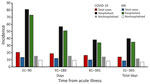
Figure. Thirty-day incidence of all events per 10,000 patients by acute illness, hospitalization status, and time from acute illness in a study of thrombotic events and stroke in the year after…
Overall, incidence of all events decreased as time increased after acute illness: 31–90 days, 20 events/10,000 COVID-19 patients and 13 events/10,000 ARI patients; 91–180 days, 19 events/10,000 COVID-19 patients and 12 events/10,000 ARI patients; 181–365 days, 16 events/10,000 COVID-19 patients and 10 events/10,000 ARI patients (Figure; Appendix Table 4). For all time intervals, incidence of all events was higher among patients who were hospitalized than patients who were nonhospitalized, and higher among patients with COVID-19 than patients with ARI. DVT and ischemic stroke were the most common events diagnosed in the year after acute illness for both COVID-19 (4 DVT/10,000 patients and 6 ischemic strokes/10,000 patients) and ARI (3 DVT/10,000 patients and 3 ischemic strokes/10,000 patients) (Appendix Table 2). DVT and ischemic stroke incidence was also higher among patients hospitalized with COVID-19 versus patients who were nonhospitalized and patients diagnosed with ARI; rates for those events decreased farther out from the acute illness (Appendix Table 4).
The unadjusted risk for any event was higher among patients with COVID-19 compared with patients with ARI regardless of hospitalization status or time interval after acute illness (hospitalized patient incidence ratio 1.11 for 31–90 days and 91–180 days, 1.12 for 181–365 days; nonhospitalized patient incidence ratio 1.62 for 31–90 days, 1.64 for 91–180 days, 1.73 for 181–365 days) (p<0.0001) (Table). The unadjusted risk for ischemic stroke was higher among patients with COVID-19 compared with patients with ARI in every time interval and among both hospitalized and nonhospitalized patients (hospitalized patient incidence ratio 1.13 for 31–90 days, 1.26 for 91–180 days, 1.12 for 181–365 days; nonhospitalized patient incidence ratio 1.65 for 31–90 days, 1.68 for 91–180 days, 1.77 for 181–365 days) (p<0.0001). Hospitalized patients with COVID-19 had a 14% increased crude risk for any event measured in the 31–365 days after acute illness compared with patients with ARI (p<0.0001) (Table). Although the overall incidence of all events for nonhospitalized patients compared with hospitalized patients was lower for both COVID-19 and ARI (Appendix Table 3), nonhospitalized patients with COVID-19 had a 73% increased crude risk for any event in the year after acute illness compared with nonhospitalized patients with ARI (p<0.0001) (Table). Among hospitalized patients, when comparing risk by specific outcomes, there was an increased risk for DVT (11%, p<0.0001), ischemic stroke (20%, p<0.0001), and TIA (27%, p<0.0001) among COVID-19 versus ARI patients but no significant difference for CVST or hemorrhagic stroke.
Among patients with COVID-19 and ARI illness, the greatest risk for incident thrombotic events, including stroke, occurred within 31–90 days after acute illness. Incident thrombotic events continued up to a year after acute illness. Overall, hospitalized patients had the highest incidence of postillness events, and patients with COVID-19 had higher incidence of thrombotic events compared with patients with ARI, regardless of hospitalization status.
Although the incidence of all events decreased as the time from acute illness increased, overall, increased awareness of risk for such events in COVID-19 patients is justified well past 1 month after acute infection. It is critical that healthcare providers maintain awareness of the risk for stroke and thromboembolic events in patients even after recovery from acute COVID-19 infection and monitor those at risk, particularly patients with known risk factors such as hypertension, high cholesterol, diabetes, obesity, smoking, sedentary lifestyle, or previous venous thromboembolisms. Current clinical guidelines recommend thromboprophylaxis during hospitalization for many adults hospitalized with COVID-19 but not after discharge or for those treated in outpatient settings (29). A small trial in 2021 showed improved clinical outcomes with thromboprophylaxis after hospital discharge in high-risk patients (30), whereas another trial published in 2023 showed no significant difference in outcomes between COVID-19 outpatients who did and did not receive thromboprophylaxis and was stopped early because of low thromboembolic incidence rates (31). The risk of bleeding from anticoagulation would ideally be balanced with thromboembolic event prevention. However, this study was not designed to determine the usefulness of thromboprophylaxis or other risk modifications after hospital discharge or in outpatient settings; further study is needed to inform that determination.
Rates for all events we tracked—DVT, hemorrhagic stroke, ischemic stroke, and TIA—were higher among hospitalized than nonhospitalized patients with COVID-19 across all time intervals. The higher rates likely reflect the higher hospitalization rates among patients at greater risk for severe COVID-19, such as those >50 years of age or with multiple comorbidities. In addition, the higher rates for all events suggest an increased risk for stroke and thromboembolic events associated with more severe acute illness (8,9,32,33). Determining the biological mechanisms driving the increased incidence of stroke and thromboembolic events after COVID-19 infection could help identify patients at higher risk and inform prevention strategies. Current thromboprophylaxis recommendations in patients with COVID-19 are limited to select hospitalized patients (34–37).
Of note, the risk ratios for all events in COVID-19 versus ARI patients were higher among the nonhospitalized group in this analysis, with a risk ratio of 1.73 (95% CI 1.71–1.76) for 31–365 days among nonhospitalized patients versus 1.14 (95% CI 1.10–1.18) in hospitalized patients. Many earlier studies focused on the initial phases of the COVID-19 pandemic, primarily during the pre-Delta and Delta variant periods (19,20). In contrast, this study provides more recent data from the Omicron-dominant period, characterized by high population immunity because of extensive vaccination and prior infections. Those updated findings could provide valuable insights for future studies and enhance early recognition and effective management of DVT and stroke, while informing the long-term cardiovascular consequences of COVID-19.
This study underscores the importance of COVID-19 vaccination and other prevention and treatment efforts to reduce risk for severe illness and subsequent adverse outcomes and conditions (38). In addition, given the higher risk for post-COVID conditions with more severe COVID-19 acute illness (39,40), our data provide yet another reason to increase efforts targeted at prevention and improved management of chronic conditions that increase the risk for severe COVID-19, stroke, and thrombotic complications. Comprehensive chronic disease management, combined with COVID-19 and ARI prevention strategies, can help reduce the incidence of postillness DVT and stroke, ultimately benefiting those most vulnerable to complications. Patient education is also crucial, particularly an emphasis on the benefits of vaccinations for those with underlying risk factors or comorbidities.
The first limitation of this study is that this analysis does not include biological measurements or pathophysiology information to assign direct causation of SARS-CoV-2 infection to stroke incidence. Second, because of the aggregated data for this analysis, we could not adjust for patient level potential confounders. Compared with patients with ARI, COVID-19 patients were in older age groups and had more chronic conditions; adjusting for those potential confounders might attenuate the differences across the groups. Although unadjusted risk ratios for all events in COVID-19 versus ARI patients were higher among the nonhospitalized group, those are relative risks, and the difference in risks might be influenced by selection bias. Hospitalized patients are more likely to get virus-specific testing to guide therapy, and patients with mild illness might have visited a provider for a diagnosis, but those with mild illness are less likely to get tested with a virus-specific test compared with those with moderate symptoms (41,42). Therefore, it is possible that hospitalized patients were more likely to be correctly categorized between COVID-19 and other ARIs, compared with those who were only seen as outpatients and might not have had definitive testing. The nonhospitalized ARI cohort was younger and healthier than the nonhospitalized COVID-19 cohort, suggesting a lower baseline risk of thromboembolism and stroke. That age difference might have led to an overestimation of the effect of COVID-19 on the thromboembolic and stroke risk. Third, only patients who had access to and sought clinical care for their acute COVID-19 or ARI illness or subsequent event were included, likely leading to the exclusion of some people with mild or asymptomatic infections and persons who never received laboratory testing for COVID-19 or ARI. Fourth, persons with mild DVT or TIA who did not seek care were also not included. Fifth, because of a coding error identified that could not be corrected after the data was received, this analysis also did not include PE as an outcome. Patients with DVT who only saw a provider after a PE developed might have been diagnosed with PE alone, leading to potential undercount of DVT cases. Sixth, excluding persons with a prior history of events (DVT, ischemic stroke, hemorrhagic stroke, PE, or TIA) limits the representativeness of the analytic sample and therefore limits the generalizability of our findings to the US population. Finally, the study period (April 1, 2022–April 30, 2023) includes various Omicron sublineages but was not designed to align with specific sublineage periods.
Future analyses with line level data available could control for patients’ chronic conditions to better identify thrombotic events attributable to viral infection. Separating out specific pathogens, such as influenza, from other ARI could also help quantify the risks of specific viruses.
In conclusion, this study identified a possible elevated risk for thrombotic events, including stroke, up to a year after COVID-19, especially among patients hospitalized with COVID-19. This risk appears to remain higher for patients with COVID-19 than for those with ARI. Future multivariate analysis with adjustments for demographic and medical differences is needed. Continued surveillance and epidemiologic studies are essential to monitor these long-term risks and assess mitigation strategies. This study also underscores the importance of stroke awareness. By recognizing stroke signs and symptoms, such as by using the FAST acronym (43), patients and providers can help ensure timely intervention, potentially improving recovery outcomes and reducing disability and mortality (44).
Ms. Pratt is an epidemiologist and nurse practitioner on the long COVID team in the National Center for Immunizations and Viral Respiratory Diseases at the Centers for Disease Control and Prevention. Her research interests include long COVID surveillance and prevention, infectious disease surveillance, and port health.
Members of the PCORnet Network Partners group: Olven Carrasquillo, Lindsay G. Cowell, Peter O’Donnell Jr., Christopher B. Forrest, Sharon J. Herring, Rachel Hess, Benjamin D. Horne, Wenke Hwang, Michael D. Kappelman, Harold Lehmann, Abu Saleh Mohammad Mosa, Jihad S. Obeid, Brian Ostasiewski, Nathan M. Pajor, Suchitra Rao, Abbey Sidebottom, Alexander Stoddard, Yacob Tedla, Andrew Vasey, and David A. Williams.