
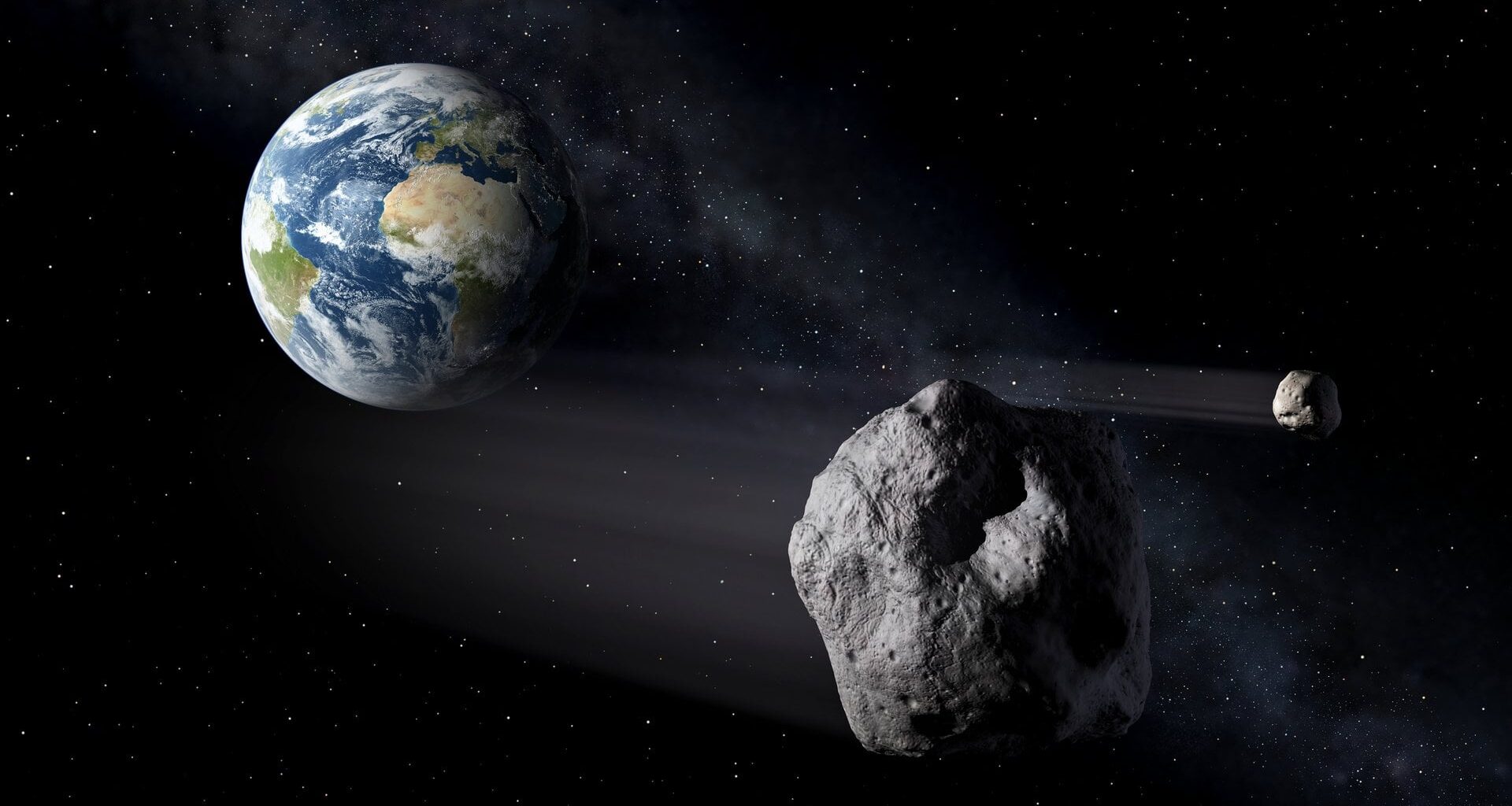
Around the sun, there are countless small bodies whose orbits occasionally bring them in close proximity to Earth, known as Near-Earth Objects (NEOs). There are currently 37,000 known Near-Earth Asteroids (NEAs) and 120 known short-period near-Earth comets (NECs), though astronomers estimate that these objects number in the millions. Of particular concern are asteroids and comets that pose a potential impact risk to Earth, known as Potentially Hazardous Objects (PHOs). While scientists are confident that none of the known PHOs will pose a risk to Earth within the next century, planetary defense measures will be needed sooner or later.
In 2022, NASA’s Double Asteroid Redirection Test (DART) successfully demonstrated one potential method for protecting Earth – a kinetic impactor that nudged the asteroid Dimorph to alter its orbit. But to do this reliably and inform asteroid defense measures closer to home, scientists need to understand how asteroid materials behave under extreme conditions. In the new study, an international team used CERN’s High Radiation to Materials (HiRadMat) facility to irradiate a sample of an iron meteorite to determine how much stress metal-rich asteroids (M-type) can withstand as they enter Earth’s atmosphere.
The stress test consisted of subjecting a sample of the Campo del Cielo iron meteorite to extremely energetic 440 GeV proton beams. They then measured tiny surface vibrations using Doppler vibrometry to capture real-time data on how the material responded to the rapidly increasing stress. Their results, described in a paper that appeared in Nature Communications, demonstrate that M-type asteroids can absorb significantly more energy without fragmenting and may even get tougher in the process.
What was especially surprising was how the meteorite dissipated more energy as it was subjected to increasing stress. These findings suggest that the internal structure of asteroids redistributes and amplifies stress in unexpected ways, similar to complex composites. They also indicate that energy can be delivered deep inside an asteroid without it breaking apart. This contradicts what conventional models suggest and could have significant implications for asteroid-deflection strategies. As study co-author Professor Gianluca Gregori (Department of Physics, University of Oxford) said:
Until now, we have relied heavily on simulations and static laboratory tests to understand how asteroid materials behave under impact or radiation. This is the first time we have been able to observe, non-destructively and in real time, how an actual meteorite sample deforms, strengthens, and adapts under extreme conditions.
The study addresses a major challenge in planetary defense research: the discrepancy between inferences from meteorite breakup in Earth’s atmosphere and laboratory measurements of meteorite strength. This study shows that this can be explained by the internal redistribution of stress within the heterogeneous structure and composition of meteorites. This data could inform new redirection methods that push asteroids more effectively while keeping them intact.
Further Reading: University of Oxford, Nature