
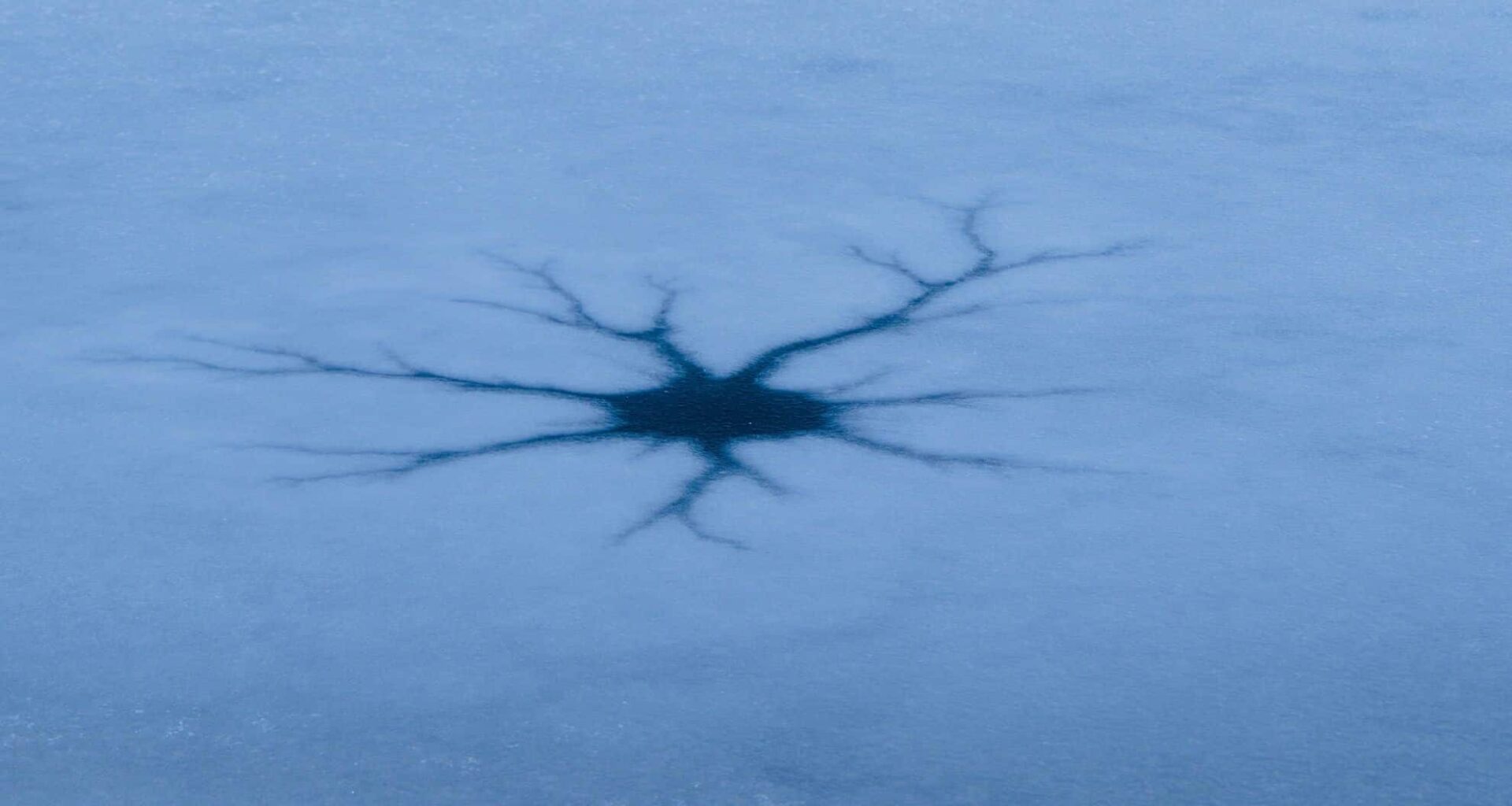
The intriguing formation, named Damhán Alla, was first observed in 1998 by the Galileo spacecraft. Scientists now suggest that the “asterisk-shaped” pattern might have formed after an impact caused melted brine to erupt through the icy surface. These findings could have significant implications for our understanding of Europa’s habitability, especially with the upcoming Europa Clipper mission scheduled to reach the moon in 2030.
The Formation of Europa’s Spider-Like Feature
Europa’s surface is known for its bizarre and striking features, many of which may be linked to subsurface liquid water. The asterisk-shaped formation in Manannán Crater is one such feature, drawing comparisons to lake stars found on Earth. According to Dr. Lauren McKeown of the University of Central Florida, these stars are formed when snow falls on frozen lakes and pressure creates holes in the ice, allowing water to flow through and spread into branching patterns. The team behind the new study, published Dec. 2 in The Planetary Science Journal, believes that a similar process could have occurred on Europa, where a brine reservoir beneath the surface may have erupted after an impact. The melted brine would have spread through the porous ice, creating the spider-like formation visible in the crater.
Field and lab experiments conducted by the team supported this theory. By recreating the conditions of Europa in a cryogenic glovebox, they found that star-like patterns formed in Europa ice simulants at temperatures as low as -100°C. These results suggest that such a mechanism could indeed be at work on Europa, where conditions are far colder than those on Earth, yet still capable of producing similar features.
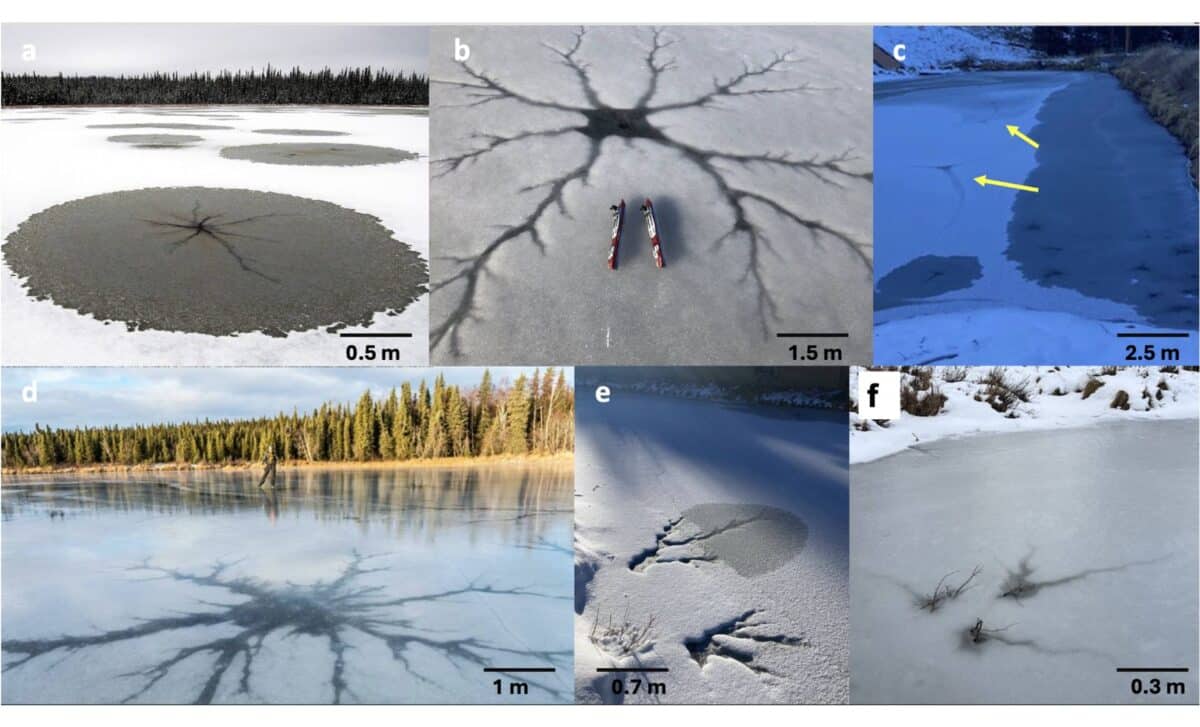 Lake stars on Earth: (a) melt pools in Alaska (Ned Rozell, Tohru Saito); (b,e) New Hampshire and Breckenridge, CO (Jamie Hess, author); (c,f) linear forms in Breckenridge (author); (d) dendritic lake star in Alaska (Joe Stock).
Testing the Hypothesis with Earth Analogues
To better understand how Europa’s spider-like feature might have formed, the researchers turned to Earth analogues, particularly the phenomenon of lake stars. These radial patterns, which occur on frozen lakes in winter, provided a model for how brine could spread across Europa’s icy surface. According to Dr. McKeown, the team’s experiments involved flowing water through Europa ice simulants under cold conditions, replicating what might happen on Europa following an impact. The experiments showed that even at extremely low temperatures, such as those seen on Europa, a branching, star-like pattern could form as brine spread through the ice.
This work was also informed by field studies in Breckenridge, Colorado, where the team observed lake stars under real-world conditions. These observations helped refine their understanding of how temperature, ice thickness, and snow coverage influence the formation of branching features like lake stars. The experiments and field tests provided valuable data, suggesting that similar mechanisms could exist on Europa, potentially revealing more about the moon’s icy surface and subsurface reservoirs.
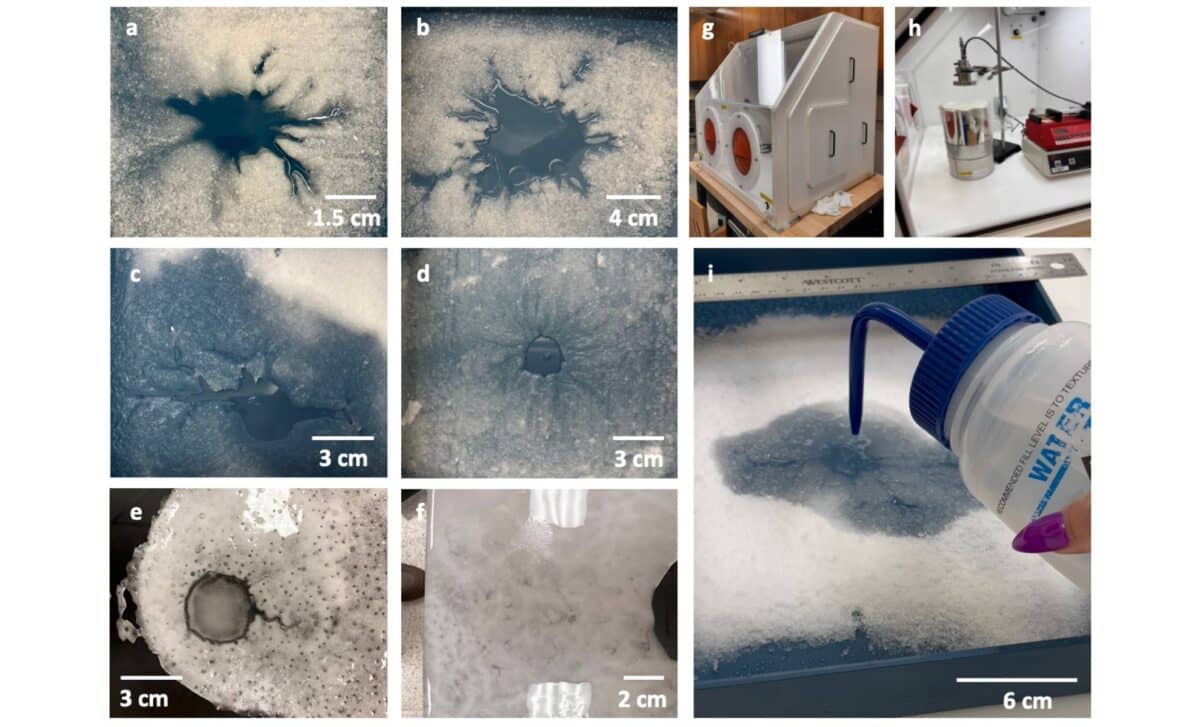 “Lab star” patterns in simulated Europa ice: (a–f) star and dendritic forms in deionized and salty ice; (g–i) LN₂ glove box setup and simulant production system. ©iopscience
Implications for Europa’s Habitability
The study of Europa’s surface features goes beyond geomorphology, it’s directly tied to astrobiology. Understanding how patterns like Damhán Alla form can offer critical insights into the conditions beneath Europa’s icy shell, where liquid water could harbor life. The research conducted by the team suggests that there may be subsurface brine pools that could erupt under certain conditions, releasing liquid water to the surface. This discovery provides more context for future missions like Europa Clipper, which will use high-resolution imaging to explore Europa’s surface in unprecedented detail.
According to Dr. Elodie Lesage from the Planetary Science Institute, the findings from their study offer new constraints on the potential depth and longevity of Europa’s subsurface brine reservoirs. The study’s modeling suggests that these brine pools could lie as deep as 6 km beneath the surface and might remain active for thousands of years after an impact. This kind of activity is important for researchers searching for signs of life, as it indicates that liquid water may have been more accessible than previously thought, creating habitable environments beneath the ice.
The upcoming Europa Clipper mission will help answer many of these questions, as its detailed imaging and data collection will provide a clearer picture of Europa’s surface features. Scientists hope that the mission will resolve the mystery of the spider-like formation in Manannán Crater and provide further evidence of the moon’s potential for harboring life.