
We are eternally fascinated by the mystery of our origins. Dust and a divine spark satisfied many until the advent of evolution theory and paleontology, which generated a broad consensus that our species originated in Africa. But doubts had lingered. There was a camp that posited a European origin for Homo sapiens.
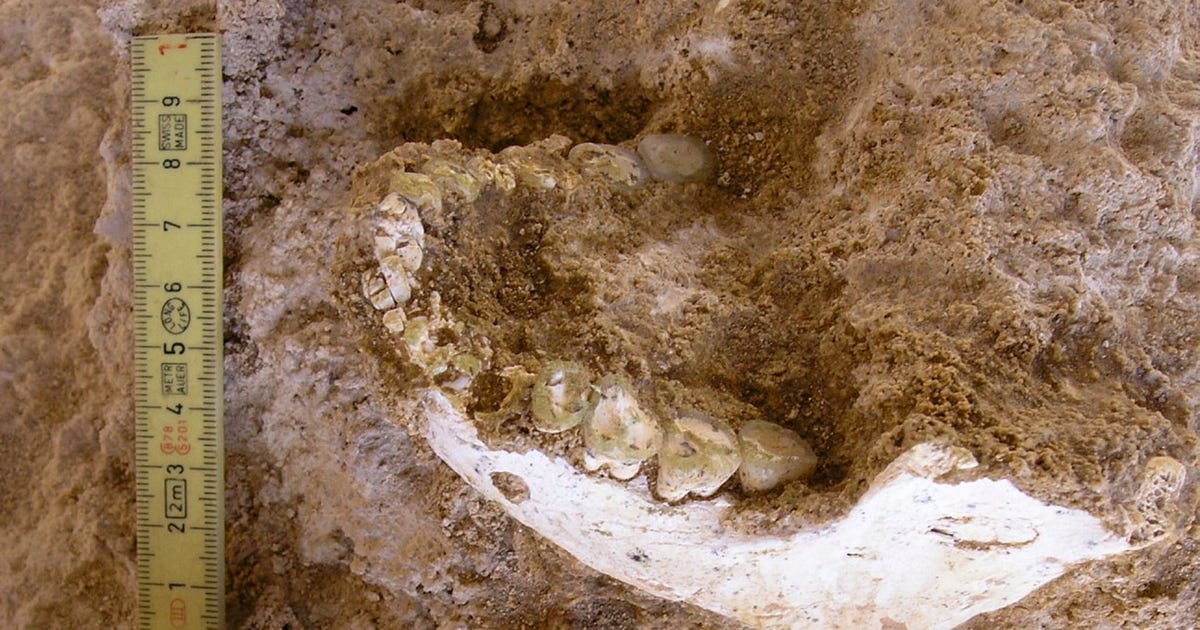
Now, hominin fossils found in an ancient hyena den in Thomas Quarry, Casablanca dating precisely to 773,000 years ago are interpreted as an early stage of the lineage that eventually gave rise to Homo sapiens – and it’s in Africa after all.
These Moroccan fossils exhibit a mix of archaic and modern traits mapping near the base of the sapiens-Neanderthal lineage. It seems to be an evolved form of Homo erectus, and is the best candidate for the last common ancestor of three species: us, the Neanderthals, and their sister species the Denisovans, Prof. Jean-Jacques Hublin of the Collège de France and Max Planck Institute for Evolutionary Anthropology in Germany with Abderrahim Mohib of the Moroccan Institut National des Sciences de l’Archéologie et du Patrimoine and a long list of colleagues propose in Nature.
Related Articles
Genetic evidence suggests that the last common ancestor with Neanderthals lived between 765,000 and 550,000 years ago. In Africa, we have fossil hominins until a million years ago, including erectus-like fossils in North Africa. Then there was almost nothing until about 600,000 years ago, Hublin explains to Haaretz by Zoom.
“In this quarry discovery, we pinpoint fossil evidence exactly in the middle of this gap in the fossil record and it’s very accurately dated at 773,000 years,” he says.
 Close
Close
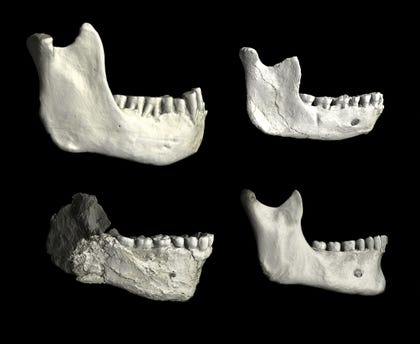
Four mandibles from the excavation. Credit: Phillip Gunz/AFP
Four mandibles from the excavation. Credit: Phillip Gunz/AFPHyenas for Darwin
Before Homo Casablanca, who hasn’t been given nomenclature yet, there had been two candidates for the last common ancestor, and neither was quite satisfactory. One from about the right time was Homo antecessor in Spain, an archaic hominin with a flattish head and face who lived between a million to about 800,000 years ago.
Actually, antecessor was very much like the Moroccan hominin, the team says. They may even have been the same species, or a sister species – connectivity between Africa and Europe through the Straits of Gibraltar may have changed depending on sea levels. Over time, the two populations became isolated and differentiated.
The bottom line is that Homo antecessor is not ancestral to sapiens, they add. But their Casablanca hominin may be.
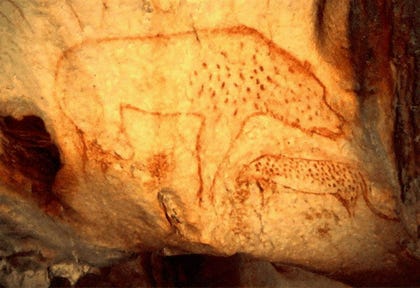
The site in Morocco, near the coast, is romantically named Grotte à Hominidés. Back in the day it was a carnivore den, the archaeologists posit based on gnawed bones from various edible species, including a hominin femur with bite marks. This is the hallmark of cave-dwelling hyenas, which would convey their prey to the shelter to eat in glorious isolation. They are extinct now but the type was portrayed in cave art in France around 30,000 years ago.
 Close
Close
Cave hyena (Crocuta crocuta spelaea) painting found in the Chauvet cave, 32,000 years old Credit: From the Flickr account of Carla216
Cave hyena (Crocuta crocuta spelaea) painting found in the Chauvet cave, 32,000 years old Credit: From the Flickr account of Carla216
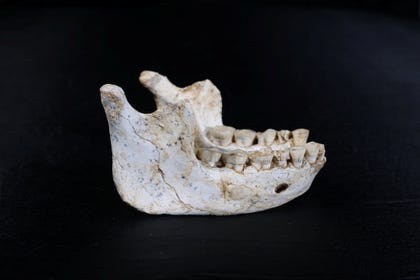
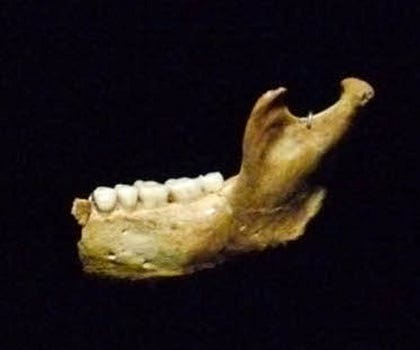
The assemblage of hominin remains in the Grotte includes a nearly complete adult jaw, half of another adult jaw, a child’s jaw, several vertebrae, and isolated teeth.
So although our postulated ancestor was apparently eaten by hyenas or another carnivore, the discovery is wonderful news partly because humans relish investigation into on our origins, but mainly: the discovery finally puts to rest chauvinistic theories that humanity evolved in classy Eurasia, not the “Dark Continent.” Also, it vindicates Darwin.
The colonial hominin
Charles Darwin, doyen of evolutionary theory, held that humans evolved in Africa because that is the home of our closest relatives, the chimpanzee and gorilla, and he wrote as much in 1871.
His notion that we had a common ancestor with apes was resisted. The Bible claimed otherwise, there was hardly any fossil evidence in Africa to back him up, the Neanderthal – evidently some sort of primitive human – had been discovered in Europe, and his peers were nauseated.
A particularly biting critic was the Bishop of Oxford, Samuel Wilberforce, who contemptuously asked Darwin defender Thomas Huxley if he thought he descended from apes through his grandmother or grandfather. Huxley reportedly sneered back, better an ape for an ancestor than a humbug.
 Close
Close
A mandible from the excavation at Thomas Quarry. Credit: Hamza Mehimdate/AFP
A mandible from the excavation at Thomas Quarry. Credit: Hamza Mehimdate/AFP
To this very day, some resist acknowledging our primate origins, and some around the world even insist that their culture must be a subset of Homo sapiens with a grander origin. You may descend from monkeys but not we.
“In Europe and Eurasia, historically, in the first half of the 20th century, many thought modern humans originated in Europe. Piltdown Man was one hoax, but there were others – a whole model was built on pre-sapiens being in Europe and people were trying to identify a European root of present-day humans,” Hublin explains – leading them to resort to forgery.
We just remind that Piltdown Man consisted of pieces of human cranium paired with an orangutan’s jaw. It was presented as a fossil in 1912, dubbed Eoanthropus dawsoni, and would be outed only decades later by the advent of science which noticed putty and paint where none should be. Apparently, the remains from two people but only one orangutan were used in its manufacture but who actually perpetrated the hoax remains unclear. But it shows the eagerness of the scientific community at least to seek the truth beyond the Bible.
There were two issues here, to be clear: the deep origin of hominins, and the deep origin of Homo sapiens. Hominins, we could accept originating in Africa, but the wonder that is we?? Excusez moi? It would take the discovery of australopithecines in Africa in the 1920s and more hominins in Africa in the 1970s and 1980s for the African-origin theory for Homo sapiens to go mainstream in academia, which largely happened in the 1980s.
 Close
Close
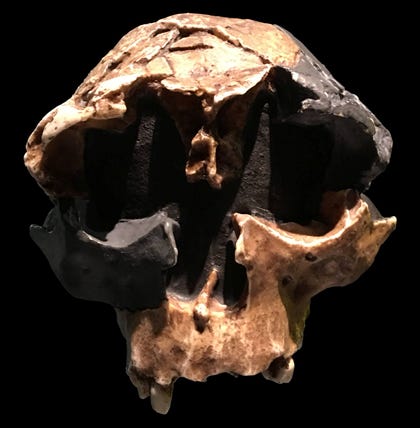
The skull of a Homo antecessor child. Credit: Velatrix
The skull of a Homo antecessor child. Credit: Velatrix
But in 1994, hominin fossils were found in the Sierra de Atapuerca mountain range in Spain from about a million to 800,000 years ago, and that threw a monkey wrench into the works. This hominin, the aforementioned Homo antecessor, had a mix of modern and archaic traits, and was proposed as the last common ancestor of sapiens and Neanderthals.
Also, the realization dawning in the last 20-plus years from genetic research, that modern humans and Neanderthals are closely related, muddied the waters. But Neanderthal fossils have only been found in Europe, central Asia and the Near East! In 2010, another species was discovered in Asia: the Denisovans. We are closely related to them too. Oysh. Our closest relatives are in Europe.
This explains how the idea of European origin was resuscitated by Spanish colleagues, Hublin explains. “Antecessor was presented asthe common ancestor of sapiens and Neanderthals – a series of papers argued that maybe we had to consider that our species originated in Eurasia. There were also some Chinese colleagues who never accepted the out of Africa model,” Hublin adds. “Even this year, there was a paper arguing that Denisovans could be the sister of Homo sapiens, implying that sapiens very likely emerged not in Africa but in Eurasia. The field has been stained by nationalism and ideology since the beginning and it is not going to stop any time soon.”
The Eurasian-origin theory requires migratory acrobatics. It requires an archaic hominin, possibly erectus, to have left Africa over a million years ago, evolved into Homo antecessor which would beget early Neanderthals and early sapiens. In Eurasia the lineage split, forming Neanderthals in the west and Denisovans in the east; and the branch that would produce sapiens went back to Africa, resulting in the “early modern human” fossil at Jebel Irhoud in Morocco from 300,000 years ago and us all.
“One argument that has been used to support the notion of European origin is that in Africa, if you move beyond 300,000 years, there isn’t much evidence. There is room for speculation and the idea that maybe our species entered Africa 300,000 years ago,” Hublin says. “I think this is using absence of evidence as evidence for absence, which of course is wrong.”
 Close
Close
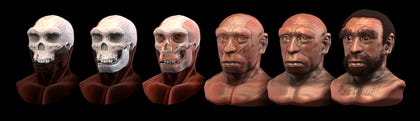
A forensic facial reconstruction of Homo heidelbergensis. Credit: Cicero Moraes
A forensic facial reconstruction of Homo heidelbergensis. Credit: Cicero Moraes
The Eurasian origin theory never did gain much traction. But there was no other candidate for the common ancestor, Hublin says. Homo antecessor lived in about the right time to be the common ancestor of sapiens and Neanderthals and we didn’t have another fossil from the time, about 800,000 years ago.
But now we do.
Out of Casablanca.
There has been another candidate for our common ancestor – Homo heidelbergensis, a hominin suggested to have spread in both Africa and Eurasia between 700,000 to 300,000 years ago.
But did he exist?
For one thing, heidelbergensis was a tad young for the role. Also, the range of fossils assigned to it in Europe don’t produce a coherent species, Hublin and the team explain. “Heidelbergensises” in Europe were probably early Neanderthals.
 Close
Close
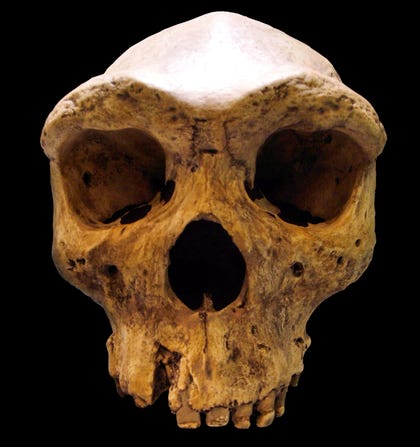
The skull of Kabwe Man in Zambia. Credit: Gerbil
The skull of Kabwe Man in Zambia. Credit: Gerbil
The Casablanca hominin is from 773,000 years ago, a time slightly earlier that genetics suggests for Neanderthals and Homo sapiens divergence. So that fits. Then the populations of this hominin that reached Europe started to diverge into a branch that later split into Neanderthals and Denisovans, while an Africa branch eventually led to Homo sapiens, Hublin explains.
In Africa, other archaic groups may have survived, as did that of Kabwe Man in Zambia, whose resemblance to Denisovans (or Neanderthals) has been noted by Israeli researchers.
Apropos the exact dating, Hublin notes by Zoom with Haaretz how rare it is to achieve such precision but they got lucky.”These hominins were found in a geological deposit which is exactly contemporaneous with a major reversal of the magnetic field, dated very precisely because it has been observed widely,” he says.
So what have we? “In Africa, we have something close to the split point,” Hublin says. Plausibly the Spain and Casablanca hominins, which are alike in teeth and jaws, sprang from the same erectus root but had been separated long enough to become distinct. Likely, after it became established in both Africa and Europe, the Mediterranean barrier between the continents became increasingly impassable.
 Close
Close
Fossils of a Homo antecessor. Credit: Nanosanchez
Fossils of a Homo antecessor. Credit: Nanosanchez
“It is not impossible that there was intermittent connections through Gibraltar in the Lower Pleistocene, during brief low sea level episodes, the strait was narrower and there were even intermediate islands!” he explains. But eventually, the two areas produced different types of hominins – “the so-called heidelbergensis and later Neanderthals in Europe and something else in Africa that eventually would result in early sapiens, like at Jebel Irhoud in Morocco,” he sums up.
In short, the team proposes that Homo antecessor in Spain was not ancestral to Homo sapiens, the Moroccan hominin was. It fits all the criteria and does not require migratory mischegoss. Suggesting antecessor as common ancestor wouldn’t be a gross mistake because it was likely the same kind of hominin as Casablanca Person, but he’s in the wrong place and Casablanca Person is in the right place.
“Ultimately everything comes out of Africa,” Hublin sums up.”In Europe, the question is – is there a real continuity between antecessor and later hominins or new influxes out of Africa around 700,000 to 600,000 years ago? That is not resolved. The main point of our story is – we do have, in Africa, 773,000 years ago, a good candidate for the ancestor of Homo sapiens.”And maybe of the Neanderthals and Denisovans too.