
The world has entered an era of “global water bankruptcy” that is harming billions of people, a UN report has declared.
The overuse and pollution of water must be tackled urgently, the report’s lead author said, because no one knew when the whole system could collapse, with implications for peace and social cohesion.
All life depends on water but the report found many societies had long been using water faster than it could be replenished annually in rivers and soils, as well as over-exploiting or destroying long-term stores of water in aquifers and wetlands.
This had led to water bankruptcy, the report said, with many human water systems past the point at which they could be restored to former levels. The climate crisis was exacerbating the problem by melting glaciers, which store water, and causing whiplashes between extremely dry and wet weather.
Prof Kaveh Madani, who led the report, said while not every basin and country was water bankrupt, the world was interconnected by trade and migration, and enough critical systems had crossed this threshold to fundamentally alter global water risk.
The result was a world in which 75% of people lived in countries classified as water-insecure or critically water-insecure and 2 billion people lived on ground that is sinking as groundwater aquifers collapse.
Conflicts over water had risen sharply since 2010, the report said, while major rivers, such as the Colorado, in the US, and the Murray-Darling system, in Australia, were failing to reach the sea, and “day zero” emergencies – when cities run out of water, such as in Chennai, India – were escalating. Half of the world’s large lakes had shrunk since the early 1990s, the report noted. Even damp nations, such as the UK, were at risk because of reliance on imports of water-dependent food and other products.
“This report tells an uncomfortable truth: many critical water systems are already bankrupt,” said Madani, of the UN University’s Institute for Water, Environment and Health. “It’s extremely urgent [because] no one knows exactly when the whole system would collapse.”
About 70% of fresh water taken by human withdrawals was used for agriculture, but Madani said: “Millions of farmers are trying to grow more food from shrinking, polluted or disappearing water sources. Water bankruptcy in India or Pakistan, for example, also means an impact on rice exports to a lot of places around the world.” More than half of global food was grown in areas where water storage was declining or unstable, the report said.
Madani said action to deal with water bankruptcy offered a chance to bring countries together in an increasingly fragmented world. “Water is a strategic, untapped opportunity to the world to create unity within and between nations. It is one of the very rare topics that left and right and north and south all agree on its importance.”
Chart showing increasing number of conflicts over water
The UN report, which is based on a forthcoming paper in the peer-reviewed journal Water Resources Management, sets out how population growth, urbanisation and economic growth have increased water demand for agriculture, industry, energy and cities. “These pressures have produced a global pattern that is now unmistakable,” it said.
In some of the world’s most densely populated river basins, including the Indus, Yellow, and Tigris-Euphrates, the rivers were periodically drying up before reaching the ocean. “In many basins, the ‘normal’ to which crisis managers once hoped to return has effectively vanished,” the report said. Lakes were also shrinking, from Lake Urmia, in Iran, to the Salton Sea, in the US, and Lake Chad. Wildlife suffered as well as people, as humans “steal” water from nature, Madani said.
Satellite view of the lake shrinking over timeLake Corpus Christi, in Texas, US, where there was a systemic retreat of surface water between October 2021 (left) and October 2025 (right) due to overuse.
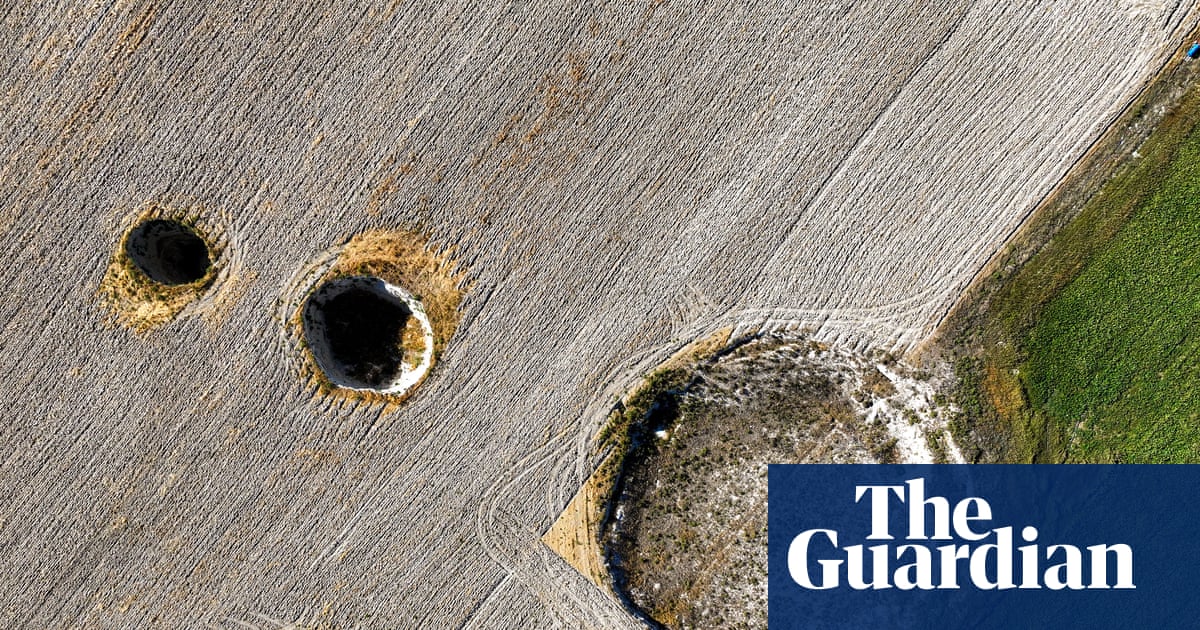
The over-exploitation of groundwater was causing cities to subside around the world, with Rafsanjan, in Iran, sinking by 30cm a year; Tulare, in the US, by about 28cm a year, and Mexico City by about 21cm a year. Jakarta, Manila, Lagos and Kabul were other major cities affected. Among the most visible signs of this water bankruptcy, the report said, were the 700 sinkholes peppering the heavily farmed Konya plain in Turkey.
Cities, such as Tehran, Cape Town, São Paulo and Chennai, had all faced day zero water crises, the report noted, while the number of water-related conflicts around the world had risen from 20 in 2010 to more than 400 in 2024.
Humanity was also slashing the amount of water available by destroying natural stores, such as wetlands, and polluting waterways. Wetlands equal in size to the entire European Union had been erased in the past five decades, the report said.
The report calls for a fundamental reset of how water is protected and used around the world. This would include cutting the rights and claims to withdraw water to match today’s degraded supply, and transforming water-intensive sectors, such as agriculture and industry, via changes in crops, more efficient irrigation and less wasteful urban systems. The report emphasises support for communities whose livelihoods must change.
“Water bankruptcy management requires honesty, courage and political will,” said Madani. “We cannot rebuild vanished glaciers or reinflate acutely compacted aquifers. But we can prevent further losses, and redesign institutions to live within new hydrological limits.”
Tshilidzi Marwala, UN undersecretary general, said: “Water bankruptcy is becoming a driver of fragility, displacement and conflict. Managing it fairly is now central to maintaining peace, stability and social cohesion.”
The challenge of sustainable water management around the world was very real, said Prof Albert Van Dijk, at the Australian National University who was not part of the UN report, although, he added, he preferred the description of collapse, or systemic failure, over bankruptcy.
A recent water report led by Van Dijk highlighted the increasingly erratic climate. “Increased variability is as much a problem as scarcity,” he said. “Sometimes there’s more water available overall, but it increasingly arrives in bursts, at the wrong place and at the wrong time. This makes management genuinely harder. For example, dam reservoir levels need to be kept low to mitigate floods but high to ensure supply during droughts.”
Dr Jonathan Paul, at Royal Holloway, University of London, said: “The report lays bare humankind’s mistreatment of water [which] threatens the viability of ‘the water cycle’ as a concept.
“The elephant in the room, which is mentioned explicitly only once, is the role of massive and unequal population growth in driving so many of the manifestations of water bankruptcy,” he said. “Addressing this growth would be more useful than tinkering with outdated, non-inclusive, and top-down water resource management frameworks.”