
John LaurensonBusiness reporter, Zilina, Slovakia
 Kia Slovakia

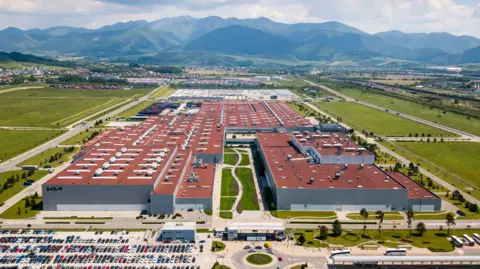
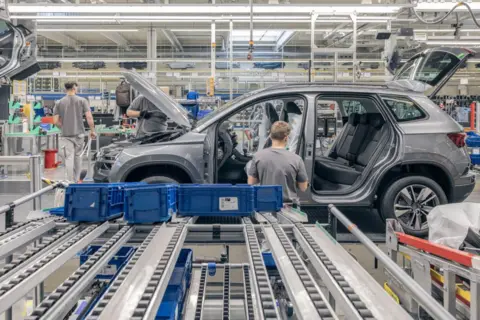
Kia’s giant plant in Zilina, Slovakia, can produce 350,000 cars per year
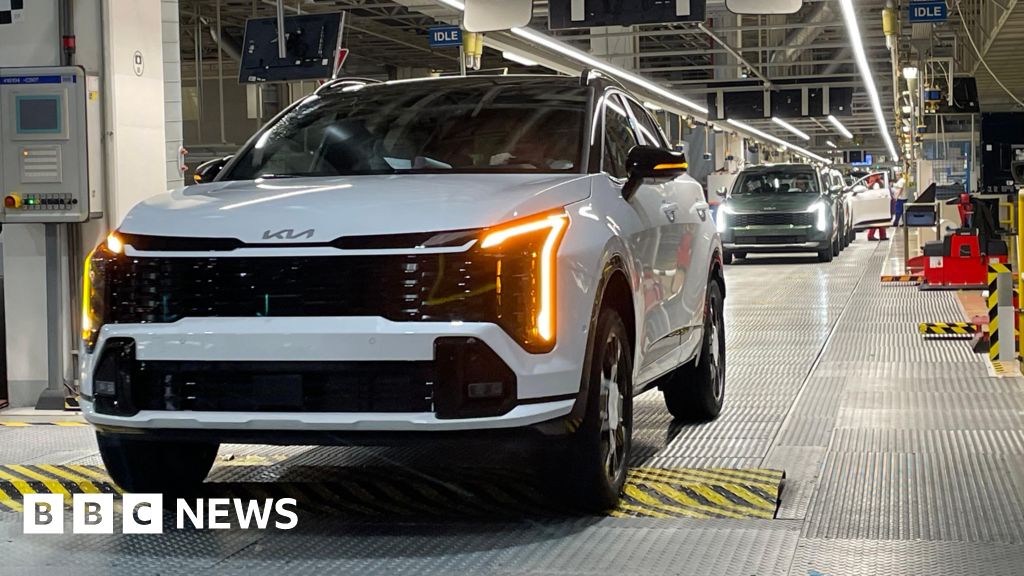
In a giant factory surrounded by mountains covered in snow, a lift lowers the steel bodies of cars onto the start of an assembly line.
They’ve just been welded together by robots – there are 690 working in this factory.
Next an army of human workers in red trousers and white t-shirts will transform these steel shells into finished cars.
One of these vehicles drives off the end of the assembly line every minute, flashing its headlights.
This is the European factory of Korean car company Kia, just outside the city of Zilina in the north of Slovakia.
It represents, Kia says, an investment of €2.5bn ($2.9bn; £2.2bn).
Volkswagen also produces cars in Slovakia. So does Stellantis (formerly Peugeot-Citroen, Fiat and Chrysler), and Jaguar Land Rover. Volvo is opening an electric car factory here in 2027.
This country of 5.4 million people makes almost a million cars a year – that’s more cars per person than any other nation in the world.
 Kia
Kia
Kia’s vast Slovak factory is its main European production base in Zilina, Slovakia
“From a child, cars are my passion,” says assembly line worker Marcel Pukhon, 48, one of the 3,700 people employed at the Kia plant.
“Now I am part of the team, and I can make the cars, so that’s something that’s a dream job.”
Marcel lived in Northern Ireland and England before moving back to his native Slovakia to work here.
At the door insulation part of the assembly line I also talk to Simona Krnova, 23. She studied business before coming here. This is not her dream job, she tells me, but it does have its good points.
“Half of my family works here, so I wanted to try. I like the people,” she says.
As for her salary, she earns €1,300 per month. “Good compared to other companies,” she adds. And later on that will rise. Kia says the average at the facility is €2,400 per month.
That is substantially higher than the country’s average monthly salary across the entire economy, which official figures show was €1,403 in 2023.
But at the same time it is considerably lower than the EU-wide average of €3,417.
Simona says she’s proud of the fact that Slovakia makes so many cars. “I like the fact that thanks to that, the production here supports our society,” she says.
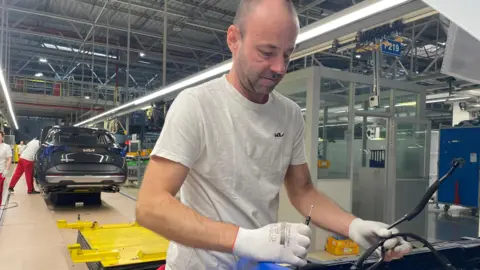
Kia assembly line worker Marcel Pukhon says he has his “dream job”
Practically everyone who works at the Kia plant is Slovak. The Korean presence is a few dozen senior managers who live in a gated community they built specially on the outskirts of a village a couple of kilometres away.
When Slovakia was part of the Czechoslovak Socialist Republic, the cars it made were, by Western standards, shoddy, noisy, thirsty and slow.
But after the Velvet Revolution of 1989 sent the Communist rulers packing, Volkswagen started investing in Czechoslovak carmaker Skoda in 1991. By 2000 it owned the whole company.
Other foreign automobile manufacturers also started to invest in the new nations of the Czech Republic and Slovakia – the two parts of the former Czechoslovakia after its separation in 1993.
Car industry expert Peter Prokop says that back then the labour costs in Slovakia were 20% of those in Germany.
Prokop, the boss of Give Management Consulting, a Munich-based business that advises clients in the automotive sector, adds that Slovakia still has a considerable cost advantage.
“On one hand you still have lower wages,” he says. “I would say 60% of the Western wages. But you have also high productivity. So it’s definitely competitive.”
Further down the Kia assembly line a machine that installs the cars’ air conditioning systems plays a bit of Mozart as it moves forward to warn people to get out of the way. Many of the vehicles have their steering-wheels on the right, British-style.
The biggest market for the cars they produce at the factory is indeed the UK, where Kia is now the fourth best-selling brand after VW, BMW and Ford.
Spain, Italy and Germany are the next biggest markets in Europe for Kia cars.
Kia Europe’s chief executive, Marc Hedrich, says that Slovakia’s car manufacturing industry also benefits from the country’s central location. “Slovakia is really in the heart of Europe, quite well-connected to the big markets,” he says.
Slovakia’s high rate of low-carbon energy generation, from hydro to nuclear, and growing use of renewables, also means that the country’s electric cars are eligible for larger levels of government discounts when customers buy them, such as the UK’s Electric Car Grant.
Another important Slovak advantage is its dense network of car industry suppliers. Some 360 companies work for the car industry. “The supplier base is enormous,” says Mr Hendrich, “this is critical”.
 AFP via Getty Images
Volkwagen makes both VW and Skoda models in Slovakia
Kia didn’t want to go into details about the incentives it received from the Slovak government to start production in the country back in 2006.
Yet Hedrich did say it received a tax credit of €29m for transforming its Slovak production lines for its new electric vehicles, the total cost of which was €108m.
The Slovak government offers these incentives to carmakers because the benefits for the country are enormous.
“There has been a huge decline in unemployment, and a significant increase in the economic strength of the Zilina region thanks to Kia,” says the city’s mayor, Peter Fiabane.
“Today, more than 20,000 people are directly employed by Kia and other companies that are linked to Kia by production.”
Hedrich also points to the quality of available workers in Slovakia. At the Zilina’s Technical School 100 students are on a Kia-sponsored “dual programme”, whereby they alternate between studying and working at the factory.
At the separate University of Zilina, around 400 of its graduates get jobs connected to the automotive industry every year.
While Slovakia leads the way, other former Eastern-bloc nations have also seen Western and Asian carmakers set up factories. In the Czech Republic there’s Hyundai, Toyota and VW, while in Poland it is Toyota, Stellantis and VW again.
Meanwhile, Audi, Mercedes-Benz and Suzuki have facilities in Hungary, Ford and Renault are in Romania, and Ford is in Serbia. All are attracted by low wages, and a tradition of industry and educated workers.
Read more global business stories