
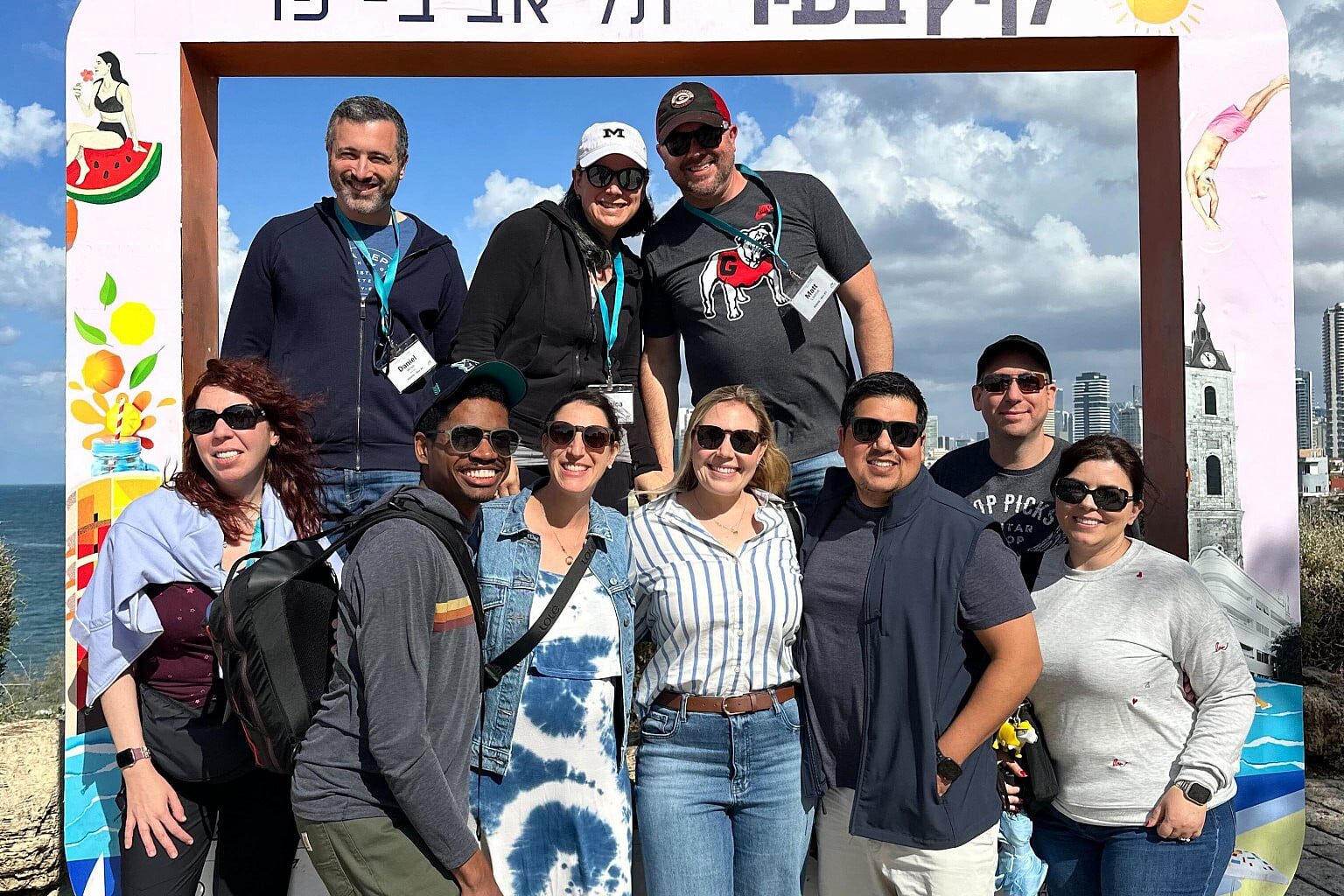
Dalia and Jean had been talking about Israel for years.
Dalia, who is Jewish, felt an increasing pull to visit, especially after the attacks of October 7. Jean, born in Haiti and raised in Brooklyn, felt something very different. Traveling to Israel for the first time in December 2025 felt heavy and complicated. It raised questions about safety, identity and where he fit in a Jewish story that suddenly felt very public and very charged.
When they arrived in Israel with Honeymoon Israel (HMI) in early December, one of their first shared experiences was hearing from Avraham Infeld, a leading Jewish educator and longtime advisor to HMI. Speaking to nearly 40 couples from New York and Washington, D.C., Infeld offered a grounding idea: Jewish peoplehood. He described it not as a checklist of beliefs or practices, but as a shared sense of responsibility for one another.
He spoke directly to the range of people in the room: Jews by birth, Jews by choice, and partners who had come to Jewish life through love and relationship. Each person, he said, brings their own story. And today, those stories often feel fractured. His question to the group was clear: If you are choosing to build your life connected to the Jewish people, how will you show up for one another now and into the future?
For Jean, this moment mattered. Jewish belonging no longer felt like something he had to earn or fully understand before stepping in. It felt like an invitation to take responsibility alongside others.
After a long pause in travel due to the war, Honeymoon Israel resumed trips in November 2025. We are the leading national organization serving young couples with an immersive trip to Israel for cohorts of couples with at least one Jewish partner. The first cohorts since October 7th included couples whose journeys had been postponed again and again. By the end of 2026, HMI expects to bring approximately 400 couples to Israel from cities across North America. Since it’s inception in 2015, HMI has run more than 170 cohorts and served over 3,000 couples.
HMI’s model is intentionally local. Each cohort is made up of couples from the same city, creating the conditions for relationships that last long after the trip ends. These groups become circles of support: people raising children around the same time, navigating careers, celebrating holidays and showing up for one another in real life. HMI provides opportunities and empowers couples to continue to gather, learn, and explore Jewish life — through learning series, Shabbat and Jewish holidays, and relationships with our partners in the Jewish community/ecosystem.
The impact of this model is visible years later. Cynthia, who traveled with HMI from Denver in 2019, recently shared: “We celebrated our annual HMI Friendsgiving, where all of the families from our trip get together. We make challah, say the blessings, and talk about both our time in Israel and what’s happening now. Our HMI family truly is our family in Colorado.”
The couples traveling today reflect the reality of Jewish life in North America. Sixty percent are interfaith couples. Forty percent are Jewish couples, including couples where one partner has converted to Judaism. Half have never been to Israel before. Many are navigating loneliness, questions about belonging and, at times, real tension with non-Jewish family members and friends. One applicant wrote, “I will likely lose a few friends if I tell them I am going to Israel. But it’s worth it.” Participants have shared during group conversations in Israel about social stigma they face at work, with their peers and family members, and in their communities.
Since October 7, these challenges have sharpened. Online and public discourse about Israel can be misguided and unforgiving, leaving many young couples unsure how to engage or where they are allowed to stand. At the same time, these couples shape Jewish life every day. When they feel connected and supported, that sense of belonging reaches far beyond the trip, into workplaces, extended families and neighborhoods.
HMI’s Israel experience is designed to help couples encounter the country as a living, breathing place. Participants meet people, hear stories and wrestle with questions that do not have easy answers. Along the way, they are invited to reflect on how Jewish values show up in their own homes and relationships.
HMI has deepened its focus on Jewish peoplehood throughout the itinerary. Educational voices reflect a wide range of perspectives on Israel, Jewish practice and identity. Ritual moments highlight the many ways Jewish life can be lived, allowing couples to see themselves reflected rather than measured.
Participants also engage with non-Jewish narratives through partnerships such as the Task Force on Arab Citizens of Israel. These encounters invite listening and curiosity. They ask couples to hold complexity while staying connected to one another.
Service has become an even more central part of the trip. Through partnerships with Repair the World and Yahel Israel, couples volunteer with organizations supporting communities impacted by and since October 7. Groups have worked at therapeutic farms in Yodfat, food distribution centers in Netivot and community shelters and gardens in places like Beit Hillel and Ofakim. Post-trip surveys show a 15% increase in participants’ sense of impact through service compared to pre-war trips, reinforcing how meaningful it feels to contribute in tangible ways.
One of the most powerful experiences on the trip is the mifgash, the encounter between American and Israeli participants. For the renewed trips, this program has been expanded. Two Israeli couples now join each cohort for four days, sharing Shabbat, travel and long conversations.
These couples, recruited in partnership with the Jewish Agency for Israel and the Israeli Association for International Couples amongst other organizations and ambassadors, represent a wide range of backgrounds and perspectives and their presence deepens the impact of the experience for Americans and Israelis alike.
In November, one of those participants was Itay, a survivor of the Nova music festival, who joined with his partner, Amit. After sharing his story, Itay reflected: “Most of the time, Israelis feel alone in the world. After this experience with you, I don’t feel alone anymore.”
Survey data echoes this impact. Participants reported a 25% increase in the value of the mifgash experience compared to 2022 trips. Spending real time together, rather than listening from a distance, has helped build trust and mutual understanding.
In an uncertain moment, couples are searching for connection as much as clarity. Honeymoon Israel offers a space where Jewish and mixed-heritage couples can explore their place in the Jewish people with honesty and care.
Sophia, who traveled with her non-Jewish partner, shared: “It’s rare to suddenly gain a whole community of people navigating similar journeys. HMI showed us there is no one right way to build a Jewish family, and now we have 40 people figuring it out with us.”
Participants arrive carrying fear, grief and disagreement. HMI’s work is to hold that reality with openness and warmth. On the trip, couples experience a broad and generous welcome into Jewish peoplehood. When they return home, they carry that sense of belonging with them and continue building Jewish life together, even when it feels challenging.
At this moment, the future of Jewish life depends on work that centers relationships, invites people in and makes room for difference. Honeymoon Israel is helping couples move from “it’s complicated” toward connection, one community at a time.
Learn more about our work, apply, or refer couples at https://honeymoonisrael.org/.
Emma Dunn is the Senior Director of Honeymoon Israel’s Israel Office, where she works at the intersection of Jewish peoplehood, community-building, and contemporary Jewish life. She joined Honeymoon Israel in 2022 as the Midwest/Central U.S. Regional Director before relocating to Israel.
Prior to HMI, Emma led young adult engagement for the Jewish Federations of Minneapolis and St. Paul and has served on multiple nonprofit boards. She holds a BA and Master of Public Policy from the University of Minnesota and a Certificate in Jewish Leadership from the Spertus Institute.
Now based in Tel Aviv, Emma writes about how Jewish community and Israel are shaped by relationships, culture, politics, and daily life. When she’s not working, she’s usually running along the beach, studying Hebrew, or exploring new people, places, and ideas.