
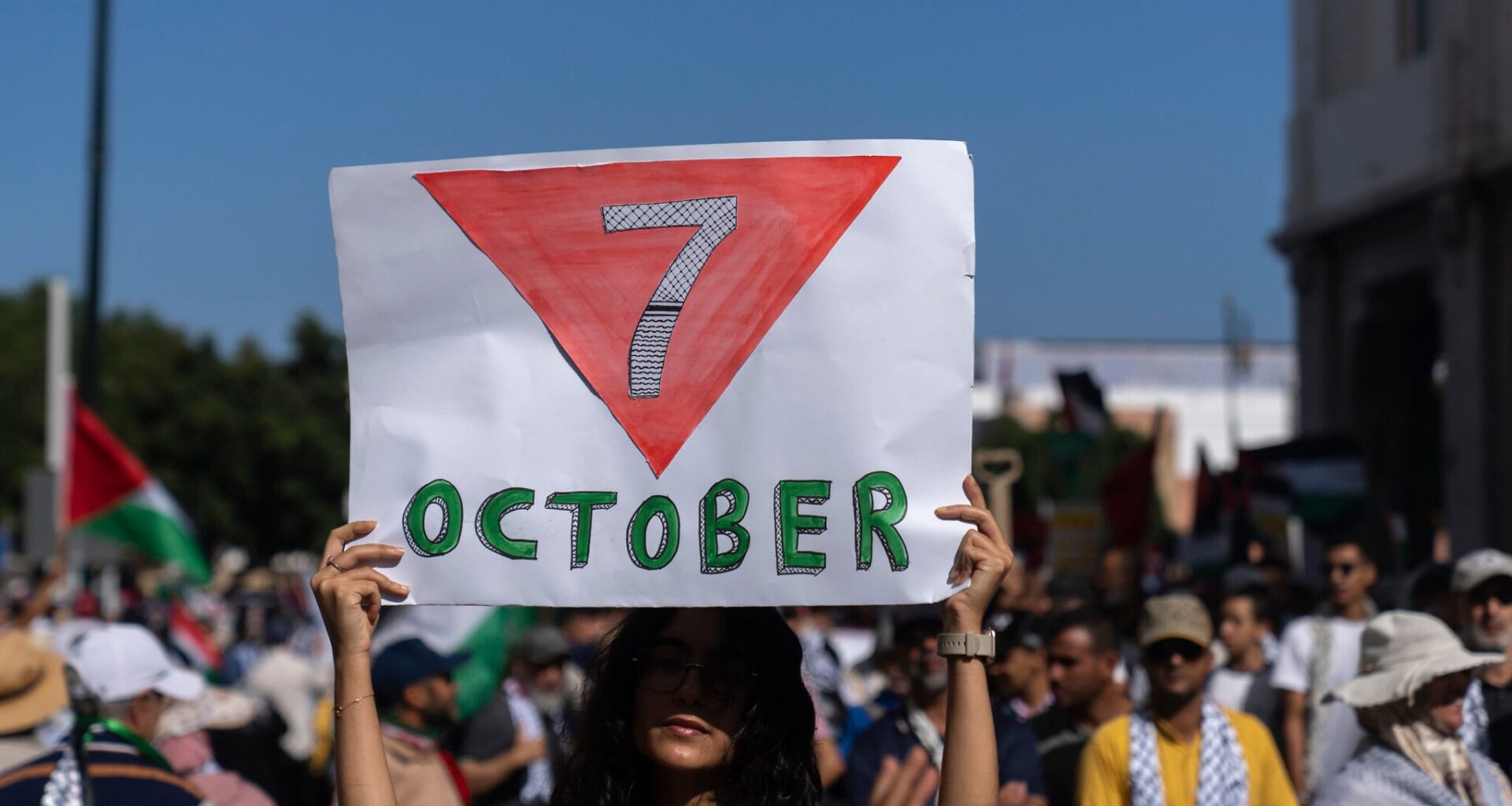
I can’t help but laugh when I see Moroccans marching in solidarity with Palestine. On the surface, it might look like a noble stand against so-called Israeli aggression, but let’s be honest – those days of pan-Arabism and the fantasy of a unified Muslim ummah are long buried. Everyone is looking out for themselves now. As societies drift toward individualism, nations mirror the same instinct – prioritizing self-interest over collective ideals.
In fact, analysts note that Palestine has become an “afterthought” in the Arab political order. What many acknowledge privately is now echoed in leaders’ own words. Even Israel’s Netanyahu has bluntly admitted that, behind closed doors, many Arab rulers “don’t give a hoot” about the Palestinian issue.
As a Moroccan, I judge Israel by how it treats Morocco, not by how it treats others. If Israel behaves well toward us (and frankly, it has good relations with Morocco), I’ll consider that in our favor. If it doesn’t, then we speak up and defend our interests. But what Israel does to, say, Palestine, Lebanon, or Iran is not my concern.
Otherwise, consistency would require us to sever ties with China over its treatment of Uyghur Muslims, cut relations with Russia over Ukraine, boycott the United States for Iraq and Afghanistan, and distance ourselves from half the world. Foreign policy does not operate on moral absolutism; it operates on national interest.
Each country must mind its own business now. The Arabs who are spending energy chanting in Rabat or Casablanca for Palestine sometimes forget that our real issues are at home. We have underpaid teachers, young graduates without jobs, and people dreaming of better lives abroad.
Look at education and opportunity: Palestinians actually outperform many Moroccans by some measures, ironically. In Palestine, adult illiteracy stands at about 2.1% (2023), meaning nearly 98% of adults can read and write, down from 13.9% in 1997. In Morocco, by contrast, 24.8% of adults were illiterate in 2024 – nearly one in four, despite improvement from 32.2% in 2014. The gulf between the two is striking in any serious comparison.
Even basic income figures disrupt the usual narrative. The official Palestinian minimum wage is about 1,880 ILS (~$580/month); even with war, many earning below it still average 1,424 ILS (~$400). In Morocco, the SMIG is 3,422 MAD (~$320-350), while the public-sector minimum is around 4,500 MAD (~$430-450).
In Morocco, we still have high youth unemployment and many graduates scrambling. In fact, an Afrobarometer poll found over one-quarter of Moroccans dream of leaving – mostly for Europe. We wish we had better prospects.
Our problem is that almost everyone who speaks, writes, and analyzes – myself included – has never actually been to Israel or Palestine. What follows is predictable: those who witness the conflict from afar often become more agitated than those living inside it.
Generations of Palestinians abroad tend to be more activist than Palestinians on the ground, because their relationship to Palestine is largely inherited through stories of dispossession and occupation. Palestinians inside Israel face real and serious injustices, but they are often more pragmatic and realistic in navigating their daily reality than those outside, who keep the cause alive in abstraction rather than experience.
An easy way to understand this is to think about how we relate to our own countries when we are abroad versus when we are inside them. From the outside, we tend to become more nationalist – speaking louder about our homeland, expressing love and nostalgia, remembering mostly the good. From the inside, the relationship is different, shaped less by idealization and more by daily realities, compromises, and frustrations.
Palestinians, despite holding one of the weakest passports in the world, surprisingly have more routes out or upward. They often receive international scholarships and special programs that Moroccans can only dream of.
And even in Israel, academic institutions push full scholarships for Palestinians (along with Arab Israelis and Jordanians). Big universities around the world have special funds to take in displaced Palestinian students. During my two years in Qatar, nearly every Palestinian I knew had studied or traveled across Europe or the US through exchange programs like Erasmus. Many Moroccans, painfully, struggle to secure basic student loans or remain stuck in endless visa limbo. Our nation lacks such targeted support.
Many countries have offered pathways for Palestinians to live abroad, whether through temporary protection, humanitarian visas, or asylum. In many cases, these arrangements lead to long-term residency and, over time, a potential route to citizenship under existing national laws.
Canada and Australia introduced special measures granting temporary residence and work or study permits, while several European states process Palestinian asylum claims on a case-by-case basis. Paradoxically, some Moroccans even attempt to pass themselves off as Palestinians or Syrians to benefit from such pathways, particularly during irregular migration to Spain.
It hurts to admit: Palestinians enjoy some privileges we don’t. They live under occupation, but that status also makes them eligible for international aid, diaspora networks, and scholarships – opportunities that free Moroccans don’t have. We remain here “living our dream” of Europe while they study abroad on donors’ dime. Moroccans envy any passport privileges we lack. We look at them and think: how do they get all these chances?
The bitterest irony is captured in a crass joke some Arabs whisper: A Palestinian once was asked to either say “alhamdulillah” (thank God) for his lot or die – he chose dying. It’s a dark punchline, but it reflects a truth we can’t ignore.
Palestinians are often shaped by resignation mixed with defiance, a refusal to sanctify deprivation. Many Palestinians refuse to respond to hardship with ritualized acceptance. They don’t easily say “alhamdulillah” for deprivation. For Moroccans, for instance, invoking “alhamdulillah” amid scarcity can feel like faith – but to Palestinians, it can look like surrender, even a quiet betrayal of dignity. Ask many Moroccans in the Gulf whom they found the hardest to work with, and you will often hear – rightly or wrongly – Palestinians mentioned.
So here I stand: I’m Moroccan, and I see through the theatrics. Yes, I stand in solidarity with human suffering, but not out of loyalty to an outdated “ummah.” I stand for my country’s interests. Israel must prove itself to Morocco on its own terms, nothing more. And until we fix our own schooling, pay, and future, it’s hypocritical to rave for others’ causes. We should wake up: solidarity without substance and clear benefit to Morocco is just a feel-good facade.
A Moroccan journalist with a Master’s degree in Media Studies from Qatar. I contribute about the Western Sahara dispute, Morocco-Israeli relations, and Jewish-Muslim coexistence in a country that was once home to around 250,000 Jews—the largest Jewish community in the region. I also run the Instagram account @murakuc.officiel, which now has over 300,000 followers and focuses on old photographs and archives of Morocco, including its deep Jewish roots that the country officially recognizes in its 2011 constitution as the Hebraic component.