
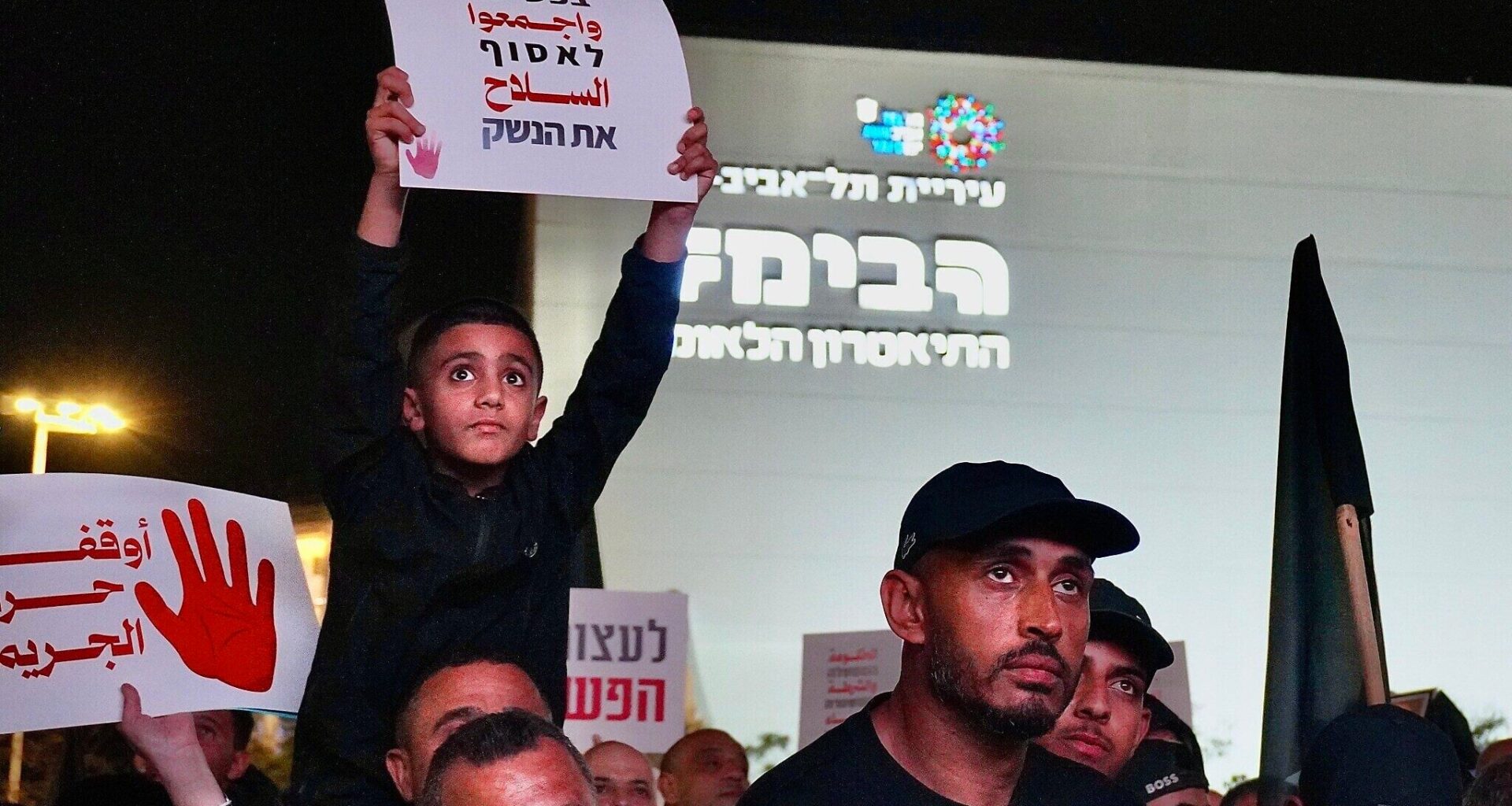
Saturday night, tens of thousands of protesters took to the streets of Tel Aviv in an outpouring of frustration against the government. They marched from Hostages Square to Habima Theater, waving black flags and accusing the state of leaving its citizens for dead.
Habima’s vast square has seen its fair share of Saturday night rallies against the government, largely driven by Tel Aviv’s large swath of secular liberal Jews, distraught over the country’s right-wing turn under Prime Minister Benjamin Netanyahu.
This time, the usual suspects made up only half the crowd. The other half, and those leading the protest, were from the country’s Arab minority, most of whom had come to the coastal city on chartered buses from across Israel.
For the last two weeks, daily protests and strikes have swept through the Arab community, part of a burgeoning struggle against rampant gang violence, which Arab leaders claim is fueled by state neglect.
The political awakening comes years into a crime wave that has brought murder to Arab communities at unprecedented levels, with 252 killed last year, a nearly 300% rise from 2017.
It was sparked late last month after Arab shop owners in the northern city of Sakhnin went on strike to protest the mafia protection rackets extorting them. The action spread to other Arab towns and days later, the streets of Sakhnin filled with tens of thousands of mostly Arab protesters demanding that something be done to rid their towns of the scourge of violent crime.
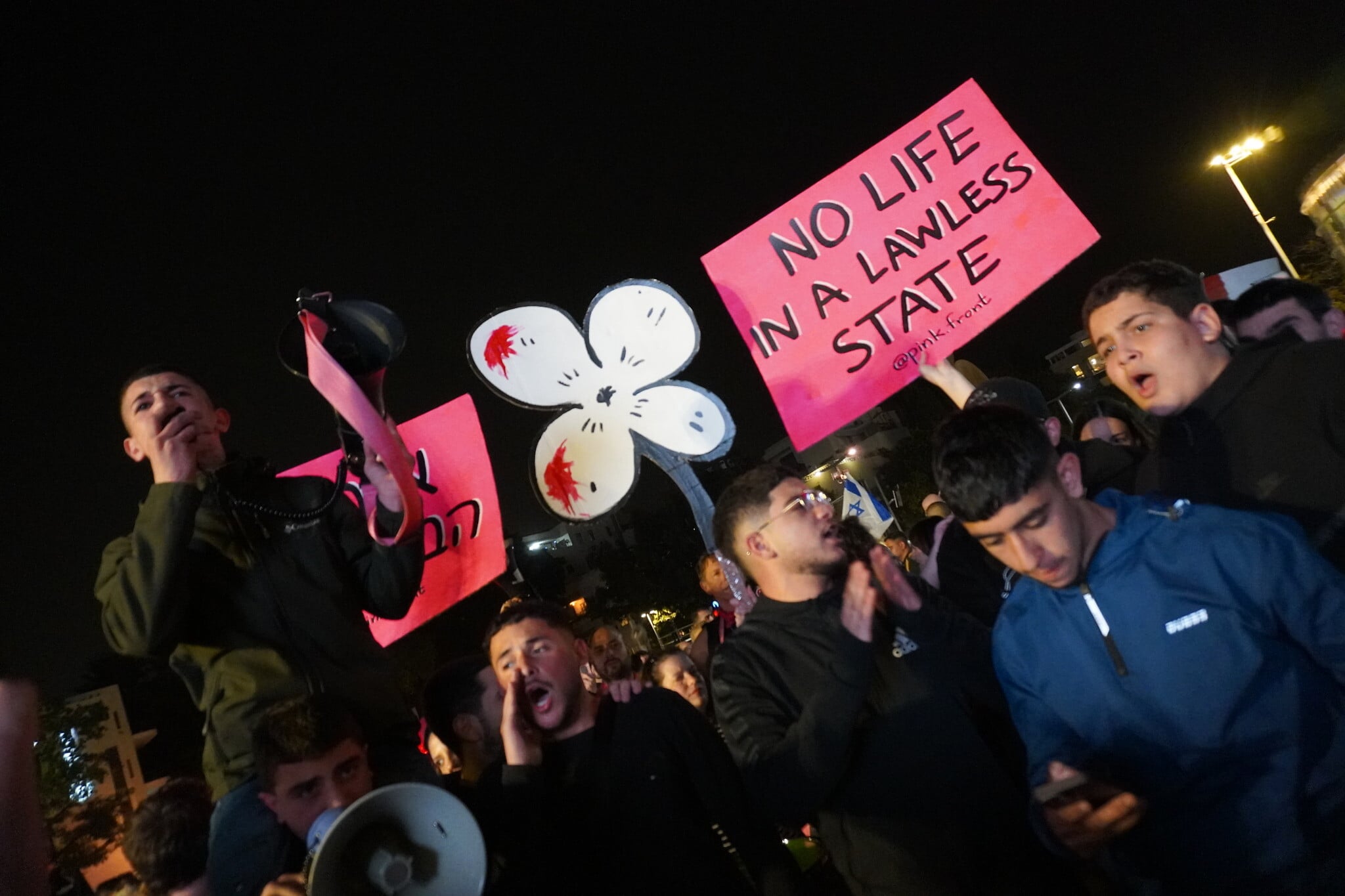
Arab and Jewish protesters demonstrate against crime and government neglect in Tel Aviv’s Habima Square on January 31, 2026. (Charlie Summers/Times of Israel)
The Sakhnin rally was not the first held by Arabs to protest crime, but it was among the largest, and unlike many previous protests, came as part of what appears to be a uniquely organized and sustained effort to bring public pressure to bear on the government over the issue. Yet like the others, it still went mostly unnoticed by the country’s Jewish majority.
The Saturday night protest aimed to change that, broadcasting a simple message to Israel’s Jews and specifically the political opposition: You can no longer ignore this, just as you could not ignore the hostage crisis, the judicial overhaul, the cost of living, or any of the other issues that have brought the masses to Tel Aviv’s streets.
Jamal Zahalka, who heads the High Follow-Up Committee for the Arab Citizens of Israel, which organized the protest, called Jewish attendance “fully an act of civic solidarity.”
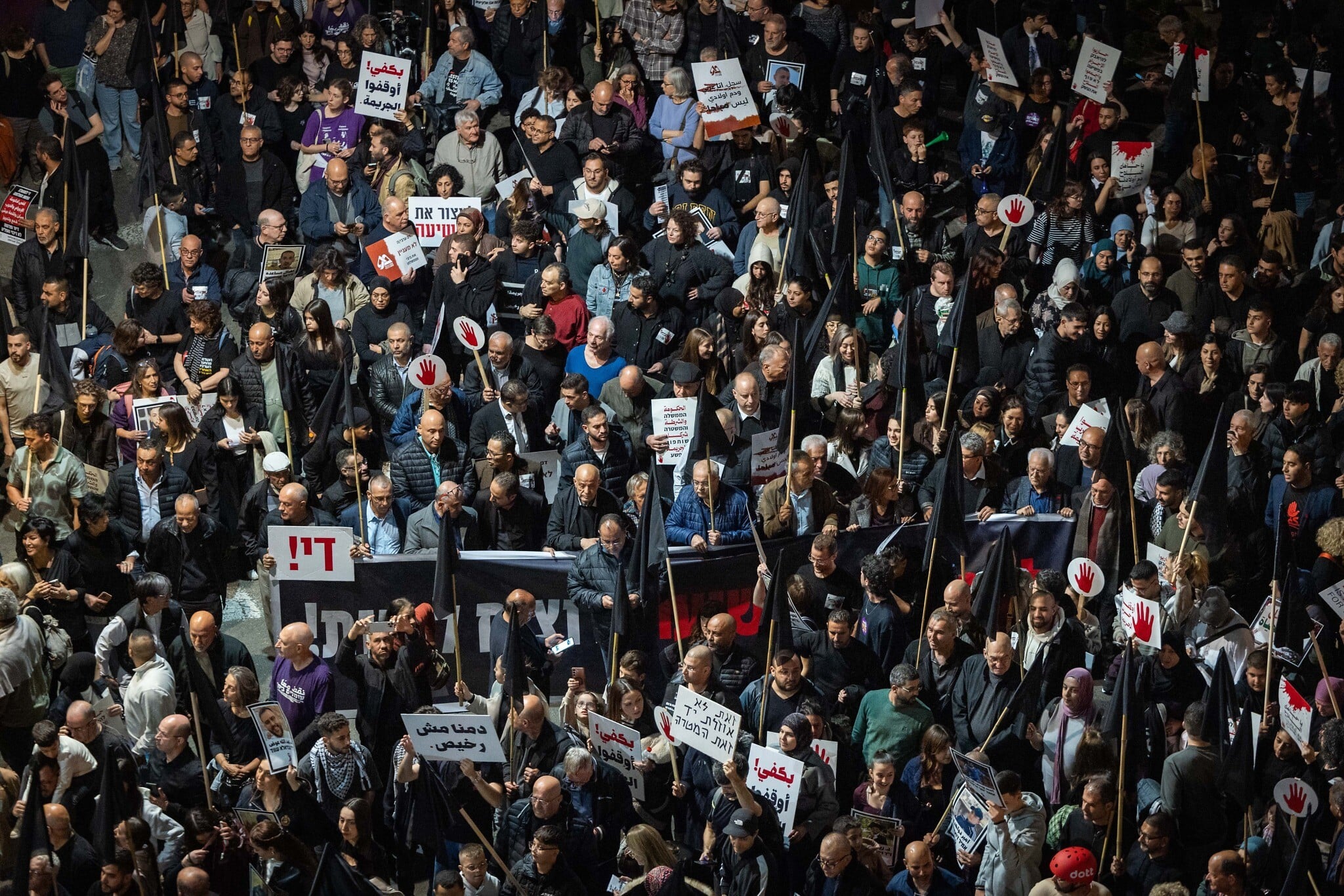
Thousands of people attend a protest against violence in the Arab community in Tel Aviv on January 31, 2026. (Yonatan Sindel/Flash90)
“The war hasn’t extinguished civic solidarity [between Jews and Arabs],” said Zahalka, a former lawmaker for the hardline Balad party. “There is hope that Jews and Arabs can work together not just against crime, but also on other issues.”
Though the protest started as a grassroots movement, Zahalka is hoping that by taking the reins and bringing the Arab community’s most burning issue to the Jewish, anti-Netanyahu street, they can gain the kind of wide consensus needed to put real pressure on the government. Saturday night’s rally was a preview for the type of movement that Zahalka is betting can shut down the country in a major, days-long strike backed by both Arabs and Jews.
Looking out toward the crowd at Habima, one saw a disparate mix of Arabic and Hebrew signs emblazoned with slogans implicating the government and law enforcement in the spiraling violence.
In a somewhat surreal union, Arab protesters donned keffiyehs, a symbol of Palestinian nationalism, while handfuls of Jewish protesters waved Israeli flags. Most flags, though, were painted solid black — a symbol of Arab society’s escalating struggle against crime.
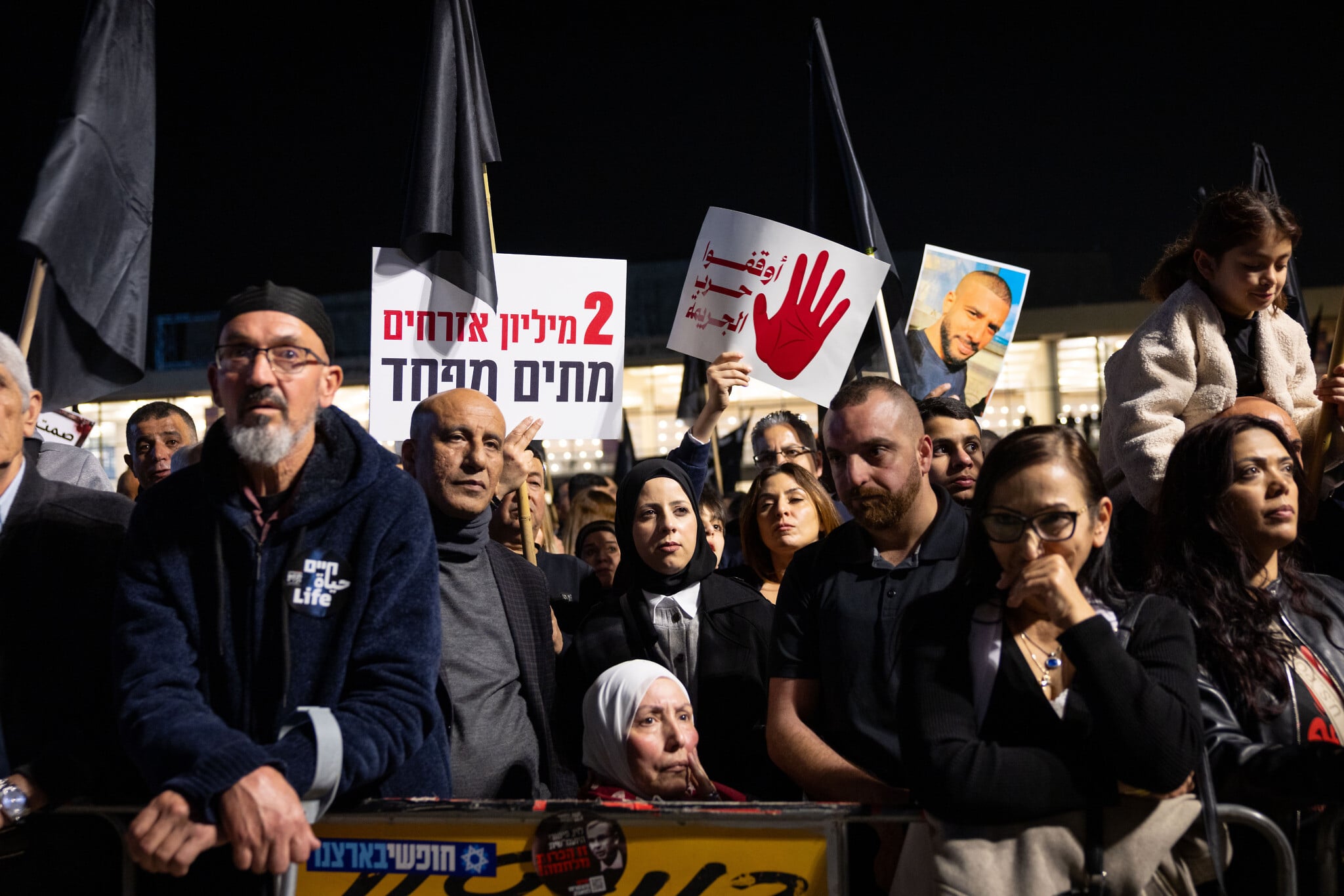
Thousands attend a protest about organized crime in the Arab community, in Tel Aviv. January 31, 2026. (Yonatan Sindel/FLASH90)
“This is the largest Jewish-Arab protest in Israel’s history; there has been nothing like it in recent memory,” said Thair Abu Ras, a political analyst at the Jerusalem-based Van Leer Institute. “The strategy now [for Arab leadership] is to make sure that the struggle doesn’t die out, to keep this issue at the top of the Israeli political agenda.”
Sakhnin spark
The current push against crime began in the northern city of Sakhnin, when Ali Zbedat, the owner of a well-known supermarket chain, went public about having been targeted in several shootings near his business, the latest of which was caught on security camera footage.
Last year was the deadliest year for Israel’s Arab minority, with 252 people killed in crime-related violence. The trend has gotten even worse in 2026 so far, with 37 Arab citizens having fallen prey to homicide as of Thursday, including eight people within two days.
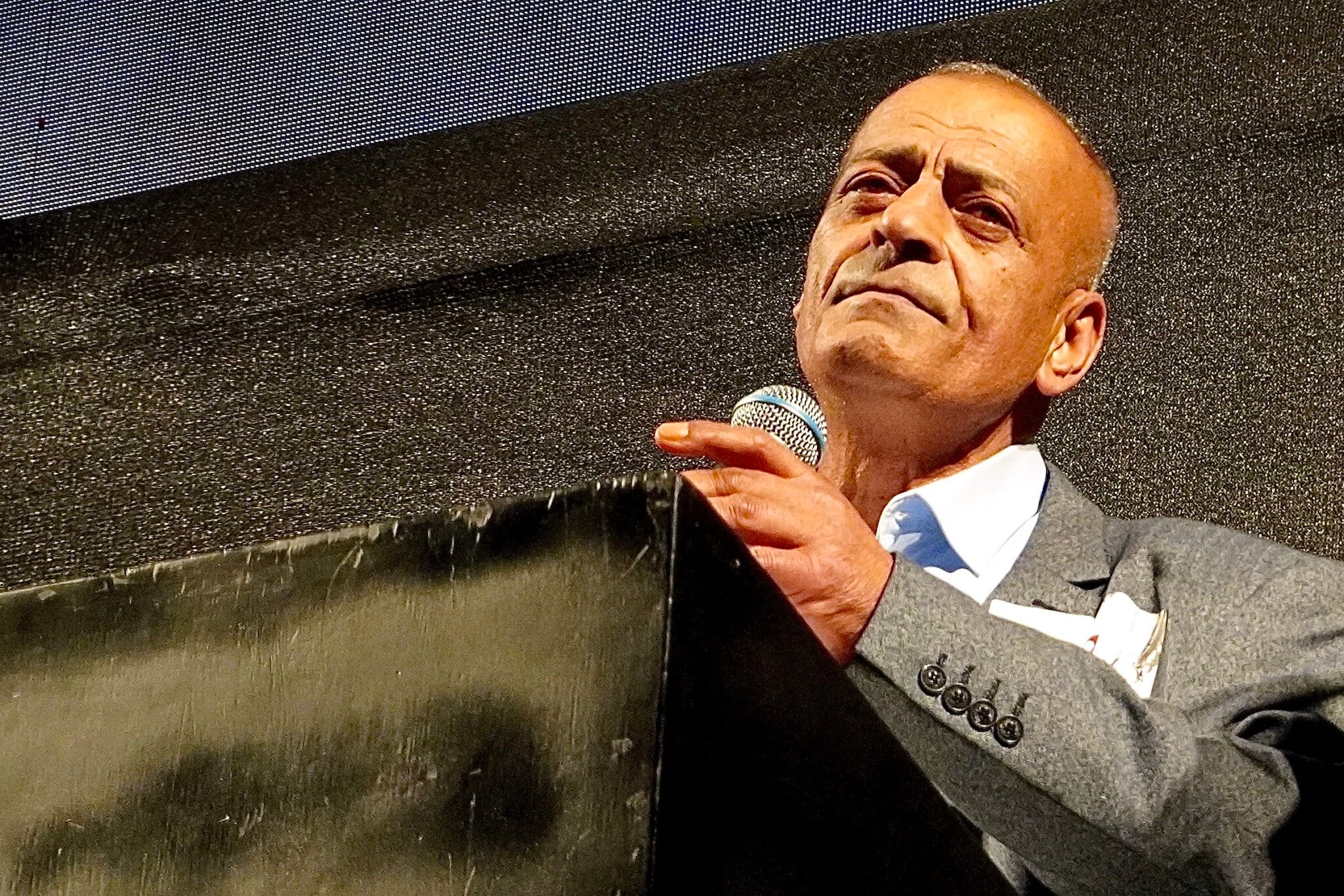
Grocery store owner Ali Zbedat, who helped spark a general strike in Arab society over the issue of violent crime, speaks to a crowd at Tel Aviv protest on January 31, 2026. (Charlie Summers/Times of Israel)
Most of Arab society views National Security Minister Itamar Ben Gvir as a major part of the problem, insisting the far-right politician’s oversight of police has led to worsening neglect of Arab towns by law enforcement.
Under him, critics say, police have done little to address the stranglehold organized crime has been able to put on Arab towns, instead prioritizing fighting terrorism or lawlessness that spills into Jewish areas.
The result is that in many Arab towns, shop owners are forced to close by sundown, parents are afraid to let their children leave the house out of fear for their lives and lethal shootings occur on a near-daily basis.
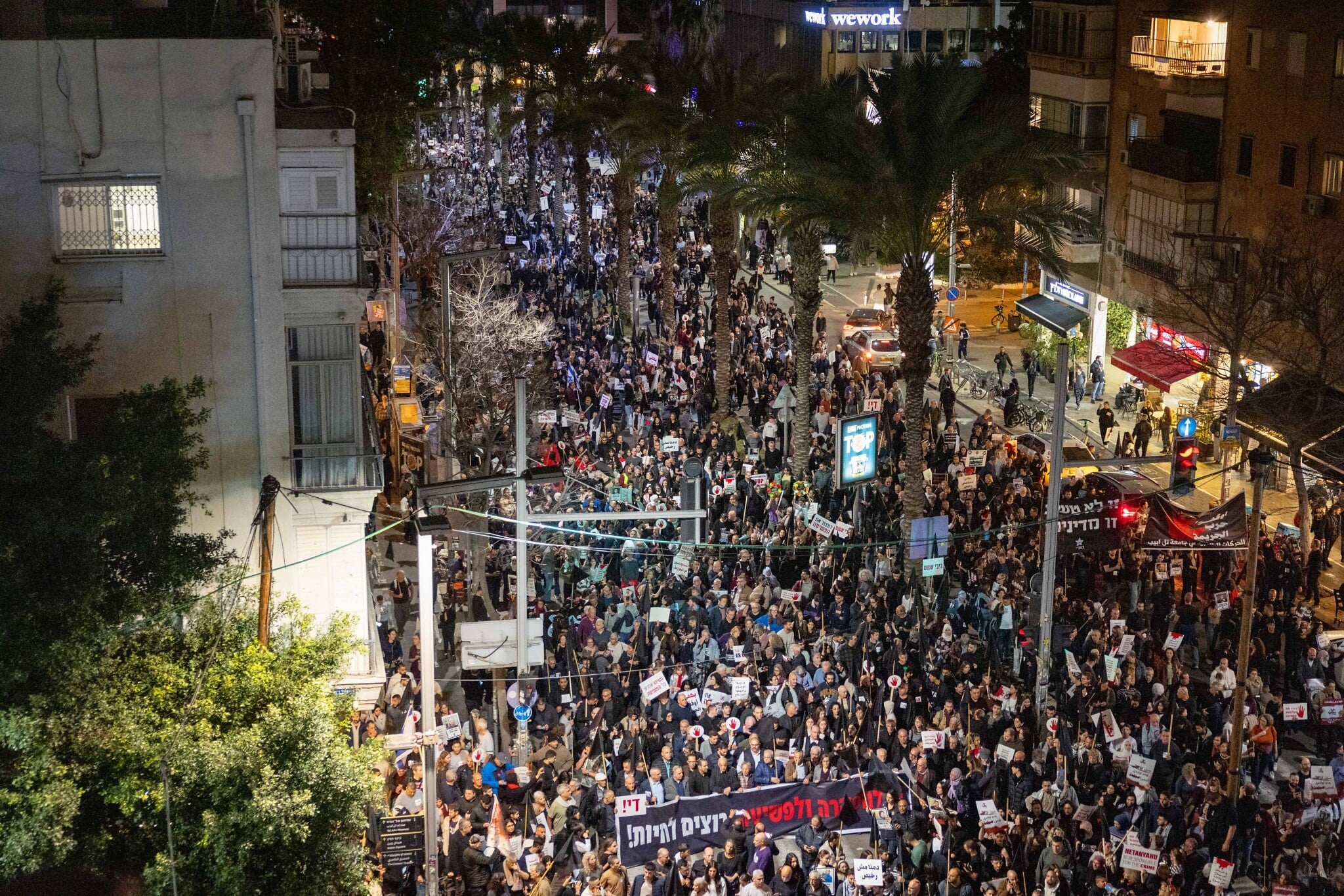
Thousands attend a protest against organized crime in the Arab community in Tel Aviv. January 31, 2026. (Yonatan Sindel/FLASH90)
Homicide rates had already been on the rise before Ben Gvir entered the government, spurred by government policies that allowed underworld crime to proliferate in Arab towns, according to experts. Under him, critics say, the problem has gone from bad to unthinkable.
In 2023, Ben Gvir’s first year, the murder rate more than doubled, from 116 to 245. It dipped slightly in 2024 before reaching new heights last year.
Law enforcement is aware of the scourge and frequently touts its efforts to get guns “off the Arab street,” but has not seen much success. In official statements, police also expressed frustration that intimidation of residents by criminals has hampered their efforts to combat violence in Arab areas.
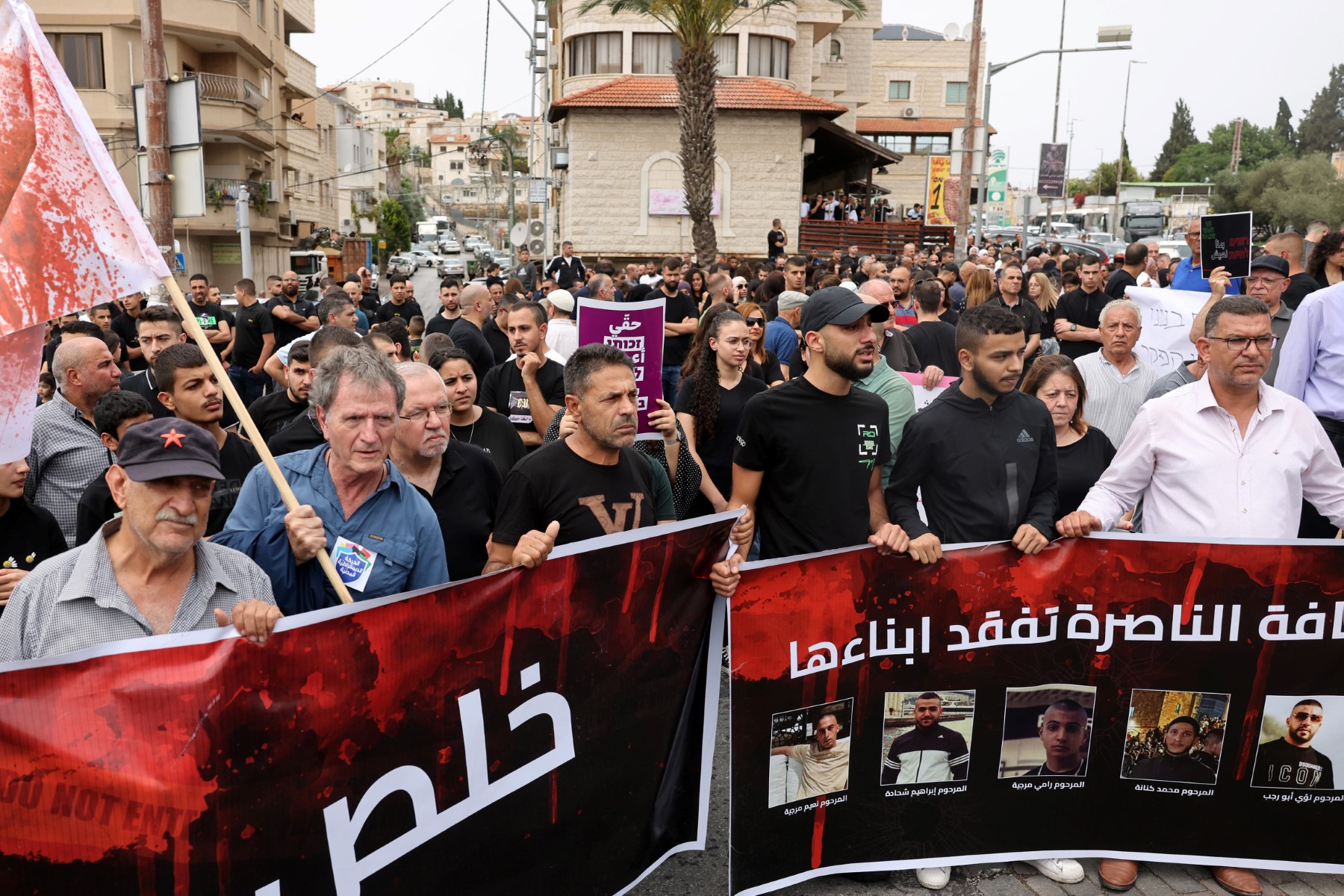
Demonstrators carry a banner bearing pictures of five Arab Israelis who were shot dead a day earlier, as they protest against their killing in the village of Yafa, west of Nazareth, on June 9, 2023. (Ahmad Gharabli/AFP)
Underworld syndicates have indeed come to dominate neighborhoods and sometimes entire towns, striking fear into residents that going to the police will put a target on their backs.
This intimidation is what made Zbedat’s move to shutter his franchise so notable. After he and his son Ibrahim announced the closure of their shops until further notice, other businessmen followed suit. Without meaning to, Zbedat sparked a general strike in the city, which had suffered a spate of near-nightly shootings by gangs seeking to extort shop owners by scaring them into paying protection fees.
“This is something that’s being organized from the grassroots,” said Abu Ras. “Arab leadership helped organize, but they stepped in only after we started to see grassroots organizing, especially in Sakhnin.”
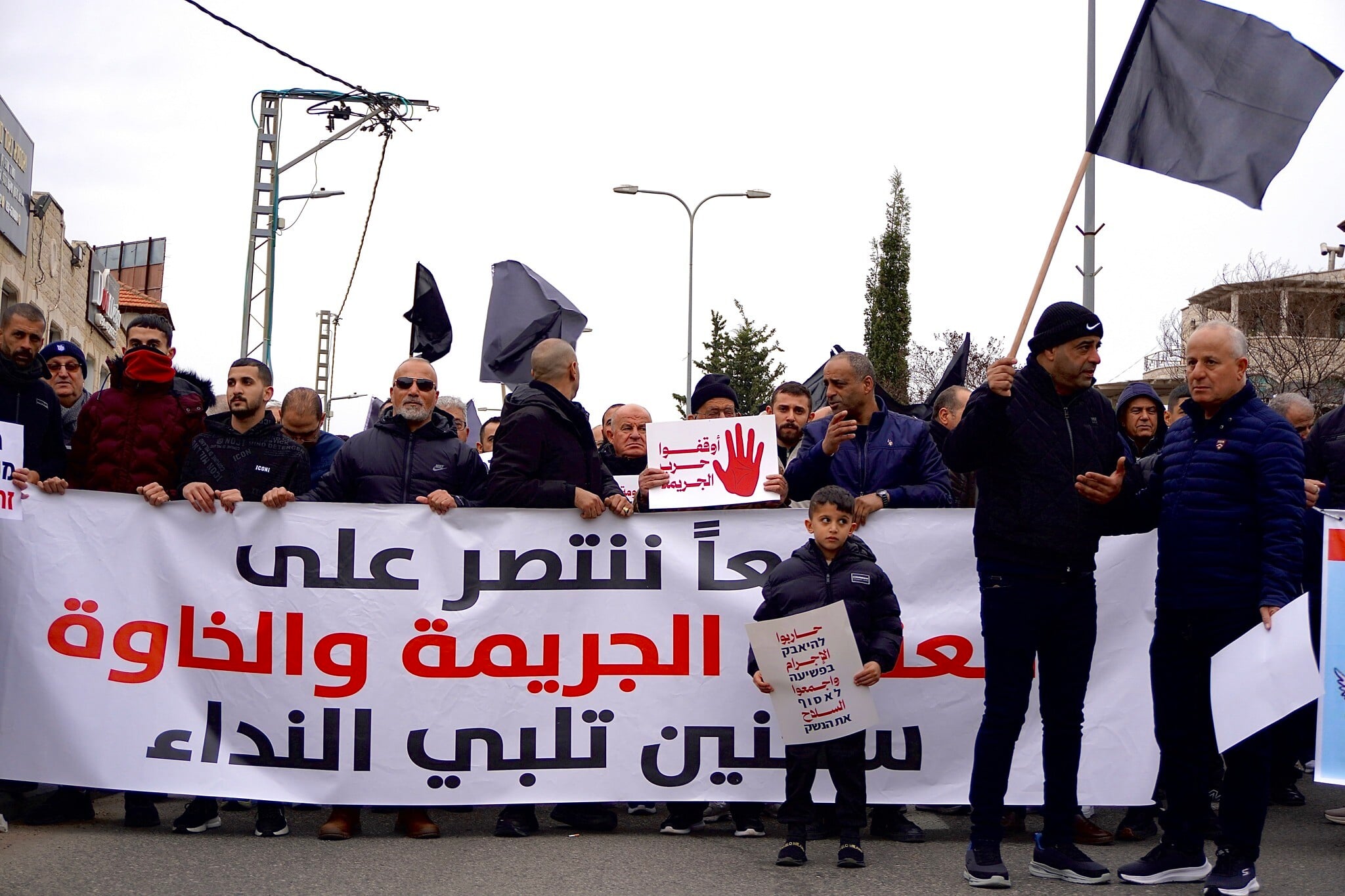
A child stands in front of a large banner that reads, ‘Together we will overcome violence, crime and extortion. Sakhnin answers the call,’ during a protest against the violent crime wave sweeping Arab society in Sakhnin, northern Israel on January 22, 2026. (Charlie Summers/Times of Israel)
The effort has become a major driving force in Arab politics. In the wake of the Sakhnin rally, the four main Arab parties involved in Knesset politics, Balad, Islamist Ra’am, secularist Ta’al and Communist Hadash, agreed to explore reuniting for upcoming elections, a move which could give Arab politicians significant sway in the political arena.
Yousef Makladeh, a prominent pollster who heads the Statnet research firm, told The Times of Israel that in the shadow of the Gaza war, Arab parties had focused less on crime, which he described as “the most painful issue” for the minority.
“Before, they focused much more on the two-state solution, on peace,” he said. But this approach was out of sync with most Arab citizens, many of whom feel they are risking their lives whenever they leave the house.
“Of course, this doesn’t mean that the Arab public wasn’t against the Gaza War,” Makladeh added. “But the moment that there was a ceasefire, the issue of achieving peace was immediately knocked lower in favor of the war against crime and gangs.”
According to the pollster, it is no coincidence that the initial spark came from Sakhnin, a political powerhouse in Arab society.
In the last elections, 68 percent of the city’s residents turned out to vote, markedly higher than Arab society’s average 53% turnout.
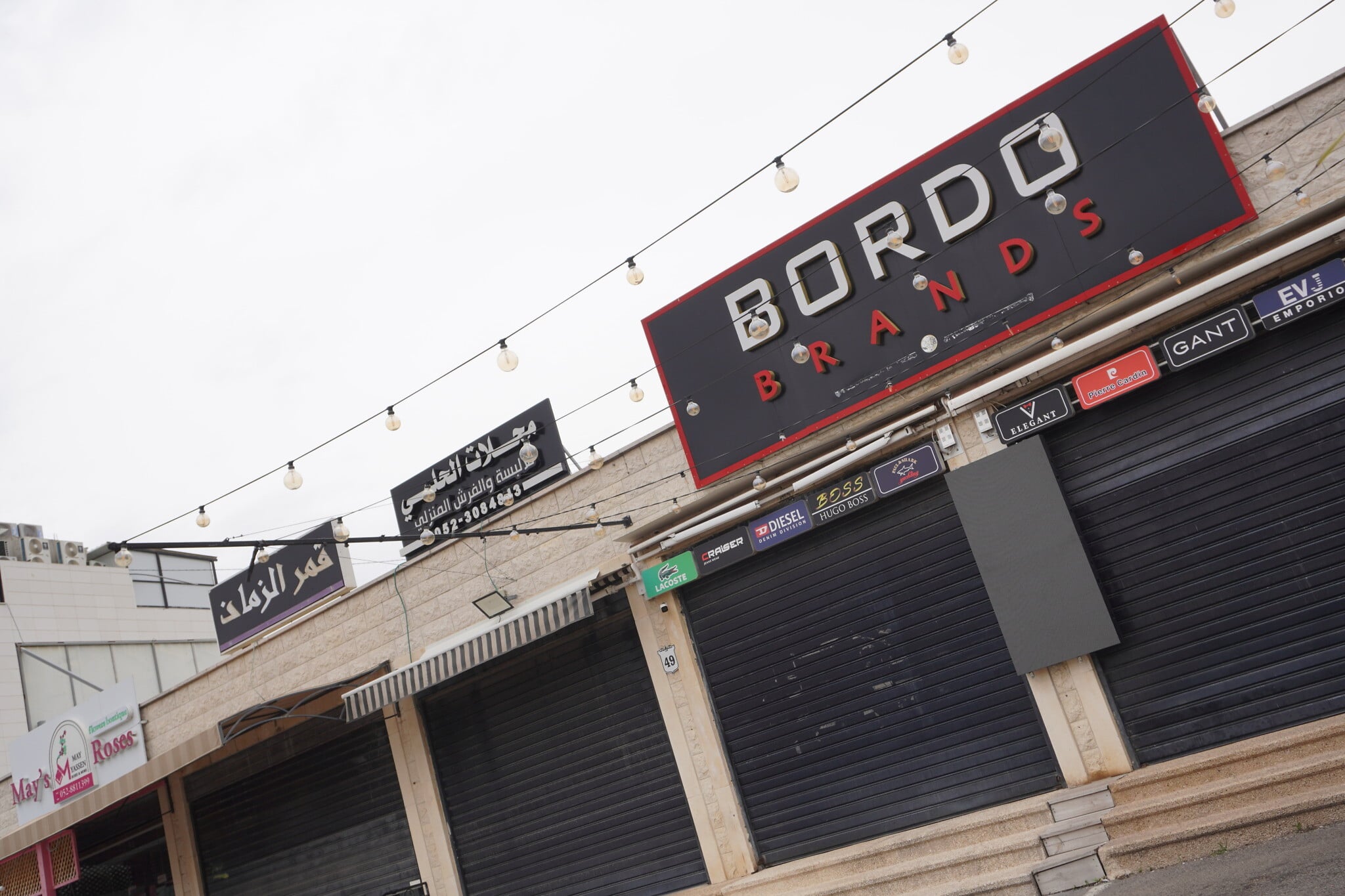
Shops in the northern city of Sakhnin remain shuttered during a nationwide strike in Arab society over police handling of violent crime on January 22, 2026. (Charlie Summers/Times of Israel)
The sudden shutdown of the city put pressure on Knesset lawmakers and communal leaders to act, Makladeh said.
This is when the High Follow-Up Committee, Arab society’s leading umbrella organization, stepped in, calling a general strike throughout the country. Arab cities and towns shut down nationwide, and tens of thousands flocked to Sakhnin for a massive march against crime.
Since then, daily protests have been taking place in Arab locales. In Tamra, worried parents marched to a police station after a shooting rattled a nearby elementary school, Arab students have been staging campus demonstrations and towns rocked by homicide are now striking the day after.
However, getting those protests to spark government action, Zahalka seems to have concluded, will mean bringing them outside of the Arab community. Unlike his erstwhile political colleague Mansour Abbas, who has sought gains for Arabs by offering his Ra’am party as a potential government partner, Zahalka is forging a different path, seeking to partner alongside those with the power to pressure the government from the outside.
Forcing the government’s hand
The Tel Aviv rally marked the first attempted foray into the Jewish mainstream by the High Follow-Up Committee, whose newly minted chief is now striving to turn the organization into a major political player.
Zahalka was elected as the organization’s chairman in November. He is the former head of Balad, whose members have been vocal in identifying with the Palestinian national movement, rejecting the Israeli left.
In the last election, Balad failed to cross the Knesset threshold, depriving the community of some four seats. Should the Joint List of Arab parties reunite, the faction will likely be part of a political juggernaut that could play kingmaker in coalition negotiations, giving it important leverage.
While the Saturday demonstration was focused on crime, Zahalka saw it as a way to help jumpstart Arab political participation after two years of relative silence during the war. “Civic solidarity,” he said, can extend to other issues as well that critics say have been neglected by the government, like education, welfare and town planning.
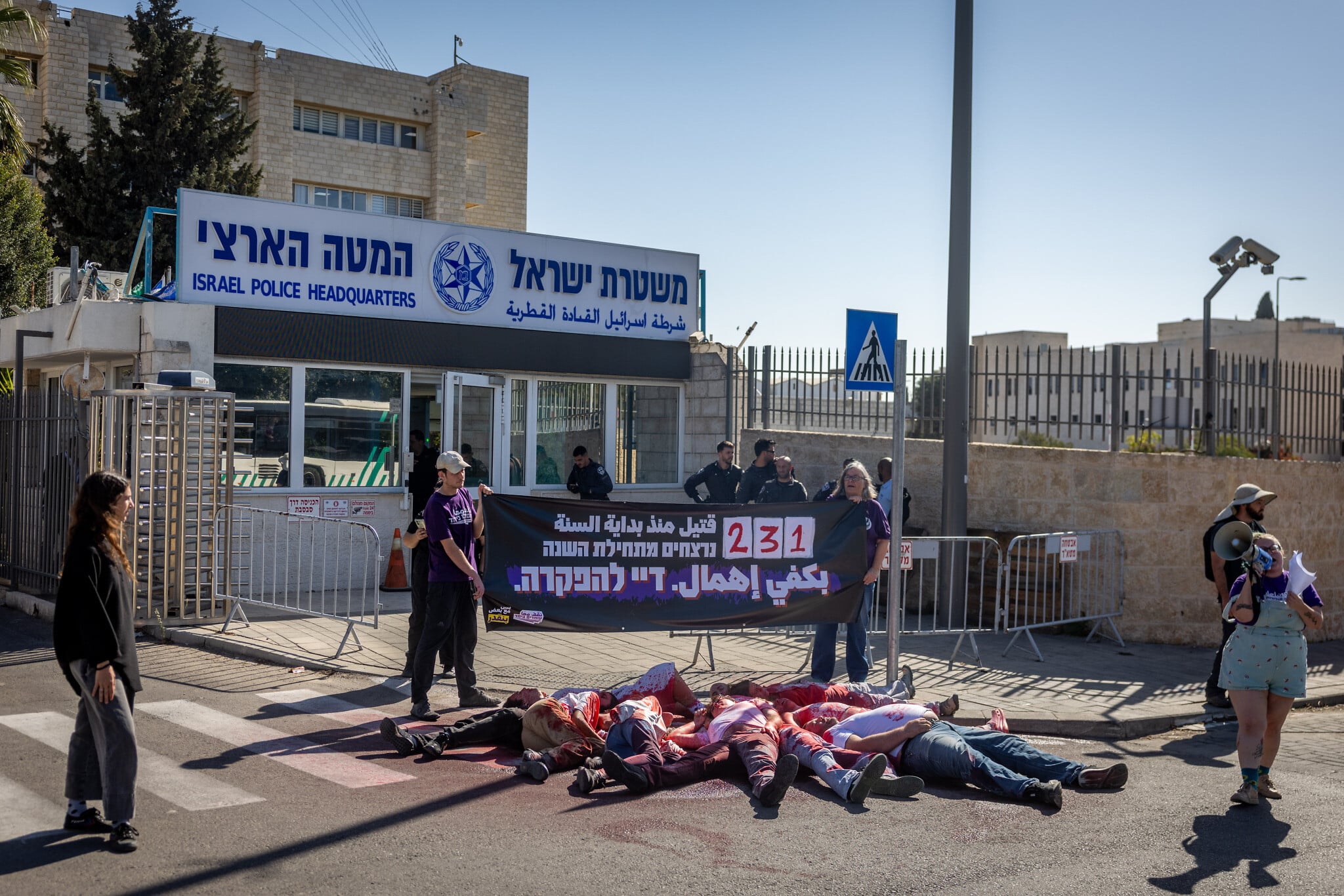
Members of the ‘Standing Together’ movement protest outside Israel’s national police headquarters in Jerusalem against rising violence in Arab communities in Israel, November 23, 2025. (Chaim Goldberg/Flash90)
“We want to leverage the Arab public against crime. This works in two directions, it is first off to exert pressure on criminal organizations. Second, to send a message to the government that there is an entire public crying out,” he told The Times of Israel this week.
“But we aren’t deluding ourselves. To try and speak to this government is like speaking to a wall,” he said.
Instead of trying to work political levers, Zahalka is hoping to “exert pressure and force the government to change its policy.” One of the ways to do this, “is to enlist the help of Jewish society in Israel,” he said.
Thus, the former Balad chairman, who didn’t shrink from haranguing Israel’s liberal opposition during his years in party politics, found himself onstage leading that same crowd in a Hebrew chant: “Enough of the violence.”
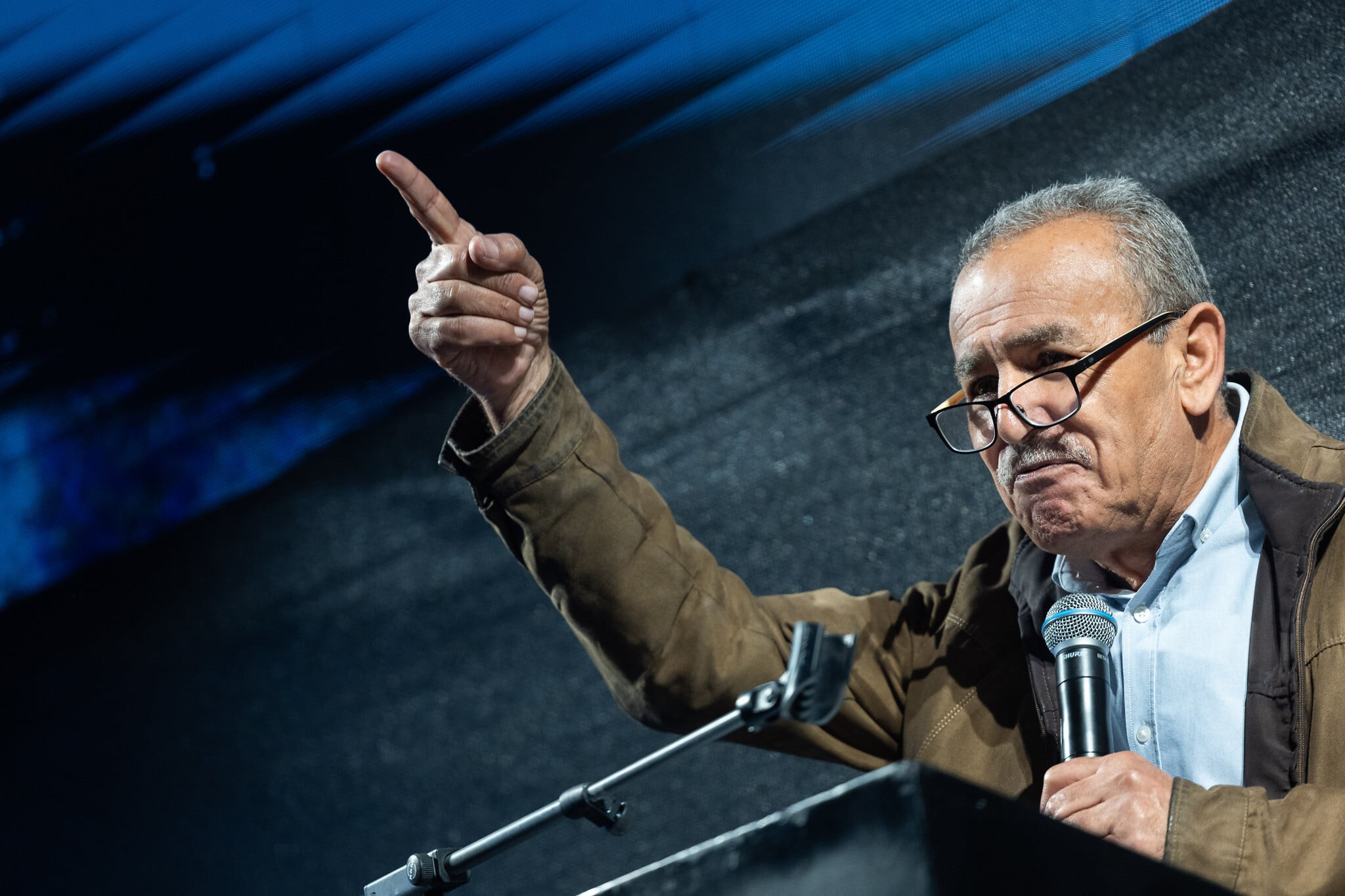
Arab-Israeli community leader Jamal Zahalka speaks at a protest against violence in the Arab community, in Tel Aviv on January 31, 2026. (Yonatan Sindel/Flash90)
But Zahalka stressed that he did not hide his politics from the crowd. “During the demonstration, I also talked about Gaza, a Palestinian state and an end to the occupation — and I was met with applause,” he said. “This is a demonstration that we can build on.”
Since he took over as chairman, Zahalka has been attempting to expand the High Follow-Up Committee’s prominence in Jewish society.
On his watch, the organization successfully convinced several Israeli universities to issue statements supporting the Tel Aviv protest and is moving toward Hebrew-language outreach on social media.
His long-term goal is to spearhead a three-day general strike over crime that includes not just Arab society, but Jewish organizations as well. He even hopes to enlist the participation of the Histadrut, Israel’s largest trade federation, but was uncertain about whether this would be feasible.
“There is major significance that Jews came to demonstrate under the banner of the High Follow-Up Committee,” Zahalka said. “Why did they come? Out of a sense of responsibility.”
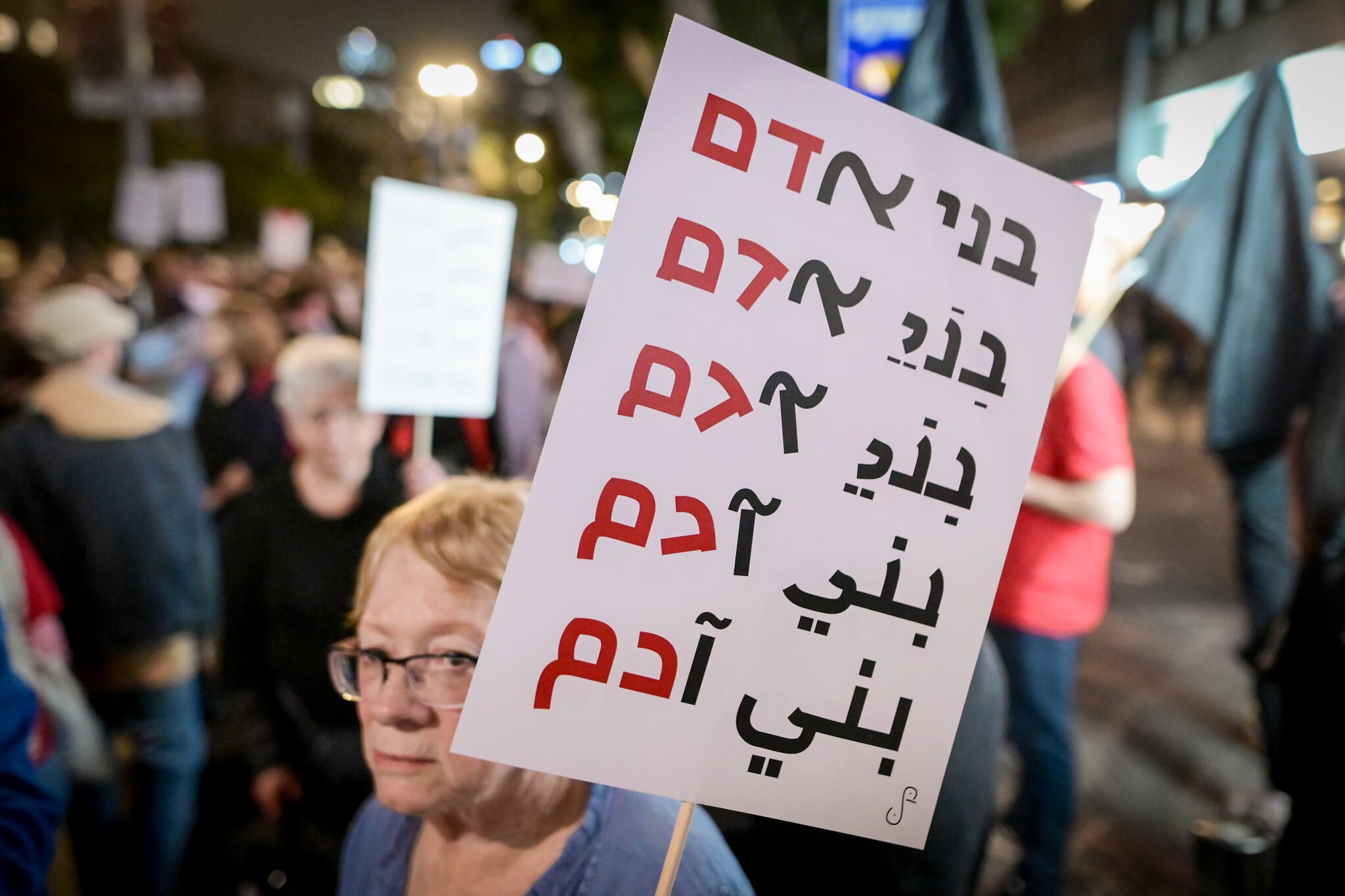
A woman holds a sign in which the phrase ‘human beings’ is written in Hebrew and Arabic, at a protest calling for action to stop organized crime in the Arab community, in Tel Aviv on January 31, 2026. (Avshalom Sassoni/FLASH90)
Elad, a Jewish protester from Rehovot, seemed to match Zahalka’s assessment. He said his connection to Israel’s Arab minority is not very strong, but stressed that “we need equality, rights for all citizens. They’re citizens like any other.”
Speaking to The Times of Israel in Tel Aviv, he drew a parallel between law enforcement’s failure to stem crime and the army’s inability to fend off the Hamas-led attacks on October 7, 2023.
“We have a government that is abandoning all of its citizens, which allowed for the murder of over 1,000 citizens on October 7 and has allowed for the murder of over 700 Arab citizens in crime,” he said, referring to the number of Arab homicide victims over the past three years.
“Of course, these are different, but they’re connected by the same thread — the government does not care.”
Rallying apart
The issue of crime in Arab society hasn’t gone entirely unnoticed by Jewish Israelis.
A number of Jewish-Arab groups, including Standing Together and the Abraham Initiatives, have attempted to raise awareness and protest over the issue, including holding rallies in Tel Aviv that featured mock funerals, and “blood”-spattered activists demonstrating in front of Netanyahu’s office.
President Isaac Herzog has also made the issue a top item on his agenda, calling it a national emergency. Last month, he went north to Sakhnin to meet with Zbedat, the strike’s initiator, and later Qasem Awad, a bereaved father who has become especially vocal on crime after the violent death of his son Abdallah, who was shot dead in early February last year.
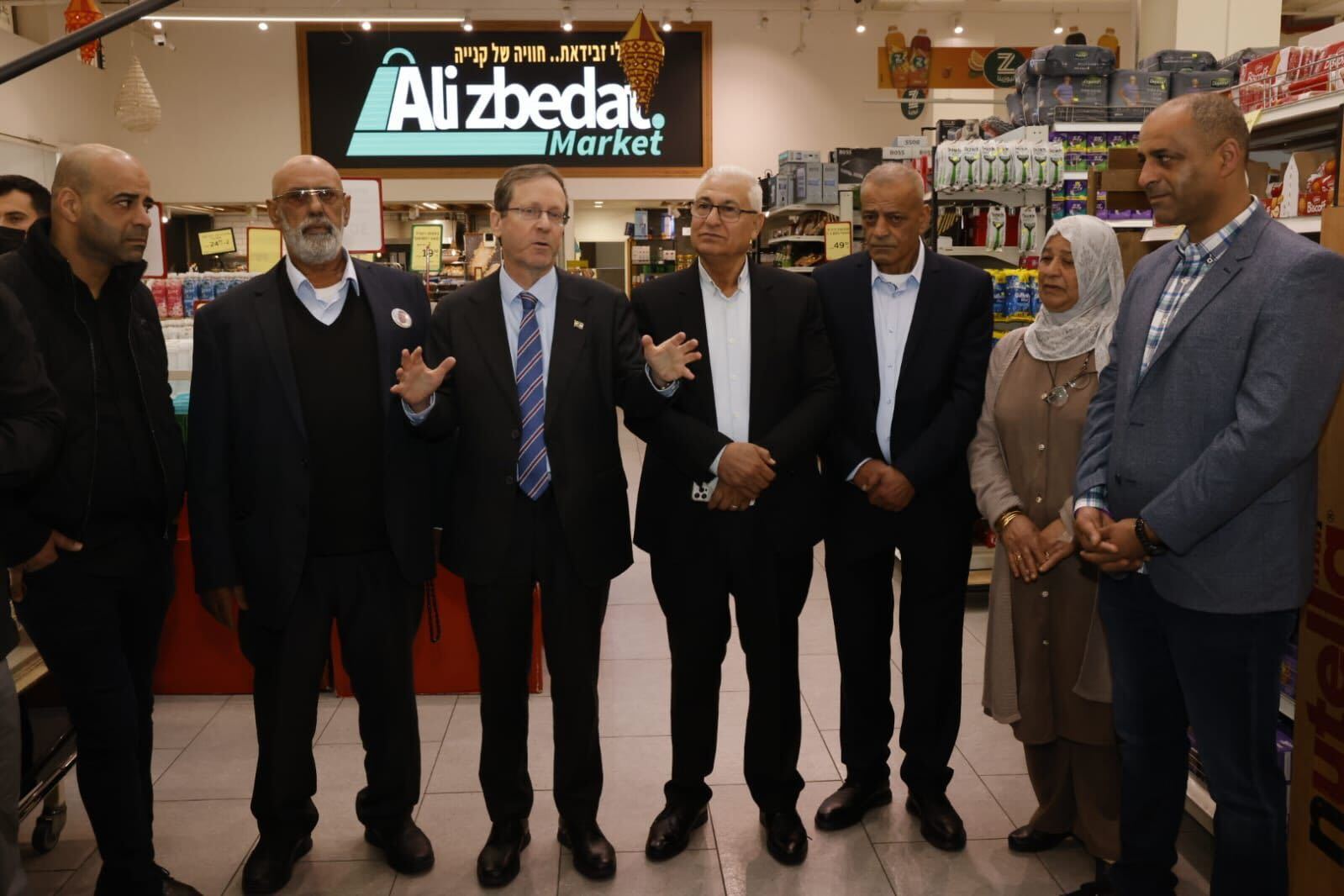
President Isaac Herzog (third from left) visits a supermarket owned by Ali Zbedat, who helped spark a general strike in Arab society against violent crime, during a visit to Sakhnin alongside the northern city’s mayor, Mazen Ghnaim (on his left), January 29, 2026. (Courtesy)
Awad is one of several bereaved relatives of homicide victims that Standing Together is attempting to organize into a cohesive political movement.
The group, which some view as a political threat to the established Arab leadership under the High Follow-Up Committee, took part in the Saturday night rally but has also organized its own protests, including blocking traffic on Tel Aviv’s Ayalon highway last month.
“I tried a full year of being quiet, I didn’t budge, but I cannot restrain myself any longer,” Awad told a Standing Together-organized conference at a Nazareth hotel last week, vowing to keep protesting.
Next week, the two groups will hold separate protests, underlining tensions between them. On Sunday, Zahalka’s group plans to rally in Jerusalem, busing in activists from around the country. Standing Together has organized a separate “day of disturbance” on Tuesday, calling on protesters to dress in black and take to the streets in nationwide demonstrations that evening.
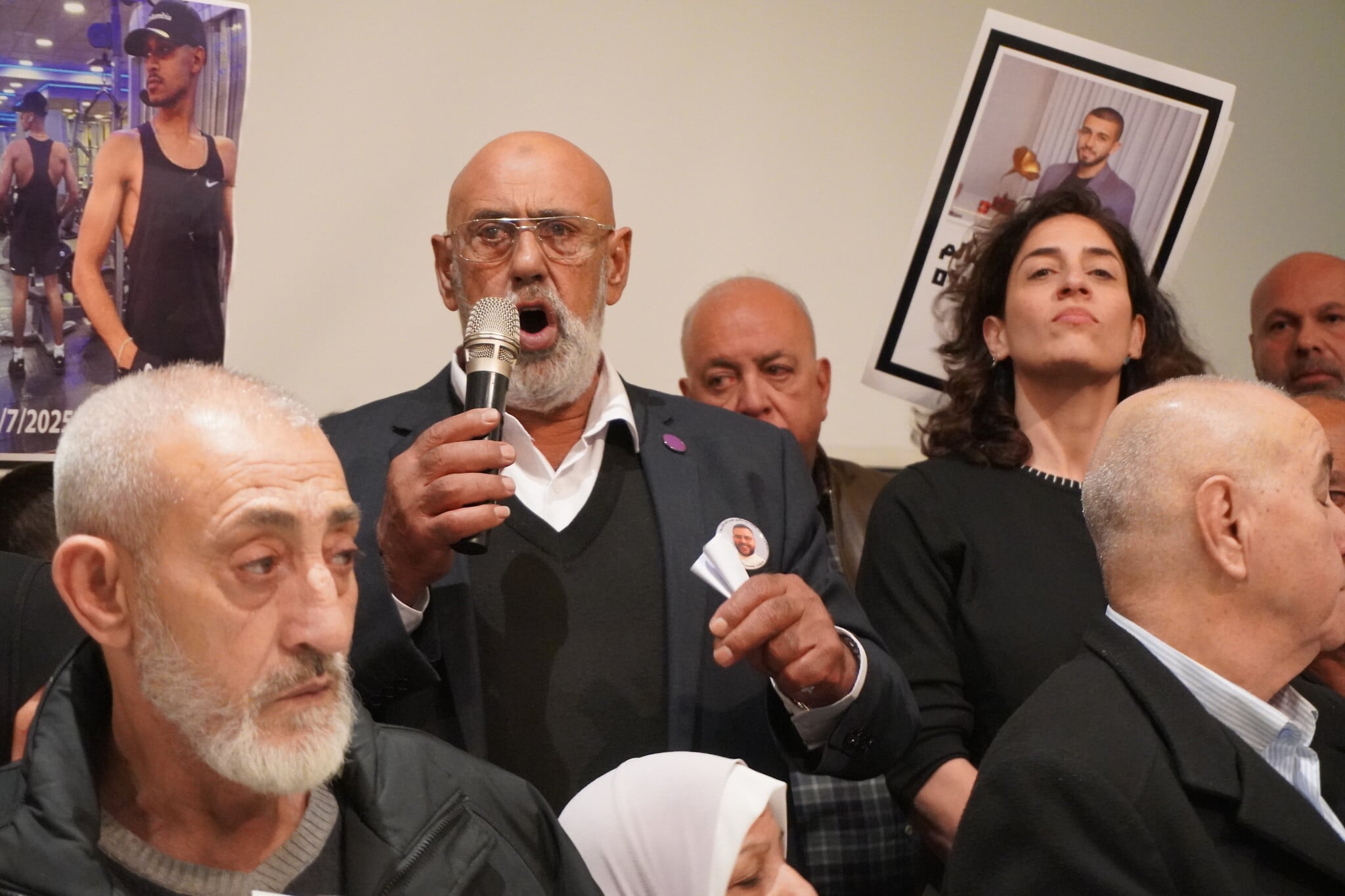
Qasem Awad, the father of Abdallah Awad, a pediatrician who was killed in Kafr Yasif, speaks in Nazareth about his son’s murder on January 29, 2026. (Charlie Summers/Times of Israel)
Nonetheless, Abu Ras expressed skepticism that the rare sight of a joint Arab-Jewish protest will occur again anytime soon.
“Israeli society is so segregated, the lack of trust between both societies is so deep,” he said.
However, he added that the sight of tens of thousands of Arab and Jewish citizens demonstrating peacefully in Tel Aviv could “legitimize cooperation between Arabs and Jews at the political level” among the opposition, breaking the longstanding hesitation of most Jewish-majority parties to partner with Arab factions. As elections approach, only Democrats chair Yair Golan has expressed support for such cooperation.
Speaking after the Saturday protest, Hadash-Ta’al chairman Ayman Odeh told The Times of Israel that the rally is a “turning point for the common struggles of Jewish and Arab society.”
Odeh, who for years has championed the idea of political cooperation between Arab citizens and Jewish liberals, said the demonstration could signal the start of reciprocal Arab participation in protests against Israel’s current right-wing government, a change from the status quo.
“It is also an opportunity to call on Arab citizens to partake in protests against the coup,” referring to the judicial overhaul, and more broadly, the policies of Netanyahu’s coalition. “This is a common struggle for all of us.”