
In late 2024, he had dug down to his brother’s apartment, which had been on the third floor, where he found the bodies of his brother and sister-in-law. He buried them in a temporary graveyard that residents of the area created during the war to hold their dead until they could be moved to a proper cemetery.
Since October, Hammad resumed digging. He drove down nine metres. Finally, he reached his own apartment, which had been on the ground floor. Now he has been focusing on clearing rubble from the eastern side, because that’s where he knows his wife was in her last moments.
“They were eating rice pudding in the living room,” he said.
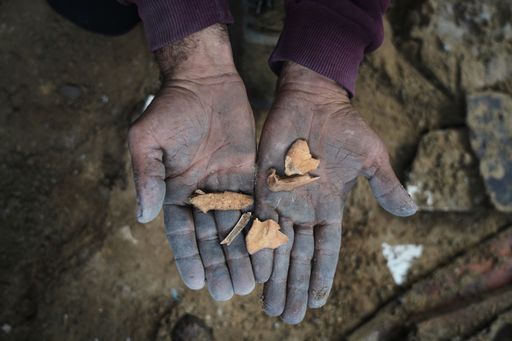
Sifting through the dirt with his sieve, he found tiny bone fragments. He shared images of the bones through WhatsApp with a doctor who said the fragments, which included a jawbone, appear to be for a small baby.
He believes it’s the remains of the baby girl they had been waiting for. They had planned to name her Haifa, after one of Hammad’s sisters-in-law who was killed by an Israeli strike just a few weeks before the strike on their home.
“All the baby’s clothes, a crib, and a room were prepared, and everyone at home was waiting for her arrival,” he said.
Discovering the bone fragments has brought him hope.
“There’s a clue that I’m reaching my wife and other children,” he said.
Once he collects enough remains, he said, he will give them a proper burial.
Related
61M tonnes of rubble
More than 700 bodies have been recovered from under buildings since the ceasefire began, Zaher al Waheidi, head of the Health Ministry’s records department, said.
Gaza has been suffering catastrophic consequences since Israel, backed by the US, launched its genocidal war in October 2023, which lasted two years and killed more than 72,000 Palestinians and wounded over 171,000
Israeli bombardment destroyed or damaged 81 percent of Gaza’s 250,000 buildings, including schools, hospitals and private houses, according to the UN’s satellite imagery analysis unit.
That has left Gaza as one of the most devastated places on earth with 61 million tonnes of rubble — about as much as 15 Great Pyramids of Giza or 25 Eiffel Towers by volume, according to the UN.
Digging out has been made more difficult by the lack of bulldozers and heavy equipment, which Israel often bars from entering Gaza.
Rescue work remains impossible in more than 50 percent of Gaza that remains under Israeli military control. There, the military has been systematically blowing up and bulldozing buildings, further reducing the possibility of finding any bodies lost inside.
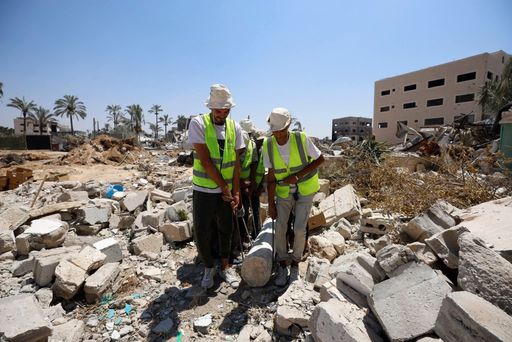
About two months ago, the UN and the Red Cross coordinated the entry of an excavator for the Civil Defence, said Karem al Dalu, a Civil Defence worker.
“But that’s not enough,” al Dalu said. He spoke as he and other rescue workers, using the new excavator, cleared the rubble of a building in Gaza City’s Sheikh Radwan neighbourhood.
The building was leveled by an air strike on December 11 2023, with some 120 people inside, said Rafiq Abdel-Khaleq Salem, whose immediate family was among those sheltering inside.
“Their only crime was that they didn’t leave, so they flattened the building over them,” he said.
In the days following the strike, 66 bodies were recovered, he said. Another 54 people remained buried under the rubble.
Rescue workers were finally able to come back to the site over the weekend. They managed to find 27 more bodies, but the rest remain missing, including Salem’s wife and their four children.
“It is a painful feeling,” he said. “I hoped to find my wife and children to bury them in graves and visit them.”