
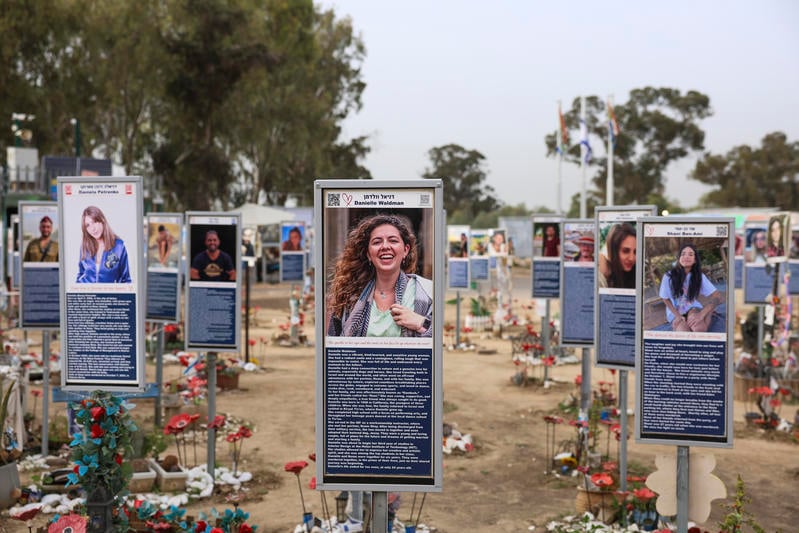
The word “massacre” was removed, at the request of the Prime Minister’s Office, from the title of a bill establishing an annual commemoration of the October 7, 2023, Hamas attack, outraging bereaved families who have accused the government of trying to “erase” history and evade accountability.
The stormy discussion was the latest argument in a long-running debate over how the attack will be investigated and remembered. Also on Wednesday, a Knesset committee discussed Prime Minister Benjamin Netanyahu’s controversial effort to create a politically appointed investigation of the October 7 attack, rather than setting up a state commission of inquiry, Israel’s highest investigative authority.
Yoel Elbaz, a representative of Netanyahu’s office, made the request to change the bill’s name at a discussion of the legislation in the Knesset Education, Culture and Sports Committee.
And a draft of the bill distributed to committee members and guests at the start of the session bore the title “Memory and Commemoration of the events of Simhat Torah,” with a previous title including the word “massacre” crossed out. (The attack occurred on the Jewish holiday of Simhat Torah.)
The bill, which combines two pieces of legislation, is meant to be a consensus measure in the normally fractious Knesset. It is supported by more than 80 of the 120 MKs, and proposes that a national memorial day be held for the October 7 attack, the worst in Israel’s history, on the 24th of the Jewish month of Tishrei.
Get The Times of Israel’s Daily Edition
by email and never miss our top stories
By signing up, you agree to the terms
That Hebrew date was chosen in a March 2024 cabinet decision, which the bill would effectively enshrine. On that date, according to the bill, a state memorial ceremony would be held. The bill would also create a commemorative body in southern Israel, where the attack took place, including a memorial site, museum, and archive.
But Elbaz sparked controversy during the committee discussion when he said that in describing the Hamas onslaught in which 1,200 people were killed and 251 kidnapped, the office preferred to use a Hebrew word that literally means “events,” but has also been used in the past to refer to riots. The reason, he said, is that October 7 “was not only a massacre — there was also heroism.”
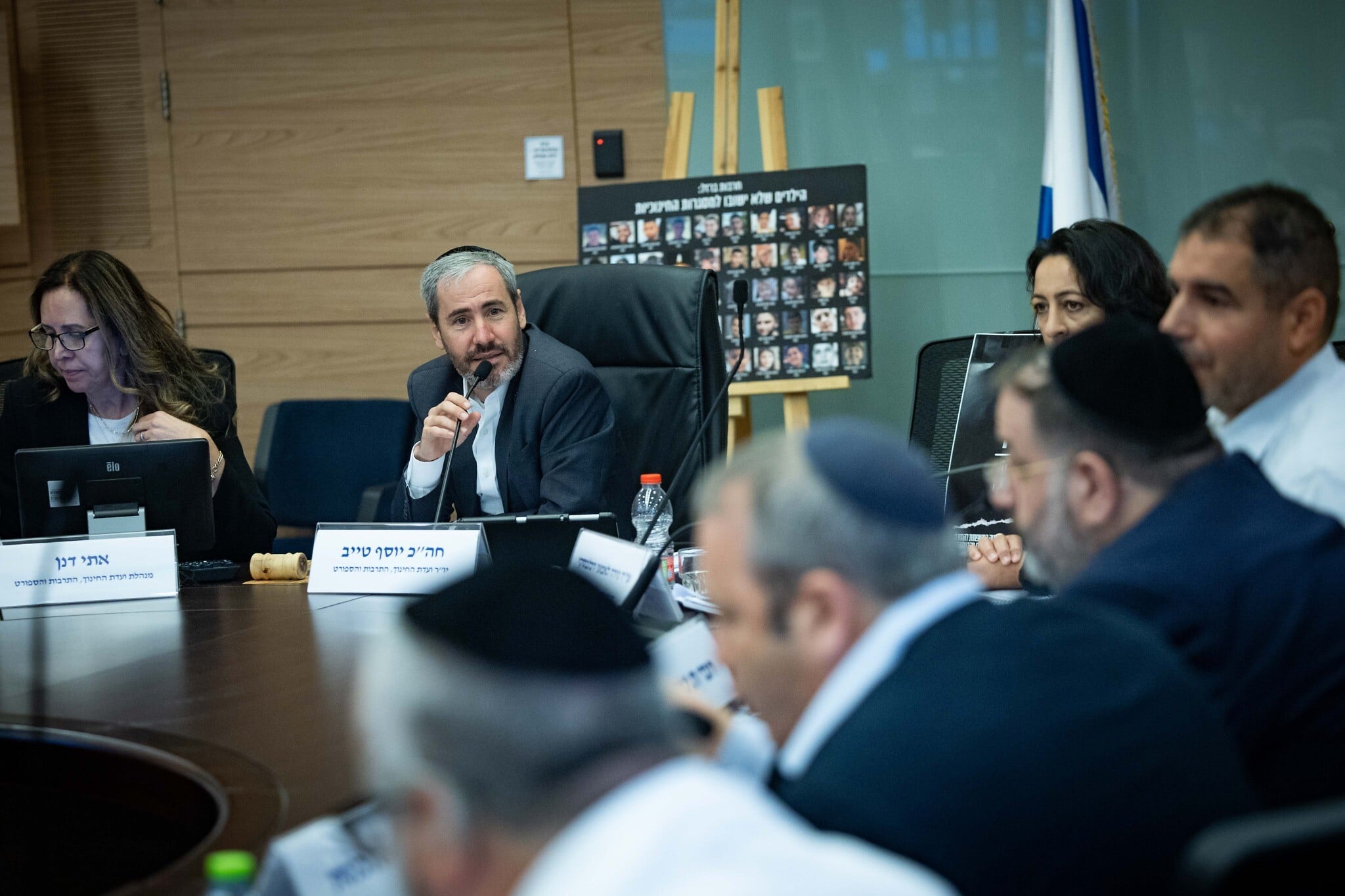
MK Yosef Taieb leads a Knesset Education, Culture, and Sports Committee meeting, July 7, 2025. (Yonatan Sindel/Flash90)
He added, “I don’t know to what degree people will remember the name of the law — they will rather remember the activities carried out by the authorities, which will also preserve the memory of the massacre.”
Initially, the acting committee chair, Shas MK Yosef Taieb, appeared to reject the idea, saying that “there will be no whitewashing of the issue.”
“We all know today that there was a massacre. My concern is whether our children and grandchildren will know that,” he said.
Still, the committee ended up deciding to accede to the request and remove the word “massacre,” though Taieb said the issue will be revisited before a final vote.
Bereaved families at the committee hearing expressed outrage over the removal.
“This law will pass over my dead body,” said Hila Abir, sister of Lotan Abir, who was murdered by Hamas terrorists at the Nova music festival. “Where is the death of our brothers and children? It was all erased!”
The October Council, representing families of those murdered during the October 7 attack, said in a statement that this is “the Prime Minister’s Office’s latest attempt to cover up the October 7 massacre.”
The statement continued, “We are here to state clearly: there was a massacre. We paid the highest possible price for it. We will ensure that everyone responsible is investigated by a state commission of inquiry and also pays the price.”
“No politician’s blood is redder than the blood of our children, our brothers, and our parents. Shame on you,” it continued.
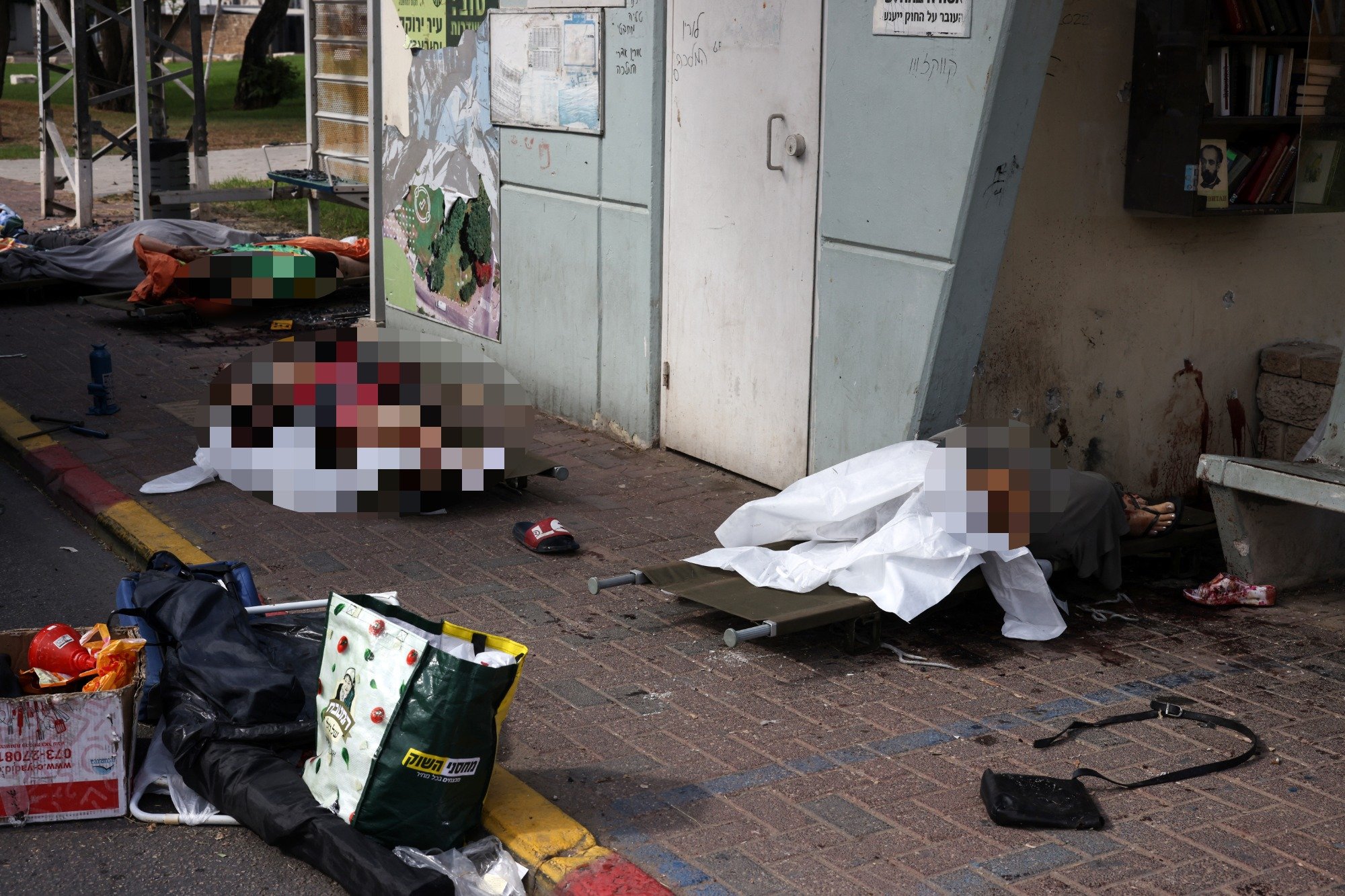
Bodies of slain Israeli civilians in the southern city of Sderot on October 7, 2023 following a massacre by Hamas terrorists. (Oren ZIV / AFP)
In response, the Prime Minister’s Office issued a statement saying that “contrary to recent reports, the bill explicitly includes the word ‘massacre,’” noting that the term appears in the text of the bill.
A PMO spokesperson later elaborated to The Times of Israel that the request to change the title came not as an attempt to exclude the word “massacre,” but rather to maintain the original name of the government’s proposal, which never included that term.
The bill that was advanced by the committee is a combination of two pieces of legislation: a private member’s bill whose title included the word “massacre,” and a government bill titled “Memory and Commemoration of the Events of Simchat Torah.”
“The Prime Minister’s Office is committed to a comprehensive and truthful commemoration of all aspects of the events, without distortion or omission, and is working to advance the bill in this spirit,” the PMO statement said.
But Abir linked the name change to Netanyahu’s efforts to set up a politically appointed investigation of the attack rather than a state commission of inquiry. She said the Knesset committee was “changing the narrative” before a commission of inquiry had been set up to establish what went wrong surrounding the attack.
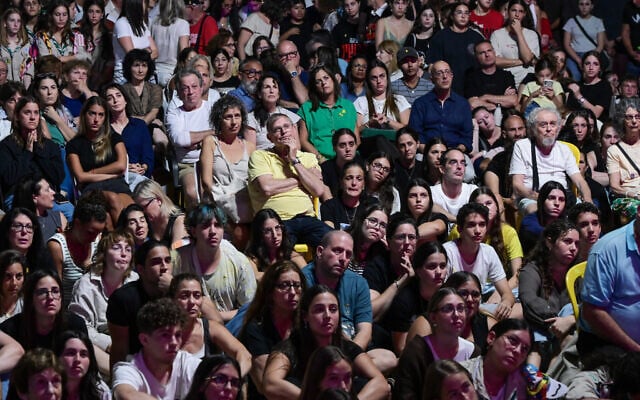
People watch on a screen the civilian October 7 memorial ceremony held at Hayarkon Park in Tel Aviv, during a gathering at Hostage Square in Tel Aviv, on October 7, 2025. (Avshalom Sassoni/Flash90)
Critics of Netanyahu’s alternative inquiry say that the government should not be in charge of investigating an attack that happened on its watch, a critique Abir echoed.
“It makes no sense for the Prime Minister’s Office to manage this event when it is the one preventing the investigation,” Abir said. “You’re leaving the cat to guard the cream?”
“We waited two and a half years, and we’ll wait a little longer until there is a worthy law that suits everyone, until there is a worthy investigation,” Abir said.
Legal adviser slams politically appointed Oct. 7 commission of inquiry
As the discussion unfolded at the Education Committee, the Knesset Constitution, Law and Justice Committee was discussing the proposal for a politically appointed inquiry, in the wake of criticism from committee legal adviser Gur Bligh.
In a letter sent Tuesday night to the committee and published Wednesday by the Knesset Spokesperson’s Office, Bligh strongly criticized the bill’s proposal to give the government the power to set the commission’s mandate and afford the Knesset the authority to appoint the commission’s members.
“The party that determines the scope of the inquiry — what will be investigated and what will not be — can influence the course of the inquiry even before it begins. Granting this authority to the government may undermine the purpose that the bill sets for itself: to bring about a full and independent investigation, based on parity between the coalition and opposition, and thus broad public trust,” he said.
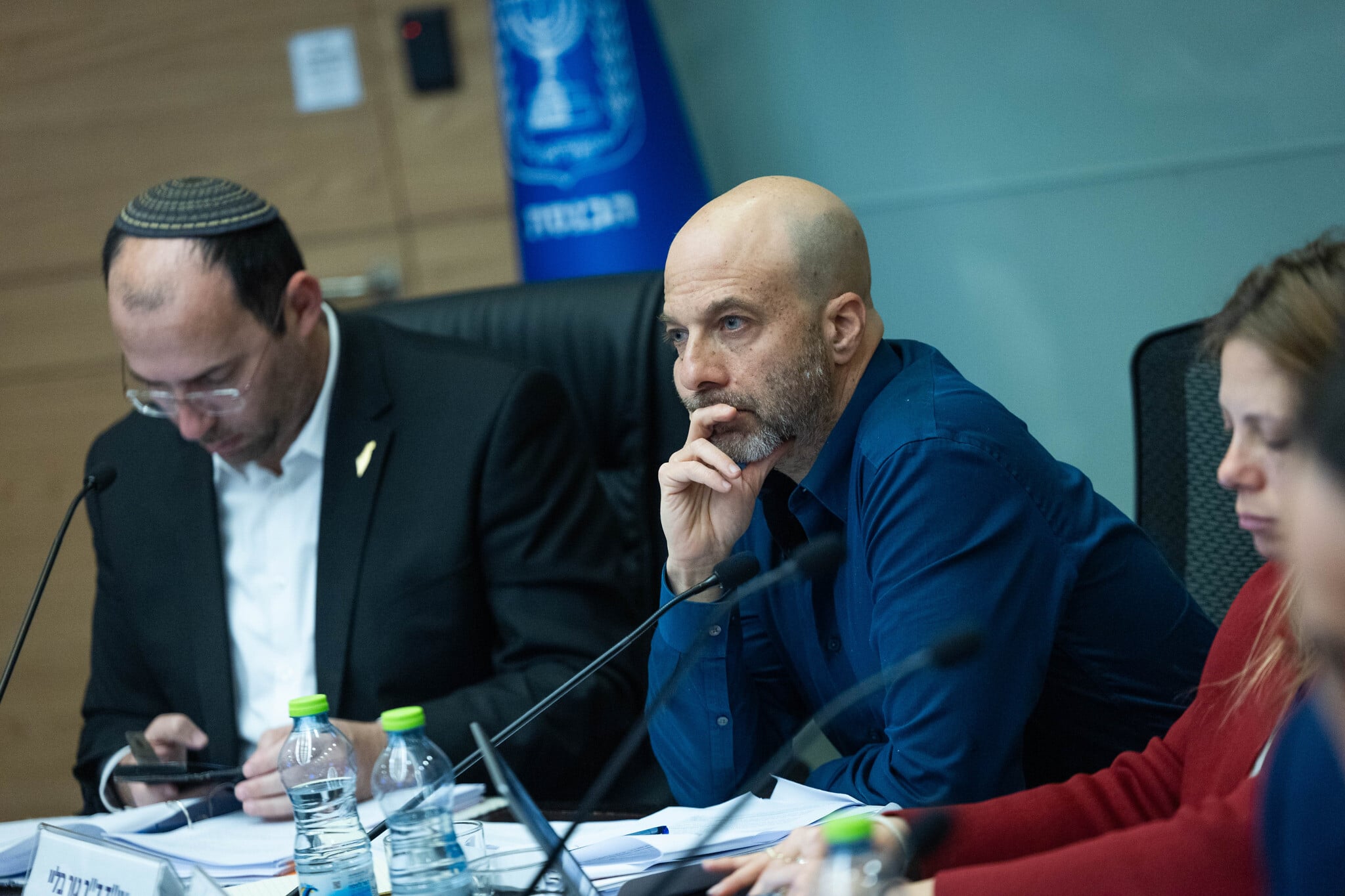
Knesset Constitution, Law and Justice Committee Legal Adviser Gur Bligh, center, and committee chairman MK Simcha Rothman attend a committee meeting in Jerusalem, February 11, 2026. (Yonatan Sindel/Flash90)
Netanyahu has long opposed the formation of a state commission of inquiry, claiming that because a state commission is appointed by the judiciary — whose powers his government has sought to curb — it would be biased against him.
The coalition is instead advancing Likud MK Ariel Kallner’s bill to set up a politically appointed probe instead. Most hostages’ families, and relatives of those murdered on October 7, oppose the legislation.
The committee’s legal adviser noted that historically in Israel, the government has not been given the power to define a commission’s mandate and that in the case of the US 9/11 Commission following the September 11, 2001, attacks, which the bill “frequently cited as a model,” the executive branch “had no role in defining [the mandate].”
Bligh also questioned whether the Knesset was the “appropriate body” to establish the committee and appoint its members, since the involvement of “political actors” could undermine public trust in the inquiry.
The bill proposed that the Knesset appoint the members of the committee leading the investigation by a vote of 80 members. If such a majority cannot be reached, half of the members will be appointed by the coalition and half by the opposition. Barring that, members will be appointed by the Knesset speaker.
With opposition parties having pledged to boycott the commission, the bill would effectively give the government exclusive power to appoint its members, with no input from the opposition.
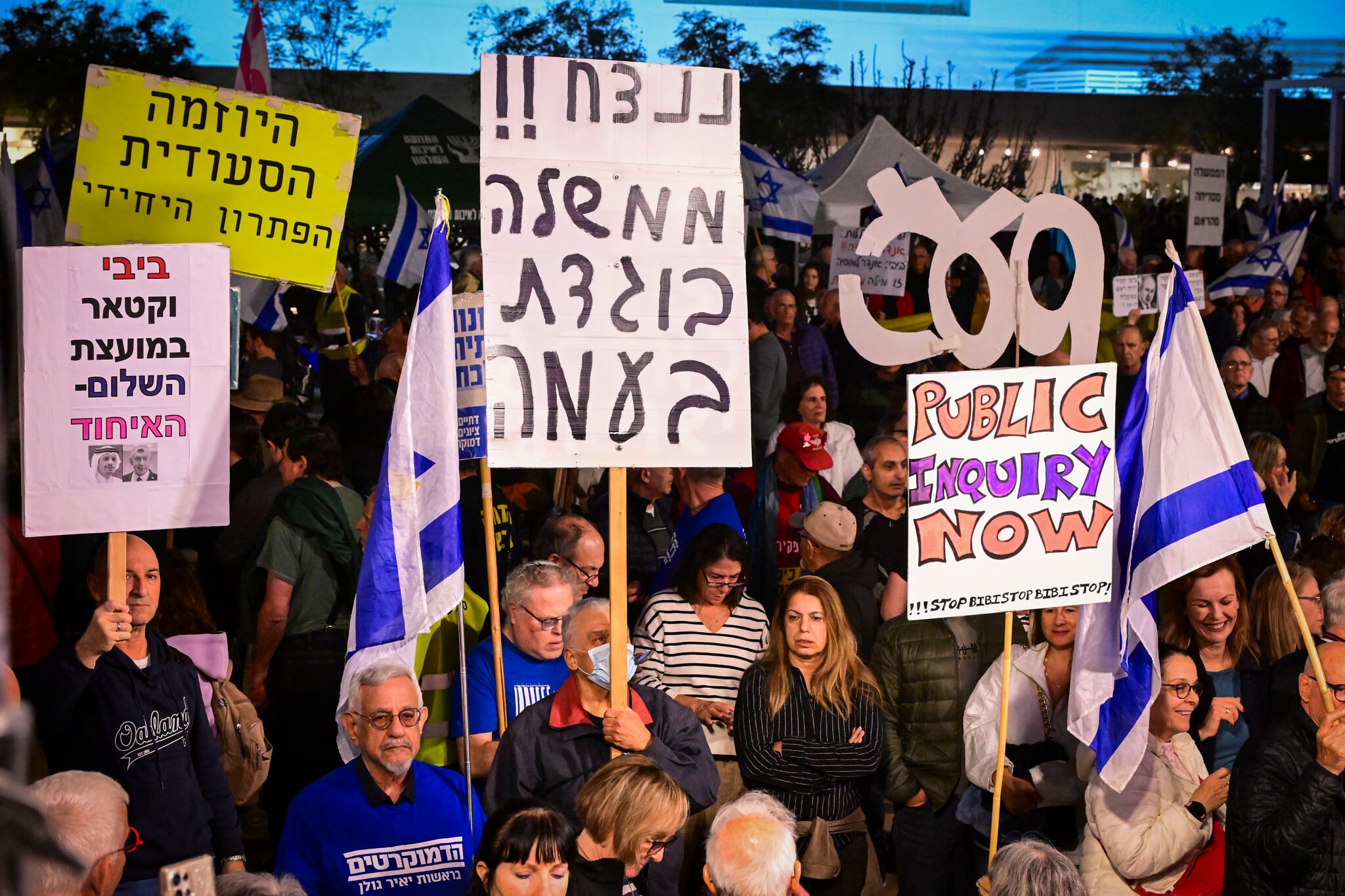
People attend a protest demanding the establishment of a state commission of inquiry into the October 7, 2023, attacks, at Habima Square in Tel Aviv, February 7, 2026. (Avshalom Sassoni/Flash90)
Because the proposed process for selecting the members ultimately gives power to the Knesset speaker — a member of the coalition — this “contradicts the objective of parity” and is “inconsistent with the declared purpose of the bill,” Bligh said.
The legal adviser also questioned why the body establishing the commission was different from the one defining the mandate of the commission, noting it may be unclear to whom the commission would report.
Netanyahu has never acknowledged direct responsibility for the failures surrounding October 7 and relentlessly attempted to place the blame on others, including political rivals and security chiefs.
His latest step on that front was to release 55 pages of answers he provided to an inquiry into October 7 by the state comptroller, in which he quoted selectively from government meetings to depict himself as supportive of aggressive action against Hamas. Subsequent media reports, however, have highlighted numerous occasions on which the prime minister was warned of Hamas’s plans for an attack, or reportedly declined opportunities to pursue a more forceful course against the terror group.
Nava Freiberg contributed to this report.