
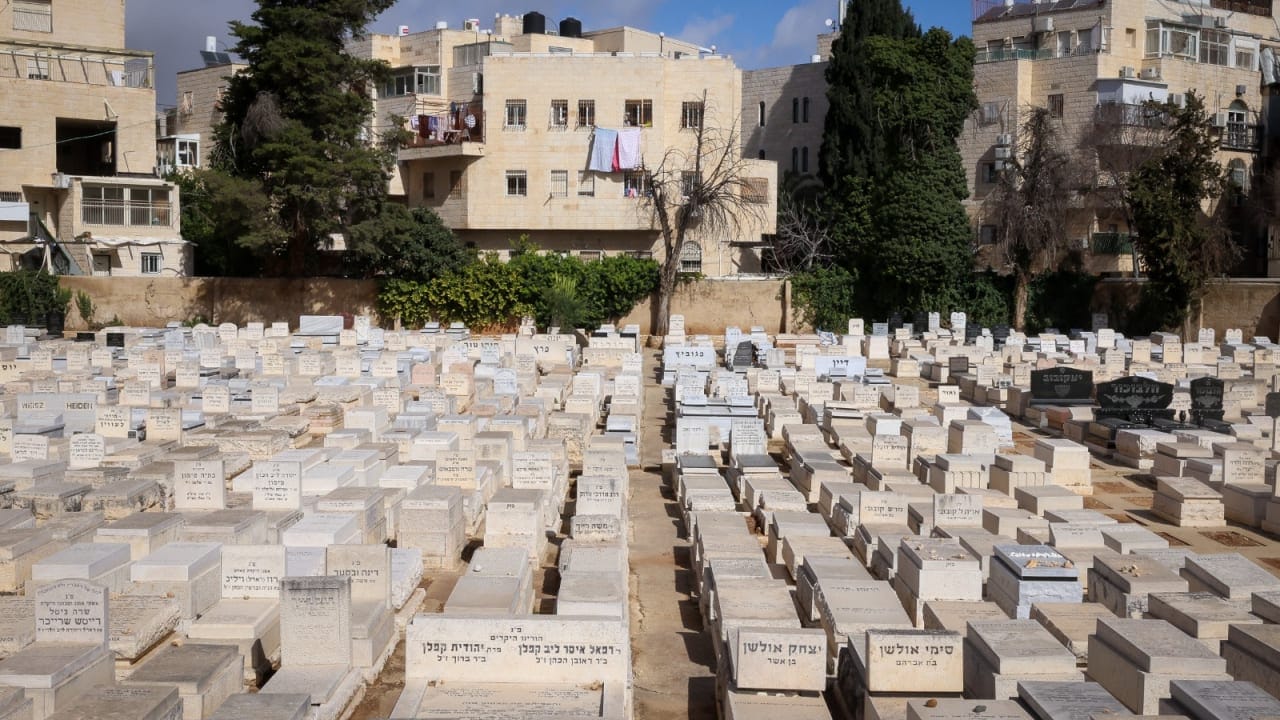
Israel’s generous burial policies and rapid population growth are leading to a burial grounds shortage worse than that predicted by the state comptroller in 2024, according to a study published by Prof. Alex Weinreb, chair of the Demography Area and Research Director at the Taub Center.
The population has been steadily rising at a rate of 1.9% to 2% for the last few decades and is anticipated to continue to increase at a more rapid rate, the report noted.
Around 311,000 women were aged 28 to 32 in 2023, considered at the peak of their childbearing years, and by 2036, this number is anticipated to rise by 23%. Even if the fertility rate drops substantially from an average of 2.9 children per woman to below 2.3, around 195,000 babies are anticipated to be born in 2036.
As a natural consequence of a higher birth rate and an average of 7,700 new migrants arriving each year, not including the children they are expected to have, the number of annual deaths is projected to continue rising, likely at a pace exceeding current levels.
While improvements in public health helped reduce mortality rates, the total number of deaths steadily increased at a rate of 1.5% to 2% per year, from 9,900 in 1953 to 23,000 in 1973; 32,900 in 1993; 41,100 in 2013; and finally 49,600 in 2023.

That steady rate is anticipated to increase to around 3.85% per year from 2025 until 2040, according to research based on calculations taking into account the elderly population and life expectancy. The annual number of deaths is projected to rise from approximately 45,000-50,000 to 100,000 by 2044 and to 200,000 by the 2080s.
Roughly 216,000 members of the 2024-2033 birth cohort will die before the end of the century, the report noted, in addition to the people born in subsequent decades of the century who may die at a younger age.
Israel’s growing number of cemeteries
The growing number of deaths has led Israel to increase the number of active cemeteries from 940 in 2019 to 1,090 in 2024, though the report has warned that Israel’s unique policies surrounding burial mean that soon it will not be able to keep up with the demand.
The Taub report noted three major factors that underlie the challenges faced by the Jewish state: religious and cultural norms vis-à-vis burial practices, scarcity of land, and demography.
Unlike in many Western countries, Israel’s population tends not to favor cremation. In both Islam and Judaism, cremation is banned, and some sects of Christianity advise against it.
Only 10% of Israel’s Jewish secular population would favor cremation over burial as the default practice.
In contrast, almost 100% of people who die in Japan are cremated, 80% in South Korea, and over 60% in the United States, Canada, and the United Kingdom.
Deviating from the norm, the standard type of burial in Israel is a single-plot burial, which generally can only allow for 300-370 graves per dunam (1,000 m²). Those advocating for this method of burial often note that it is unused land, often hills, which are converted to cemeteries, and so no real land is being lost.
Israel’s unique policy has likely widely contributed to this inefficient burial practice, the report noted. While European countries usually only cover the cost of the most basic of funerals, usually a cremation, the National Insurance Institute (NII) pays for the burial of every resident who dies in Israel, to be buried in their residential area and for the related services.
In contrast to Israel’s policy, burials in the West are often expensive and thus encourage families to choose more affordable options like cremation. Burial in Germany, for example, costs the equivalent of around NIS 52,000; and in London, in a recycled grave, the cost is between NIS 44,000 and NIS 102,000.
Further complicating Israel’s burial shortage is the permanent nature of Israeli resting places. In the West, graves are often provided on leaseholds of various lengths, with few able to afford the cost of perpetual rights. Graves are rarely given to a single body for more than a generation, the report noted.
The need for new permanent sites has often been an issue for Jewish cemeteries, especially in countries that restricted Jewish expansion. The famous Prague Jewish cemetery, in use from 1439 to 1787, saw mounds of earth piled over existing plots to bury more people. The result of this burial practice meant the site is up to five meters higher than the surrounding area and needs a retaining wall. A similar solution was adopted in the main Warsaw Jewish cemetery from after World War I until the 1930s, when people were buried in mounds layered over existing graves.
The “double burial” method effectively doubles the carrying capacity of a given piece of land to 600 graves per dunam for standard field burial, or up to 740 for intensive field burial. A third grave could potentially be added if the grave was originally dug deeper.
Another alternative burial style, the “condensed burial,” allows for people’s remains to be stacked vertically in a walled chamber or at a height, such as in a multi-storey cemetery like those in the Yarkon Cemetery in Gush Dan and in the main Jerusalem cemetery on Har Ha’menuchot. This is notably more efficient than the single plot method currently preferred. While this method makes more efficient use of land, it ultimately requires more substantial infrastructure. For example, the burial chambers underneath Har Hamenuhot Cemetery in Jerusalem cost NIS 300 million to build for around 40,000 burial spots at a rate of NIS 7,500 per spot.
Though not yet popular in Israel, an ancient method of burial has also regained popularity in the West. More people are using the “bone collection” method, in which remains are unburied after a year in a cemetery and moved to a family collection area, such as a tomb.
This method can hold 3,000 people per dunam and was a popular practice from the First and Second Temple period (1000 BCE to 500 CE).
Weinreb stressed, “Israel faces a choice between adhering to existing burial patterns that are not sustainable, in which ‘the dead take from the living,’ and adopting burial solutions practiced in antiquity – Sanhedrin burial (niche burial) combined with Land of Israel burial (the custom of bone collecting).
“It is important to understand that this issue has far-reaching social and economic implications, and that without a deep shift in outlook and long-term strategic planning, we will, before long, face a severe crisis whose consequences will affect not only us but also future generations.”
Solving Israel’s burial place shortage is not simple, the report noted. The privatization of burial services may encourage more efficient land use, but it would also enshrine socioeconomic inequalities and force families to face the brunt of the cost for burial.
Another option could be to relax the guarantee that a burial will take place close to a deceased person’s residence, which would allow burials in less inhabited areas of the country. This could also work as an economic boost for the periphery and justify extending public transport routes.
Finally, the report suggests Israel could adopt a Venetian-style use of land. The main cemetery servicing Venetians since the 19th century has been on the Isola di San Michele, a small island to the north of the main Venice Island. If Israel could construct an artificial island off its coast, or extend land as it did to the Yovel port in Ashdod, new burial space could be created.
The report concluded that a serious cultural change in how the deceased are buried in Israel is essential, especially given that burial customs developed in the Jewish Diaspora are unsuitable for Israel.
Sustainability is rooted in ancient Jewish tradition, and Israel’s growing population means practices need to be revisited to cope with the incoming grave shortage.