
When Sivan Maman Avneri brings her children to daycare in Mivtachim, she passes a roundabout that honors the heroes that fell defending the agricultural community in the southern Gaza envelope on Oct. 7. The roundabout brings back the painful memories of that day, including that of the local security squad and an off-duty IDF soldier who died fighting the Hamas terrorists. Among those killed in the heavy gunfire was Avneri’s beloved cousin Tal Maman, a local farmer and father of three.
But in the past month, thanks to the dozens of beautiful red tulips that are blooming, Avneri feels somewhat differently.
“There’s usually a heaviness in this roundabout. It’s a place that’s hurting with all these memories,” Avneri said. “But now, all these colorful red tulips surround the memorial at the roundabout, and they create a different kind of atmosphere.”
On Oct. 7, some 25 Hamas terrorists infiltrated the Mivtachim area, but thanks to the quick actions of the local security squad, a greater massacre was prevented. The combined five-person security squads made up of mostly farmers from the adjoining agricultural communities of Yesha and Mivtachim were able to fend off the terrorists for several hours, engaging in heavy gunfire near the roundabout and the senior citizens’ center in Mivtachim. The five were all killed before further Israeli reinforcements finally arrived.
The memorial in the Mivtachim roundabout displays the names of the fallen: Dan Asulin and Tal Maman of Mivtachim, and Lior Ben Yaakov, Gil Avital, and St.-Sgt. Itay Nachmias of nearby Yesha.

“The other day, I drove by the roundabout with my kids, and I thought how much these tulips bring some life to the sadness and mourning here,” said Avneri, a married mother of three who lives with her family in Yesha.
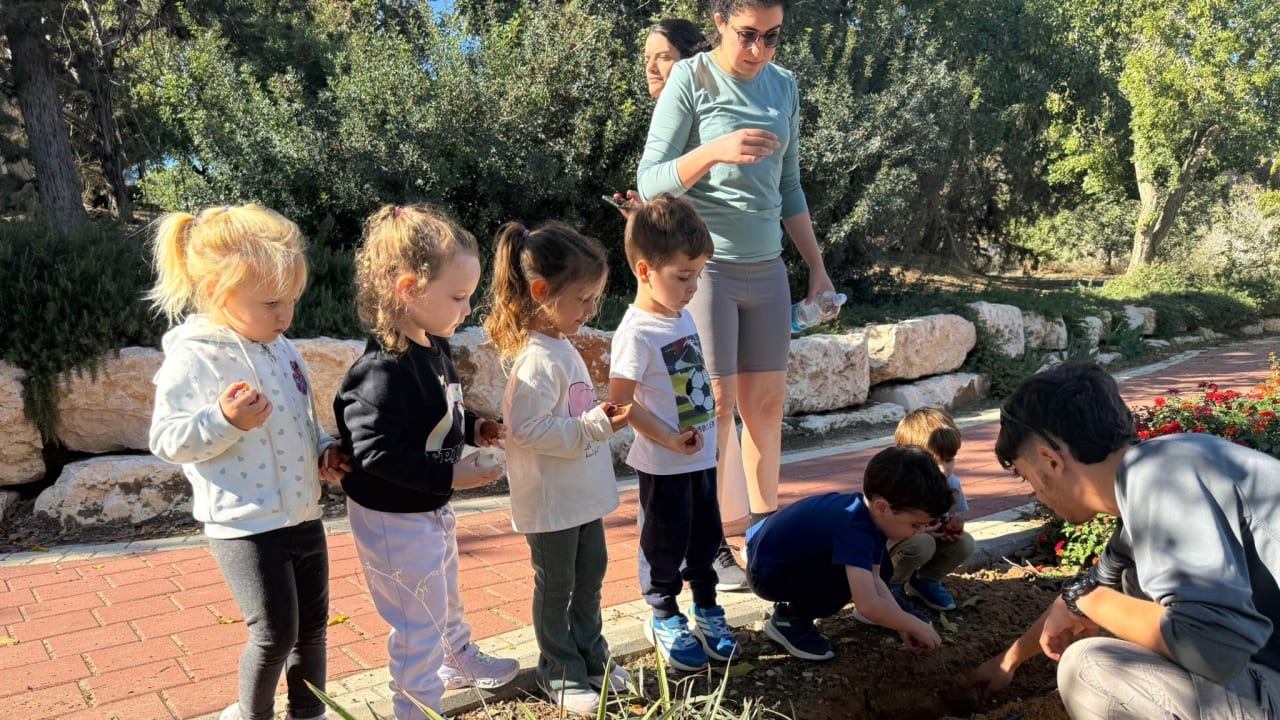
She recalls getting a text in the community WhatsApp in November calling for volunteers to help plant the dozens of tulip bulbs that had arrived from Holland.
‘Tulips have brought us some color and hope’
“My daughters went along with their grandfather to help out with the tulip planting in November,” she said. “These blooming tulips have brought us some color and hope.”
The Tulip planting is part of an annual project spearheaded by the Dutch-based Christians for Israel organization, founded in 1979, with branches in 40 countries and made up of supporters from all Christian denominations.
In November 2025, the organization sent 150,000 tulip bulbs to be planted across Israel. Now, around 50,000 tulips are blooming in the communities along the Gaza border. The Israeli coordinator for the project, Shirley Katzir, told the Magazine that the bulbs were planted in 25 communities in the Gaza envelope, including schools and playgrounds.
“The impact of this project on the residents is immense. Every year, the reactions are so moving and continuously surprising,” said Katzir, who has volunteered her time to organize the Dutch delegation’s visit to Israel and the tulip planting for two decades. “This is an incredible experience of love and giving, which these flowers create year after year.
“The donors come to us from a place of deep connection and a desire to support, strengthen, and be partners in building the country,” she added.
While the project has been going on for the past 25 years, Leon Meijer, the executive director of Christians for Israel International, said that since Oct. 7, the project has given special emphasis to areas in the North and the South that have been impacted by the war.
“In 2024, when we visited Israel, we traveled to Majdal Shams and donated 15,000 tulips bulbs, which were planted there. We talked with the parents who lost children in the rocket attack on the soccer field,” he recalled.
“We also visited Kibbutz Be’eri that year when the Israeli hostages were still held in Gaza. Our contact there asked that we plant the tulip bulbs in the form of a heart at the entrance of the kibbutz so that the hostages would see the tulips when they would return to the kibbutz. It shows just how resilient the people of Israel are. They never gave up the hope that their loved ones would be freed,” he commented.
“I believe that the tulip project is even more meaningful now,” Meijer told the Magazine. “Many Israelis that we encounter when we visit feel that the world has forsaken them. We see how touched people are by the tulip donations and that there are Christians who support and love Israel.”
He said that since Oct. 7, Dutch contributions to Israel have only increased, although support sometimes comes at the cost of personal familial relationships because of the relentless media reports and news coverage in the European media that are intensely critical of Israel. “Family members and friends might look at an Israel supporter in their family more suspiciously now. People are more aware of what it means to support Israel; it’s not always a well-received decision among other family members.”
The Dutchman, an avid marathon runner, said that it was his wife who initially got him involved with Christians for Israel. “We have two teams that visit Israel every year. We visit schools, kindergartens, retirement homes, hospitals, army bases, and communities along the border, as well as in Judea and Samaria.”
Meijer said that supporters of Christians for Israel donate around 20 euros for a bag of tulip bulbs to be sent to Israel. Each bag has the name of the donor printed on it. A delegation of Dutch supporters visit Israel every year and divide into two teams, which distribute the bulbs to regional councils and municipalities across the country.
“We take the time to get to know the locals and plant the tulips with them. This creates a very different kind of conversation. There’s something about bending your knees and digging into the soil that creates a different kind of conversation with people,” Meijer said. “For me, the tulips show that the Jewish people will not be uprooted again. The flowers have taken on a deeper meaning. There’s something Zionistic there.”
For Avneri, that conversation means a more hopeful future for her children. “When we look at the tulips, it gives me hope that maybe our children can have a brighter future here,” she said. After Oct. 7, the Avneris, like many families from the Gaza border area, had to relocate elsewhere in the country until they could return to their home. The family finally moved back to Yesha last August after living for nearly two years in Midreshet Ben-Gurion near Kibbutz Sde Boker.
“It feels good to be back here,” she said. “I was apprehensive at first, but now I know it was the right decision to return to where I grew up, where most of my family still lives, and raise our children here.”
The writer lives with her family in Midreshet Ben-Gurion, where she works as an English teacher and writes in her free time. She made aliyah from Calais, Maine, in 2004.