
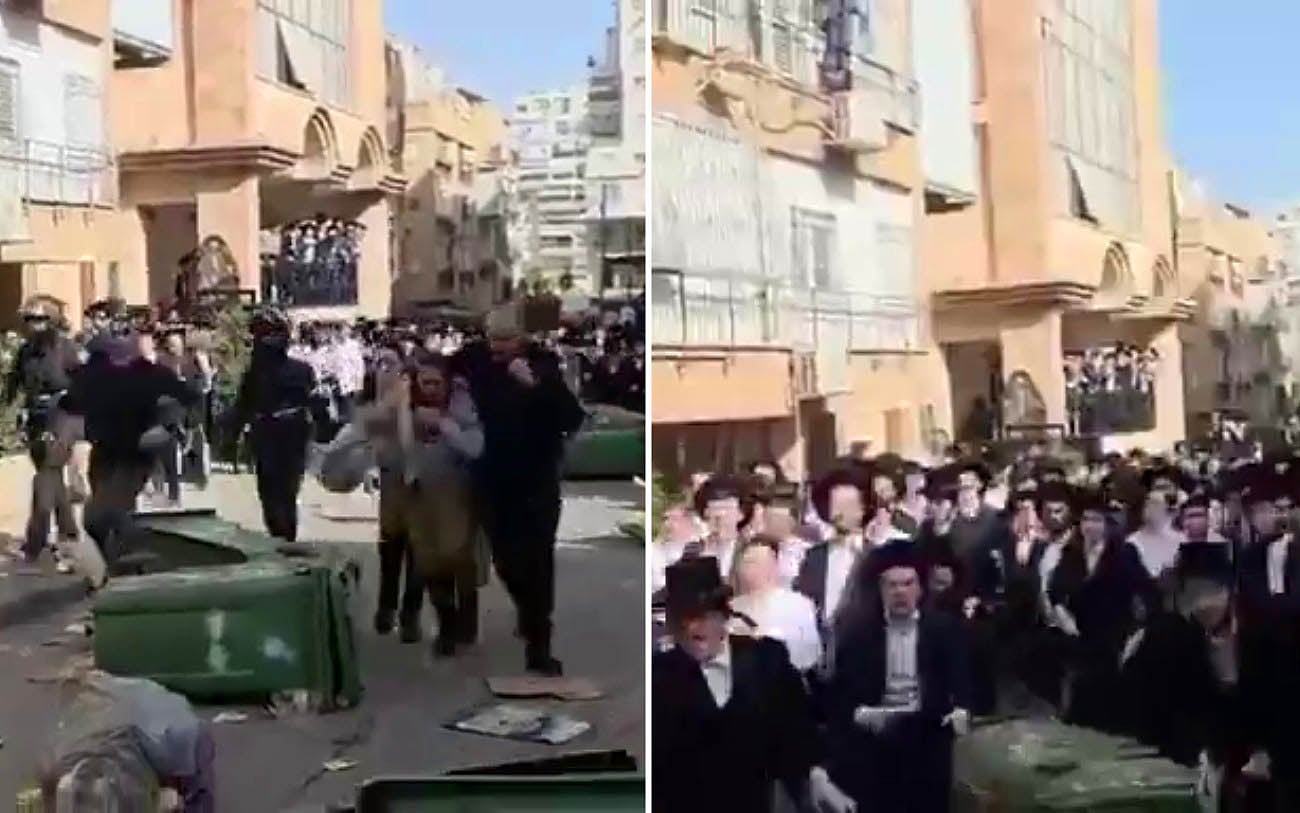
Two female soldiers came under attack Sunday afternoon by hundreds of ultra-Orthodox men in Bnei Brak, who chased after the pair, as police spirited them out of the Haredi city.
In staggering footage of the attack, a handful of officers were seen shielding the two servicewomen as they fled a Haredi mob thronging the street, which was littered with garbage and overturned garbage dumpsters.
The servicewomen, squad commanders at the Education and Youth Corps, had been on an official home visit to one of the soldiers in their unit when they were confronted by the mob. Contrary to some claims, they were not members of the Military Police.
The two were forced to hide behind dumpsters, while police rushed to the scene on foot. While officers left their vehicles unattended, rioters overturned a patrol car and set fire to a police motorcycle.
One of the servicewomen told the Walla news outlet that she had asked her commanders not to send them into the city, but was given no choice. The pair had entered wearing skirts and left their weapons at home so as not to provoke residents.
Get The Times of Israel’s Daily Edition
by email and never miss our top stories
By signing up, you agree to the terms
On Sunday evening, IDF Chief of Staff Lt. Gen. Eyal Zamir spoke to the pair of young women, lamenting the “intolerable reality” in which the attack took place.
“A reality in which IDF soldiers, men and women, cannot move freely within the State of Israel is an intolerable reality that must be addressed,” Zamir told the servicewomen. “We will not accept harm to our soldiers, and I expect that the law will be fully enforced against those who harmed you.”
The crowd continued to wreak havoc after the soldiers were rescued, throwing stones, burning dumpsters, and attacking law enforcement at the scene. Large police forces were deployed to the area, including mounted officers and riot police, who used stun grenades to quell the upheaval.
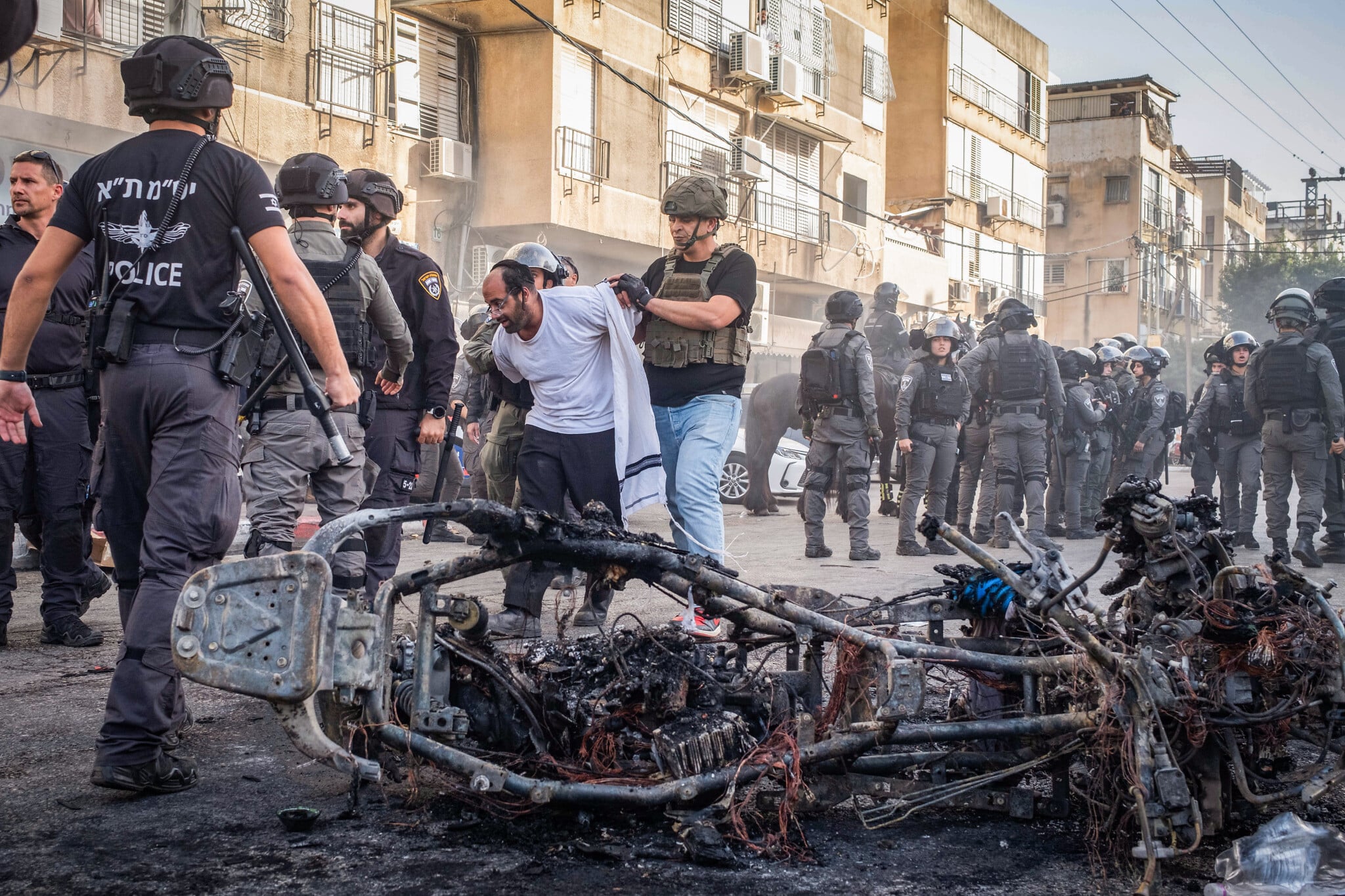
Ultra-Orthodox Jewish men clash with police following an assault on two female Israeli soldiers in Bnei Brak, February 15, 2026. (Oren Ziv/Flash90)
Police arrested 23 members of the mob, the Tel Aviv District chief said an hour after the riots broke out. Three officers were lightly injured during the commotion.
The police motorcycle that protesters set on fire contained a tefillin and a prayer book in its luggage box, police said. The ritual items were burned to a crisp in the attack.
In a video clip shared by police, a Hatzalah volunteer could be seen trying to prevent the motorcycle from going up in flames. Haredi rioters jump toward him and grab his arm, dragging him from the vehicle.
A Hatzalah medic tries to keep a police motorbike from burning to a crisp, but young Haredi men spring forward, grab his arm and drag him from the vehicle pic.twitter.com/RFkvWnojPI
— charlie summers (@cbsu03) February 15, 2026
Reporters covering the incident’s aftermath were seen being shoved and harassed by young men on the street, despite the police forces operating at the scene.
Violence harms ‘righteous’ anti-draft struggle
The ambush and subsequent riots received across-the-board condemnation, including from Haredi politicians and spiritual leaders, who warned that the incident might damage the community’s anti-conscription efforts.
Yitzhak Goldknopf, chairman of the ultra-Orthodox United Torah Judaism party, said he was shocked by the footage and called the violence “contrary to the Torah.”
His Sephardic counterpart, Shas head Aryeh Deri, said the incident stood to “harm the entire Haredi public, cause a desecration of God’s name, and inflict heavy damage on the righteous struggle for the Torah world.”
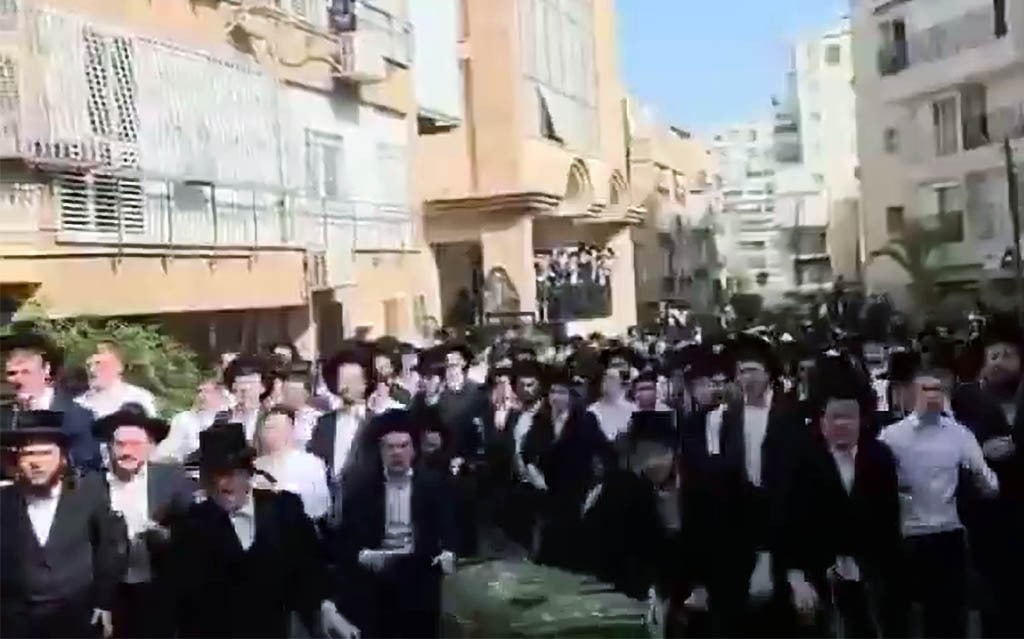
The mob that chased two female soldiers in Bnei Brak on February 15, 2026 (Screen grab/David Keshet/X)
Deri’s remarks came shortly after former Sephardic chief rabbi Yitzhak Yosef went so far as to call for the excommunication of those who took part in the attack. “There is no place for such behavior among us. They must be denounced and cast out from the community,” Yosef declared.
Prime Minister Benjamin Netanyahu condemned the attack as “completely unacceptable,” while saying that the perpetrators were an “extreme minority that does not represent the entire Haredi community.”
National Security Minister Itamar Ben Gvir made similar remarks, promising that the attackers — a “small group of violent anarchists” — would “pay a heavy price,” but that they nevertheless did not represent “the vast majority of the Haredi public.”
Police chide army for not coordinating visit with cops
Speaking on the edge of the city after the riots had calmed, Tel Aviv District police commander Haim Sargaroff appeared to place partial blame on the army, saying it “did not coordinate” with law enforcement in advance.
“The moment we know that an IDF force is entering [a Haredi area], we are prepared to provide reinforcement, but when they enter without coordinating with us, when they enter and start carrying out an operation, we are only [able to] react,” he said.
The Military Police, responsible for detaining draft dodgers, is supposed to obtain permission from local law enforcement in advance before entering a Haredi area to carry out arrests, but the two servicewomen had not been sent to catch draft evaders.
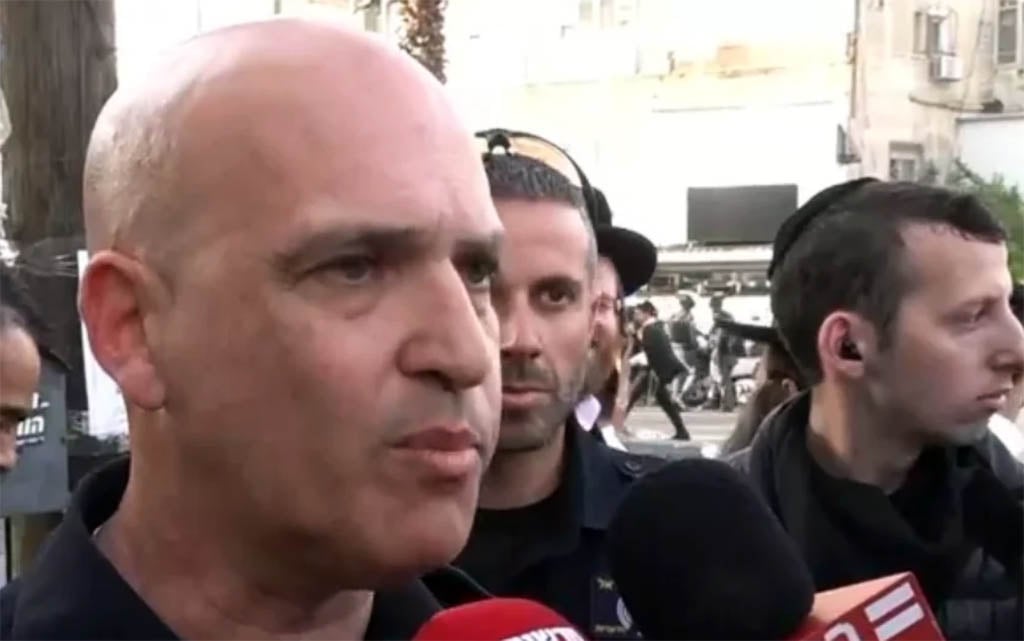
Tel Aviv District commander Haim Sargaroff speaks to reporters after a riot in the Haredi city of Bnei Brak on February 15, 2026. (Screenshot/Channel 12)
According to Sargaroff, the two soldiers found refuge with a law-abiding resident who hid them in a “secure place,” while police rushed to the scene and eventually extracted them from the city.
Law enforcement arrived in limited numbers, leaving their squad cars and motorcycles unattended while running to the soldiers on foot, Sargaroff said. During that time, rioters “took advantage of the situation,” overturning a patrol car and setting fire to a police motorcycle.
Asked by a reporter whether police were afraid of entering Haredi areas, Sargaroff averred, “We are not afraid. We enter any area, at any time, any yeshiva. There is no concern.”
Nevertheless, IDF officials have complained that police systematically prevent them from arresting draft evaders in ultra-Orthodox neighborhoods, amid regular outbursts of violence whenever security forces are seen operating in such areas.
The attack occurred after a resident called a telephone hotline run by the Jerusalem Faction, a hardline anti-conscription group, to wrongly claim that the soldiers were attempting to deliver conscription orders.
At 1:43 p.m., a hotline set up by the group sent its subscribers an email claiming that “Military Police soldiers are now roaming around Bnei Brak handing out conscription orders” and that there were “riots in several locations.”
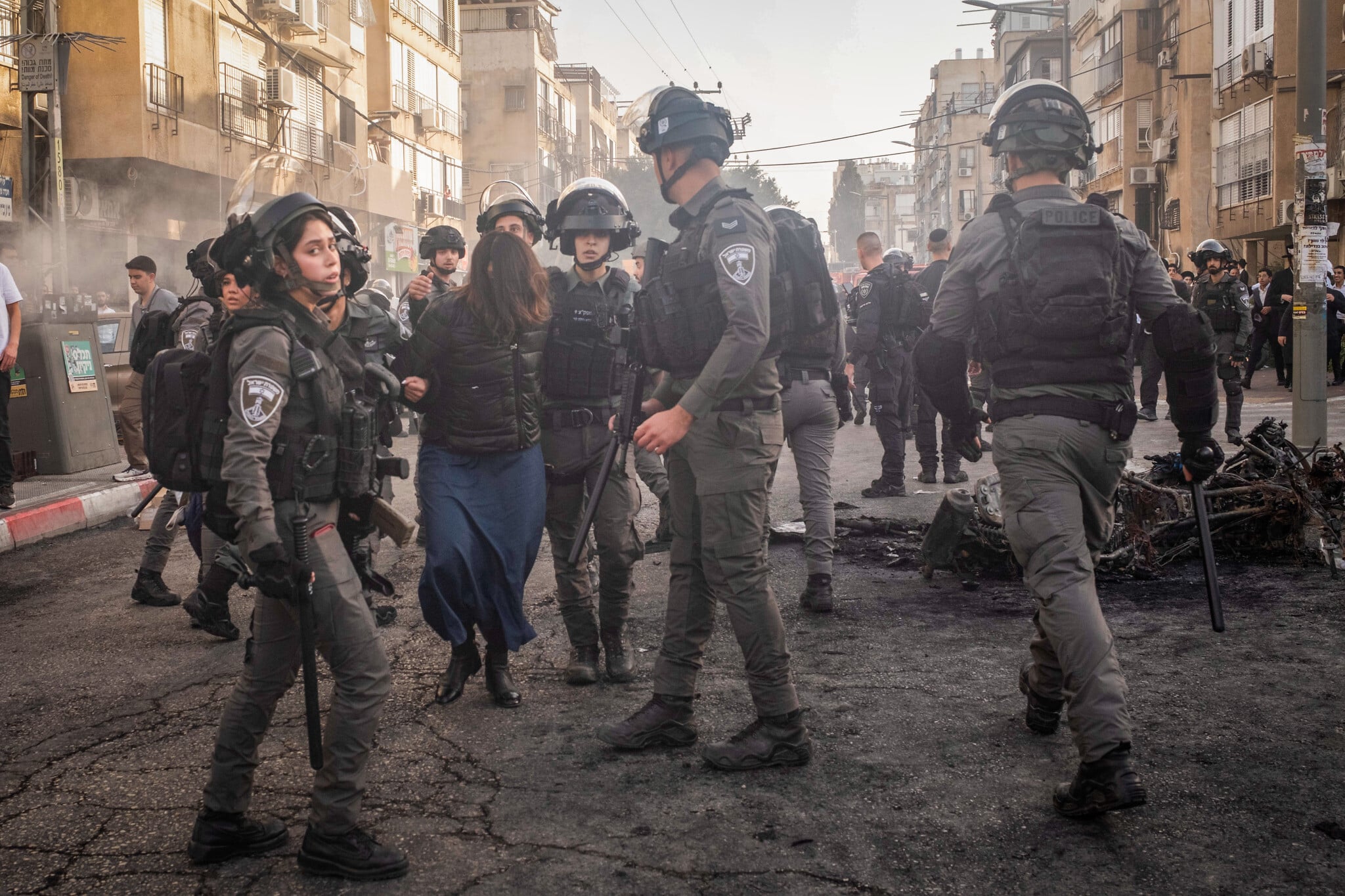
Police in Bnei Brak following an assault on two female soldiers, February 15, 2026 (Oren Ziv/Flash90)
Later, a spokesman for the Jerusalem Faction denied any connection with the incident, stating that the riots were “not something organized.”
“I don’t know what caused it. I have no idea. I don’t know what it was about,” he told The Times of Israel. “I have no idea what happened there, but I can only understand that today people in military uniforms are coming into Bnei Brak… It could raise everyone’s eyebrows, the fear that they might be coming to arrest yeshiva boys.”
After being shown screenshots of the emails, the spokesman shared an audio clip circulating on an ultra-Orthodox WhatsApp group in which a man was heard saying that he called the hotline after the two soldiers knocked on his door in order to present him with an enlistment order.
Some 80,000 ultra-Orthodox men aged between 18 and 24 are currently believed to be eligible for military service, but have not enlisted. The IDF has said it urgently needs 12,000 recruits due to the strain on standing and reserve forces caused by the war against Hamas in Gaza and other military challenges.
For the past two years, the Haredi leadership has pushed for a law keeping its constituency out of the IDF, after the High Court ruled that decades-long blanket exemptions from army duty traditionally afforded to full-time Haredi yeshiva students were illegal. Since then, coalition lawmakers, dependent on Haredi support to keep them in government, have struggled to find a formulation that could win ultra-Orthodox backing while also meeting widespread demands for the community to share in the burden of mandatory military service.